SOC 2 EVIDENCE COLLECTION: STRATEGY AND BEST PRACTICES

What challenges do many organizations face in successfully passing SOC 2 audits? There might be several reasons, but poor SOC 2 evidence collection is the most common challenge that you face.
A successful SOC 2 compliance review depends on SOC 2 evidence collection, which is a structured way to gather, organize, and present proof that internal controls work as intended throughout the audit period. Moreover, for SaaS companies, technology providers, and service organizations handling sensitive customer data, SOC 2 compliance has evolved from a competitive advantage to an absolute business necessity.
The underlying reality is that companies with robust security controls still fail audits, not because their defenses are weak, but rather because they cannot prove those controls worked when it mattered most. Consequently, compliance teams scramble during audit season, manually reconstructing months of security activities from fragmented email threads and informal spreadsheets, only to face devastating gaps during fieldwork.
Furthermore, enterprises pursuing SOC 2 Type II certification face exponential complexity; proving operational effectiveness across twelve months implies collecting thousands of evidence items consistently. So, what makes the difference between smooth audits and audit reworks? The distinction lies in the understanding of SOC 2 evidence collection methodologies, implementing automated evidence collection, and establishing workflows that turn chaos into confidence.
This in – depth guide delivers proven strategies and best practices for compliance leaders, founders, IT managers, and security teams. You will learn how to build sustainable SOC 2 evidence collection processes that reduce manual effort, improve audit outcomes, and ensure continuous SOC 2 requirements compliance that transforms evidence collection from a compliance burden into a competitive advantage.
Tl; DR:
Concern: Companies with solid security still struggle with SOC 2 audits, not from weak controls, but because they can’t prove those controls actually worked. Manual evidence gathering turns into a nightmare of missing logs, fragmented records, and weeks of painful audit rework.
Overview: Learn how to enhance SOC 2 evidence collection. This guide shows you how to automate workflows, run smart risk assessments, map evidence to what auditors actually want, and build collection processes that work continuously, cutting manual work while getting better audit results
Solution: Stop the audit chaos by automating evidence collection and running it year – round. Do proper risk assessments to know what matters, build workflows that gather proof automatically, and validate everything before auditors show up.
WHAT IS SOC 2 EVIDENCE COLLECTION?
SOC 2 evidence collection refers to the systematic gathering of documents, records, system outputs, and observations that demonstrate compliance with AICPA Trust Services Criteria. This process ensures your organization’s controls are designed appropriately and function effectively over time.
Let’s take a closer look at the different types of audit evidence.
Effective SOC 2 evidence collection requires gathering multiple categories of audit evidence that together demonstrate comprehensive compliance, as outlined below:
- Documentary Evidence: It includes policies, procedures, and formal documentation that establish your control framework.
- Observational Evidence: This consists of screenshots, system configurations, and real-time observations that demonstrate controls in action.
- Analytical Evidence: It encompasses reports, dashboards, and trend analyses that show control performance over time.
- Testimonial Evidence: This includes interviews, attestations, and confirmations from personnel responsible for control execution, validating that documented processes actually occur as described.
How does evidence collection vary between SOC 2 Type I and Type II
| Aspects | SOC 2 Type I | SOC 2 Type II |
|---|---|---|
| Audit focus | Control design at a point in time | Control effectiveness over 3-12 months |
| Evidence volume | Dozens of evidence items | Thousands of evidence items |
| Collection approach | Point-in-time snapshots | Continuous monitoring throughout the period |
| Policy documentation | Single policy documents | Monthly review records and updates |
| System configuration | One-time configuration snapshots | Change management logs tracking modifications |
| Monitoring requirements | Current state documentation | Regular monitoring reports and exception tracking |
| Automation need | Optional for efficiency | Essential for managing volume and consistency |
THE ROLE OF SOC 2 RISK ASSESSMENT IN EVIDENCE COLLECTION
It is not possible to collect the right evidence without knowing the risks first. Therefore, a solid SOC 2 risk assessment sits at the core of any effective evidence strategy. Think of risk assessment as your roadmap, which shows you which vulnerabilities actually matter in your environment and what proof you will need to show they are handled. Instead of blindly gathering every document imaginable, you are laser – focused on what auditors genuinely care about based on your actual risk profile.
To elaborate, you identify threats against each Trust Services Criterion, evaluate how well your current controls handle them, figure out exactly what evidence each risk needs, and set up how often you will monitor and collect that evidence. Companies that do thorough risk assessments collect less evidence overall because they target what actually matters and avoid wasting time on generic checklists.
Keep your risk assessments current and updated, too. As threats evolve and your business changes, your evidence strategy needs to keep pace. This prevents you from burning hours on low – risk areas while missing critical high – risk controls.
AUTOMATED SOC 2 EVIDENCE COLLECTION: TRANSFORMING THE COMPLIANCE
Manual evidence gathering is destroying the efficiency of compliance teams. That’s why astute organizations are adopting system – driven evidence collection to eliminate tedious tasks and enhance coverage.
Automated systems collect evidence continuously with minimal human involvement, significantly reducing manual effort and minimizing gaps during audit reviews.
Benefits of Automated SOC 2 Evidence Collection
Continuous Monitoring: This means your systems are grabbing evidence 24/7 throughout the entire audit period. No more hoping you didn’t miss something critical because you only checked monthly.
Reduced Manual Effort: Automated SOC 2 evidence collection frees up your team to actually improve security instead of drowning in spreadsheets. Teams often spend a lot of time on evidence collection. With proper automation, that workload drops dramatically.
Improved Accuracy: Automating evidence collection cuts out the human mistakes. Therefore, there are no more typos in timestamps, no more copying the wrong configuration, and no more formatting inconsistencies that make auditors raise eyebrows.
Real – Time Alerts: This process catches control failures the moment they happen, so you can fix issues right away instead of discovering them during the audit when it’s too late.
Key technologies for automation
The tech stack for solid automated evidence collection includes API integrations that connect directly to your cloud platforms, security tools, and business apps for live data pulls. Log aggregation platforms gather and analyze system logs, user activity, and security events in one place. Configuration management tools automatically track every system change, software update, and security tweak. Workflow automation handles the scheduling, validation, and organization based on rules you set once.
ESSENTIAL SOC 2 REQUIREMENTS AND EVIDENCE MAPPING
Each of the five Trust Services Criteria demands specific evidence types. Understanding which evidence corresponds to each requirement helps you avoid scrambling during audit preparation.
Security Criteria Evidence
Security controls need proof of your access management policies and user provisioning records, network security configurations with monitoring logs, vulnerability management reports showing you’re actually fixing issues, and incident response procedures with records proving you followed them. Each security control refers to specific evidence demonstrating its proper design and functionality.
Availability Criteria Evidence
Availability controls require system monitoring and uptime reports, capacity planning and performance metrics, backup and recovery procedures with test results proving they work, and change management processes with proper approvals. The SOC 2 evidence collection needs to show that your systems stay up like you promised customers.
Processing Integrity Evidence
Processing integrity demands data validation controls and error handling procedures, system processing logs and exception reports, quality assurance testing and results, plus data reconciliation and verification records. This proves your system processes data completely, accurately, and on time.
Map each control to its specific evidence requirements. This stops you from both collecting too many irrelevant records and leaving gaps in your SOC 2 evidence collection.
BUILDING AN EFFECTIVE EVIDENCE COLLECTION STRATEGY
Random and unplanned evidence gathering fails. A structured approach to SOC 2 evidence collection keeps you audit – ready without the compliance chaos. These include,
Establish Clear Governance
Start by clarifying who owns what. To clarify, assign control owners who are actually responsible for gathering, validating, and maintaining evidence for their specific controls. Moreover, document the procedures: when evidence gets collected, what quality standards apply, who to escalate to when evidence goes missing and the review workflow before anything hits the auditor’s desk.
Implement Centralised Repository Management
Stop letting evidence scatter across email, Slack, and random drives. Your repository needs version control, access logging, and secure auditor sharing. Therefore, organize everything by Trust Services Criteria and specific controls, evidence type and collection date, responsible team member and approval status, and which audit period it covers.
Develop Automated Collection Workflows
Create automated evidence collection workflows that handle the tedious tasks. Set them up to schedule regular pulls from your integrated systems, automatically validate completeness and format, flag missing or problematic evidence for manual review, and generate standardized reports auditors can actually use.
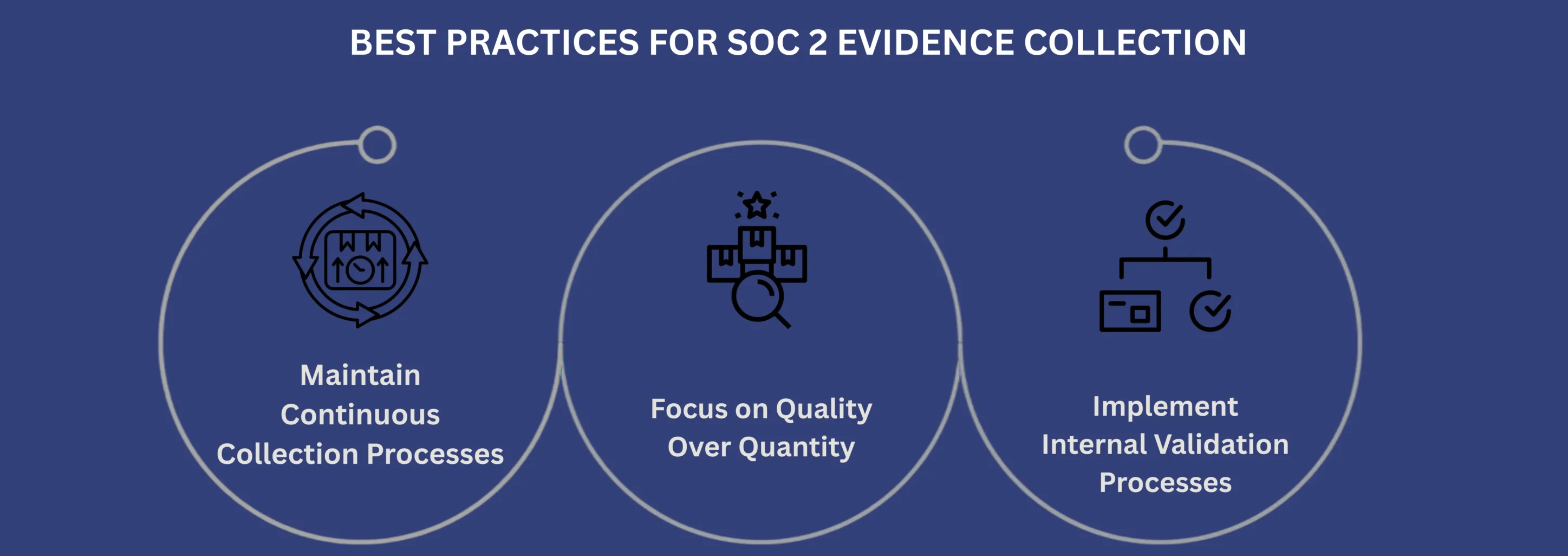
BEST PRACTICES FOR SOC 2 EVIDENCE COLLECTION
These practices separate teams that ease through audits from those stuck in endless remediation loops. The following practices drive audit readiness:
Maintain Continuous Collection Processes
Don’t wait until two weeks before the audit to start gathering evidence. Run continuous collection year – round for better coverage. This means scheduled extractions from automated systems, monthly evidence reviews and validation, quarterly process effectiveness checks, and annual procedure updates based on what you learned.
Focus on Quality Over Quantity
Auditors don’t want a mountain of random documents, but rather, they want relevant, well – organized proof. Collect evidence that directly shows your controls work, not everything your systems generate. Quality evidence relates directly to specific control objectives, covers the complete audit period consistently, includes proper timestamps and authentication, and shows both design and operational effectiveness.
Implement Internal Validation Processes
Catch problems before auditors do. Conduct internal audits that verify evidence is complete, accurate, and relevant. Accordingly, verify completeness against your evidence inventory, check dates and configurations to make sure they are right, assess relevance to specific control objectives, and standardize formats for consistent presentation.
COMMON MISTAKES TO AVOID
Understanding the following mistakes can help prevent similar issues. The key examples are outlined below:
- Overcollection of Irrelevant Evidence: This phenomenon happens when teams think more is better. It’s not. It just confuses auditors and makes them question whether you understand your controls. Stick to evidence that directly supports control objectives.
- Inconsistent Evidence Formats: These slow down reviews and raise red flags about process maturity. Therefore, set standard formats for common evidence types and actually use them consistently.
- Last – Minute Collection Efforts: Collecting evidence during the last moment could spike error rates and guarantee incomplete coverage. Hence, start SOC 2 evidence collection early in the audit period and keep it consistent instead of pulling all – nighters before fieldwork.
- Inadequate Version Control: This leads to outdated or conflicting evidence submissions. Therefore, implement clear versioning and make sure only current, approved evidence is collected for audit purposes.
HOW CERTPRO SUPPORTS SOC 2 EVIDENCE COLLECTION
CertPro is a licensed CPA firm that performs independent SOC 2 Type I and Type II examinations in accordance with AICPA attestation standards. Our role is to objectively evaluate management’s controls and supporting evidence against the applicable Trust Services Criteria.
We assess whether evidence produced by the organization is complete, consistent, and sufficient to support control design and, where applicable, operating effectiveness. This approach helps reduce uncertainty during the examination and supports a smoother audit process.
CertPro’s examinations focus on SOC 2 evidence collection quality, control ownership, and execution consistency. By evaluating how evidence is maintained over time, we help organizations understand how well their controls operate in practice.
Rather than treating evidence as a last – minute audit exercise, organizations that maintain disciplined internal processes are better positioned for SOC 2 reporting. CertPro’s independent examinations provide third – party assurance that these practices align with SOC 2 requirements.
Connect with CertPro to learn more about our SOC 2 Type I and Type II examination services to support your reporting and assurance needs.
Key Takeaways
Success in SOC 2 evidence collection comes down to smart planning, mature processes, and using technology correctly. Companies that run continuous collection, lean on automation, and maintain quality standards get better audit results with less effort.
What actually works is a comprehensive SOC 2 risk assessment that first guides evidence requirements and then implements automated evidence collection for efficiency and accuracy. It must also ensure that there is a clear understanding of SOC 2 Type II requirements and their implications for evidence, emphasizing the importance of quality and relevant proof rather than simply accumulating documents. Lastly, it is crucial to invest in technology and standardize processes to ensure sustainable compliance.
Treat evidence collection as an ongoing capability instead of an annual fire drill. That’s how you build stronger security while actually reducing the compliance burden over time.
FAQ
What types of evidence are required for SOC 2 audits?
You will need policies, system logs, access reviews, risk assessments, monitoring records, and configuration documentation that prove your controls operated effectively throughout the audit period. It also depends on which Trust Services Criteria apply to your audit scope.
How does automated evidence collection improve SOC 2 compliance?
Automation cuts manual effort and improves accuracy by eliminating human error. It enables continuous monitoring throughout audit periods and sends real – time alerts when controls fail, making compliance more efficient and reliable regardless of your organization’s size.
What's the difference between SOC 2 Type I and Type II evidence requirements?
Type I requires point – in – time evidence of control design, typically dozens of documents showing how things work on audit day. Type II demands continuous evidence collection over three to twelve months, proving operational effectiveness, which means thousands of evidence items collected consistently throughout that entire period.
How long should SOC 2 evidence collection be retained?
SOC 2 does not prescribe a specific AICPA – mandated evidence retention period. Most organizations retain SOC 2 – related documentation for at least three years, although actual retention periods vary based on industry regulations, contractual obligations, and internal record-keeping policies.
What role does risk assessment play in evidence collection?
Risk assessment identifies your actual vulnerabilities and determines what specific evidence you need, helping you prioritize collection efforts and ensure comprehensive coverage of identified risks.
Can small organizations implement automated evidence collection?
Absolutely. Many cloud – based tools and platforms offer automated evidence collection that works for organizations of all sizes, often through affordable solutions and integrations. Small teams actually benefit most from automation since it maximizes limited resources while maintaining comprehensive coverage.
WHAT IS SOC 2 EVIDENCE COLLECTION?
THE ROLE OF SOC 2 RISK ASSESSMENT IN EVIDENCE COLLECTION
AUTOMATED SOC 2 EVIDENCE COLLECTION: TRANSFORMING THE COMPLIANCE
ESSENTIAL SOC 2 REQUIREMENTS AND EVIDENCE MAPPING
BUILDING AN EFFECTIVE EVIDENCE COLLECTION STRATEGY
BEST PRACTICES FOR SOC 2 EVIDENCE COLLECTION