HOW SOC 2 TYPE II CERTIFICATION IMPACTS CUSTOMER CONFIDENCE AND DATA SECURITY

Enterprise buyers changed how they evaluate vendors. They no longer trust self-reported security claims. Instead, vendor risk management became a top priority. Consequently, procurement teams demand independent proof. They need verification that vendors protect their data.
SOC 2 Type II certification solves this problem. It’s a formal audit governed by the AICPA. Licensed CPA firms conduct these audits. It’s not just a marketing tool. Rather, it tests whether your security controls actually work. Specifically, the test runs for six to twelve months.
A SOC 2 Type 2 report proves more than policy existence. It shows you followed your policies consistently. Additionally, it proves you monitored them properly. Furthermore, independent auditors tested everything. As a result, SOC 2 Type II certification provides structured, time-based assurance rather than a point-in-time review. Similarly, it affects contract negotiations. Therefore, it builds long-term customer confidence.
This guide teaches you several things. First, you’ll learn about Type I versus Type II. Second, you’ll understand what the report covers. Third, you’ll see how it strengthens security. Finally, you’ll discover why it helps enterprise sales. Finally, you’ll discover how SOC 2 Type II certification supports enterprise sales by demonstrating verified operational reliability.
Tl; DR:
Concern: Enterprise buyers require independently verified proof that your security controls operate effectively over time. Written policies and self-attestations are no longer sufficient to satisfy vendor risk assessments or enterprise procurement requirements.
Overview: SOC 2 Type II certification is an independent attestation performed by a licensed CPA firm under standards issued by the American Institute of Certified Public Accountants. It evaluates whether defined security controls operated effectively across a six- to twelve-month review period.
Solution: Organizations that complete SOC 2 Type II certification demonstrate sustained control effectiveness, reduce security review delays, meet enterprise contract requirements, and strengthen customer confidence through structured, independently validated assurance.
UNDERSTANDING SOC 2 AND ITS RELEVANCE
SOC 2 means System and Organization Controls 2. The AICPA created this framework. It evaluates how tech companies handle customer data. The framework covers five trust areas. These are security, availability, processing integrity, confidentiality, and privacy.
SOC 2 isn’t self-reported. An independent CPA firm must do the audit. The firm tests your evidence. Then it issues a formal report. The report includes findings and the auditor’s opinion. When organizations pursue SOC 2 Type II certification, this independent examination extends over a defined review period to verify that controls operate effectively over time.
People often misunderstand “SOC 2 compliance.” It’s not a government regulation. It’s not a legal requirement either. Instead, it means aligning with AICPA standards. Additionally, it means passing independent testing.
Compliance isn’t a one-time achievement. It requires ongoing effort. You must operate controls continuously. Moreover, you need consistent monitoring. Therefore, you must collect evidence throughout the year to maintain credibility. This continuous operation is especially critical for maintaining SOC 2 Type II certification, since auditors evaluate control performance across several months rather than at a single point in time.
SaaS companies handle lots of customer data. Enterprise buyers check vendors carefully before buying. This is especially true in regulated industries. Therefore, attestation became the widely accepted assurance mechanism in enterprise vendor risk programs. Without it, your sales slow down. In addition, security reviews take much longer.
WHAT MAKES SOC 2 TYPE II CERTIFICATION DIFFERENT?
Type I and Type II check the same criteria. However, they differ in what they test. Type I looks at control design at one moment. In contrast, Type II tests if controls worked over time. Specifically, Type II runs for six to twelve months. Because of this, Type II gives much stronger proof.
| Dimension | SOC 2 Type I | SOC 2 Type II |
|---|---|---|
| Assessment Focus | Control design at one date | Control effectiveness over time |
| Review Period | Single point in time | 6 to 12 months |
| Assurance Level | Moderate | High |
| Enterprise Need | Suitable for early-stage companies | Required by most enterprises |
A SOC 2 Type 2 report is detailed. It includes several sections. First, the system description. Second, management’s claims. Third, the auditor’s opinion. Additionally, it describes each control tested. Furthermore, it shows testing procedures and results. It also lists any problems found. Importantly, it shows how you fixed them.
The report doesn’t guarantee you’ll never have breaches. Instead, it confirms your controls worked properly. Specifically, during the entire review period. As part of SOC 2 Type II certification, this time-based evaluation demonstrates that controls operated effectively across several months, not just at a single point in time.
SOC 2 Type II needs proof that your controls work. This proof must cover the full period. Auditors use sampling to check consistency. Consequently, you must run controls all year. In other words, not just during the audit.
Auditors ask for specific evidence. For example, user access records. Additionally, they want MFA logs. They also need change approvals. Similarly, incident response records are required. Furthermore, vendor assessments must be ready.
Companies with organized evidence do better. Specifically, they get cleaner audit results. Therefore, maintain good records year-round.
HOW SOC 2 TYPE II CERTIFICATION STRENGTHENS DATA SECURITY
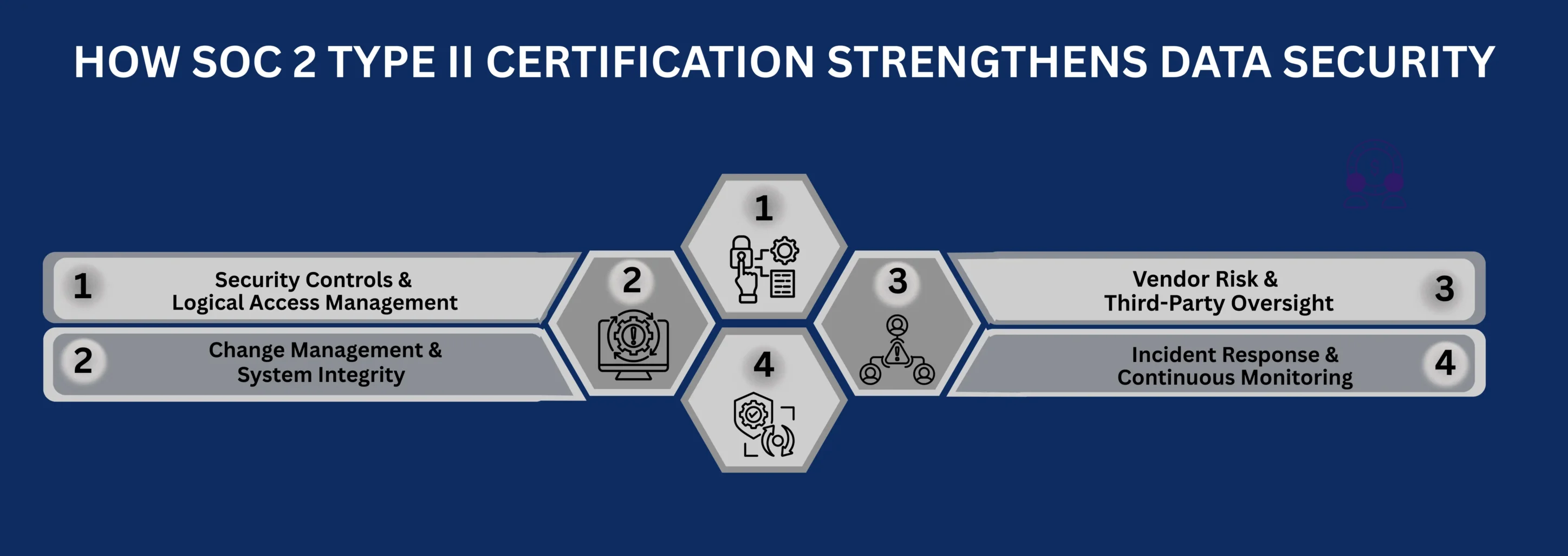
1. Security Controls and Logical Access Management
Access control is the foundation of SOC 2. Auditors test several things here. First, they check least-privilege access. Second, they verify regular access reviews. Third, they confirm quick access removal. This happens when employees leave. As a result, your attack surface shrinks. Therefore, better access control means better security.
2. Change Management and System Integrity
Bad system changes cause security problems. They’re a common source of vulnerabilities. Under SOC 2 Type II certification, organizations must demonstrate that system changes are properly authorized, reviewed, and tested before deployment. SOC 2 Type II requires proof of authorized changes. Moreover, changes need peer reviews and testing. Additionally, you must track all changes.Consequently, this reduces misconfigurations. Similarly, it stops unauthorized deployments. Therefore, your systems become more secure.
3. Vendor Risk and Third-Party Oversight
Most SaaS companies use third-party services. For example, hosting providers and monitoring tools. SOC 2 Type II requires vendor monitoring. Additionally, you must review vendor reports yearly. As a result, you manage third-party risk better. Therefore, vendor oversight becomes proactive.
4. Incident Response and Continuous Monitoring
Auditors also evaluate your detection and response capabilities. They review monitoring systems and verify that response procedures are documented and tested. Furthermore, they expect evidence that incidents are logged, investigated, and resolved according to defined timelines. Monitoring tools must show continuous activity, including evidence of threat detection and response. Through SOC 2 Type II certification, this continuous testing over time demonstrates that security operations function consistently rather than sporadically. Therefore, your security framework evolves into an ongoing operational discipline instead of a one-time compliance exercise.
THE DIRECT IMPACT ON CUSTOMER CONFIDENCE
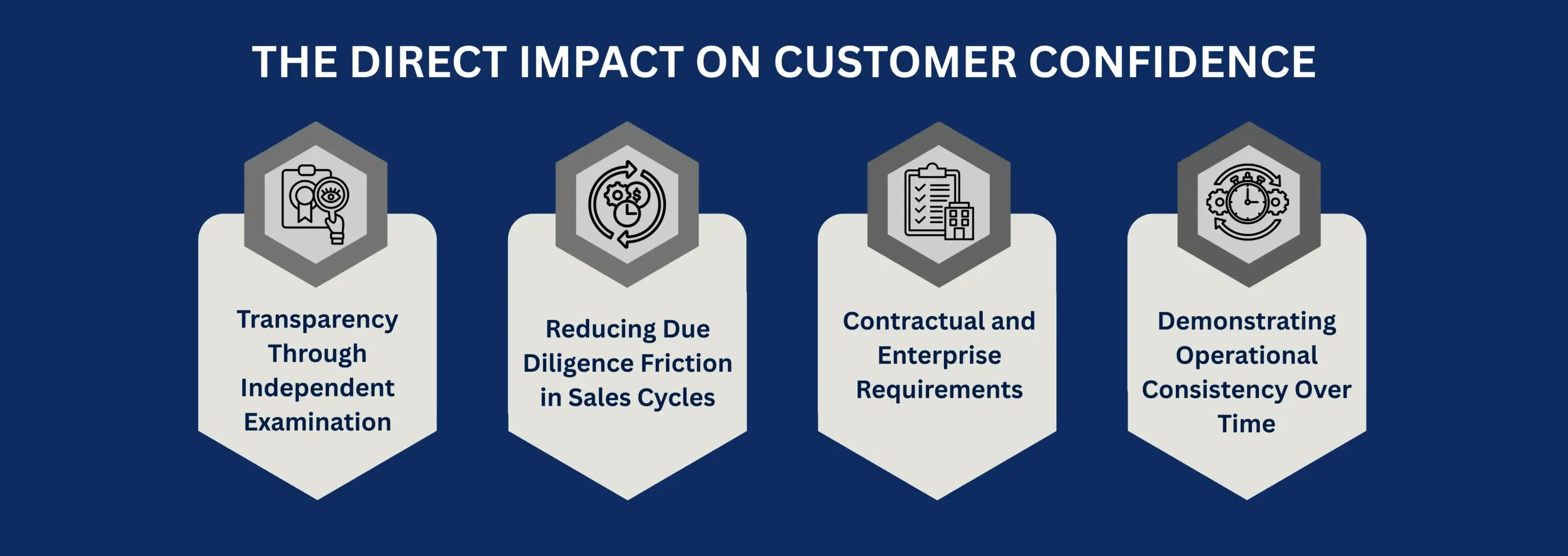
Transparency Through Independent Examination
Customers doubt security self-assessments. Claims without proof carry little weight. This is especially true during procurement. However, SOC 2 Type II certification changes everything. Security claims become verified facts. As a result, procurement teams trust the evidence.
Reducing Due Diligence Friction in Sales Cycles
Security reviews often slow enterprise sales. However, SOC 2 Type II helps you respond faster. You can share the report directly. Consequently, questionnaires take less time. In addition, contracts close faster.
Contractual and Enterprise Requirements
Many enterprise contracts now require SOC 2 Type II certification. Similarly, regulated industries demand it. It’s often needed for vendor onboarding. Therefore, companies without it get disqualified early. In fact, this happens before conversations start. In contrast, certified companies access enterprise markets. Otherwise, these markets stay closed.
Demonstrating Operational Consistency Over Time
SOC 2 Type II tests controls over months. Because of this, it shows operational reliability. Furthermore, annual renewals strengthen this signal. Therefore, it sends an important message. Your security is continuous. In other words, it’s not a one-time project.
SOC 2 ATTESTATION PROCESS: WHAT ORGANISATIONS SHOULD EXPECT
Readiness and Gap Assessment
Most organizations start with a readiness assessment. This checks current controls against AICPA standards. The goal is to find gaps early, specifically before the formal audit begins. For companies preparing for SOC 2 Type II certification, this step helps reduce surprises during the official review period. Skipping this step causes problems. Therefore, invest time in readiness assessment.
Documentation and Evidence Collection
Prepare several things before the audit. First, document your controls. Second, write clear policies. Third, set up evidence systems. Additionally, good organization reduces work later. Specifically, during the live audit. Therefore, prepare thoroughly upfront.
Control Testing by an Independent CPA Firm
The CPA firm examines your evidence. They also talk to control owners. Furthermore, they verify each control worked properly. Specifically, across the full period. Finally, auditors request various materials. For example, logs and change tickets. Importantly, from the entire audit window. In other words, not just recent weeks. This period-based evaluation is a defining characteristic of SOC 2 Type II certification, as it focuses on sustained control performance rather than a point-in-time snapshot.
Issuance of the Final SOC 2 Type 2 Report
After testing ends, the firm issues the report. This document includes several things. First, the auditor’s opinion. Second, tested controls. Third, testing methods. Finally, all results. Subsequently, you share this with customers. Specifically, under confidentiality agreements. Therefore, it becomes standard security documentation.
COMMON MISCONCEPTIONS ABOUT SOC 2 TYPE II CERTIFICATION
SOC 2 is formally an attestation. It’s not technically a certification. Only licensed CPA firms can issue valid reports. This must follow AICPA standards.Therefore, certificates from non-CPAs aren’t valid. In other words, the source matters greatly.
SOC 2 Type II isn’t legally required. Most organizations aren’t forced to get it. However, enterprise customers often require it. This is especially true in certain industries. For example, financial services, healthcare, and government.Yet for SaaS companies in these markets, SOC 2 Type II certification is practically required. Therefore, while not legally mandatory, it’s business-critical.
SOC 2 Type II does not guarantee data breach prevention. It checks if controls worked. Specifically, during the review period only. However, it doesn’t eliminate all breach risk.Even so, it proves something important. You invested in structured security. Moreover, this was independently verified as part of SOC 2 Type II certification.
SOC 2 Type II covers a specific period. It doesn’t automatically renew. Instead, you need annual audits. This maintains ongoing assurance. Therefore, treating it as one-time causes problems. Specifically, evidence gaps develop. Consequently, future audits get harder
WHY INDEPENDENT SOC 2 EXAMINATION MATTERS
Role of a Licensed CPA Firm
Only licensed CPAs can issue valid SOC 2 reports. This must follow AICPA standards. CPA firms have strict independence rules. Additionally, they follow quality control requirements.
Also, verify your auditor’s CPA license. Consulting firm reports aren’t equivalent. Therefore, choose carefully, especially when pursuing SOC 2 Type II certification.
Objectivity and Evidence-Based Testing
Independent auditors evaluate evidence critically. Moreover, they report findings accurately. As a result, this makes reports credible.
Similarly, customers trust independent assessment. In other words, not self-reported claims. Therefore, independence is crucial.
Alignment With AICPA Standards
SOC 2 engagements are conducted in accordance with SSAE 18 under the AICPA attestation standards. This is the AICPA attestation standard. Since it’s standardized, reports are comparable. Specifically, in scope, methods, and format.
Therefore, customers can trust any valid report. This works regardless of which firm did it. As a result, standardization builds market trust.
Ongoing Compliance Maturity
Each annual SOC 2 cycle improves several things. First, your documentation gets better. Second, evidence management improves. Third, your team gains expertise. As a result, organizations maintaining SOC 2 yearly get stronger. Additionally, they build more resilient operations. Therefore, benefits compound over time.
CONCLUSION
SOC 2 Type II certification became essential for enterprise trust. It proves your controls were tested independently. Moreover, they were applied consistently. Furthermore, they worked effectively over months.
Additionally, benefits go beyond just compliance. Companies with SOC 2 Type II gain advantages. First, sales cycles move faster. Second, contracts get approved easier. Third, security becomes a business strength.Furthermore, achieving it makes you actually more secure. This happens in practice, not just theory. Therefore, the investment pays off in real security.
Ultimately, the question changed for SaaS companies. It’s not whether to get SOC 2 Type II. Instead, it’s how to do it efficiently. Moreover, how to sustain it. Therefore, focus on lasting security value.
FAQ
How do I know if my organization is ready to start a SOC 2 Type II audit?
First, run a readiness assessment. This checks against AICPA standards. However, if you lack documented policies, fix that first. Similarly, if evidence collection is inconsistent, improve it. Additionally, you may need better monitoring tools. Meanwhile, plan for three to six months of readiness. Therefore, don’t rush the preparation phase.
What are the most common reasons a SOC 2 audit produces findings or exceptions?
Several issues cause most findings. First, delayed user access removal. Second, inconsistent MFA use. Third, incomplete audit logs. Additionally, missing early-period evidence. Finally, outdated policies. Therefore, fix these during readiness. As a result, you’ll avoid most exceptions.
What is the difference between SOC 2 and ISO 27001?
SOC 2 Type II works primarily in North America. It’s recognized by US enterprises. In contrast, ISO 27001 is international. It’s a management system certification. Many mature companies get both. However, if your customers are US-based, start with SOC 2 and prioritize based on your market.
What happens if a SOC 2 report has exceptions?
Exceptions are findings where a control did not operate as described during the review period. They do not automatically rule out a vendor. However, customers will review them closely. In practice, buyers want to know the cause of each exception and whether it has been fixed. A clean fix plan matters as much as the issue itself.
Is SOC 2 compliance required by law?
SOC 2 is not a statutory requirement for most private companies. It is an independent assurance report under AICPA standards. However, many enterprise and regulated customers require SOC 2 Type II in contracts or vendor onboarding. In practice, it often becomes a commercial requirement for enterprise sales.
UNDERSTANDING SOC 2 AND ITS RELEVANCE
WHAT MAKES SOC 2 TYPE II CERTIFICATION DIFFERENT?
HOW SOC 2 TYPE II CERTIFICATION STRENGTHENS DATA SECURITY
THE DIRECT IMPACT ON CUSTOMER CONFIDENCE
SOC 2 ATTESTATION PROCESS: WHAT ORGANISATIONS SHOULD EXPECT
COMMON MISCONCEPTIONS ABOUT SOC 2 TYPE II CERTIFICATION