


AUDIT REPORTING BEST PRACTICES FOR ACCURACY & COMPLIANCE

Audit reporting is important for every business organization. For business leaders, clear audit reporting is essential to understand risks, controls, and issues that need remediation.
A simple and direct reporting process turns audit work into plain insights that anyone can understand, helping your team plan fixes, close gaps, and show that you follow ISO standards, SOC 2 criteria, and internal rules. It also supports decisions during certifications and regulatory audits.
However, many organizations struggle with audit reporting. These issues often make the report difficult to decipher.
Common challenges include:
- Inconsistent audit reporting styles arise when different teams use varying writing approaches, resulting in reports that appear uneven and confusing.
- Unclear evidence that sounds vague or too technical, so readers cannot see the real issue.
- Some reports lack strong evidence, so the results seem weak or incomplete.
- Missing details increase compliance risk and slow down regulatory or certification reviews.
- Poor communication between auditors and stakeholders leads to delays and misunderstandings.
Good audit reporting creates the opposite outcome. To elaborate, clear and simple writing helps leaders understand risks fast. Accordingly, strong evidence increases confidence in every finding.
Furthermore, direct recommendations guide teams and support quick fixes. Complete and accurate reports assist certifications and regulatory checks because they provide a reliable record of actions, controls, and results.
When reports follow a steady structure, teams can compare issues, track progress, and plan improvements with ease. This, in turn, fosters trust and promotes improved governance throughout the organization.
This blog will share proven best practices. It will explain how to structure reports, improve evidence, use clear language, follow auditing standards, and communicate better with stakeholders.

Tl; DR:
Concern: Many organizations produce audit reports that are unclear, inconsistent, or missing key evidence. These issues confuse readers, slow decisions, and increase compliance risk during certifications and regulatory reviews.
Overview: Audit reporting gives leaders a clear view of risks, controls, and required actions. When reports use simple language, strong evidence, and a steady structure, teams understand findings faster and plan remediation with confidence. Good reporting also supports ISO, SOC 2, and internal audit requirements.
Solution: Organizations can improve audit reporting by using a clear scope, strong evidence, and accurate risk details. They also benefit from aligning reports with standards like ISO 19011 and SSAE for SOC 2. CertPro supports this process by delivering structured, high – quality audits with clear findings, complete evidence, and actionable guidance. CertPro’s audit methods help businesses produce accurate reports, speed up remediation, and meet certification or regulatory expectations with confidence.
AUDIT REPORTING: DEFINITION AND CORE PRINCIPLES
In compliance and cybersecurity, audit reporting establishes a company’s understanding of its risks and demonstrates the effectiveness of its controls. In simple words, audit reporting means documenting the reviewed controls, issues found, and the way forward. That definition sounds plain, but in practice, it’s a cornerstone of trust.
For instance, an audit report with one unclear control description is enough to panic your team regarding a risk that didn’t exist. Hence, accuracy and clarity are the critical elements that shape decisions, budgets, and even board conversations.
When a report is structured neatly with compliance needs, it helps leaders see where their environment is solid and where it needs attention. That’s why having a clear idea of “what is audit reporting” is important. Because audit reports sit at the center of Governance Risk and Compliance (GRC) programs.
They guide remediation planning, influence policy updates, and act as a record that regulators and customers can rely on. Conversely, a messy or vague report slows all of that down.
The best auditing report format follows a few core principles. They stay objective, lean on verifiable evidence, and explain conclusions in plain language. As a result, the readers don’t have to ponder how an auditor landed on a finding. Compliance audit reporting also stays true to the audit scope. This means that if the engagement was focused on access controls, then the report shouldn’t drift into commentary on asset management or patching schedules.
Standards like ISO 19011 and SOC 2 give structure to what good audit reporting looks like. ISO 19011 stresses factual accuracy, balanced conclusions, and clear alignment with criteria. Furthermore, SOC 2 pushes for precision in describing control tests and results so that anyone reviewing the report can follow the process from start to finish.
To summarize, solid audit reporting helps companies make smarter, faster decisions about their future.
WHAT IS SCOPE, OBJECTIVE, AND METHODOLOGY?
A solid audit report always starts with a simple question: what exactly did we look at? As a primary step, while defining the scope, you give readers a clear picture of the terrain. That includes the time frame you covered, the business units or processes you walked through, and even areas you didn’t include on purpose.
To clarify, let’s assume a situation. Consider that your client is questioning a finding that didn’t match their current workflow. It turns out that you reviewed the process from last quarter, not the one they recently updated. Hence, defining a clear and well – bounded scope is essential for a successful audit report.
From there, set the objectives in a way that leaves no room for assumptions. Maybe you’re checking compliance with internal policies, or you’re testing whether controls actually work as intended. Or else, it could be a broader look at operational health or emerging risks. Each purpose leads you down a different path, so you want readers to understand the purpose behind checking it in the first place.
Then comes methodology, which is just as important as scope and objectives. Therefore, describe your evidence – gathering process, whether that meant reviewing policy documents, interviewing staff, or running walk – through tests. If you used sampling, do indicate that too. Moreover, if your work referenced ISO/IEC 27001 ISMS (Information Security Management System) clauses or an internal control framework, mention that too. As a result, these details help people trust what they’re reading.
This level of transparency gives stakeholders confidence in your auditing report. When they know how you reached your conclusions, your findings gain credibility, value, and trust.
ESSENTIAL COMPONENTS OF A HIGH – QUALITY AUDIT REPORT
In the previous section, we’ve discussed scope, objectives, and methodology. Now, here, let’s focus on the other crucial elements of compliance audit reporting.
Detailed Findings
A solid audit report always starts with clear findings. Consider this the part nobody wants to read, but everyone ends up relying on. The findings include what was observed, the proof behind each point, the seriousness of the issue, and which controls were affected. Teams demand transparency and accuracy here. To clarify, if a control failed because access logs weren’t reviewed for three months, state that clearly. Similarly, if the risk is assessed as moderate instead of critical, explain why. This level of clarity helps leaders make quick, confident calls.
Recommendations
Once the findings are on the table, people want to know the way forward. Therefore, recommendations should be clear, action – focused, and arranged by priority. For example, consider it like giving directions to someone late for a meeting, where you don’t overwhelm them with every street name; you just tell them the fastest route. Good remediation guidance works the same way. Make it simple, realistic, and structured so teams start moving right away.
Supporting Evidence
This is the backbone of the report. Evidence can include appendices, logs, screenshots, or relevant policy sections. Strong evidence helps external auditors or future reviewers pick up the audit trail without confusion.
Conclusion
The conclusion ties everything together by summarizing the organization’s compliance standing and suggesting next steps. A clear outlook, a realistic path forward, and a sense of closure give leadership a clear picture of their current posture and future demands.
BEST PRACTICES FOR COMPLIANCE – FOCUSED AUDIT REPORTING
Clear and well – structured audit reports are pivotal elements of the compliance process. In this section, let’s learn about the best practices to follow to ensure a smooth audit reporting process.
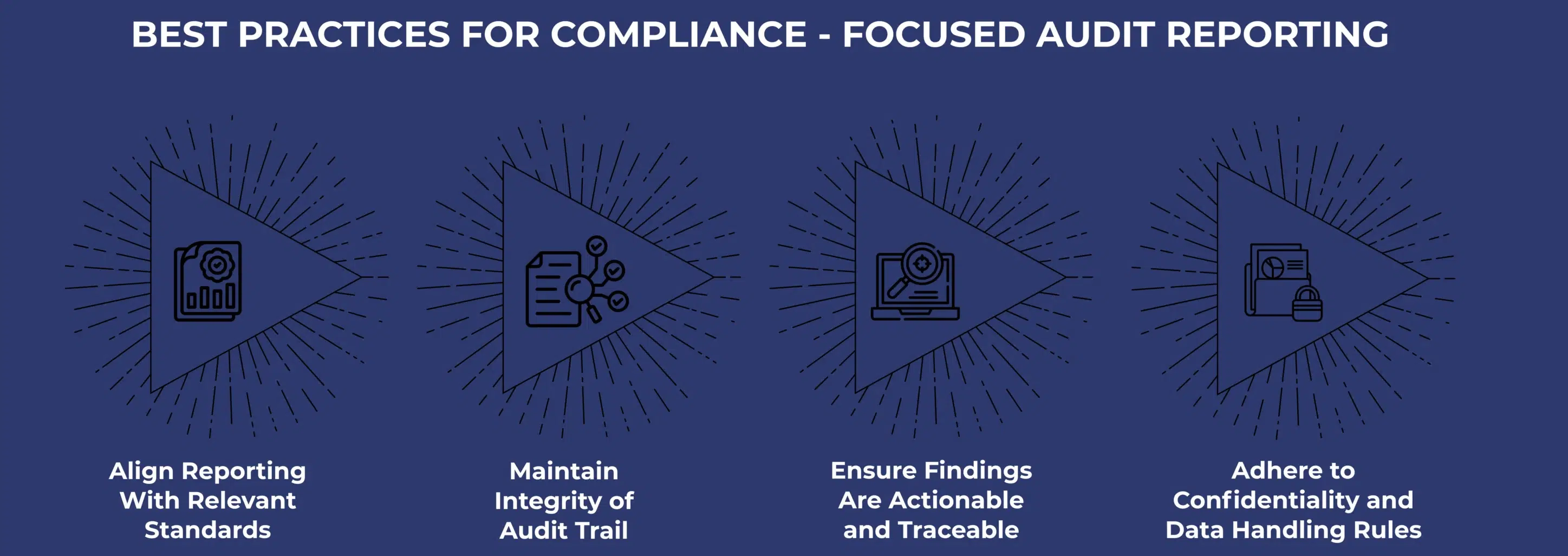
Align Reporting With Relevant Standards
Audit reports are more effective when they speak the same language as their supporting frameworks. To clarify, each standard has its own way of framing risk, controls, and outcomes.
- SOC 2 readers expect clear alignment with the AICPA Trust Services Criteria and SSAE 18 (Statements on Standards for Attestation Engagements) requirements.
- ISO 19011 focuses more on process, objectivity, and evaluative language.
- PCI DSS becomes very specific about cardholder data paths.
- HIPAA expects clarity about privacy safeguards.
Auditing standards help reduce errors in reports and support better decisions during audits. Hence, matching the structure of your audit report with the right framework could help everyone stay aligned and reduce unnecessary delays in the certification journey.
Maintain Integrity of Audit Trail
A reliable audit trail is a core foundation of audit reporting. Good retention habits, reliable timestamps, and version control help your work face scrutiny. This practice matters even more in cybersecurity or digital forensics engagements, where a single missing log can halt the progress of compliance auditing. Following the right auditing standards helps reduce gaps in cybersecurity audits and improve the accuracy of findings.
Ensure Findings Are Actionable and Traceable
Readers appreciate clarity. A strong finding connects the dots from evidence to control to business impact and then wraps with a fix that actually helps. For example, instead of saying “access reviews are inconsistent,” show the proof, match it to the exact control, explain how it affects risk exposure, and offer a practical remediation step.
Adhere to Confidentiality and Data Handling Rules
Audit reports often contain sensitive client information, so careful handling matters. Add or remove details when needed, store drafts securely, and avoid exposing regulated data. In heavily regulated sectors, even minor errors could cause long – lasting damage.
COMMON MISTAKES TO AVOID IN AUDIT REPORTING
A common issue in the audit reporting process is the urge to drop technical explanations without any context. It might feel natural when you’re close to the systems, but readers often end up confused. If you need to explain something like a misconfigured IAM (Identity and Access Management) policy, add a quick line about its importance.
Another problem is missing or incomplete evidence. If the evidence supports a finding, include it. Because even a strong report will raise questions if screenshots, logs, or timestamps are missing. Thus, clear, complete evidence saves time, avoids repeated clarifications, and earns the trust of interested parties.
Furthermore, you can’t perform risk scoring without a proper reason. If you score something high because it “felt risky,” the reviewer will question the entire report. Therefore, use simple, grounded reasoning. Additionally, match the scores for impact and likelihood with one or two clear sentences.
Teams also struggle with unclear recommendations. Listing issues without saying what to resolve could confuse the stakeholders. Clarify which items and areas require immediate attention and monitoring.
Finally, reports sometimes move away from the defined scope or the target framework. So, stay in line with the scope to avoid post – audit confusion.
Tools and Technologies That Improve Audit Reporting
Here are a few tools that can make the audit reporting process easier:
- Compliance automation platforms that collect signals, map controls, and keep everything organized.
- Document management systems that store audit files in a single location.
- Evidence collection tools that reduce manual screenshots.
These tools boost efficiency, improve consistency, and prepare teams for audits.
CONNECT WITH CERTPRO FOR QUALITY AND STANDARD AUDITS
Strong audit reporting is essential for any organization to have clear insight, reliable governance, and steady compliance. Teams can easily understand audit reports and swiftly implement suggestions when they employ the best practices discussed above.
To elaborate, clear reporting helps leaders to understand risks better, monitor controls, plan fixes, and communicate with confidence. Furthermore, it supports smoother certifications and regulatory audits, which are critical in today’s complex and dynamic compliance environment.
This is where CertPro adds real value. As a global leader in high – quality compliance audits, CertPro delivers audit reporting that meets established standards and gives organizations a thorough understanding of their operations. As a result, our experts help you improve clarity, reduce risk, and boost your entire internal compliance and security policies. With CertPro, you gain a partner that understands your goals, guides your remediation, and improves trust with every stakeholder.
If you want audit reports that drive action, support certification, and improve governance, partner with CertPro today. Reach out to our team to turn your audit process into a clear, compliant, and strategic advantage.
FAQ
What is the audit reporting process?
The audit reporting process starts with collecting evidence. Then the team checks controls against clear criteria. Thereafter, they record the findings and create a simple report for leaders. The report shows risks, control gaps, and needed actions. It also assigns owners and timelines so leaders can improve security and overall control performance.
What should an audit report include?
An audit report should list the scope, goals, criteria, and methods. Then it should explain the findings and their risk level. It must also give clear actions to resolve issues. The report should offer simple and factual insights that help leaders understand control gaps and needed improvements across security and operations.
How does audit reporting help businesses?
Audit reporting helps businesses identify risks and resolve weak controls. It also helps them prove compliance to clients and regulators. Furthermore, it helps in better decision-making and overall enterprise security.
What are some examples of auditing standards?
Common auditing frameworks include ISO 19011 for audit guidelines, ISO 27001 for security audits, and the AICPA Trust Services Criteria for SOC 2. These frameworks guide how audits are planned, performed, and reported. They support clear reporting, better controls, and long – term compliance.
Who is required to have an SOC 2 audit report?
Service organizations that store or process customer data often need SOC 2 audit reports. This includes SaaS companies, cloud platforms, IT service firms, and managed security providers. SOC 2 reports offer independent proof of data protection and strong internal controls. They help organizations show secure operations and good governance to customers and regulators.

How CertPro Conducts an Effective SOC 2 Type II Audit: A CPA-Led Playbook for SaaS
A SOC 2 Type 2 examination results in an independent CPA - issued attestation report on whether your controls are suitably designed and operated effectively over a period of time. It’s based on the AICPA Trust Services Criteria. This requirement is essential, as in...
AUDITING REPORT FORMAT: BEST PRACTICES FOR CYBERSECURITY COMPLIANCE
If you are a business leader thriving in this era of strict regulations and sophisticated cyberattacks, then you must have realized the importance of compliance and security audits. According to Deloitte, 93% of audit committees rank cybersecurity in their top three...

Who Audits the Auditor? Why AI Auditing Itself Needs Independent Oversight
Recently, Deloitte found itself in the spotlight for all the wrong reasons. The firm later revealed that its AI-generated report for a major government client had skipped key oversight procedures. The Australian Financial Review reported that the firm publicly...