

The role of healthcare organizations in the current medical world is reaching new heights. Most of them handle sensitive patient data as a part of their daily business operations. The information helps them to provide swift delivery of healthcare services for the patients. But they also hold the fundamental responsibility to safeguard sensitive health data. HIPAA refers to these healthcare providers as “covered entities”. It also designates individuals or organizations that partner with them to handle Protected Health Information (PHI) as business associates. HIPAA standards mandate the use of a Business Associate Agreement to regulate these entities. The agreement makes sure that the vendors or business associates who handle PHI are performing safe and ethical business practices.
It’s a well-known fact that even a single health data breach can financially disrupt an organization. This is because a health data breach can result in millions of dollars in fines and damage to reputation. Despite clear regulations, these covered entities do make HIPAA compliance mistakes. Or they fail to fully understand the details of a Business Associate Agreement. A BAA is not optional, but it’s a mandatory requirement under HIPAA standards. Without it, both covered entities and business associates are considered lawbreakers. Moreover, the covered entities are responsible for any mistakes made by business associates.
Therefore, to make things clearer, this blog completely focuses on business associate agreements. It enriches you with deep knowledge to get a clear answer to the question, “What is a business associate agreement?” Additionally, it discusses the common pitfalls that happen in BAA and the solutions to overcome them.

Tl; DR:
Concern: Many healthcare organizations and their vendors mishandle sensitive patient data due to a poor understanding of Business Associate Agreements (BAAs). Missing, outdated, or unclear agreements can lead to HIPAA violations, legal penalties, and reputational harm.
Overview: Under HIPAA, BAAs are mandatory contracts between covered entities and their business associates who handle Protected Health Information (PHI). These agreements define responsibilities, data handling rules, and breach protocols. Common pitfalls include missing agreements, outdated terms, weak enforcement, and unclear breach timelines.
Solution: To stay compliant, organizations must assess vendors, update BAA templates, train staff, and clearly define breach notification rules. CertPro offers expert HIPAA compliance support and automated tools to help businesses draft strong BAAs, prevent violations, and protect their reputation.
WHAT ARE BUSINESS ASSOCIATE AGREEMENTS?
A business associate is an organization that creates, maintains, receives, and transmits Protected Health Information (PHI) on behalf of covered entities. They include vendors, service providers, consultants, and subcontractors. Some examples of the business associates are medical billing companies, document storage firms, and software companies whose solutions involve the interaction between systems holding ePHI. They are not employees of covered entities but provide services involving PHI. A Business Associate Agreement is a legally enforceable contract signed between the covered entity and the business associates. Subcontractors who handle PHI must also sign BAAs with business associates. These subcontractors are firms that handle PHI on behalf of the business associates. For example, transcription service providers, backup service providers, and shredding firms are all considered business associate subcontractors.
To keep data safe and secure, business associates must adhere to the strict rules mentioned in the Business Associate Agreements. This legal contract clearly explains what a business associate can or cannot do with the PHI. The Health Insurance Portability and Accountability Act (HIPAA) devised national rules for handling sensitive health information. Accordingly, the business associate agreement is a legal mandate and is required by the law. Furthermore, it helps to protect the healthcare data from misuse, loss, or unauthorized access.
BAAs are a key aspect of HIPAA compliance. They make sure that anyone handling PHI is performing their duties in a safe and secure manner. The BAAs clearly define everyone’s role in protecting health data, lower the risk of data breaches, and provide support during HIPAA audits.
WHY BUSINESS ASSOCIATE AGREEMENTS MATTER: MAJOR IMPLICATIONS
HIPAA standards have two key rules: the HIPAA privacy rule and the HIPAA security rule. Both of them aim to protect the sensitive health information called the PHI. To clarify, a privacy rule controls who can access and share PHI, and a security rule defines procedures for storing and securing the ePHI. Additionally, without a business associate agreement, neither a person nor a firm can legally access PHI. No vendor can legally access PHI without a valid Business Associate Agreement in place. A valid and detailed BAA clearly defines the duties of each party dealing with the health data. It says what PHI the business associate can use, how to protect it, and what to do if it is breached.
Moreover, if a breach happens, a business associate agreement can protect the covered entity. The BAA proves that the covered entity took enough measures to follow the HIPAA regulations. Furthermore, it puts the responsibility on the business associate for its actions and limits the entity’s legal exposure in case of audits and lawsuits. Both parties will bear responsibility in the absence of a business associate agreement, potentially leading to significant fines, legal actions, and reputational damage. A missing or vague Business Associate Agreement leads to serious problems. Therefore, covered entities must sign clear and strong BAAs with all the third parties who might handle the sensitive patient data. As a result, it not only paves the way for HIPAA compliance but also builds trust and protects your business in the long run.
COMMON PITFALLS IN BUSINESS ASSOCIATE AGREEMENT
Even business associates with moral values can unintentionally make mistakes that lead to HIPAA violations. This can lead to data breaches and expensive fines. Now, let’s learn about some of the common pitfalls that could happen in a business associate agreement.
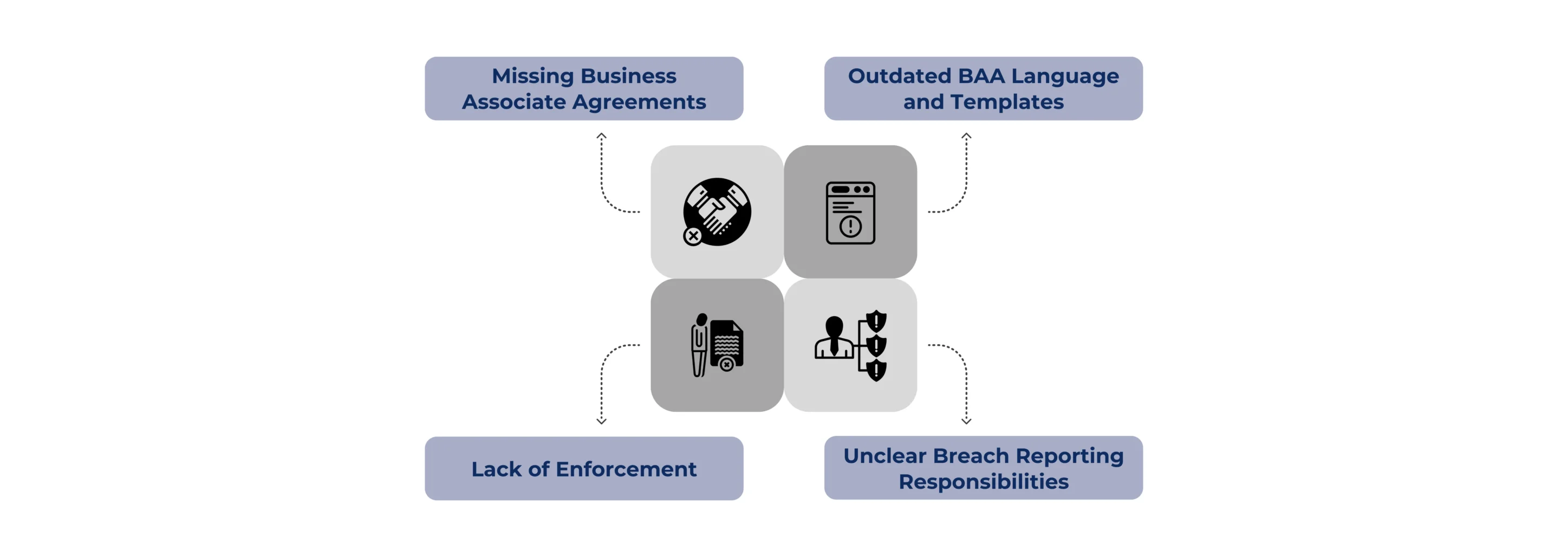
1. Missing Business Associate Agreements: Many covered entities lack a clear understanding of the HIPAA regulations. So, they fail to sign a BAA with certain vendors by assuming that they might not require them. The key to clearing this confusion is simple. Business associate agreements are legally required for any vendor that accesses the PHI. So, the entities must make a full list of vendors, including the subcontractors, and consequently sign a Business Associate Agreement with them.
2. Outdated BAA Language and Templates: The HIPAA business associate agreement regulations are undergoing constant changes and updates. But a few business BAA documents follow old templates that don’t match with the current standards. To clarify, old agreements may contain outdated language, missing key privacy or security provisions. Furthermore, it may lack provisions about subcontractors and miss breach reporting timelines.
3. Lack of Enforcement: As a business entity, just signing a HIPAA business associate agreement is not enough. You must take serious efforts and commitment to enforce its provisions. Therefore, you must thoroughly check whether the business associates are following the rules and stay alert for any issues.
4. Unclear Breach Reporting Responsibilities: The HIPAA regulations require the covered entities to adhere to the 60-day breach notification deadline. But many BAAs fail to clearly define how and when a business associate must report a breach. This lack of clarity breeds confusion during a security incident.
Moreover, entities using cloud services often assume that they are safe. But mere assumption is not enough. These cloud providers must sign a business associate agreement to stay HIPAA compliant.
STEPS TO AVOID THE PITFALLS AND STAY HIPAA COMPLIANT
Proper planning and commitment are required to avoid the common mistakes in a business associate agreement. The key lies in setting up clear procedures and following them diligently. Let’s look at some of the key solutions to stay safe and HIPAA compliant.
1. Vendor Assessment Process: Before working with any vendor, it’s the entity’s sole responsibility to vet them thoroughly. To put it simply, check their business practices, risk profile, breach history, and compliance posture. If your vendors access, process, or store PHI, then they are considered business associates and must sign a BAA.
2. Updating Old Templates: Over time, HIPAA business associate agreement regulations undergo updates. Accordingly, the entity must update the business associate agreement templates. Make sure it has provisions for restricted use of PHI, breach reporting procedures, subcontractor rules, and return or destruction of ePHI. Make sure your templates cover security measures like data encryption, access controls, and breach timelines.
3. Training Staff: The employees of the entity must have adequate knowledge on how to handle the third-party vendors. Therefore, conduct training on HIPAA regulations and procedures to deal with vendors handling PHI. They must also be able to use updated BAA templates and determine who requires business associate agreements. Train staff on identifying vendors that need BAAs and using secure vendor communication practices.
4. Breach Notification Timelines: Add clear provisions in every business associate agreement regarding breach notification timelines. This means that a good agreement must clearly mention how and when a vendor should report a breach. Delays in reporting by vendors can lead to HIPAA violations for entities.
CONCLUSION
Hence, a Business Associate Agreement is not just a legal contract. It’s a core aspect of a HIPAA compliance strategy. If third parties handle your PHI, it’s your duty to ensure that they are following safe and ethical data handling procedures. To take care of this need, a detailed and updated BAA is necessary. Moreover, HIPAA standards legally mandate its implementation. Furthermore, a BAA helps to stay HIPAA compliant, avoid legal fines, and respond to breaches faster.
Businesses need to understand that BAA is not just about protecting data. But they are about protecting your reputation and sealing the foundation for long-term growth. A good BAA must include provisions regarding permissible and limited use of PHI, security control measures, and breach reporting processes. Additionally, subcontractor compliance rules and processes of returning data, destructing or terminating them when rules are broken. All these complex details and procedures are pivotal for staying HIPAA compliant. But businesses often struggle to answer, “what is a business associate agreement?” and lack a clear understanding of HIPAA regulations.
Business Associate Agreements are important for protecting sensitive patient information and staying HIPAA compliant. They provide clear rules, reduce risks, and build trust with key parties. Therefore, organizations must create and review BAAs with utmost caution, alongside conducting a thorough HIPAA risk assessment to ensure comprehensive data protection. If your firm needs any guidance in this process, CertPro is here to help you. We have a team of HIPAA experts who offer practical solutions and smart tools that offer compliance. Contact CertPro today for smooth and impeccable HIPAA audits and compliance solutions.
FAQ
What is the role of a business associate in a HIPAA breach?
A business associate must report HIPAA breaches to the covered entity, help investigate, fix security issues, and follow HIPAA rules. They can face penalties if they fail to comply.
What is the difference between a BAA and a data use Agreement?
When a party handles identifiable PHI, they use a Business Associate Agreement. On the other hand, sharing limited data sets for research or public health purposes requires a Data Use Agreement.
What are some examples of PHI?
PHI includes names, birth dates, Social Security numbers, medical records, test results, insurance details, phone numbers, doctor notes, and billing info that connect to a person’s health or identity.
How often should Business Associate Agreements be reviewed or updated?
BAAs should be reviewed regularly and updated whenever HIPAA rules change, vendor services change, or new subcontractors are added to ensure continued compliance.
What are the main responsibilities of a HIPAA business associate?
A business associate must protect PHI, follow HIPAA security rules, report breaches, and ensure their subcontractors also comply with HIPAA standards.

About the Author
ANUPAM SAHA
Anupam Saha, an accomplished Audit Team Leader, possesses expertise in implementing and managing standards across diverse domains. Serving as an ISO 27001 Lead Auditor, Anupam spearheads the establishment and optimization of robust information security frameworks.

HIPAA UPDATES 2026: KEY REGULATORY CHANGES, NEW RULES, AND COMPLIANCE IMPACT EXPLAINED
Healthcare data breaches continue to rise, and the pattern is clear. Attackers target patient records because they carry long-term value. At the same time, many organizations still rely on outdated controls, scattered data systems, and weak vendor oversight. That gap...

Why is HIPAA Important to Patients
LAST UPDATE -- 10-01-2025 The Health Insurance Portability and Accountability Act, also known as HIPAA, is crucial for patients because it safeguards their privacy and health information. In order to provide national standards for the security of specific health...
WHAT IS THE HIPAA OMNIBUS RULE
In the U.S. healthcare sector, sensitive medical records are often subjected to cyberattacks like data breaches and ransomware. For example, recently a misconfigured MongoDB database has led to the exposure of 2.7 million patient profiles. This incident is due to a...