

CCPA vs GDPR compliance significantly impacts businesses in terms of following compliance practices. European companies must understand compliance differences and similarities before expanding their businesses in the USA. The General Data Protection Regulation (GDPR) generally allows European websites to track visitor data related to browsing patterns and preferences. The event can help their business development and growth in the digital business arena. In addition, GDPR allows the right to be forgotten—to remove their data from the process. Thus, it makes European businesses more transparent during their data collection process. GDPR compliance is mandatory for the collection of data from EU citizens. Therefore, it provides transparent information about data processing, revocable consent options, and respecting data subject rights.
On the other hand, the California Consumer Privacy Act (CCPA) creates more restrictions on personalized marketing activities in the USA. Under the CCPA, users have more rights to opt out of using their data for targeting and profiling. The law informs users about data processing, access, and sharing with third parties. This may restrict advertisers’ access to third-party and third-party data sources formerly used for audience expansion. This article will discuss why CCPA is essential for European businesses to expand globally. Stick to the article for information that will help in your compliance journey.
Tl; DR:
Concern: Understanding the differences between CCPA and GDPR compliance is essential for European companies. These regulations impact how personal data is handled, with GDPR focusing on the protection of EU citizens’ data and CCPA regulating data privacy for California residents.
Overview: CCPA focuses on consumer rights for California residents, offering opt-out options for data sharing, while GDPR offers broader privacy protections for EU citizens, with stricter consent requirements. Both laws have significant implications for companies worldwide.
Solution: European businesses need to ensure compliance with both GDPR and CCPA to avoid penalties and enhance customer trust. CertPro provides expert guidance for navigating both regulations effectively.
UNDERSTANDING CCPA VS GDPR COMPLIANCE
CCPA compliance, commonly known as the “California GDPR,” is a state-wide data privacy law that governs how corporations handle California citizens’ personal information. It was passed in 2018 and took effect on January 1, 2020. Thus, the first modern and comprehensive data privacy legislation was passed in the United States. Since then, several states have passed legislation, including California, which enlarged and revised the CCPA compliance with the California Privacy Rights Act (CPRA). Some significant components of the CCPA are:
- Californians have the right to know what personal information a business has collected about them, including data obtained through cookies and how it is used and shared.
- Allowing consumers to opt out of selling or sharing their personal information with third parties.
- It requires corporations to obtain consumers’ agreement before gathering and using personal data classified as sensitive or belonging to a child.
- Compelling firms to erase a consumer’s personal information when requested.
GDPR compliant is a European Union-wide policy governing how businesses and organizations handle personal data. It aims to give EU inhabitants, regardless of citizenship, more control over their data while simplifying laws for worldwide enterprises. The law applies to companies that process data from EU residents even if they are not based in the EU, a concept known as extraterritoriality. It took effect on May 25, 2018. Some significant components of the GDPR are:
- Organizations must only collect personal data for a specific, openly stated reason (purpose), which they must document.
- In most circumstances, organizations must obtain individuals’ explicit, informed, and voluntary agreement for the stated purpose before collecting or processing personal data. If the purpose of data collection and processing changes, organizations must obtain new consent from users.
- When data is no longer needed, it should be erased, returned, or anonymized.
- Individuals have rights over their data, including accessing, updating, deleting, and receiving a copy.
- Companies must have a documented legal justification to handle personal data (legal basis) and be transparent with consumers about that reason and how they manage gathered data.
WHY DO EUROPEAN COMPANIES NEED TO COMPLY WITH GDPR VS CCPA PRIVACY REGULATIONS?
The CCPA vs GDPR compliance has a global reach. The CCPA applies to all enterprises that gather data from California citizens, regardless of location. Still, the GDPR extends to any firm that offers products or services to EU residents and collects and uses their data. The GDPR protects all individuals in the EU during data processing. The CCPA compliance protects California citizens, and not just temporarily. As a result, travelers are exempt from the CCPA. The GDPR applies to all businesses and their properties, including websites and mobile applications, that process personal data in the European Union. In contrast to the CCPA, the Act has no compliance thresholds.
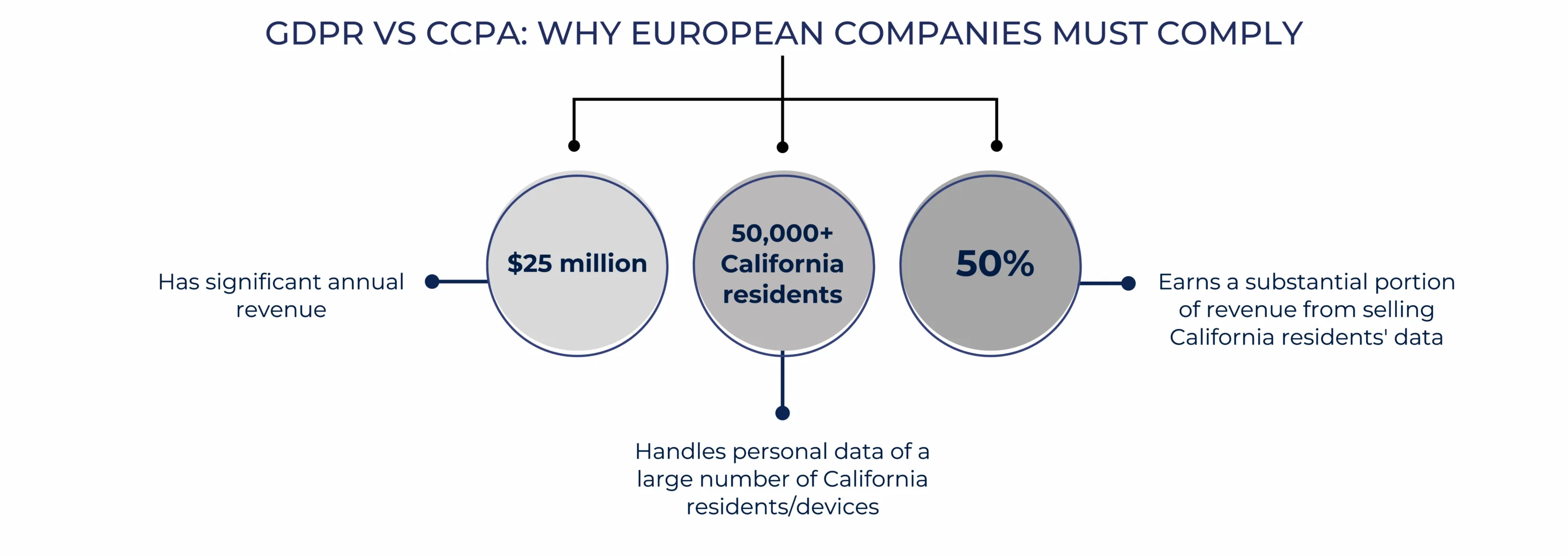
The CCPA defines “business” broadly. It applies to any for-profit organization that collects personal information from California residents regardless of location and meets at least one of the following requirements.
- Has yearly gross revenues that exceed $25 million.
- Buys, receives, sells, or shares personal information of at least 50,000 California persons, households, or devices.
- 50% or more of its annual revenue comes from selling California citizens’ personal information.
HOW DOES CCPA VS GDPR COMPLIANCE DIFFER IN THEIR CONSENT REQUIREMENTS?
Both the GDPR and CCPA emphasize gaining user consent for cookies. However, each law does this differently. The GDPR stresses gaining express agreement before collecting any data. In contrast, the CCPA concentrates on allowing customers to opt out later and, in most situations, does not require prior consent to acquire and process personal data. Furthermore, the GDPR provides a broader scope and tighter data protection regulations than the CCPA.
Consent Requirements: Under GDPR, businesses must obtain express, unambiguous agreement from individuals before collecting and processing their data, referred to as an “opt-in model.” Consent must be an explicit affirmative action and cannot be implied from an unrelated action or absence thereof. Users have the right to amend or withdraw their consent at any time. This requirement also applies to tracking cookies, which are considered a type of personal data under GDPR.
The CCPA does not require express opt-in consent to collect personal data unless it is sensitive (meaning it poses a higher risk of harm if exploited) or belongs to a minor. Instead, it allows customers to opt out of selling their personal information to third parties. Businesses can gather and use most personal data without authorization. Still, they must include a “Do Not Sell My Personal Information” link on their website so that customers can exercise their opt-out right.
Definition of Personal Data: The GDPR defines personal data as “any information relating to an identified or identifiable natural person.” This contains direct identifiers, such as names and ID numbers, and indirect identifiers, such as location data or an IP address. This also includes aspects of a person’s physical, psychological, or genetic identity, healthcare or financial information, political or religious opinions, and other characteristics. It is important to emphasize that the GDPR broadly views personal data. This means that even seemingly innocent material might be considered “personal data” if it can be associated with an individual or used to identify them. This includes website cookies, media recordings, biometrics, and GPS data.
The CCPA defines personal information similarly to the GDPR, including data that might directly or indirectly identify or describe a customer or household. This includes personal information such as names, email addresses, Social Security numbers, browsing history, purchasing data, and geographical information. Similarly to the GDPR, the CCPA incorporates indirect identifying characteristics based on a person’s physical, physiological, or genetic identities.
However, the CCPA has a few specific exclusions for certain types of personal data already protected by other US laws.
HOW TO BE CCPA COMPLIANT?
CCPA compliance aims to empower customers and ensure appropriate data handling methods. First, corporations must give customers the option of whether or not to sell their personal information. Organizations can accomplish this by offering a “Do Not Sell My Personal Information” option. Companies must also disclose the types of personal information they collect, the purposes for which it will be used, and the third parties to whom it may be disclosed. To accomplish this, businesses must know all website internet trackers and cookies.
Second, organizations must allow consumers to learn about, access, request deletion, and prohibit selling their personal information. The CCPA, like the GDPR, limits storage length. Companies must avoid retaining personal information for longer than necessary and warn customers how long their data will be maintained. CertPro can also assist businesses that must comply with the CCPA by identifying all tracking technologies, centralizing allowing customers to opt out of data sales, and managing consumer rights as needed.
WHAT ARE THE FINES AND PENALTIES FOR NON-COMPLIANCE?
CCPA vs GDPR compliance contains fines that can be imposed on organizations that fail to comply with their requirements. Penalties are tier-based on the severity of the transgression. However, the GDPR has significantly higher possible penalties than the CCPA. If you fail to comply with the CCPA, the California Attorney General’s Office (formerly the CPPA) may seek civil fines of up to $2,500 per inadvertent violation or up to $7,500 for deliberate breaches or those involving minors. The CCPA also gives customers a private right of action if their personal information is compromised due to a company’s failure to implement acceptable security measures. Consumers can claim statutory damages of $100 to $750 per event.
PREPARE FOR THE FUTURE WITH CERTPRO
CCPA vs.GDPR compliance aims to protect data and give consumers power, but some significant differences exist. These regulations have become well established, and businesses should have sound privacy compliance policies and procedures. This benefits consumer relationships, brand reputation, and regulatory compliance. As governments worldwide continue to create and update laws to keep up with technology and digital marketplaces, implementing data handling techniques, compliance standards, and methods for securely storing a user’s information and engaging with a data privacy specialist is the best course of action.
CertPro can help you in this regard. We offer both services for our clients at affordable prices. CCPA vs GDPR compliance is evident in creating a legal framework across the EU that prioritizes privacy through user control.
FAQ
What are the important differences between CCPA and GDPR?
The GDPR mandates prior consent for data collection, while the CCPA allows opting out. GDPR protects EU residents, requiring legal data collection bases. CCPA safeguards California residents, emphasizing opt-out options for data use.
Who needs to comply with the CCPA and GDPR?
Under the GDPR, any website, company, or organization that processes personal data on individuals inside the EU must comply if they are not themselves inside the EU. Under the CCPA, only companies or for-profit organizations that meet the law’s definition of business are required to comply.
What are the compliance thresholds for CCPA?
The CCPA applies to businesses exceeding $25 million in annual revenue, handling data of 50,000+ individuals/devices, or earning over 50% of revenue from selling personal data.
Can businesses be compliant with both CCPA and GDPR?
Yes, businesses can adopt practices that meet both standards, such as offering robust data privacy policies, obtaining explicit consent, and enabling opt-out options for U.S. consumers.
How do CCPA and GDPR handle user rights?
The GDPR grants users the right to access, correct, delete, and transfer their data. The CCPA provides similar rights but emphasizes opt-out options and limits the sale of personal data.

About the Author
ANUPAM SAHA
Anupam Saha, an accomplished Audit Team Leader, possesses expertise in implementing and managing standards across diverse domains. Serving as an ISO 27001 Lead Auditor, Anupam spearheads the establishment and optimization of robust information security frameworks.

DATA MAPPING FOR GDPR: BUILDING A COMPLIANCE-READY INVENTORY
Have you ever tried to answer a simple question like “Where’s our customer data stored?” Most probably, you would have found yourself hopping across five different tools and six spreadsheets. Despite all the research work, you might still get a negative signal from...

10-STEP GDPR CHECKLIST: A COMPLETE GUIDE
In the current global economy, businesses are heavily dependent on customer data. This helps them in enhancing business operations and providing customized services. However, this dependency also comes with the responsibility of protecting the data. One of the most...

GDPR ARTICLE 9: A PRACTICAL GUIDE TO HANDLING SENSITIVE DATA
The use of sensitive data is an essential part of modern business operations. Most businesses across various sectors store, handle, and process sensitive data as part of their business operations. In simple words, sensitive data is nothing but critical information...