
HOW COMPLIANCE AUDIT SOFTWARE IMPROVES AUDIT READINESS

Today, most companies deal with a growing number of compliance regulations. From data privacy standards to security frameworks like SOC 2 and ISO 27001, the list of compliance obligations keeps expanding. At the same time, regulators and external auditors now expect more precise records and tighter controls than before.
Many teams still use spreadsheets and shared drives to manage audit preparation. While these tools may work for simple tasks, they create real problems at scale. Evidence gets missed, records fall out of date, and teams struggle to stay aligned across departments.
Moreover, compliance audit software addresses these gaps directly. It brings audit records, control evidence, and workflow tasks into one platform. As a result, companies can maintain ongoing audit readiness rather than scrambling to prepare when a review is announced. This article covers how compliance audit software works, what it includes, and why it matters for modern compliance programs.
Tl; DR:
Concern: Manual audit preparation often relies on spreadsheets, emails, and scattered documentation. As organizations adopt multiple compliance frameworks and operate across different teams, collecting accurate audit evidence becomes time-consuming and difficult to manage. These fragmented processes can delay audit readiness and increase the risk of missing or incomplete documentation during reviews.
Overview: Compliance audit software provides a centralized system for managing audit documentation, policies, and control records. It helps organizations organize compliance activities, automate evidence collection, and maintain structured audit workflows. By consolidating compliance data in one platform, teams can track requirements more efficiently and support ongoing audit preparation.
Solution: Using compliance audit software allows organizations to move from reactive audit preparation to a more structured and continuous process. Automated documentation and centralized records help teams maintain consistent evidence across frameworks. This approach improves audit readiness, simplifies audit cycles, and provides auditors with clear, organized information for evaluation.
WHAT IS COMPLIANCE AUDIT SOFTWARE?
Compliance audit software is a digital platform that helps companies plan, track, and manage audits and compliance tasks. Instead of relying on manual processes, teams use the platform to store control records, manage evidence, schedule audit tasks, and produce compliance reports from a single place.
The main goal of compliance audit software is to simplify the audit cycle. It helps teams collect the right evidence and build the records needed for internal reviews. Most platforms also include automation features that cut down on manual work. For example, they pull system logs automatically, send task reminders, and produce audit reports without anyone compiling data by hand.
Additionally, it is worth noting how compliance audit software differs from general compliance tools. General tools focus on tracking policies and training updates. This software, by contrast, is built specifically for the audit process. It creates detailed audit trails, organizes evidence by control, and gives auditors a clear view of how controls are operating. Both types can work together, but they serve different roles.
WHAT IS AUDIT MANAGEMENT IN COMPLIANCE PROGRAMS?
Audit management is the structured process used to plan, carry out, record, and review audits within a company. Moreover, it ensures that compliance standards are checked consistently and that internal controls are working as intended. Understanding this process also helps explain why compliance audit software tools add real value here.
The Audit Management Lifecycle
Most audit programs follow a four-stage process. Each stage has a clear purpose and produces specific outputs that feed into the next step. The table below summarizes the lifecycle:
| Audit Stage | Activities | Key Deliverables |
|---|---|---|
| Planning | Define scope, objectives, and audit team | Audit plan and schedule |
| Execution | Collect evidence, test controls, and review records | Field notes and control test results |
| Documentation | Record findings and gather supporting files | Audit workpapers and evidence files |
| Reporting | Summarize findings and share with leadership | Audit report and action items |
When teams handle these stages manually, coordination becomes difficult. Records get stored in different places, tasks fall through the gaps, and the audit trail becomes hard to follow. The platform ties these stages together in one system, making the whole process easier to manage and track.
Internal vs. External Compliance Audits
Internal audits are run by a company’s own team to check that controls are working and policies are followed. They help spot gaps before an external reviewer finds them. External audits, in contrast, are conducted by outside parties such as auditors or regulators, often for certifications like SOC 2 or ISO 27001. Both types follow the same basic lifecycle. However, external audits require tighter evidence quality and more detailed audit trails. A solid platform, such as compliance audit software, supports both by keeping records organized and ready for review at any time.
Documentation and Evidence Management in Audits
Strong evidence management is central to any audit. Auditors need clear proof that controls were in place during the review period. This means collecting files such as access logs, policy sign-offs, and system configuration records. Without a structured system, gathering this evidence can take weeks. The right platform solves this by collecting and storing evidence on an ongoing basis. By the time an audit begins, the records are already organized and ready to share.
KEY FEATURES OF MODERN COMPLIANCE MANAGEMENT SOFTWARE
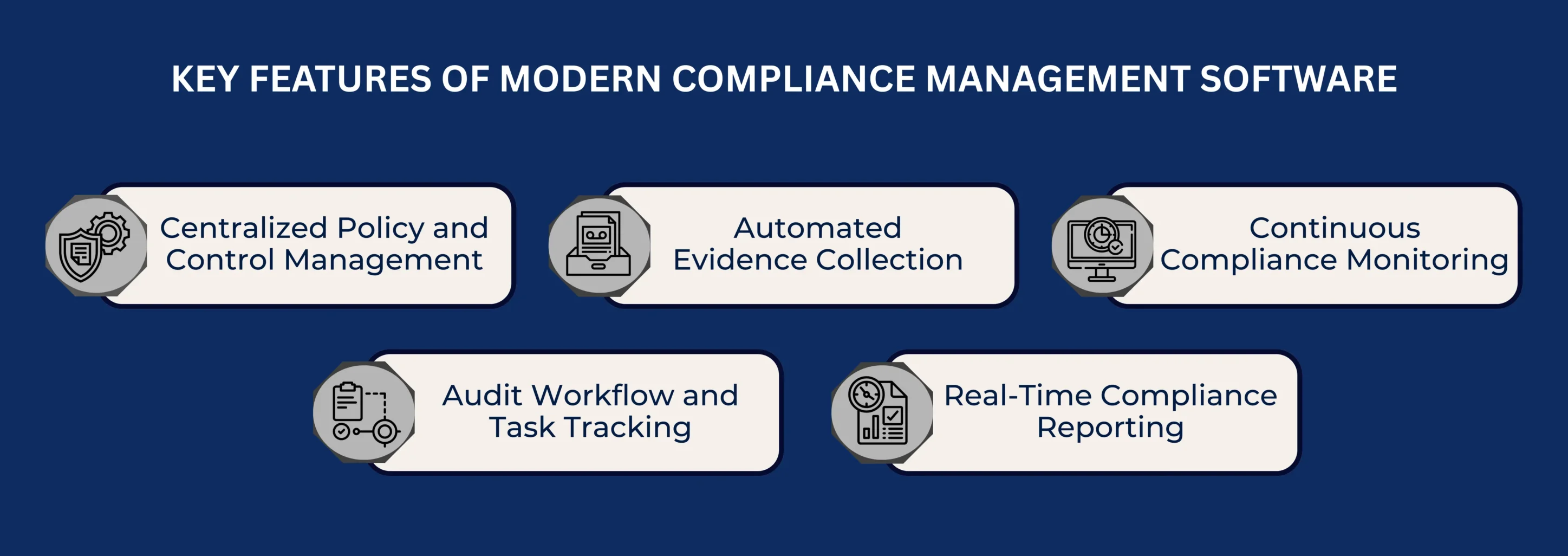
Modern compliance management software, including compliance audit software, is built around a set of core features that work together to keep audit programs running smoothly. Specifically, here is a closer look at each one.
Centralized Policy and Control Management
A shared policy library in compliance audit software keeps all controls, procedures, and records in one place. Teams can see which controls are active, who owns them, and when they were last reviewed. This visibility makes it much easier to show auditors that controls are well-managed and reduces the risk of outdated policies slipping through a review.
Automated Evidence Collection
Rather than asking staff to pull logs and access records by hand, the platform collects this data automatically. It connects to cloud platforms and security tools to gather evidence on a set schedule. This keeps audit files current, removes manual effort, and ensures that evidence is consistent and directly tied to the controls being tested.
Continuous Compliance Monitoring
Compliance does not stop between audits. Continuous compliance auditing depends on continuous monitoring to track control status in real time and flag issues as they arise. If a configuration drifts out of specification or a policy approval lapses, compliance audit software alerts the right team member. As a result, teams get early visibility into control failures. This early warning system helps companies fix problems before they become audit findings.
Audit Workflow and Task Tracking
Workflow tools assign audit tasks to the right people, set deadlines, and track progress across teams. Each step is visible, so managers can see what is done, what is pending, and where delays exist. This structured approach keeps audit programs on schedule and ensures nothing is overlooked.
Real-Time Compliance Reporting
Dashboards and reporting tools give leadership a live view of compliance status. Teams can generate reports showing control coverage, open gaps, and recent audit activity. These reports are useful for internal governance and for sharing with external auditors. Pre-built reports also speed up the start of a formal audit.
HOW COMPLIANCE AUDIT SOFTWARE IMPROVES AUDIT READINESS FOR MODERN COMPLIANCE
Audit readiness means being able to show compliance and provide supporting records at any point. This is where compliance audit software delivers its most direct value. The sections below explain how each capability connects to stronger audit readiness.
Reducing Manual Audit Preparation
Traditional audit preparation can take weeks, requiring teams to pull files from multiple systems and chase colleagues for records. These tools remove most of this effort. Because evidence is collected on an ongoing basis, teams can respond to audit requests quickly. As a result, the preparation work shifts from a large, one-time effort to a continuous, low-effort background process.
Improving Documentation Accuracy
Manual records are prone to errors. Files get updated without version tracking, timestamps are missing, and it is often unclear who made a change and when. Compliance audit software, however, creates a full, time-stamped audit trail for every action taken. Each record is tied to a specific control, user, and date. This level of accuracy gives auditors confidence that the evidence is genuine and complete, which in turn speeds up the review process.
Enabling Real-Time Control Monitoring
One of the biggest audit risks is discovering a control failure during the review itself. Real-time monitoring prevents this. By tracking control status continuously, compliance audit software alerts teams as soon as a gap appears. For instance, if a user access review is overdue or an encryption setting has changed, the platform flags it immediately. Teams can then fix the issue well before any auditor sees it.
Supporting Cross-Team Collaboration During Audits
Audit prep rarely falls on one team alone. IT, security, HR, and operations all play a role in gathering records and confirming control status. Without a shared system, coordinating across these teams is slow and error-prone. A shared audit platform gives every team one place to upload files, complete tasks, and track progress. This shared workspace reduces back-and-forth communication and helps audits stay on schedule.
Providing Clear Evidence for Auditors
External auditors need evidence that is easy to find and clearly linked to the controls being tested. When records are scattered across emails and shared drives, auditors spend more time searching and less time reviewing. Good compliance audit software organizes all evidence by framework, control, and time period. Consequently, auditors can find what they need quickly and move through the review more efficiently. This structured approach shortens audit timelines and reduces the chance of findings caused by disorganized records.
THE ROLE OF COMPLIANCE AUDITORS IN SOFTWARE-ENABLED AUDITS
A compliance auditor is a professional who reviews a company’s policies, controls, and records to check that it meets the relevant standards and rules. Even when such compliance audit software is in place, the auditor’s role remains essential. Software organizes the data, but auditors apply professional judgment to evaluate what that data means. Understanding what a compliance auditor is helps teams recognize the value auditors bring in validating evidence and ensuring compliance frameworks are properly applied.
Responsibilities of Compliance Auditors
Compliance auditors handle several key tasks during a review. They plan the audit scope and test approach, review policies, and test controls by sampling logs and transactions. They also identify gaps and document their findings. Finally, they issue a formal report with conclusions and, where needed, recommendations for improvement. These tasks require judgment that no software tool can fully replace.
How Auditors Review Digital Audit Evidence
When the platform is in use, auditors typically review evidence within the system itself. They check control ownership records, verify that audit trails are complete, and test a sample of automated evidence to confirm it was collected correctly. Because everything is stored in one place, this process is faster and more consistent than reviewing records spread across multiple systems.
How Software Improves Auditor Visibility
One of the clearest benefits of this software for auditors is visibility. Instead of requesting files and waiting for responses, auditors can access evidence directly. They can see the full history of a control, including when it was tested and who approved it. In turn, this supports a more thorough review and reduces the follow-up questions that slow down the audit process.
CHALLENGES AND BEST PRACTICES WHEN IMPLEMENTING COMPLIANCE AUDIT SOFTWARE
Adopting this type of software has clear benefits, but implementation comes with real challenges. Understanding these early helps teams plan better and avoid common setbacks.
Common Challenges
Data Integration Across Systems: These platforms need to connect to existing IT tools, cloud systems, and security tools to pull data. If those systems use different formats or lack APIs, integration can be slow and costly. Therefore, teams should map out their data sources before choosing compliance audit software.
Process Adoption Across Teams: Software only works if people use it. Staff across IT, security, and operations need to understand how to log evidence and follow new workflows. Without clear ownership and training, teams may revert to old habits, leaving the platform underused.
Maintaining Accurate Compliance Data: Automated tools are only as reliable as the data they pull from source systems. If underlying records are incomplete, compliance reports will not reflect actual control status. Regular data quality checks keep the platform accurate.
Best Practices
Align Software With Your Compliance Framework: Set up the platform around the specific frameworks your company follows, such as SOC 2, ISO 27001, or HIPAA. Mapping controls to the right standards from the start makes audits more straightforward and reduces the need to re-organize evidence later.
Maintain Continuous Evidence Collection: Do not wait for an audit to start collecting evidence. Configure compliance audit software to gather records automatically on an ongoing basis. This ensures that audit files are always current and that teams are not scrambling at short notice.
Conduct Periodic Internal Audit Reviews: Schedule regular internal reviews to test whether controls are working as expected and whether the platform is capturing the right evidence. These reviews catch gaps early and give teams the chance to adjust processes before an external audit. Firms such as CertPro, an independent CPA firm registered under AICPA, can support companies in structuring these reviews and ensuring that their compliance programs meet the relevant standards.
CONCLUSION
Compliance audit software gives companies a structured way to stay audit-ready year-round. By centralizing records, automating evidence collection, and supporting cross-team workflows, it removes much of the manual effort that makes audits stressful. In addition, these tools improve compliance quality over time by making gaps visible early and keeping controls consistently documented.
That said, software is a tool, not a substitute for professional judgment. Compliance auditors remain essential to evaluating control strength and drawing sound conclusions. When both work together, companies can build more transparent, resilient compliance programs that support long-term governance goals.
FAQ
What is compliance audit software and how does it help with audit readiness?
Compliance audit software is a platform that helps companies plan, track, and manage audits. It centralizes control records, automates evidence collection, and keeps audit workflows organized in one shared system.
What is audit management in compliance?
Audit management is the process of planning, carrying out, recording, and reviewing audits within a company. It ensures that controls are tested consistently and that compliance standards are met across all review cycles.
What is the role of a compliance auditor?
A compliance auditor reviews policies, tests internal controls, and checks whether a company meets the relevant standards. They identify gaps and issue formal findings with recommendations for corrective action.
How does compliance management software support audits?
Compliance management software organizes control records, automates evidence gathering, and tracks audit tasks in real time. This gives auditors structured access to the evidence they need and reduces the time spent on manual preparation work.
Can compliance audit software replace manual audit preparation?
It greatly reduces manual work by automating evidence collection and workflows. However, auditors still apply professional judgment to evaluate controls and draw conclusions. Software supports the process but does not replace skilled review.
WHAT IS COMPLIANCE AUDIT SOFTWARE?
WHAT IS AUDIT MANAGEMENT IN COMPLIANCE PROGRAMS?
KEY FEATURES OF MODERN COMPLIANCE MANAGEMENT SOFTWARE
HOW COMPLIANCE AUDIT SOFTWARE IMPROVES AUDIT READINESS FOR MODERN COMPLIANCE
THE ROLE OF COMPLIANCE AUDITORS IN SOFTWARE-ENABLED AUDITS
CHALLENGES AND BEST PRACTICES WHEN IMPLEMENTING COMPLIANCE AUDIT SOFTWARE
HOW SOC 2 COMPLIANCE SOFTWARE CHANGES AUDIT READINESS
There's a version of SOC 2 preparation that most security teams know too well. The audit date is approaching. Someone sends a spreadsheet asking for access logs, vendor assessments, and approval records. People scramble. Documentation gaps appear. What should take...
HOW SOC 2 TYPE II CERTIFICATION IMPACTS CUSTOMER CONFIDENCE AND DATA SECURITY
Enterprise buyers changed how they evaluate vendors. They no longer trust self-reported security claims. Instead, vendor risk management became a top priority. Consequently, procurement teams demand independent proof. They need verification that vendors protect their...
SOC 1 VS SOC 2: WHICH REPORT YOUR CUSTOMERS ACTUALLY ASK FOR
If you sell SaaS or provide outsourced services, you have likely been asked for a SOC report. However, the follow-up question is rarely easy to answer: do they mean SOC 1 or SOC 2? Both reports fall under the AICPA’s System and Organization Controls (SOC) reporting...