
HIPAA UPDATES 2026: KEY REGULATORY CHANGES, NEW RULES, AND COMPLIANCE IMPACT EXPLAINED

Healthcare data breaches continue to rise, and the pattern is clear. Attackers target patient records because they carry long-term value. At the same time, many organizations still rely on outdated controls, scattered data systems, and weak vendor oversight.
That gap creates real exposure. Regulators have responded with stricter enforcement. Audits now go deeper, and penalties arrive faster. You can’t rely on policies alone. You need proof that your controls work in real conditions.
The HIPAA updates 2026 reflect this shift. Regulators now push for faster patient access to data, stronger security practices, and tighter control over third parties. Patients expect quick, digital access to their records.
Delays now raise compliance risks. Security expectations have also moved forward. Encryption, multi-factor authentication, and continuous monitoring now sit at the center of HIPAA compliance conversations. At the same time, third-party risk has come into focus. Vendors, cloud providers, and analytics tools often handle sensitive data. Regulators now expect clear accountability across that chain.
This impacts a wide group. Healthcare providers must rethink workflows and access controls. Furthermore, SaaS vendors and healthtech startups must prove they can protect data at scale. Insurers and business associates must align contracts and monitoring with new expectations.
This guide breaks down the 2026 HIPAA changes and explains why they matter. It also shows what actions you need to take now. You’ll see where most organizations fall short and how to close those gaps before an audit or breach forces the issue.
Tl; DR:
Concern: Healthcare data breaches keep rising, and attackers target PHI for its long-term value. Meanwhile, many organizations still depend on outdated controls, manual workflows, and weak vendor oversight. This increases exposure. With HIPAA updates 2026, regulators have tightened enforcement. Audits go deeper, and penalties arrive faster. They now expect clear proof of security in real conditions. As a result, gaps in access control, vendor management, and monitoring create immediate compliance risk. SaaS firms and healthcare providers now face constant pressure to prove compliance in real time.
Overview: The HIPAA updates 2026 bring major operational changes. Patient data access must be faster and digital-first. Security now requires encryption, MFA, and continuous monitoring. The scope of business associates has expanded to include SaaS and AI vendors. Enforcement has become stricter with higher penalties and detailed audits. Organizations must also maintain continuous risk analysis with clear evidence. Privacy rules demand tighter access and real-time consent tracking, while security aligns with modern frameworks and zero trust. Third-party risk now sits at the center of compliance.
Solution: Organizations must act quickly. Update policies to match real system behavior. Run current risk assessments across the cloud and vendors. Apply strict role-based access controls. Maintain audit-ready evidence such as logs and reports. Monitor systems and vendors continuously. Early action reduces audit risk and builds trust with regulators and clients.
WHAT ARE THE KEY HIPAA UPDATES IN 2026?
Consider that you are a SaaS founder undergoing a HIPAA audit. Your team have solid features, but they struggled to deliver patient data within the expected time. That delay alone triggered compliance concerns. That’s the reality now. Small gaps create big risks.
Key changes you need to know
- Faster Patient Access Timelines: Patients expect near real-time access with HIPAA updates 2026. Slow responses now raise red flags.
- Stronger Cybersecurity Requirements: You’ll need encryption, MFA, and ongoing monitoring. Think of it like a security system that stays on, not one you switch on during audits.
- Expanded Definition of Business Associates: More vendors fall under HIPAA. If your tool touches Protected Health Information (PHI) in any way, then you’re accountable in accordance with HIPAA updates 2026.
- Higher Penalties for Non-Compliance: Fines hit faster. Regulators look for proof rather than mere intent.
- Mandatory Risk Analysis Updates: Annual reviews won’t be sufficient to ensure security. Risks change fast, so your assessments must keep up.
| Old vs New Expectations | ||
|---|---|---|
| Area | Before | Now |
| Access timelines | Days to weeks | Faster, often near real-time |
| Security | Basic safeguards | Continuous, layered controls |
| Enforcement | Reactive | Proactive and strict |
Why did these changes happen?
Ransomware attacks keep hitting healthcare. However, the traditional HIPAA regulations couldn’t keep pace with them. Cloud tools and AI now handle sensitive data daily. That shift forced regulators to act and introduce the HIPAA updates 2026.
KEY CHANGES TO HIPAA PRIVACY RULE IN 2026
The HIPAA updates 2026 push one clear idea. Patients expect speed, control, and transparency. Regulators now enforce that expectation with sharper rules. If your team handles PHI, these changes will affect daily operations.
Faster Patient Access Requirements
Response time for PHI requests has tightened with HIPAA updates 2026. Delays now create direct compliance risk. Many organizations still rely on manual workflows or fragmented systems. That slows everything down. The update pushes digital access. Patients want records through portals, apps, or secure APIs. If your system can’t deliver quickly, it creates friction and audit exposure.
Expanded Patient Rights
Patients now have more control over how their data moves. They can restrict disclosures with fewer barriers. That shift puts pressure on internal processes. Teams must track consent accurately and apply it in real time. A simple mistake can expose sensitive data. This is where many companies struggle. Consent logs often sit in silos.
Stricter “minimum necessary” Standard
Regulators now expect tighter data-sharing procedures under HIPAA updates 2026. Teams must limit access to only what is needed for a task. Over-sharing creates risk. This change affects workflows across support, analytics, and engineering. For example, giving full record access to a support agent may no longer pass scrutiny. You need role-based access and clear audit trails.
Real-World Example
Earlier, a clinic could take several days to process a record request through email and manual checks. In 2026, that same request must move through a secure portal with identity checks and quick delivery. The process must leave a clear audit trail.
These updates demand operational discipline. Strong systems, clear policies, and real-time visibility now define HIPAA compliance.
HIPAA UPDATES 2026: SECURITY RULES AND CYBERSECURITY EXPECTATIONS
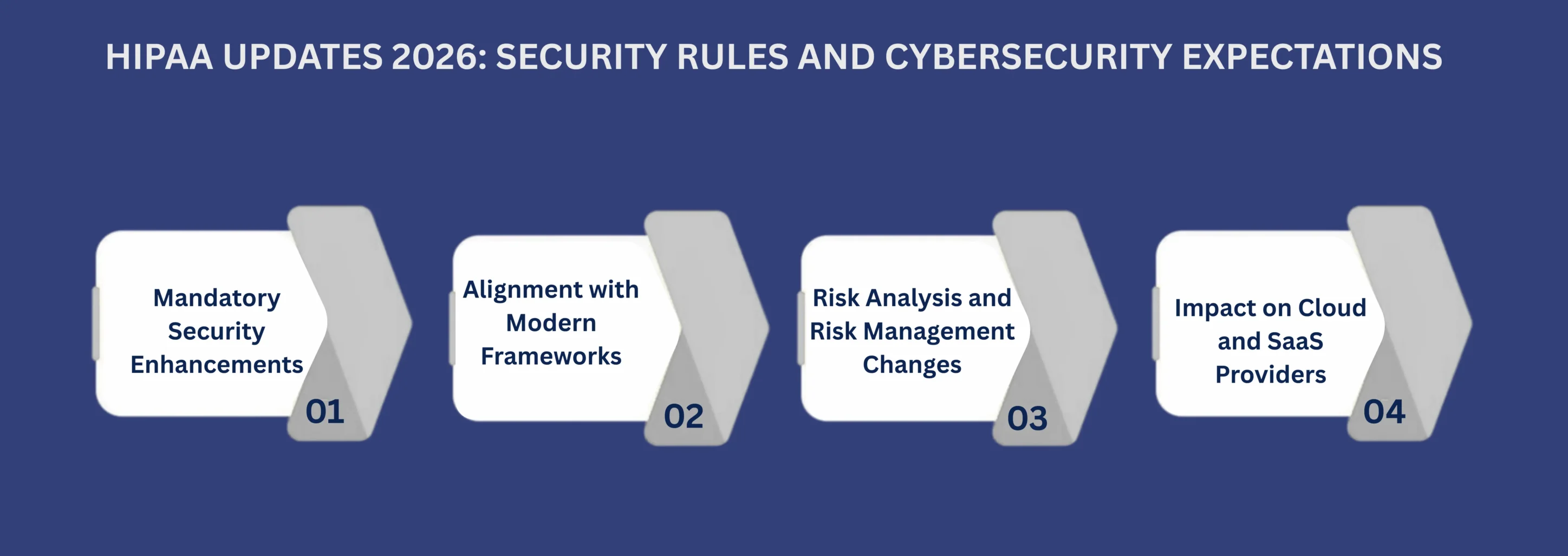
The 2026 updates bring HIPAA security closer to how modern systems actually run. Threats have changed fast. Many controls in place today were designed for older environments. Regulators now expect security that works in cloud-first, API-driven setups.
Mandatory Security Enhancements
Encryption now carries clear expectations. Data must stay protected both at rest and in transit using the right security controls. Weak or partial encryption raises audit concerns. Multi-factor authentication is now a baseline. Password-only access creates risk, especially for remote teams and admin accounts. Continuous monitoring also takes center stage. Logs must show real activity, not just system events. Security teams need visibility into who accessed what and when under HIPAA updates 2026.
Alignment with Modern Frameworks
The updated rule aligns more closely with frameworks like NIST. It also reflects zero trust principles. Every access request must be verified. Systems should not assume trust based on network location. This approach fits today’s distributed environments. A risk-based model guides control selection. High-risk systems demand stronger safeguards.
Risk Analysis and Risk Management Changes
Risk assessments now require more frequency and depth. Annual reviews feel outdated in fast-moving environments. Regulators expect ongoing evaluation with clear documentation with HIPAA updates 2026. Evidence matters. You must show how risks were identified, prioritized, and addressed. Many organizations struggle here. They document policies but fail to track real risk decisions.
Impact on Cloud and SaaS Providers
Cloud adoption has shifted responsibility. Providers secure the infrastructure. You remain responsible for how data is configured and accessed. Misconfigurations still cause many breaches. Vendors handling PHI must meet strict expectations. Contracts must reflect security duties, and monitoring must extend beyond your internal systems.
These updates demand real security maturity. Controls must operate daily, not sit idle for audits.
HIPAA UPDATES 2026: NEW RULES FOR BUSINESS ASSOCIATES AND THIRD-PARTY RISK
The HIPAA updates 2026 close a gap that many teams relied on for years. Data now flows through APIs, cloud tools, and AI services. Regulators see that entire chain. If your system touches PHI at any point, you fall under scrutiny.
Expanded Definition of Business Associates: More vendors now sit inside HIPAA scope. This includes analytics tools, AI platforms, and background processors that handle PHI indirectly. A logging service that stores patient identifiers can trigger obligations. Many SaaS teams miss this. They assume they stay outside because they don’t “own” the data. Regulators look at access and exposure, not ownership.
Direct Liability and Enforcement: Enforcement now reaches vendors directly. Audits no longer stop at the covered entity. I’ve seen cases where a hospital passed review, but its vendor failed due to weak access controls. That failure still created risk for both parties. Accountability now travels both ways with HIPAA updates 2026. If a breach happens, investigators follow the data trail across systems.
Updates to Business Associate Agreements (BAAs): BAAs now carry stricter terms. Contracts must define breach timelines, security controls, and reporting duties with precision. Vague language creates legal and operational risk. Teams must align legal terms with actual system behavior. If your contract promises rapid breach reporting, your detection systems must support that claim.
Third-Party Risk Management Expectations: Vendor risk management now demands ongoing attention. One-time assessments don’t hold up. You need continuous visibility into vendor security posture. That includes access logs, incident response readiness, and control validation.
These changes shift responsibility into daily operations. Vendor risk now sits at the center of HIPAA compliance.
COMPLIANCE IMPACT OF HIPAA UPDATES 2026: WHAT ORGANIZATIONS MUST DO
The HIPAA updates 2026 change how compliance shows up in daily work. Auditors now ask for evidence that reflects real operations. If your controls live only in documents, you’ll feel the pressure quickly.
Immediate Actions: Start with policies and procedures. They must match how your systems run today. Outdated language creates gaps during audits. Furthermore, review your Business Associate Agreements as well. Many contracts still carry vague terms. Under the HIPAA Omnibus Rule, business associates are directly accountable for safeguarding ePHI. Update agreements with clear breach timelines and defined security duties.
Run a fresh risk assessment. Use current data flows, not last year’s diagrams. Include cloud services, APIs, and third-party tools. Then train your workforce. Teams need to understand how these updates affect their daily actions. A support agent, for example, should know exactly how much PHI they can access and share.
Common Gaps: Many organizations rely on old risk assessments. Threats change fast, so static reviews fail in real conditions. Vendor oversight also remains weak in many cases. A single misconfigured tool can expose PHI. Documentation often falls short too. During audits, missing logs or unclear records raise immediate concerns.
Audit and Enforcement: Enforcement has become sharper. Penalties increase when organizations fail to show control effectiveness. Audits now happen more often. Investigators look for logs, access records, and incident response evidence. They focus on what actually happened inside your systems.
A Practical Roadmap:
- Start with a clear assessment of your environment.
- Fix the gaps with targeted controls.
- Document every decision and action.
- Keep monitoring your systems in real time.
- Then prepare for audits with evidence ready.
Strong compliance now depends on consistency. Your systems, teams, and vendors must stay aligned every day.
CONCLUSION
HIPAA updates in 2026 raise the bar for how you handle PHI. Auditors now expect proof that your controls work in real time. Gaps show up fast, especially across vendors, cloud systems, and access controls. Many teams discover issues only during an audit. That delay costs time, money, and trust.
This is where CertPro CPA LLC plays a critical role.
For SaaS firms and healthcare businesses, this matters. CertPro operates as an independent audit firm for HIPAA assessments. We evaluate the administrative, technical, and physical controls your organization has already established under the HIPAA Security Rule and HIPAA Privacy Rule.
Furthermore, we review policies, test control effectiveness, and examine evidence such as access logs, risk analyses, and incident response records. Then, we assess whether your controls align with HIPAA requirements for protecting electronic protected health information (ePHI).
Based on this evaluation, we issue independent audit reports or assessment outcomes that reflect the actual compliance posture. This independence strengthens the credibility of your HIPAA assessment. If your systems handle PHI, now is the right time to validate your compliance posture. A clear, independent audit gives you answers before regulators ask the questions.
FAQ
What are the key changes in HIPAA updates 2026?
HIPAA updates 2026 focus on faster patient data access, stronger cybersecurity controls, and stricter third-party oversight. Organizations must implement encryption, multi-factor authentication, and continuous monitoring and maintain clear evidence of compliance across systems, vendors, and daily operations.
How do HIPAA updates 2026 impact SaaS and cloud providers?
HIPAA updates 2026 expand compliance scope to SaaS and cloud vendors handling PHI. These providers must secure data access, monitor activity, and meet strict contractual obligations. Shared responsibility models now require clear accountability and ongoing security validation.
What new cybersecurity requirements are introduced in HIPAA updates 2026?
HIPAA updates 2026 require encryption for data at rest and in transit, mandatory multi-factor authentication, and continuous monitoring. Organizations must track user activity, detect anomalies, and maintain logs that prove security controls operate effectively in real environments.
How do HIPAA updates 2026 affect patient data access timelines?
HIPAA updates 2026 push for faster, often near real-time access to patient records. Organizations must replace manual processes with digital systems like portals or APIs. Delays in access now create compliance risks and can trigger audit scrutiny.
What should organizations do to comply with HIPAA updates 2026?
Organizations should update policies, review business associate agreements, conduct current risk assessments, and train teams. They must also maintain audit-ready documentation, enforce role-based access, and monitor systems continuously to meet HIPAA updates 2026 requirements.
HOW SOC 2 COMPLIANCE SOFTWARE CHANGES AUDIT READINESS
There's a version of SOC 2 preparation that most security teams know too well. The audit date is approaching. Someone sends a spreadsheet asking for access logs, vendor assessments, and approval records. People scramble. Documentation gaps appear. What should take...
HOW SOC 2 TYPE II CERTIFICATION IMPACTS CUSTOMER CONFIDENCE AND DATA SECURITY
Enterprise buyers changed how they evaluate vendors. They no longer trust self-reported security claims. Instead, vendor risk management became a top priority. Consequently, procurement teams demand independent proof. They need verification that vendors protect their...
SOC 1 VS SOC 2: WHICH REPORT YOUR CUSTOMERS ACTUALLY ASK FOR
If you sell SaaS or provide outsourced services, you have likely been asked for a SOC report. However, the follow-up question is rarely easy to answer: do they mean SOC 1 or SOC 2? Both reports fall under the AICPA’s System and Organization Controls (SOC) reporting...