
HOW TO BUILD A GRC TEAM IN 2026: KEY ROLES AND RESPONSIBILITIES

A GRC team is a cross – functional department that is responsible for managing governance, risk management, and compliance objectives within an organization. In simple words, this exclusive group acts as the guardian of a firm’s compliance and security posture. According to PwC’s 2025 Global Compliance Survey, 85% of global respondents say compliance requirements have become more complex in the last three years, and executives rank cybersecurity and data protection/privacy among the most important compliance priorities, alongside corporate governance and conduct risks.
In 2026, building the right GRC team is a survival and strategic requirement for business growth. This need is due to the constant change of compliance regulations and standards in areas such as cybersecurity, privacy, and AI governance. To clarify, every quarter brings a new audit request, a new control, or a new report. Regulatory timelines are fast – moving (for example, DORA has applied since 17 Jan 2025 in the EU financial sector, and the EU AI Act rolls out in phases), which is why ownership, evidence, and reporting structure are important in the modern era. Lack of such a structured GRC team will overwhelm you with a constant state of pressure and operational fatigue.
For instance, consider that you are a mid – size SaaS firm. You have solid tools, smart people, and good business intentions. Still, your audits keep failing. This is because the risks were handled by IT, compliance was managed by legal and security issues were addressed by operations. In such a poorly managed situation, a minor security issue serves as evidence that no one is fully accountable. This proves that you lack a well – planned and structured GRC team.
A well – built GRC team can address this issue. This guide to building a GRC team will provide clarity on key roles and responsibilities, offering guidance tailored to the latest compliance and audit environments. Moreover, it explains the benefits, challenges, best practices, and key stakeholders involved in building a GRC team.

Tl; DR:
Concern: In 2026, compliance is harder, audits are deeper, and risk moves faster. Many businesses still manage GRC across IT, legal, and security with no clear owner. As a result, audits fail, risks appear late, and teams stay stuck in reactive mode.
Overview: This guide explains what a modern GRC team does and why it matters. It shows how GRC gives leaders clear risk visibility, keeps regulations aligned with daily work, and supports continuous audit readiness. It also breaks down the key roles, team structures by company size, and the importance of clear ownership using simple RACI mapping. Most importantly, it explains how GRC has shifted from periodic checks to ongoing oversight tied to business risk.
Solution: To build an effective GRC team, businesses must start with a clear business need, assess current gaps, define roles, and assign ownership. Teams should hire for judgment, use tools that support real workflows, and document clear processes. When internal capacity is limited, external experts like CertPro act as a strategic extension of the GRC team. CertPro helps identify gaps, conduct quality audits and assessments, prepare for certification, and keep compliance aligned with changing regulations. The result is fewer surprises, faster audits, and GRC that supports growth instead of slowing it down.
WHAT IS A GRC TEAM?
Businesses of all sizes and industries that have operated long enough know the importance of an effective GRC (Governance, Risk, and Compliance) program. This program functions as the central guidance for organizations to handle risks, ensure compliance adherence, and build a clear and informed governance structure. In this context, the sole responsibility for handling the activities of the GRC program lies with the GRC team. The GRC team is responsible for owning the entire strategy and integrating the policies and functions of the GRC program into the organization’s overall operations.
A GRC team is a cross – functional group that manages governance policies, business risks, and regulatory duties under one operating model. They protect your firm by implementing continuous monitoring of your security and compliance posture. Furthermore, they build systems and programs to identify, manage, and mitigate the risks faced by organizations in a proactive manner. To add on, a GRC team exhibits a coordinated and cross – functional approach. In simple words, they strive for continuous improvement by integrating governance into your daily operations. Moreover, they help align the internal policies and external compliance requirements with the key business objectives.
At its core, a GRC team exists to give leaders an obvious overview of their risk exposure and appetite. For example, instead of finding gaps during an annual audit, teams now spot issues as systems change. That shift matters because a delay in mitigating compliance gaps will ultimately lead to regulatory fines and loss of trust. Hence, build a cross – functional core that owns governance risk management compliance to give leaders a single view of risk.
Next comes regulatory alignment. A modern GRC team translates complex compliance regulations into daily operations policies. As a result, people know what to do and why it matters. Taking care of governance and regulatory adherence naturally leads to audit readiness. Here, updated and well – documented evidence, along with clear accountability, could help you during external audits.
KEY ROLES THAT EVERY GRC TEAM NEEDS
In a modern GRC team, each role solves a real problem that businesses face on a day – to – day basis.
The head of GRC sets the tone and direction of the GRC program. This person connects risk and compliance work to business goals. They communicate with the leadership and explain risky and vulnerable areas and why mitigating them matters. Without this role, GRC becomes a distraction instead of guidance.
Next comes the risk manager. This role keeps risks visible and updated by tracking changes in systems, vendors, and products. Hence, a risk manager is someone who identifies risks early and pushes for mitigation procedures.
Meanwhile, the compliance manager handles the internal policies and external compliance obligations. They map laws and standards to daily work. They also run audits. When auditors ask for evidence, this person knows where it lives and who owns it.
Then you need a security and IT lead. Controls don’t run on paper; rather, they live in systems. This role bridges GRC and technical teams. They help turn policies into working controls and real evidence.
Finally, the internal audit or assurance lead checks reality. They test controls and flag gaps before external auditors do. That early signal builds confidence.
| Role | Responsibility | Key Outputs |
|---|---|---|
| Head of GRC | Sets the tone of the GRC program and ensures leadership support. | Risk reports and board updates. |
| Risk manager | This role monitors and handles risk management. | Risk register and risk management plans. |
| Compliance manager | Owns regulations and audits | Policies and audit evidence |
| Security and IT lead | Supports control execution | Control evidence and access logs |
| Internal Audit lead | Test and validates the control | Internal audit reports and findings. |
STRUCTURE AND OWNERSHIP OF A GRC TEAM
The structure of a GRC team must match the company’s size and its risk appetite. Here, the real issue starts when teams copy enterprise models that do not fit their current posture.
- Small and Mid – Size Companies: GRC usually runs lean here, with one or two people taking care of multiple roles. For instance, a single lead may handle risk, compliance, and audit preparation. Such an arrangement could feel fine during the early stages. But the real issues happen when the company starts scaling with a GRC team that lacks clear ownership and accountability.
- Growing SaaS and Regulated Firms: They need a clear separation of roles and duties. Therefore, it is no longer appropriate for one person to handle both risk and compliance simultaneously. With evolving systems, customer expectations, and audits, dedicated risk and compliance roles become the new business necessity. Clear role separation in GRC vs. SOC reduces confusion during incidents, audits, and regulatory reviews.
- Large Enterprises: Here, the local teams manage the risks, and a central group outlines policies and reporting. This balance keeps control without slowing teams down.
Now, let’s have a simple view of the different structures of GRC teams across the market:
- Startup: One GRC owner with IT and legal support.
- Mid – market: Separate risk and compliance leads.
- Enterprise: Distributed teams with central oversight.
Businesses must understand that none of the above – discussed structures could work efficiently without clear ownership. But how do you build ownership that actually works in real time?
A simple RACI – style (Responsible, Accountable, Consulted, and Informed) mapping helps. In this structure, one owner is responsible for creating and maintaining policies, another owner tests the controls, and a third owner reports the risks to leadership.
Furthermore, the ownership must be linked to their outcomes.
- Risk owners maintain the risk register.
- Control owners provide audit evidence.
- GRC leadership handles board reporting.
GRC TEAM REPORTING STRUCTURE: WHO SHOULD THEY REPORT TO
Choosing where the GRC team reports affects audit outcomes, risk visibility, and trust across teams. GRC either sits too close to operations or too far from decision – makers. Both scenarios are problematic and require a clear structure.
Why reporting lines matter
GRC needs enough distance to challenge controls but enough access to influence action. Therefore, reporting to the same team that conducts the tests weakens the findings. Ignoring risks occurs when GRC operates in isolation. Hence, the right balance keeps issues visible and fixable.
Common reporting models by company type
Regulated and Financial Organizations: The GRC team usually reports into Risk or Compliance. This keeps testing independent from IT and security teams.
SaaS companies: GRC often partners closely with the CISO because security controls dominate audits. At the same time, the legal team supports contracts and privacy interpretations. In this context, understanding GRC vs. SOC is critical when building a team, since each function needs different skills and reporting lines.
Large Enterprises: GRC team stays centralized for policies and risk methods. Furthermore, the control over ownership stays with business units.
For example, HR owns training controls, IT owns security, and finance owns SOX requirements.
GRC teams must conduct tests independently. Accordingly, the control owners must execute clearly. This structure and communication facilitate faster audits, early risk detection, and informed leadership.
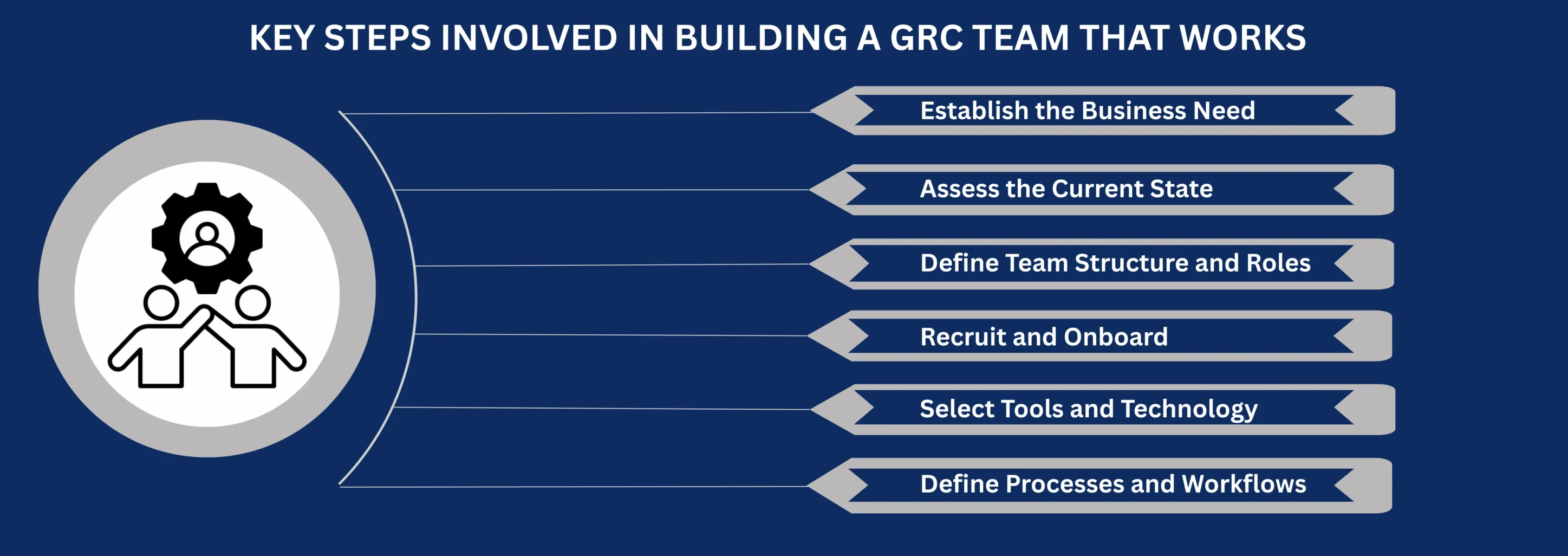
KEY STEPS INVOLVED IN BUILDING A GRC TEAM THAT WORKS
A GRC team must match your company’s size, compliance posture, and current business goals. Hence, building it requires a proper plan and calculative approach. The following steps will help you in building a strong GRC team. Diligently following these steps will help your teams gain a thorough knowledge of “What is GRC?”
1. Establish the Business Need
Every Governance, Risk, and Compliance (GRC) team begins with a specific reason for its formation. Maybe audits drag on for months or the leaders struggle to identify the risks before they escalate. Therefore, always begin the process by identifying the need to build a GRC team. Match it to your business goals like growth, customer trust, or market access. This step creates authority and provides the team a clear mandate and goal from day one.
2. Assess the Current State
Next, conduct a thorough review of your current posture. This is because most companies already do the GRC work without a structure. As a result, the firms could face unnoticed risks, unverified evidence, and unclear ownership. Connect them all and try to identify the already present vulnerabilities and gaps.
3. Define Team Structure and Roles
Now it’s time to assign roles and responsibilities. Choose the core roles that fit your size and risk level. Then write defined responsibilities in plain language. Then create a RACI for policies, risks, and controls. Thus, accountability grows with clear roles and responsibilities.
4. Recruit and Onboard
Hire for judgment, not just titles. Some of the best GRC leaders come from roles in security, audit, or legal fields. Once onboarded, train them on the key frameworks and internal systems. Moreover, share your past audit lessons to provide them clarity over your compliance posture and needs.
5. Select Tools and Technology
Choose platforms that centralize evidence and track controls. In this context, you could use compliance automation platforms for alerts and monitoring changes.
6. Define Processes and Workflows
Finally, ensure proper documentation of all the important processes. Document policies, reviews, risk mitigation, and incident response plans. Blend automation with human judgment to achieve a balance to shorten audits and build confidence.
In summary, approach each step strategically and begin with a small pilot project in one area. Learn and analyze its outcomes and adjust your team as required. That is how GRC becomes steady, trusted work.
CHALLENGES AND BEST PRACTICES OF BUILDING A GRC TEAM
Despite having a proper plan and sufficient resources, a GRC team could face issues during business expansion or new updates. Therefore, in this section, let’s learn about some of the common challenges faced by GRC teams and the best practices for overcoming them.
1. Lack of Executive Involvement
Many GRC teams fail before they begin because leadership does not fully back them. Without executive support, decisions stall, priorities change often, and GRC becomes a hurdle rather than a solution.
Best Practice: Approach the leaders with clear business needs, board – ready visuals, and KPIs. Furthermore, clarify to them the financial and long – term benefits of having a GRC team.
2. Unclear Roles and Responsibilities
This problem shows up fast. without proper ownership and structure, your team will fail to detect the risks. This lack of ownership and structure will eventually lead to audit failures.
Best Practice: Implement RACI for every policy and control requirement. This helps remove confusion.
3. Isolated Compliance, Risk, and Security
Isolated work slows your GRC program. To elaborate, the security team fixes issues but never feeds updates to compliance owners. This lack of communication and context leads to unexpected risks during audits. A strong GRC program only works with effective communication and coordinated efforts.
Best practice: Implement an Integrated Risk Management (IRM) approach to store risk data on a single platform, which helps you conduct monthly, cross – functional reviews.
4. Talent Gaps in Regulatory Knowledge
Many candidates know tools but lack expert – level judgement. Some possess a thorough understanding of the regulations, yet they lack the necessary technical knowledge. This gap could lead to surface – level risk assessments and weak controls.
Best Practice: Create a training pipeline focusing on upskilling and cross – skilling. For example, you could move experts from security and legal teams to GRC roles. Furthermore, focus on certifications and mentorship from senior risk and compliance managers.
CLOSING THOUGHTS
Building a GRC team in 2026 is about choosing the right roles and defining clear responsibilities. Most GRC teams fail due to unclear roles and ownership. Therefore, success in building a GRC team is assured when the structure matches real business risk, when responsibilities are clear, and when someone is always accountable. That clarity turns GRC into a daily discipline instead of audit panic.
However, many startups and growing firms encounter challenges such as hiring, evolving regulations, and frequent audits. This is where the right external partner changes the outcome.
CertPro works as a strategic extension of your GRC team. CertPro acts not as outsiders who merely drop off reports and leave, but as hands – on experts who step in to fill gaps when your team needs support the most. Our quality audits ensure that your firm is following the right regulations and implementing the proper controls and policies. Our service helps you to achieve global compliance certification and adhere to industry – and region – specific regulatory standards.
The value is practical. Faster audits, fewer surprises, and clear answers when customers or regulators ask hard questions. For startups, this means credibility without overhiring and for scaling businesses, it means stability while teams grow into new roles. Connect with CertPro today and turn your compliance into a growth tool.
FAQ
What is a GRC team?
A GRC team manages how an organization identifies risk, meets regulatory requirements, and stays audit – ready. It connects governance, risk, and compliance work so leaders get clear visibility, faster audits, and better control over legal, security, and operational risks.
What are the core skills needed for a GRC team?
A strong GRC team needs risk analysis skills, regulatory knowledge, audit coordination experience, and clear communication. It also needs judgment, documentation skills, and the ability to work closely with security, legal, IT, and leadership to integrate regulatory obligations into daily business operations.
What are the benefits of building a GRC team?
Building a GRC team reduces audit fatigue, lowers regulatory risk, and improves decision – making. It also helps organizations to spot issues early, respond faster to changes, and build trust with customers, regulators, and partners through consistent and well – owned compliance practices.
Who are the key stakeholders of a GRC team?
Key GRC stakeholders include executive leadership, security and IT teams, legal and compliance teams, internal audit, and business owners. Furthermore, the external auditors, regulators, and customers also rely on GRC outputs during audits and assessments.
Can startups function without a GRC team?
It is fine for early – stage startups, but they still need some ownership for managing risks and compliance tasks. Or else, they could outsource their audit support from expert vendors and use GRC automation tools to collect evidence and monitor risks.
GRC IN CYBERSECURITY: WHAT IT MEANS AND WHY IT MATTERS IN 2026
In 2026, the pressure on companies to manage cyber risk responsibly has never been greater. Regulators demand structured controls, boards want clear risk reporting, and threat actors are becoming more sophisticated. Against this backdrop, GRC in cybersecurity has...
HOW COMPLIANCE AUDIT SOFTWARE IMPROVES AUDIT READINESS
Today, most companies deal with a growing number of compliance regulations. From data privacy standards to security frameworks like SOC 2 and ISO 27001, the list of compliance obligations keeps expanding. At the same time, regulators and external auditors now expect...

Compliance Best Practices in 2026: How to stay ahead of regulatory changes
Why is the implementation of compliance best practices critical for 2026? Compliance in 2026 demands operational proof, not the documentation intent. Regulations change faster, audit scrutiny is higher, and reporting timelines are tighter across privacy,...