

In today’s business world, information is just as valuable as any other product. Cyberattacks and risks always happen, though, making it hard to gather and store information. Because of this, new cyber threats raise the risk to information security and leave the business open to cyberattacks. To keep things safe, companies need to have a firm security policy in this area. It is not as easy as you think to understand the idea. Today’s technologies and complicated ways of doing things make risk more difficult. A lot of businesses agree that risk management gets more complex over time. Because of this, the current methods for assessing risk are not enough to deal with the threats. Along with new tools, working with people from different industries raises business risks. Cyber risk experts also say that cloud risks are getting more complicated.
This article will discuss infosec risk management in 2026 and how to use proactive strategies to deal with the complicated risk environment.

UNDERSTANDING THE INFOSEC RISK MANAGEMENT
Information Security Risk Management(ISRM) helps companies identify vulnerabilities and create mitigation strategies. The process manages the risks associated with information security. In detail, it helps to identify, assess, and treat the risks to maintain data security, integrity, and confidentiality. Furthermore, the ISRM treats risks based on the organization’s risk tolerance. A standard advice is that businesses should not try to eliminate the risks; organizations should identify them and achieve a risk mitigation strategy.
Moreover, the risk management program addresses business uncertainties and ensures the desired business outcomes are achieved. However, risk management is not constant; it is modified per the organization’s size and functionality. Here we mention some benefits of risk management for your businesses:
- Recognize the vulnerabilities of an information system.
- Identify the extent of vulnerability and its possible impact on your organization.
- Evaluate the cost, probability of occurrence, and impact on your organization to determine the best ways to manage risks.
- Provide opportunities for organizations to develop proactive strategies in risk management.
- Offer a systematic way for organizations to identify and manage potential threats and vulnerabilities.
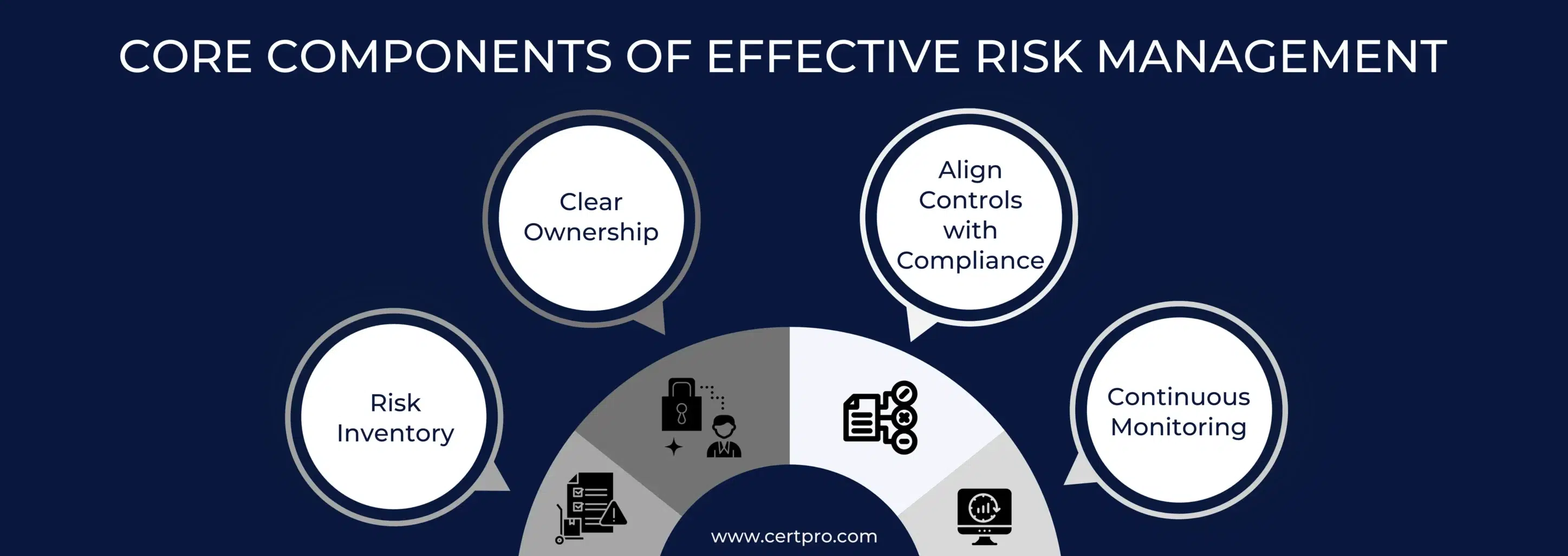
CORE COMPONENTS OF EFFECTIVE RISK MANAGEMENT
Effective risk management requires a few considerations to eliminate the risks and keep the process moving:
Risk Inventory: Organizations must have a comprehensive inventory of assets and related risks. Thus, scoring risks helps you understand the importance of potential threats and implement necessary controls to eliminate the threats.
Clear Ownership: Combating risks involves taking appropriate measures at the correct time. Thus, transparent ownership of risks and related actions should be documented. It will offer you a transparent picture of the organization’s infosec risk management process.
Align Controls with Compliance: Organizations must implement risk management controls that align with compliance best practices. This helps develop a robust framework for the overall risk management process.
Continuous Monitoring: Risk monitoring helps identify risks in the compliance process and identify gaps in the controls.
RESPONSIBILITIES IN MANAGING INFORMATION RISKS
The best risk management plans can be insufficient for your organization if communication is inconsistent. Thus, a successful risk management program depends on the stakeholder’s participation.
Process Owners: These high-level players are usually the finance or audit team in charge of the ERM (Enterprise Risk Management) program. The information security team oversees the ISRM program, which is part of ERM. Therefore, people on this team need to be in the field constantly to move the process forward.
Risk Owners: These people fix certain risks in their systems by buying the tools needed for mitigation, tracking, and repairing the process. Therefore, the risk owner is responsible for managing the risks. Thus, you will be the risk owner if you accept the budget for any risk management project.
Information Security Risk Management Team: This group will implement the chosen treatment plan. It includes system users and system managers or engineers. The management team is in charge of the parts of the risk management method related to computers and securities.
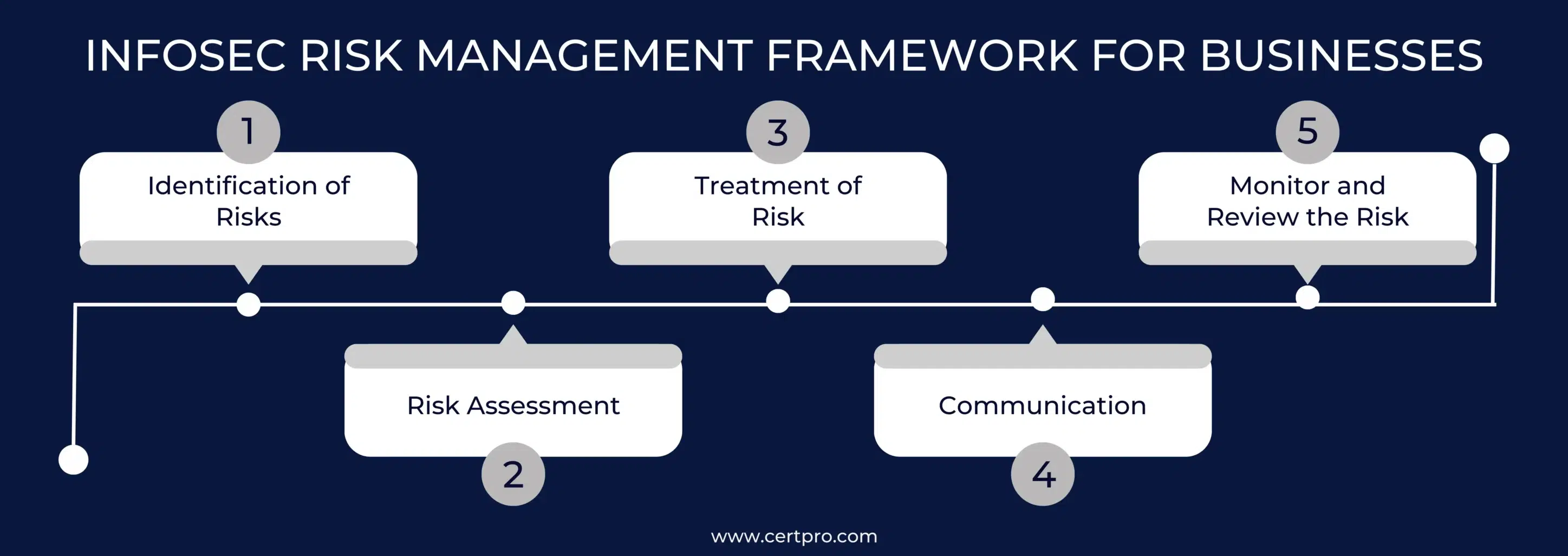
INFOSEC RISK MANAGEMENT FRAMEWORK FOR BUSINESSES
Infosec risk management is a systematic approach to managing risks and preventing data breaches. The following points can help you in creating a framework for managing the information security risk in your organization:
Identification of Risks: The first stage of the risk management framework helps identify your organization’s risks. Therefore, it identifies assets relevant to information security that impact an organization’s integrity and confidentiality. The risks may relate to the network, servers, and devices. In addition, the identification of vulnerabilities is also essential for risk management. It can put the organization in a vulnerable position. Therefore, weak passwords, lack of encryption, and poor data backup increase the risks.
On the other hand, identifying potential threats in risk management helps manage risk appropriately. It helps to understand possible threats from vulnerabilities and their impact on your organization. Threats can arise from software, malware, and infrastructure failures.
Risk Assessment: The next step is to review the risks, which assess the occurrence of risks and its impact on your organization. Therefore, risk assessments help businesses identify the most impactful risks for businesses.
Treatment of Risk: The risk assessment process identifies potential risks, and organizations must select the treatment process. One option is remediation, where controls are implemented for specific instances to fix the vulnerabilities. On the other hand, mitigating risks reduces the likelihood and impact of risks on businesses. However, it can not fix the vulnerabilities. Another risk treatment is a transference of risk, in which you can purchase insurance coverage from a third party to cover the cyber losses. However, organizations can purchase such opportunities through risk mitigation strategies and remediation processes.
Furthermore, risk acceptance is a treatment process in which risk management may cost more than the incident. In this situation, ensure the process does not affect the other function and keep it untouched. Lastly, risk avoidance is a treatment process; you can change or remove the data from the affected servers or places. Basically, it avoids the risks by transferring the data to a safe environment.
Communication: No matter which treatment choice you make, the employees need to know about it. Thus, the employees should be involved in the process and make them realize the importance of security practices in your organization. In addition, accountability and duty should also be clearly outlined and linked to specific people in the organization. During incidents, inform the concerned person and take appropriate measures. In this regard, the IT team will prevent the reoccurrence of the incident and preserve the environment.
Monitor and Review the Risk: Risk management is an ongoing process. Therefore, continuous security tracking and upgrading procedures ensure the organization’s systems are always safe. Thus, the risks should be checked often, especially when a system, purpose, vision, or process change occurs. You can also look at risks again during modifications to rules and regulations.
CHALLENGES WITH THE TRADITIONAL RISK MANAGEMENT PROCESS
The traditional risk management process has some issues that can be eliminated with the automation of risk management programs. The common problems are:
Broad-Brush Approach: Comprehensive risk management requires an inclusive view of risks. This approach creates challenges because time, resources, and budgets are limited. It often forces organizations to consider all risks equally or overestimate their importance. Therefore, the consequences of susceptible risk can cause massive damage to companies.
Insufficient Risk Assessment: A periodic risk assessment will be inadequate in a volatile market where new threats are constantly multiplying. In many cases, manual risk assessment may cause errors in risk-finding. Thus, the risk can penetrate the gaps and manipulate your organization’s security posture. Therefore, continuous monitoring is essential to find vulnerabilities and fix errors in this scenario.
Illusion of control: The traditional risk management process usually ends with listing risks, potential results, and ways to reduce those risks. However, eliminating vulnerabilities from the list does not help prevent and manage risks. For that reason, businesses need to be able to evaluate and mitigate risks continuously.
FINAL THOUGHTS
Assessing risks, sharing plans, and sticking to the process are essential to a risk management program. You can also use the same steps to stop hackers. CertPro can help you figure out where your compliance method is lacking. We can do audits from the outside for automated compliance sites. Our skilled auditing team will work with your compliance partner to keep the audit going. On top of that, our safety audit team will help you stay on track with compliance.
FAQ
Is ISO 27001 a risk management framework?
The risk assessment and management are critical steps in your ISO 27001 certification. In fact, an organization-wide risk assessment is the central focus of ISO 27001.
Is ISO 31000 a risk management framework?
The standard describes a risk management process that establishes the organization’s framework and principles for risk management.
What are the three significant types of IT risks?
The risks can be categorized as IT security, hardware or software failure, and IT disasters.
What is cyber security risk?
Cybersecurity risk is the potential for exposure or loss from a cyberattack or data breach. Thus, it involves identifying potential threats and vulnerabilities in your organization’s digital network systems.
What is the difference between ISO 27001 and ISMS?
ISMS is a systematic approach to managing and protecting sensitive company information. ISO 27001 is an international standard that provides requirements for implementing and certifying an ISMS.

About the Author
Anuja Patil
Anuja Patil, an Executive Team Lead at CertPro, excels in guiding her team to deliver premier information security solutions. With a strong background in ISO 27001, SOC2, GDPR, and various other compliance standards, she ensures that projects are managed efficiently and security frameworks are continually optimized.
WHY RISK QUANTIFICATION MATTERS FOR SECURITY, COMPLIANCE, AND BOARD DECISIONS
Today, most companies deal with a complex security environment. Cloud tools, third-party vendors, and strict rules all add to their risk exposure. At the same time, boards and senior leaders need a clearer view of how those risks are being handled. Most traditional...
Data Breach Costs and Impact IN 2025: Global Insights for Business
A data breach can be defined as an incident where sensitive information is leaked or compromised by unauthorized users. In simple words, it happens when someone gets access to data they should not have. The data include customer records, employee files, payment...
SHADOW AI: DETECTION, RISK CONTROLS AND A PLAYBOOK FOR SAFE ENTERPRISE AI
Imagine that you are a busy team member rushing to meet a deadline. To complete the task, you have copied a chunk of sensitive project data and pasted it into a generative AI chatbot to “speed things up.” And as expected, you have also finished the tasks. The whole...