
PIPEDA
Personal Information Protection and Electronic Documents Act
In today’s world, technology connects us all and crosses geographical boundaries. Every online action collects personal information, which maximizes the internet’s potential. However, cybercriminals pose a significant threat, so ensuring data security is crucial. This is where PIPEDA helps. The Personal Information Protection and Electronic Documents Act (PIPEDA) is a Canadian federal law that controls how organizations collect and use personal information. PIPEDA applies to many sectors, including private companies, non-profits, and federal organizations involved in commerce.
Compliance with PIPEDA is vital. Consequently, it protects individuals’ privacy rights and builds trust between people and organizations. However, non-compliance can lead to penalties and harm an organization’s reputation. Moreover, a PIPEDA compliance certificate shows a commitment to data protection and reassures clients about the safety of their information.
CERTIFICATION AND AUDITING SERVICES BY CERTPRO FOR PIPEDA
CertPro provides affordable PIPEDA compliance solutions worldwide. We grasp the need to balance costs with regulations. Our personalized method ensures you pay only for essential services. Accordingly, this quickens compliance, avoiding business interruptions. With our affordable pricing and efficient processes, CertPro makes PIPEDA compliance accessible without compromising audit quality. Therefore, trust CertPro to help you achieve PIPEDA compliance within your budget.
WHY CHOOSE CERTPRO FOR PIPEDA CERTIFICATION AND AUDITING?
CertPro is the best choice for PIPEDA certification and auditing for many reasons. Our team is experienced and will guide you through the certification process. We always follow data security rules and focus on your business needs. Additionally, CertPro has a strong track record of success. We can help you build trust, reduce risks, and show that you care about protecting customer data.
| Factors | CertPro Advantage |
| Time to Certification | Standards-aligned audit timelines |
| Process | Streamlined and efficient methodology |
| Expertise | 12+ years of industry experience |
UNDERSTANDING THE PERSONAL INFORMATION PROTECTION AND ELECTRONIC DOCUMENTS ACT (PIPEDA)
PIPEDA is Canada’s privacy law that protects personal information. It was created on April 13, 2000. This law builds trust and keeps data safe. Initially, it focused on online businesses. However, it now also covers areas like banking, broadcasting, and healthcare. PIPEDA ensures personal information is handled properly. It respects privacy while allowing information to be used in reasonable ways. The law applies to many types of organizations, including private companies, non-profits, and federal agencies. Personal information is defined broadly. It includes things like names, addresses, emails, phone numbers, and birthdates. In addition, it also covers social insurance numbers, financial data, and medical information.
THE PRINCIPLES OF PIPEDA
PIPEDA has some exemptions, so it might not apply if a province has similar laws. Therefore, it also exempts information for journalism, art, or literature. Employee information used only for work purposes is also exempt. Organizations must check if PIPEDA applies to them and ensure compliance.
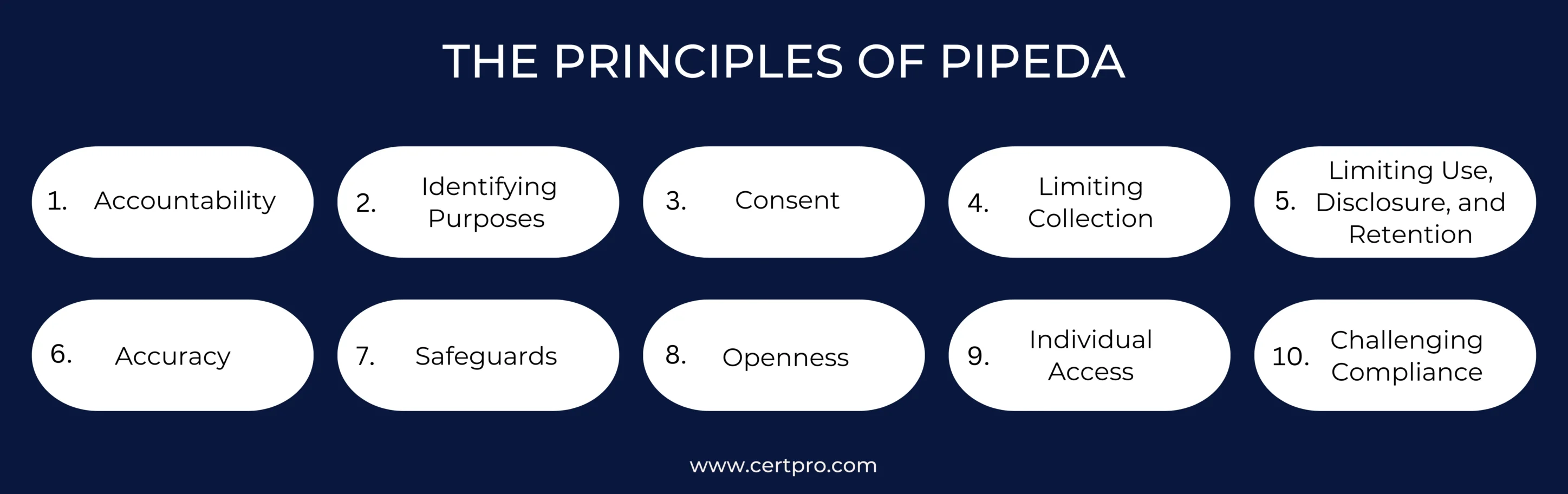
The fair information principles form PIPEDA’s foundation. The schedule contains ten principles that guide personal information protection and management.
- Accountability: Organizations are accountable for personal information. They must designate responsible individuals. Furthermore, this includes data sent to third-party vendors.
- Identifying Purposes: Organizations identify the reason for collecting personal information. They do this before or at the time of collection.
- Consent: Collecting, using, or disclosing personal information needs consent. However, this is unless consent is inappropriate.
- Limiting Collection: Organizations collect only necessary information. They use fair and lawful means for this.
- Limiting Use, Disclosure, and Retention: Information is used only for its original purpose, which requires individual consent or legal necessity. Additionally, organizations keep data only as long as necessary.
- Accuracy: Personal information must be accurate. It should also be complete and up-to-date.
- Safeguards: Organizations protect personal information. They use security measures suitable for data sensitivity.
- Openness: Organizations provide transparent information about data policies. They explain personal information management practices.
- Individual Access: Organizations provide information about data use and disclosure upon request. Individuals can access and challenge this information and request amendments if necessary.
- Challenging Compliance: Individuals can raise compliance concerns. They address these to the responsible individuals.
These principles ensure information is handled responsibly. They maintain trust and protect privacy.
PIPEDA: PRIVACY RIGHTS
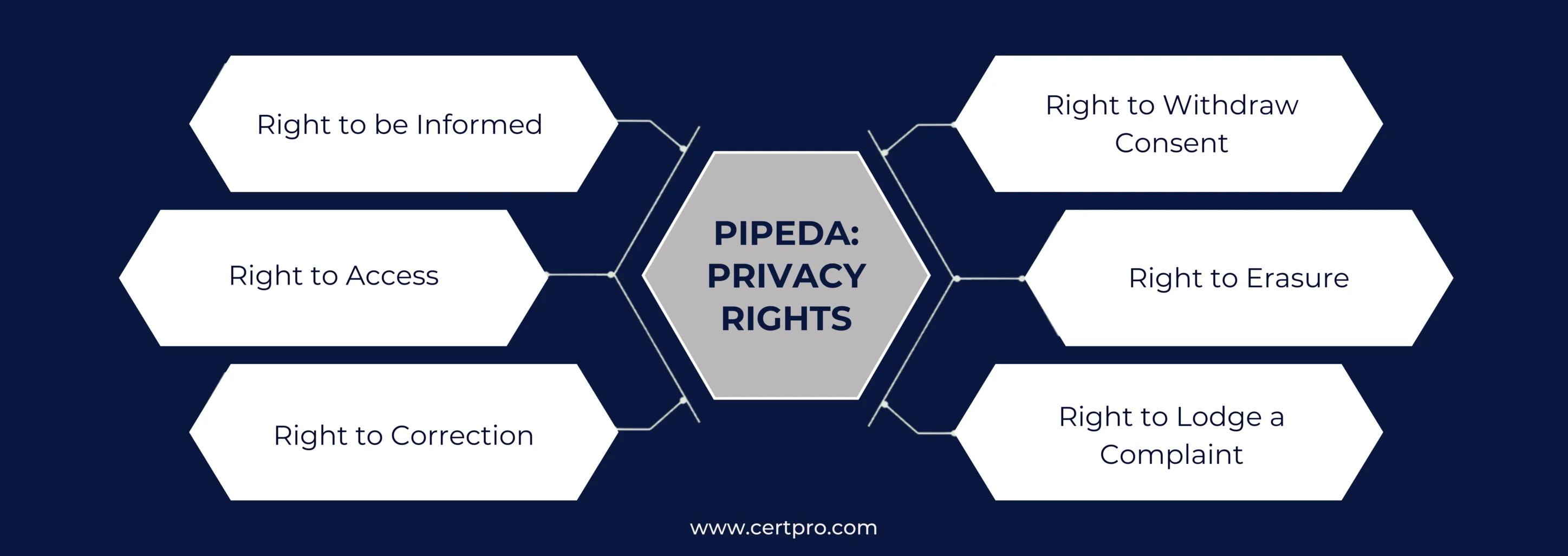
The privacy rights of individuals are essential in data protection. PIPEDA follows these rights closely. Therefore, here are some key points:
Right to be Informed: Organizations must inform people why they process their data. This can be done orally or in writing. PIPEDA does not explicitly call this the right to be informed.
Right to Access: People can access information on how their data is used. Organizations must respond within 30 days. The response should be free or at a minimal cost.
Right to Correction: People can ask organizations to fix wrong data. Corrections should also be sent to any third parties involved.
Right to Withdraw Consent: People can withdraw their consent at any time. However, organizations may keep data for as long as needed to fulfill their purpose.
Right to Erasure: The OPC says people can delete their online information. Some believe PIPEDA covers this under the right to withdraw consent.
Right to Lodge a Complaint: People who think an organization has violated PIPEDA can complain to the OPC.
Organizations under PIPEDA must include these rights in their privacy notices. They should explain how to use these rights and verify identity for requests.
HOW TO GET PIPEDA CERTIFICATION
As a company grows, following PIPEDA rules can get more complicated. Additionally, different regions may have their own laws. Therefore, businesses need to understand these local rules and improve their systems to stay on track. While it’s important to know the rules, companies also need to create clear systems for handling data that follow PIPEDA’s principles. This way, they can stay compliant now and in the future.
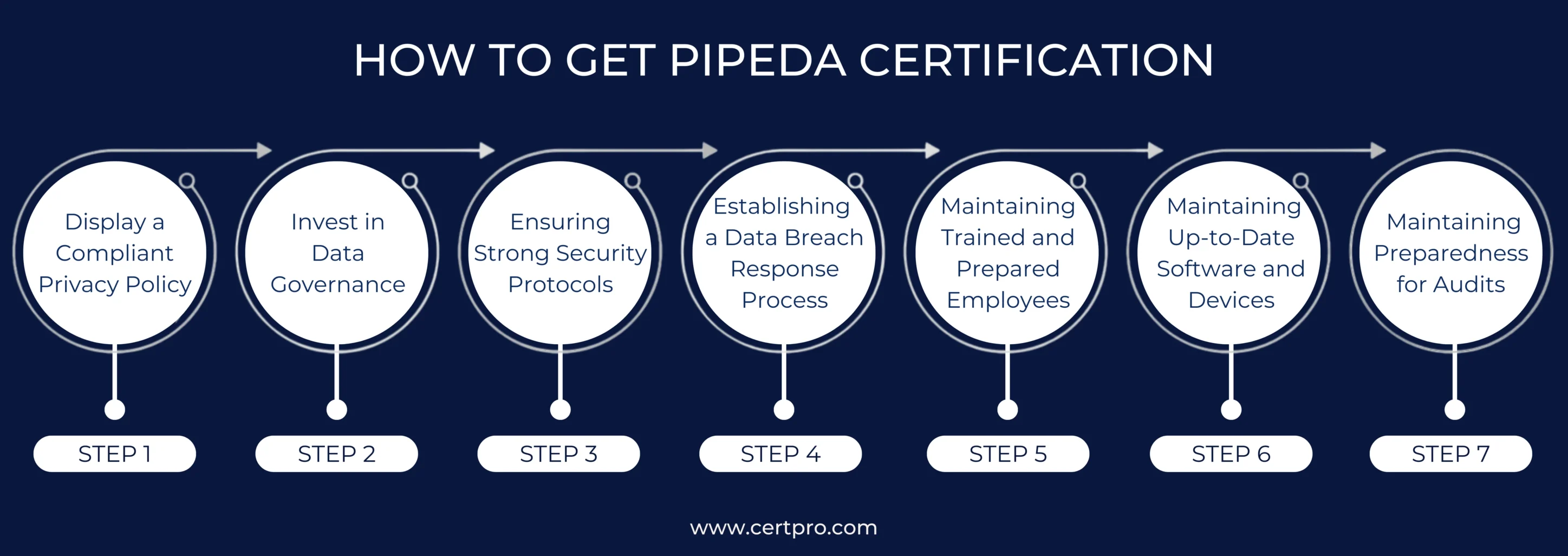
Here are some steps to follow PIPEDA rules:
Display a Compliant Privacy Policy: Make sure to display a privacy policy that follows the rules. This policy should clearly explain how user information is collected, used, and shared. It should also be easy to read, easy to access, and updated regularly.
Invest in Data Governance: Moreover, it’s important to invest in data governance to keep data private, accurate, and secure. Strong data governance helps prevent data breaches and keeps personal information safe.
Ensure Strong Security Protocols: Set up strong security measures. Regularly check and improve these protections to guard against data breaches. Be sure to use trusted security tools and services.
Establish a Data Breach Response Process: Create a clear plan for handling data breaches. This plan will help minimize damage and ensure quick action when needed.
Maintain Trained and Prepared Employees: It’s also essential to teach employees how to spot risks like phishing. Ensure they know how to protect personal information during transactions.
Maintain Up-to-Date Software and Devices: Update software and devices regularly. This helps prevent privacy problems and lowers security risks.
Maintaining Preparedness for Audits: Keep important information organized and ready for audits. Use tools to find, classify, and track sensitive data. This helps apply security measures and stay compliant.
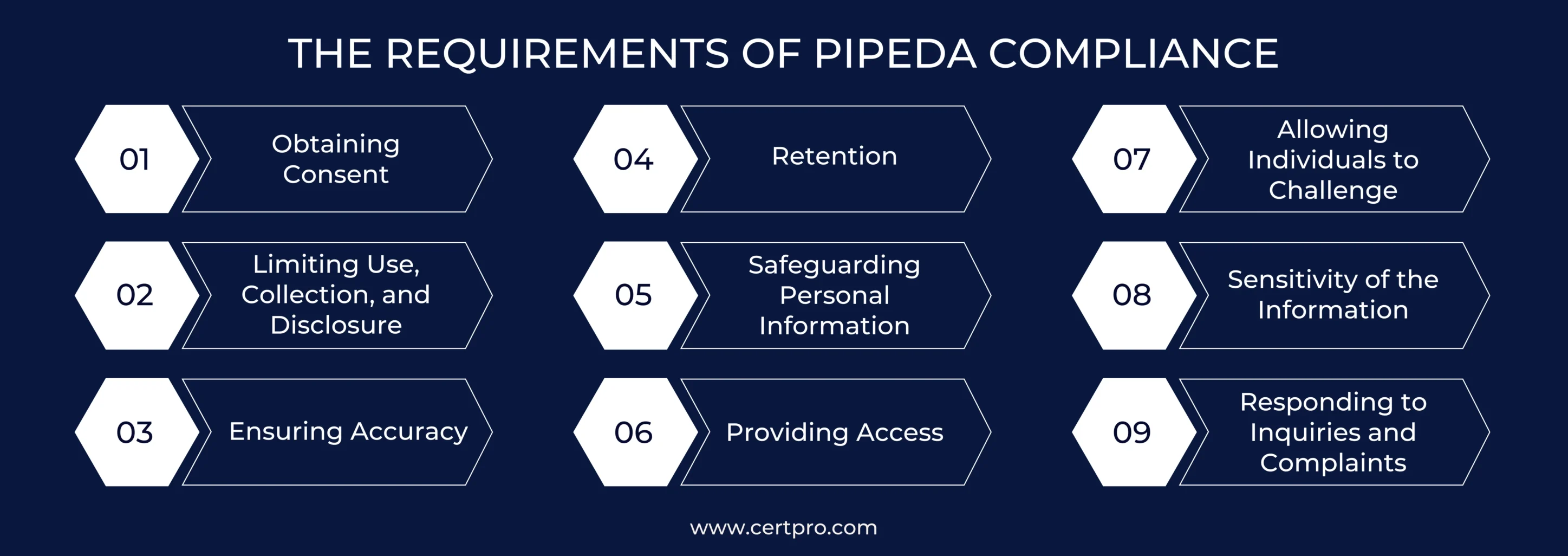
THE REQUIREMENTS OF PIPEDA COMPLIANCE
Under PIPEDA, organizations have rules for handling personal information. These PIPEDA requirements include:
Obtaining Consent: Organizations need explicit consent before using personal information. They must explain why they need it.
Limiting Use, Collection, and Disclosure: Organizations can only use personal info for specific reasons. If they want to use it differently, they need consent again.
Ensuring Accuracy: Organizations must keep personal info accurate and up to date.
Retention: They should only keep personal info for as long as needed.
Safeguarding Personal Information: Organizations must protect personal info from unauthorized access.
Providing Access: People can ask for their info and how it’s used.
Allowing Individuals to Challenge: People can question the accuracy of their info.
Sensitivity of the Information: Extra protection is needed for sensitive info, like health data.
Responding to Inquiries and Complaints: Organizations must handle privacy inquiries and complaints promptly and effectively.
Therefore, organizations must comply with these PIPEDA requirements. However, non-compliance can lead to penalties and harm to reputation. In severe cases, legal action can occur. Courts can enforce remedies for damage caused by unauthorized access to personal information.
BENEFITS OF PIPEDA COMPLIANCE
Following PIPEDA brings many benefits for organizations in Canada. Here are the main advantages:
Legal Compliance: Following PIPEDA helps organizations meet legal rules. This helps avoid fines and legal problems.
Customer Trust and Confidence: PIPEDA compliance shows that an organization cares about protecting personal information. This builds trust and confidence with customers.
Better Reputation: Being PIPEDA-compliant improves a company’s reputation. It shows a strong commitment to privacy and data protection. This can lead to more customers and good reviews.
Competitive Advantage: PIPEDA compliance gives a business an edge over others. Customers care about privacy and prefer businesses that follow the rules. Business partners also like working with compliant companies.
Risk Reduction: Being compliant reduces the risk of data breaches. It helps prevent unauthorized access and avoids financial losses and legal fines.
Improved Data Accuracy: PIPEDA requires accurate personal information. This ensures better decisions and improves customer service.
Clear Data Practices: PIPEDA emphasizes being clear about how data is used. This transparency helps customers trust the business and make informed choices.
International Data Transfers: Complying with PIPEDA helps share data across borders. This is good for international business partnerships.
Employee Privacy: PIPEDA also protects employee information. This shows the company’s commitment to privacy.
Overall, following PIPEDA brings many benefits. It helps with legal issues, builds trust, and improves how data is handled.
ELIGIBILITY FOR PIPEDA COMPLIANCE
Organizations must meet certain rules to follow PIPEDA. PIPEDA applies to businesses that collect, use, or share personal information for commercial reasons. This also includes foreign businesses that handle personal information from Canadian citizens for commercial purposes.
However, some organizations do not need to follow PIPEDA. These include federal government entities listed under the Privacy Act, provincial and territorial governments, not-for-profit groups, political parties, charities, hospitals, schools, universities, and local governments. Also, the rules may change depending on where the personal data is processed. Some provinces have their own privacy laws that may allow businesses to skip PIPEDA rules. It’s important for organizations to understand these rules so they can figure out if they need to follow PIPEDA.
THE COST OF PIPEDA COMPLIANCE
The cost of PIPEDA compliance can vary. It depends on things like how large the firm is, what tools the business uses, and the technology platforms in place. It also depends on the locations and any extra services needed. So, PIPEDA compliance costs can cover a lot of things, such as audits, creating privacy policies, improving data security, training staff, and setting up systems to handle complaints.
Additionally, businesses might need to pay for encryption technology, ways to handle data breaches, and systems to keep data safe. Sometimes, companies may have to hire lawyers or privacy experts to make sure they follow the rules. The cost of PIPEDA compliance is different for each business because every company has its own needs. It is customized to fit their situation and the steps required to meet the legal requirements.
CERTPRO’S SUPPORT IN ACHIEVING PIPEDA COMPLIANCE FOR YOUR BUSINESS
CertPro helps your business follow PIPEDA rules to protect personal information. We offer full auditing and consulting services. Our experienced team looks at your privacy practices, finds any gaps, and helps you fix them. This means we help create and apply privacy policies, procedures, and controls. We also do privacy impact assessments.
In addition, CertPro provides training for your staff to make sure they understand and follow privacy rules. Working with CertPro helps protect personal information, makes things more transparent, and shows that you follow the rules. Our services help you manage PIPEDA’s details, build trust with your customers, and meet privacy standards. Furthermore, CertPro keeps your business up to date with the latest PIPEDA rules and best practices. This ongoing support ensures your business stays in line with any changes to the rules.
FAQ’s
WHAT IS THE ROLE OF CONSENT UNDER PIPEDA?
HOW DOES PIPEDA DEFINE PERSONAL INFORMATION?
WHAT ARE THE CONSEQUENCES OF NON-COMPLIANCE WITH PIPEDA?
ARE THERE ANY EXEMPTIONS OR EXCEPTIONS UNDER PIPEDA?
DOES PIPEDA HAVE AN EXPIRATION DATE?

GRC IN CYBERSECURITY: WHAT IT MEANS AND WHY IT MATTERS IN 2026
In 2026, the pressure on companies to manage cyber risk responsibly has never been greater. Regulators demand structured controls, boards want clear risk reporting, and threat actors are becoming more sophisticated. Against this backdrop, GRC in cybersecurity has...

HOW COMPLIANCE AUDIT SOFTWARE IMPROVES AUDIT READINESS
Today, most companies deal with a growing number of compliance regulations. From data privacy standards to security frameworks like SOC 2 and ISO 27001, the list of compliance obligations keeps expanding. At the same time, regulators and external auditors now expect...

Compliance Best Practices in 2026: How to stay ahead of regulatory changes
Why is the implementation of compliance best practices critical for 2026? Compliance in 2026 demands operational proof, not the documentation intent. Regulations change faster, audit scrutiny is higher, and reporting timelines are tighter across privacy,...