
We are living in the age of AI revolution. Yes, nowadays AI impacts everything from healthcare to transportation to high-value business decisions. For businesses, AI tools are capable of delivering faster operations, smarter insights, and happier customers. But the uncomfortable truth is, are all businesses capable of ensuring responsible AI? Because unchecked AI can do real damage. It can discriminate without valid reasons, leak sensitive data, or make decisions that nobody can explain. This is where trust disappears, customers walk away, and regulators step in.
That’s why responsibility matters just as much as innovation. Responsible AI is a practical approach to building and using AI systems in a way that’s fair, transparent, and accountable. It’s about making sure your AI systems respect privacy, avoid bias, stay secure, and work for people. In simple terms, it’s AI that businesses can trust, defend, and scale with. Why is responsible AI governance important now? Customers wanted to know how safe your AI tools are and the AI policy that you follow to manage them ethically. Similarly, the global regulators are drafting strict laws like the EU AI Act and the NIST AI Risk Management Framework. Additionally, even global business giants are struggling with AI risks.
Furthermore, companies that take Responsible AI seriously avoid risks and gain a competitive edge. Responsible AI is about making sure that your innovative progress doesn’t backfire. So, if you’re betting on AI tools and systems to drive growth, you need to ensure responsible use of AI , too. Let’s learn what is responsible AI and why it is essential nowadays for business growth and success.

WHAT IS RESPONSIBLE AI? A BASIC UNDERSTANDING
WHY RESPONSIBLE AI MATTERS FOR BUSINESSES
KEY STEPS FOR BUSINESSES TO ENSURE RESPONSIBLE AI DEVELOPMENT
IMPORTANCE OF RESPONSIBLE AI: KEY BENEFITS
HOW DOES ISO 42001 HELP ENSURE RESPONSIBLE AI PRACTICES?
Tl; DR:
Concern: AI drives business growth, but unchecked AI brings serious risks like bias, data breaches, and compliance penalties. Additionally, the customers and regulators now demand transparency, fairness, and accountability in AI systems. That’s why responsible AI matters. It ensures your AI is ethical, secure, and aligned with global legal standards like the EU AI Act.
Overview: To achieve this, businesses must build governance models, perform risk assessments, ensure data integrity, and maintain transparency. Adopting ISO 42001, the first international AI management standard, makes this process structured and credible. It aligns AI operations with ethical principles and compliance requirements while reducing risks and improving trust.
Solution: Partner with CertPro, a trusted expert in ISO 42001 assessment and certification. We help startups and enterprises build responsible AI systems that are fair, accountable, and future-ready. Acting now prevents costly penalties, reputation loss, and operational chaos. Don’t wait. Secure your AI strategy today with CertPro.
WHAT IS RESPONSIBLE AI? A BASIC UNDERSTANDING
Responsible AI is the practice of using AI tools in a safe, ethical, and trustworthy manner. Furthermore, these RAI principles underscore the need for human oversight and overall societal well-being. It is about making sure that your AI models, datasets, and applications are developed and deployed ethically and legally without causing any harm or biases. Additionally, misusing AI could lead to security and ethical issues that could harm the user, the data subjects, and society as a whole. Responsible use of AI is built upon a few core RAI principles. Businesses building or using AI systems must ensure that their AI tools follow these principles. They include
- Fairness ensures AI treats everyone equally, avoiding biased decisions in the hiring process or lending credits.
- Transparency means businesses explain how AI works instead of hiding behind “black boxes.
- Accountability is about holding someone accountable when AI tools make a mistake.
- Privacy protects sensitive data from misuse
- Reliability guarantees systems work as intended under real-world conditions.
- Security keeps AI tools safe from cyberattacks
- Finally, inclusiveness makes AI accessible and beneficial to all, not just a select few.
The global regulators and international bodies are already drawing alongside this AI revolution to regulate it. For example, the EU AI Act sets strict rules for high-risk AI applications, such as facial recognition or healthcare. Businesses ignoring these rules and disregarding AI responsibility will risk massive fines, lawsuits, and reputational damage. At the same time, tech giants like Microsoft and Google have published their AI ethics frameworks. These set expectations for vendors, partners, and even customers about the responsible use of AI. Innovation is not the real challenge for businesses here; rather, it is about ensuring responsible innovation. And that starts with embedding ethics into every AI decision.
WHY RESPONSIBLE AI MATTERS FOR BUSINESSES
Responsible AI is the difference between trust and doubt in today’s digital world. Customers, investors, and regulators expect businesses to use AI ethically. For instance, consider an algorithm that discriminates or leaks private data. Consequently, headlines will explode, users will walk away, and regulators will step in. No business desires to become that case study. To add on, the legal pressure from international bodies is obvious, too. The EU AI Act, liability directives, and new digital services rules are reshaping compliance. These aren’t light suggestions; instead, they’re enforceable, with fines that can cripple growth. Moreover, companies that cling to the mindset of “we’ll handle it later” often end up paying twice in the form of penalties and lost reputation.
Then there’s the hidden risk called operational chaos. Issues such as AI bias, hallucinated outputs, or security gaps could harm your users and disrupt the entire system. For instance, consider that if your chatbot gives harmful advice or your model misclassifies data, then the process of fixing it could be both expensive and exhaustive. On the other hand, promoting responsible use of AI is a competitive advantage now. Customers reward your fairness, and investors will value your AI governance model. Additionally, the public notices transparency and openness. Businesses that foster AI responsibility build resilience, attract loyalty, and earn long-term credibility.
KEY STEPS FOR BUSINESSES TO ENSURE RESPONSIBLE AI DEVELOPMENT
Responsible AI development is a continuous commitment that requires a structured process. Some of the critical steps involved in building responsible AI governance are explained below.
Build an AI Governance Model:
Consider implementing an AI management system to ensure that policy is effectively put into practice. ISO/IEC 42001 sets clear requirements for policies, objectives, roles, and continual improvement. Accordingly, name your owners (product, legal, security) and define decision rights before a model is deployed.
Conduct Risk and Impact Assessments:
Use the NIST AI RMF to map use cases, measure impacts, and manage controls across the AI lifecycle. Furthermore, use AI risk assessment tools to identify problems early. Review them regularly to prevent the small issues from escalating into full-blown security incidents.
Ensure Data Integrity:
Set responsible AI policies for data lineage, retention, consent, and access. Test your training data sets for representativeness and the answers for label quality. The EU AI Act expects governance of training, validation, and test sets. It would be beneficial to start building that evidence now.
Build Transparency and Fairness:
Prefer interpretable AI models where stakes are high. Add XAI only when you must. Keep technical documentation updated so you can explain what influenced an output and why. This paperwork is your defense in audits and incidents.
Integrate Human Oversight:
Allocation of trained reviewers with the authority to pause deployment and invalidate biased outputs in credit, hiring, health, or safety contexts. To add on, the EU AI Act makes human oversight a deployer’s duty.
Perform Continuous Monitoring:
Continuously monitor for drifts, errors, bias metrics, and abuse patterns. Furthermore, set thresholds that trigger rollback and retraining. Consider logging every decision and outcome; review them regularly.
Training and Awareness:
Train teams on bias, privacy, security, and incident response. Make “stop the model” a celebrated move when evidence reports harm. This process builds a foundation for responsible use of AI.
IMPORTANCE OF RESPONSIBLE AI: KEY BENEFITS
Responsible AI changes how people experience your products and how regulators treat your business. When executed effectively, it accomplishes more than simply avoiding problems. To clarify, it shapes trust and fairness and provides real commercial value.
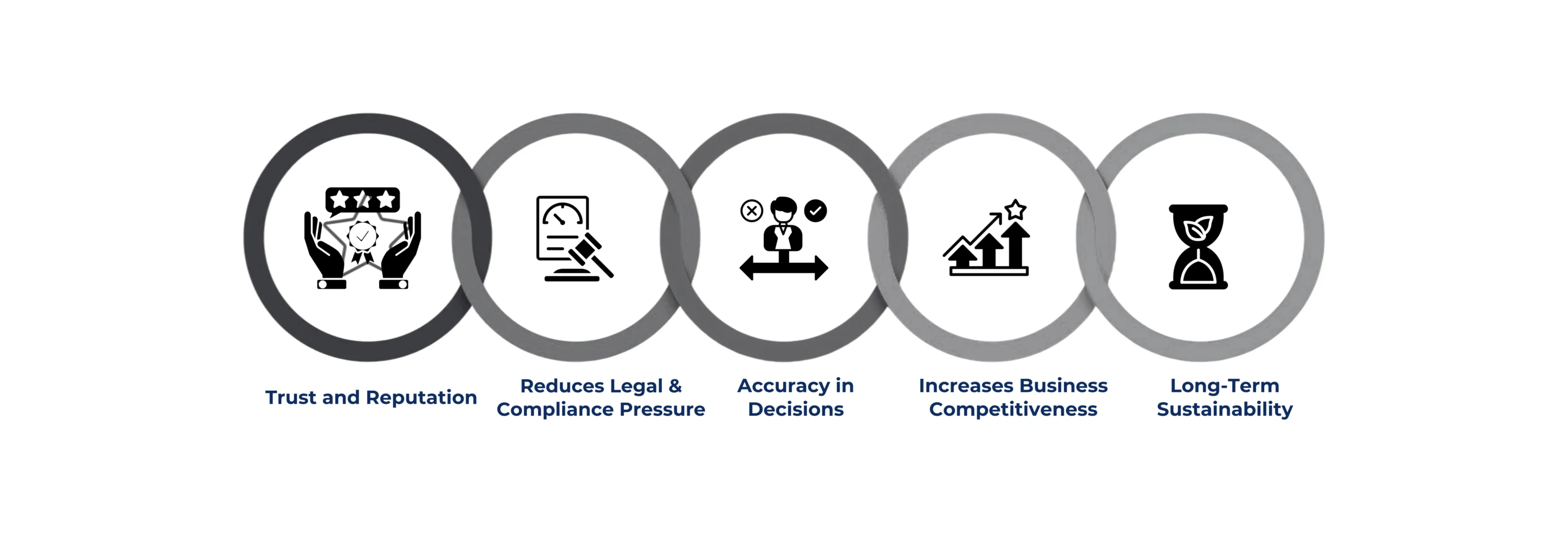
Trust and Reputation: People notice when your systems act unfairly. A visible failure can spread fast and destroy your reputation. For instance, consider the backlash companies face when algorithms discriminate or make harmful decisions. It only takes one viral story to damage a brand. Responsible AI protects you from that.
Reduces Legal and Compliance Pressure: AI regulations and frameworks are already active in places that matter. For example, the EU’s AI Act sets clear standards for risky systems. Therefore, preparing now reduces sudden legal shocks and heavy fines.
Accuracy in Decisions: Bias in training datasets produces biased outcomes. High-profile cases, like a recruitment tool and a criminal-risk model, show how bias harms people and business credibility. Hence, fixing bias with responsible AI practices provides you with more accurate, defensible decisions.
Increases Business Competitiveness: Teams that can explain and defend their AI systems progress faster and scale better in the market. Plus, the firms that document AI governance and show ethical AI practices win trust from partners and customers.
Long-Term Sustainability: Responsible AI aligns with ESG goals, showing your commitment to people and the planet. Plus, it future-proofs your business against new regulations and rising public expectations.
HOW DOES ISO 42001 HELP ENSURE RESPONSIBLE AI PRACTICES?
ISO 42001 is the first international standard for AI management systems. It is designed to help businesses deploy AI in a safe, ethical, and transparent way. Here’s how it brings real value to businesses with AI responsibility:
Aligns AI with Governance and Compliance: ISO 42001 sets up a clear governance framework. It defines roles, responsibilities, and processes for responsible AI oversight. This means your organization can meet global regulations, like the EU AI Act, with ease.
Emphasizes Risk and Impact Assessment: AI tools do make mistakes in the form of biased decisions, data misuse, and security gaps. To tackle this, ISO 42001 makes you identify these risks early. For example, if your hiring AI shows bias, the standard helps you in identifying and correcting it.
Promotes Transparency and Documentation: Teams must be able to explain why and how AI made a decision. According to ISO 42001, responsible AI principles must be promoted through transparent reporting and documentation. Such documentation improves explainability, making it easier to justify AI outputs to stakeholders, regulators, or even customers.
Drives Continuous Improvement: AI is constantly evolving, and it’s a continuous learning model. To elaborate, the AI models could drift over time, and the data might change frequently. Hence, responsible AI compliance with ISO 42001 guides you to audit and update AI regularly.
Integrates with Responsible AI Principles: This global AI standard reinforces fairness, accountability, and inclusiveness. Moreover, it helps build trust, protect your reputation, and support sustainability goals by reinforcing responsible AI governance.
Thus, ISO 42001 is your roadmap for responsible AI and assists businesses in leading with confidence in the AI era.
PARTNER WITH CERTPRO TO BUILD RESPONSIBLE AI GOVERNANCE
Every business using AI faces real risks in the form of biased decisions, data misuse, regulatory fines, and reputational damage. Therefore, delaying swift action could lead and penalties, loss of stakeholders’ trust, stalled growth, and missed market opportunities.
This is where CertPro shines as your strategic partner in helping you understand what is responsible AI. With deep expertise in ISO 42001 assessment and certification, CertPro helps you build a responsible AI management system that is safe, ethical, and transparent. From mapping risks and auditing processes to ensuring compliance with global regulations, CertPro guides businesses every step of the way. We tailored our services to cater to the needs of both early-stage startups and established enterprises. By partnering with CertPro, you are positioning your brand as a leader in responsible AI, boosting credibility with investors, customers, and partners. So, the earlier you act, the faster you secure trust, minimize risk, and scale your AI initiatives confidently.
Ready to lead responsibly with AI? Connect with CertPro today for a comprehensive ISO 42001 assessment and certification plan. Protect your business, build trust, and turn responsible AI into a competitive advantage.
FAQ
What are responsible AI principles?
Responsible AI is built on fairness, transparency, accountability, privacy, reliability, security, and inclusiveness. These principles ensure ethical AI decisions, protect users, and align AI systems with business values and regulatory compliance.
How can businesses implement Responsible AI effectively?
Businesses can implement Responsible AI by building governance models, conducting risk assessments, ensuring data integrity, promoting transparency, integrating human oversight, monitoring continuously, and training teams to manage AI ethically and safely.
What risks do businesses face without Responsible AI?
Without Responsible AI, businesses face problems like unfair decisions, misuse of data, fines from regulations, damage to their reputation, failures in operations, and losing customer trust, which can result in legal penalties, financial losses, and a weaker position in business markets.
Can startups benefit from ISO 42001 Responsible AI certification?
Yes, startups gain credibility, attract investors, minimize regulatory risks, and demonstrate ethical AI practices. ISO 42001 certification provides a structured framework to implement responsible AI even with limited resources.
How does CertPro help businesses achieve Responsible AI compliance?
CertPro offers ISO 42001 assessment and certification, documentation review, and compliance guidance. It helps startups and enterprises build safe, ethical, and transparent AI systems, strengthening trust, mitigating risks, and scaling AI initiatives confidently.

About the Author
Abhijith Rajesh
Abhijith Rajesh is an Associate Manager at CertPro, specializing in ISO 27001, SOC2, GDPR, and other Information Security Compliance standards. He leads a dedicated team, ensuring the delivery of top-tier information security solutions. Abhijith excels in managing projects, optimizing security frameworks, and guiding clients through the complexities of the ever-evolving threat landscape.

GRC IN CYBERSECURITY: WHAT IT MEANS AND WHY IT MATTERS IN 2026
In 2026, the pressure on companies to manage cyber risk responsibly has never been greater. Regulators demand structured controls, boards want clear risk reporting, and threat actors are becoming more sophisticated. Against this backdrop, GRC in cybersecurity has...

HOW COMPLIANCE AUDIT SOFTWARE IMPROVES AUDIT READINESS
Today, most companies deal with a growing number of compliance regulations. From data privacy standards to security frameworks like SOC 2 and ISO 27001, the list of compliance obligations keeps expanding. At the same time, regulators and external auditors now expect...

Compliance Best Practices in 2026: How to stay ahead of regulatory changes
Why is the implementation of compliance best practices critical for 2026? Compliance in 2026 demands operational proof, not the documentation intent. Regulations change faster, audit scrutiny is higher, and reporting timelines are tighter across privacy,...