

WHY RISK QUANTIFICATION MATTERS FOR SECURITY, COMPLIANCE, AND BOARD DECISIONS

Today, most companies deal with a complex security environment. Cloud tools, third-party vendors, and strict rules all add to their risk exposure. At the same time, boards and senior leaders need a clearer view of how those risks are being handled.
Most traditional risk reviews use labels like “high,” “medium,” or “low.” While these labels help sort risks, they rarely give leaders enough detail to act on. For this reason, business leaders need to know the real cost of a security event before they can plan or spend wisely.
Risk quantification fills this gap. It puts numbers at risk by looking at the chance of an event, the likely loss, and how well controls are working. Consequently, security teams can share risk data in terms that boards and executives can act on. For companies seeking stronger security and compliance, this approach has become a key part of governance.

Tl; DR:
Concern: Traditional risk assessments often describe threats in subjective terms that executives and board members find difficult to interpret. Additionally, as cyber threats grow and regulatory expectations increase, organizations increasingly need clearer ways to understand risk exposure. They also need to justify security investments, and prioritize compliance and control activities.
Overview: Risk quantification converts cybersecurity and operational risks into measurable values rather than relying solely on qualitative labels such as high or medium. By estimating both probability and financial impact, organizations gain clearer visibility into risk exposure. In turn, teams can align security, compliance, and governance discussions around measurable evidence.
Solution: Risk quantification translates technical risk scenarios into financial and operational estimates. As a result, this approach allows security teams to communicate risk in business terms, support compliance oversight, and assist boards in evaluating decisions with measurable data rather than subjective assessments.
WHAT IS RISK QUANTIFICATION IN CYBERSECURITY?
Risk quantification is the process of measuring risk using numbers. Instead of labeling a threat high or low, companies estimate how likely it is and how much damage it could cause. In cybersecurity, this means looking at threat likelihood, system weaknesses, control strength, and financial impact.
When combined, these factors allow you to estimate the likely cost of a cyber event. For example, a data breach could lead to fines, lost revenue, legal fees, and damage to your brand. Ultimately, this process produces a financial loss range. It helps teams compare threats and choose where to invest for the most impact.
How Is Risk Quantified in Practice?
The process uses structured analysis of threats and their business impact. Methods vary by organization. However, most follow a clear path that starts with listing threats and ends with estimating financial exposure.
Key Components Used in Risk Quantification
| Component | Description | Example |
|---|---|---|
| Likelihood | Probability that a given threat will occur within a set timeframe. | A misconfigured cloud access could occur once per year. |
| Impact | Potential financial, operational, or reputational loss from an incident. | Potential loss from downtime, fines, and brand damage. |
| Control Strength | Effectiveness of current security measures in reducing risk. | Multi-factor authentication reduces unauthorized access. |
| Data Inputs | Historical incidents, industry data, and expert input to improve estimates. | Previous breach data and vendor risk assessments. |
Quantitative Models Used to Measure Cyber Risk
In many cases, companies use structured models to guide their review. Commonly used methods include chance-based modelling, scenario review, and financial loss estimation. These models create a standard way to compare risks across different threat types. In doing so, they turn technical findings into financial data, which helps leadership set spending priorities.
For instance, a fintech company with 350 employees operating across multiple digital payment platforms can review access logs, vendor records, and existing security controls. From this analysis, the result allows the organization to estimate the likelihood and potential cost of a data breach. The team can address a misconfigured access control first if the review indicates that it could lead to significant regulatory penalties and operational downtime. Thus, structured analysis transforms technical vulnerabilities into clear business priorities.
Translating Technical Risk Into Financial Impact
Typically, security teams often work with technical data like threat logs and weakness scores. However, executives think in terms of cost and business risk. Cyber risk quantification bridges this gap. It turns technical findings into financial loss estimates. Security leaders can speak the same language as the board. This, in turn, helps leadership set priorities and manage budgets with more confidence.
WHY RISK QUANTIFICATION MATTERS FOR MODERN SECURITY PROGRAMS
Security teams rarely have unlimited budgets, yet new threats constantly emerge across cloud environments, third-party vendors, and internal systems. Against this backdrop, risk quantification helps organizations make informed decisions by identifying threats with the highest financial or operational risk.
With this visibility, leaders can clearly see the potential impact of each threat, and therefore, they can focus resources on areas that matter most. Likewise, risk quantification also enables better collaboration between security teams and executives. Instead of merely relying on abstract threat descriptions, teams can share numbers and financial estimates that support strategic decision-making.
For instance, a SaaS company managing 200 employees across multiple cloud platforms can analyze access logs, vendor assessments, and current controls to calculate the likelihood and financial impact of a potential data breach. If the analysis shows that a misconfigured access control could result in a large amount of loss due to fines, downtime, and reputational damage, the team can prioritize remediation of this high-risk configuration first.
Over time, applying risk quantification regularly strengthens the maturity of security programs. Teams can demonstrate the effectiveness of controls, track risk reduction progress, and clearly communicate the value of security investments. This approach transforms risk discussions from subjective assessments to measurable, actionable business insights, supporting operational efficiency and strategic planning.
KEY BENEFITS OF CYBER RISK QUANTIFICATION
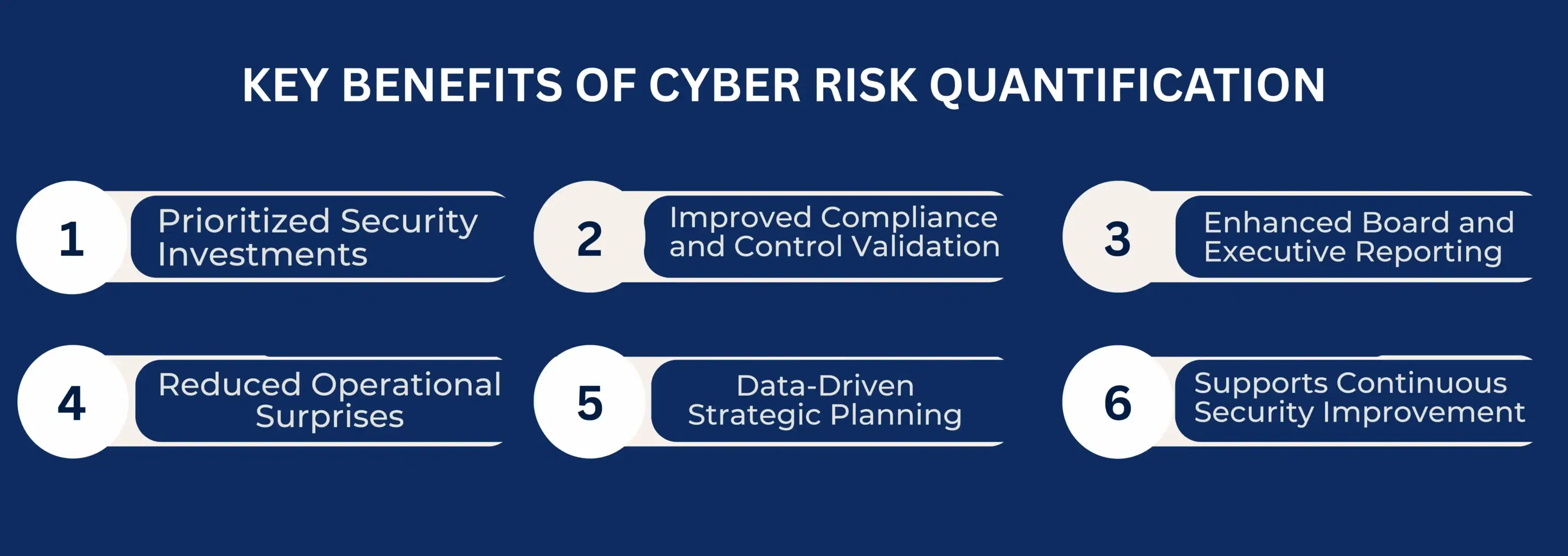
Implementing cyber risk quantification provides organizations with measurable insights that go beyond subjective risk labels. These benefits enhance security, compliance, and strategic decision-making:
Prioritized Security Investments: Quantified risk data allows ranking threats based on their potential financial and operational impact. Leadership can focus resources on the areas posing the greatest risk, rather than reacting to every vulnerability.
Improved Compliance and Control Validation: By translating technical controls into measurable outcomes, organizations can demonstrate their effectiveness during audits and risk control certification reviews. Quantified data provides structured evidence that controls reduce exposure, thereby supporting regulatory compliance and internal governance processes.
Enhanced Board and Executive Reporting: Cyber risk quantified in financial terms bridges the gap between technical security metrics and business decision-making. Boards and executives can understand the potential costs of incidents and, in turn, make informed decisions about risk acceptance and resource allocation.
Reduced Operational Surprises: Regular risk quantification helps teams detect trends and emerging threats early. As such, this proactive approach minimizes surprises during audits or security incidents and strengthens overall operational resilience.
Data-Driven Strategic Planning: Quantified risk insights guide long-term security and business planning. In addition to this, organizations can assess trade-offs between security investments and potential losses, align controls with organizational priorities, and track progress over time with measurable metrics.
Supports Continuous Security Improvement: By monitoring quantified risks continuously, organizations can validate whether implemented controls are effective. This ongoing feedback loop drives stronger risk management practices and builds a more mature, resilient security program.
THE ROLE OF RISK QUANTIFICATION IN COMPLIANCE AND RISK CONTROL CERTIFICATION
Compliance programs require proof that security controls are in place and working. Here, risk quantification provides clear, documented evidence of threat management. Organizations undergoing independent audits, including those by CPA firms registered with the AICPA, often rely on structured risk analysis to support control testing.
How Quantified Risk Supports Regulatory Compliance
Many rules and regulations require companies to assess and record their security risks. Structured risk reviews give a clear, repeatable way to do this. Specifically, they show how likely a threat is and how well current controls address it. This evidence can then be used in audits, governance reviews, and third-party checks.
Internal Control Validation and Measurement
Organizations put security controls in place to reduce risk. However, knowing if those controls work takes more than guesswork. For instance, better access controls or improved monitoring tools may reduce the chance of a breach. Quantitative analysis can measure exactly how much risk they reduce. This kind of proof is especially useful during risk control certification reviews that check the design and day-to-day use of controls.
Aligning Security Controls With Compliance Requirements
Most compliance rules expect companies to match their controls to their biggest risks. When you know which threats are most costly, you can focus control efforts in the right places. Such knowledge also strengthens audit readiness. Auditors want to see that control choices were based on real data, not just general policy.
WHY BOARDS AND EXECUTIVES NEED QUANTIFIED CYBER RISK DATA
Boards and executives are responsible for managing risk across the whole organization. However, most security reports are full of technical terms that are hard to act on. Quantified data changes this. It shifts the focus from vulnerability counts to business impact. This approach makes it much easier for leaders to understand what is at stake.
Improving Board-Level Decision Making
Boards have to divide resources across many priorities. Quantified risk data helps them see where security spending will do the most good. Rather than approving a budget based on general worry, boards can review financial exposure figures. Then they can judge whether proposed security investments are worth the cost.
Communicating Cyber Risk in Business Terms
Risk quantification turns cyber threats into the financial language that executives already use. This makes it easier to weigh security trade-offs against other business needs. Additionally, it removes the communication barrier between security teams and the boardroom. Leaders can engage with the data directly and make faster, better-informed decisions.
Supporting Strategic Security Investments
Organizations always face choices about where to invest in security. Quantified analysis helps leaders pick the options most likely to cut financial losses. As a result, security budgets become easier to justify and defend. Over time, organizations that use this approach build stronger links between their security work and their business goals.
COMMON CHALLENGES IN IMPLEMENTING RISK QUANTIFICATION
While risk quantification offers significant benefits, organizations often face practical obstacles when trying to implement it effectively. Understanding these common challenges can help teams plan, prioritize, and overcome barriers to make data-driven risk decisions.
Data Availability: High-quality data is often difficult to obtain. Estimating threat likelihood and financial impact requires access to past incident records, structured analysis, and consistent processes. Many organizations are still developing these capabilities.
Workflow Integration: Teams may lack established workflows to incorporate quantified risk insights into planning and decision-making. Without these processes, valuable analysis can remain underutilized.
Cross-Functional Collaboration: Effective risk quantification requires input from security, finance, risk management, and leadership teams. Building this kind of cross-team coordination takes time and sustained effort.
Adoption Challenges: Despite the hurdles, organizations are increasingly recognizing the benefits of quantified risk analysis and investing in the tools, processes, and expertise needed to implement it effectively.
CONCLUSION
Cyber threats continue to evolve as organizations adopt new technologies, rely on cloud platforms, and expand their digital footprint. This increasing complexity makes it difficult for leaders to understand the true potential impact of security incidents.
Risk quantification addresses this by measuring both the likelihood and financial consequences of cyber threats, providing concrete, data-driven insights. By translating technical vulnerabilities into measurable business risks, organizations can prioritize mitigation efforts, allocate resources efficiently, and strengthen overall security posture.
These insights not only enhance security programs but also support regulatory compliance and risk control certification by producing structured, auditable evidence. Boards and executives benefit from a clear, quantified view of exposure, enabling more informed decision-making and strategic planning. Over time, this approach fosters a transparent, resilient, and continuously improving security program aligned with broader business objectives.
FAQ
What is cyber risk quantification?
Cyber risk quantification measures cybersecurity threats using numbers. It estimates how likely an incident is and what it could cost. This enables companies to concentrate on the most significant risks and allocate resources accordingly.
How is risk quantified in cybersecurity?
It involves looking at the chance of a threat and the financial or business impact it could cause. Companies also factor in how well their current controls reduce that risk. Together, these inputs produce actionable risk scores that guide security decisions.
Why does risk quantification matter for organizations?
It puts real numbers behind security risks. This helps teams set priorities, make the case for spending, and share clear data with executives and boards. It also reduces guesswork and builds confidence in both strategic and day-to-day planning.
How does risk quantification support compliance programs?
It creates clear, structured evidence that controls are working. This supports audits, compliance reviews, and internal governance work. Additionally, it demonstrates to regulators the execution of due diligence and fortifies audit preparedness.
Do boards benefit from quantified cyber risk data?
SOC 2 is not a statutory requirement for most private companies. It is an independent assurance report under AICPA standards. However, many enterprise and regulated customers require SOC 2 Type II in contracts or vendor onboarding. In practice, it often becomes a commercial requirement for enterprise sales.
WHAT IS RISK QUANTIFICATION IN CYBERSECURITY?
WHY RISK QUANTIFICATION MATTERS FOR MODERN SECURITY PROGRAMS?
KEY BENEFITS OF CYBER RISK QUANTIFICATION
THE ROLE OF RISK QUANTIFICATION IN COMPLIANCE AND RISK CONTROL CERTIFICATION
WHY BOARDS AND EXECUTIVES NEED QUANTIFIED CYBER RISK DATA
HOW SOC 2 COMPLIANCE SOFTWARE CHANGES AUDIT READINESS
There's a version of SOC 2 preparation that most security teams know too well. The audit date is approaching. Someone sends a spreadsheet asking for access logs, vendor assessments, and approval records. People scramble. Documentation gaps appear. What should take...

HOW SOC 2 TYPE II CERTIFICATION IMPACTS CUSTOMER CONFIDENCE AND DATA SECURITY
Enterprise buyers changed how they evaluate vendors. They no longer trust self-reported security claims. Instead, vendor risk management became a top priority. Consequently, procurement teams demand independent proof. They need verification that vendors protect their...
SOC 1 VS SOC 2: WHICH REPORT YOUR CUSTOMERS ACTUALLY ASK FOR
If you sell SaaS or provide outsourced services, you have likely been asked for a SOC report. However, the follow-up question is rarely easy to answer: do they mean SOC 1 or SOC 2? Both reports fall under the AICPA’s System and Organization Controls (SOC) reporting...