
These days, businesses mostly talk about security and safety. Because cyber threats are becoming more common, companies must ensure security and follow the rules. Even though we used to talk about these two ideas together, they are not the same. To sum up, security quickly keeps out people who want to break in. Conversely, compliance means following the rules that protect your business and make it look better. So they can work together to create a strong partnership that speeds up business growth.
People often wonder why the standards are the same when security and compliance are different. To find out more about security vs. regulations, read the piece. After that, you’ll know how the two processes are alike and different.

UNDERSTANDING THE CONCEPT OF SECURITY
Security includes all your organization’s essential moves to defend against cyber threats. Therefore, simple security measures cannot protect your company against the risks. You must execute hardware and software security controls to prevent cyber attacks. In this regard, you can consider firewalls with multi-factor authentication to prevent unauthorized access. Cybersecurity provides a shield to your organization against cyber threats. Let’s discuss some common categories for security tools:
IT Infrastructure: This category includes all your organization’s computing systems. It protects the internet connection, firewalls, servers, data centers, and cloud computing systems. Software components secure operating systems, antivirus, and antimalware. Thus, security measures secure your data and prevent cyber threats.
Network Access: It is the most significant part of your organization from which attackers can infiltrate your systems. Therefore, strong passwords to firewalls and strategic restrictions in the company’s network can prevent risks. In this regard, Identity Access Management (IAM) tools ensure network security.
Authentication: Security starts with the authentication process, which provides an extra protection layer. Hence, two-factor authentication or multi-factor authentication can support this security measure. It prevents unauthorized access to secure servers, which is essential for security.
User Training: Human errors play a crucial role in information security incidents. Thus, proper employee training creates awareness of how to respond to phishing attacks or maintain cybersecurity cleanliness. The process may sound simple, but it profoundly affects managing and preventing cyber risks.
EXPLAINING THE CONCEPT OF COMPLIANCE
Compliance means following the rules and promising to build trust in your business. As a result, it gives proof and reassures clients about safety steps. Also, compliance makes the client feel better about how safe and secure their info is. Putting security rules in place helps your company meet compliance standards. However, security measures, like the compliance process, can be specific to the business. Let us say that to comply with HIPAA, the healthcare business needs to put in place security controls. For SOC 2 compliance, a SaaS-based business needs different security controls, though.
After putting in place security controls, your company can also get compliance. Compliance approval means that the business follows the rules set by regulators. So, remember that compliance certification has strict due dates for renewal and surveillance audits. Ensuring you follow the rules also assures clients that their information is safe. The most important thing to remember is that compliance is important for safety, but it doesn’t mean you will be safe from cyberattacks. Conformity demands ongoing checks and audits to fix any security problems.
SECURITY VS COMPLIANCE
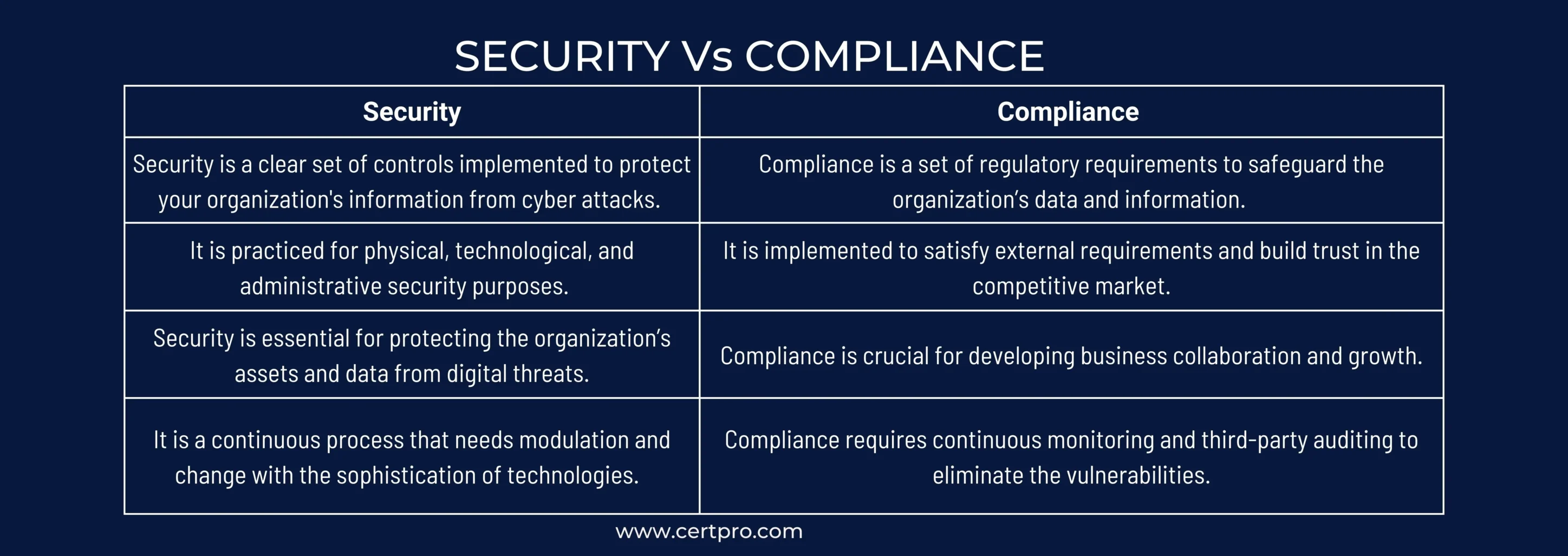
Security and compliance are interconnected but differ in key aspects. Again, security is a combination of controls to protect your organization’s assets. In contrast, compliance is meeting regulatory standards to satisfy legal requirements. Therefore, companies can secure their data by implementing standard compliance like GDPR, HIPAA, SOC 2, and ISO 27001. In addition, when your organization executes security controls to become compliant, your firm automatically follows the regulations.
Moreover, security and compliance are essential tools for risk assessment. Security measures and compliance needs must be aligned to achieve complete protection. In some cases, organizations implement security measures that are insufficient for compliance. For instance, an organization implemented antimalware, but the employees do not know the National Institute of Standards and Technology’s guidelines. Another example is an organization that implemented PCI DSS compliance but did not use the authentication tools for data access. It may create security gaps in organizations and increase vulnerabilities. Therefore, you should know security needs beyond compliance and have robust IT control covering all business areas.
SIMILARITIES OF SECURITY AND COMPLIANCE
Security and compliance are two common factors in cybersecurity. Hence, security measures are driven by business risk and legal obligations to implement compliance. Compliance helps to convince customers about their data security and privacy. Most importantly, with compliance certifications, the customers can understand what security controls the organizations apply. However, being compliant do not ensure security. Thus, you must understand how to mitigate and transfer risks to protect your system against threats. Hence, security provides well-protected and compliant communication for your clients.
Security measures are developed to protect the organization’s assets and prevent unauthorized access. Thus, organizations can implement different frameworks for their functionality and cybersecurity. Therefore, the compliance process can help organizations improve security by creating a specific standard and checklist. For example, your organization is implementing ISO 27001:2022 to develop a robust Information Security Management System (ISMS). However, your company is a SaaS provider and implements compliance for data security. In other instances, different IT companies can follow the exact compliance to create robust security controls.
Likewise, SOC 2 compliance creates trust for SaaS companies regarding data safety and security. In this process, the third-party auditor scrutinizes the data handling practices and ensures protection. Therefore, SOC 2 compliance assures customers that their data is appropriately managed.
STATISTICAL ANALYSIS OF DATA SECURITY AND COMPLIANCE
Security controls and compliance are constantly evolving due to emerging risks. Let’s check out some insightful data on the cost of data breaches in recent years and determine the relevance of security and compliance for your organization.
It is a known fact that data breaches and cybersecurity incidents negatively influence your business’s growth and development. The incident can cause financial, reputational, and operational difficulties. Statistical data suggested that cyberattack losses could reach $10.5 trillion by 2025. Therefore, a 300% high rise was observed from 2015. Interestingly, IT hacking incidents increased by 80% in 2022, which was around 45% in 2018. Thus, it indicates that technological advancement makes hackers more efficient. One company in every 31 companies worldwide experienced weekly ransomware attacks in 2023. The scenarios suggested that businesses require cybersecurity measures to continue their business and functionality.
Today, we live in a fast-paced world where technology is improving regularly. Thus, it signifies that hacking technologies are also advancing and extending. Again, businesses face more cyber threats, which create pressure on implementing security compliance. However, organizations should take proper measures to maintain compliance. The data on implementing compliance suggested that 88% of global companies spend $1 million yearly on GDPR compliance, and 40% spend over $10 million annually. Cybersecurity risks frighten the world; therefore, around 250 bills and resolutions have been introduced to prevent cyber threats. As per many cybersecurity observers, privacy laws will protect the personal information of 75% of people worldwide by the end of 2024.
CERTPRO’S GUIDANCE IN SECURITY AND COMPLIANCE
All know that security is the trip, and compliance is the road map. You can’t take a break on this road; you must keep improving your protection and letting your audience know about your essential movements. Our understanding and experience can help you with more than just the basics.
CertPro can help you get better protection and follow the rules. Our risk evaluation team can help your business develop a strong cybersecurity system. We can look at what your business needs and create a protection plan. Our expert advice and help can also boost your confidence and image in the market. Our clients get personalized services because we follow the compliance plan and listen to what our clients want. To learn about cybersecurity and regulations, you can go to CertPro.com. Contact us if you have more specific questions; one of our auditors will gladly help.
FAQ
What is the role of security compliance?
What is a breach of security in data protection?
What are the types of security breaches?
How to report a data breach?
What are the primary security requirements?

About the Author
Anuja Patil
Anuja Patil, an Executive Team Lead at CertPro, excels in guiding her team to deliver premier information security solutions. With a strong background in ISO 27001, SOC2, GDPR, and various other compliance standards, she ensures that projects are managed efficiently and security frameworks are continually optimized.
GRC IN CYBERSECURITY: WHAT IT MEANS AND WHY IT MATTERS IN 2026
In 2026, the pressure on companies to manage cyber risk responsibly has never been greater. Regulators demand structured controls, boards want clear risk reporting, and threat actors are becoming more sophisticated. Against this backdrop, GRC in cybersecurity has...
HOW COMPLIANCE AUDIT SOFTWARE IMPROVES AUDIT READINESS
Today, most companies deal with a growing number of compliance regulations. From data privacy standards to security frameworks like SOC 2 and ISO 27001, the list of compliance obligations keeps expanding. At the same time, regulators and external auditors now expect...

Compliance Best Practices in 2026: How to stay ahead of regulatory changes
Why is the implementation of compliance best practices critical for 2026? Compliance in 2026 demands operational proof, not the documentation intent. Regulations change faster, audit scrutiny is higher, and reporting timelines are tighter across privacy,...