
HOW SOC 2 COMPLIANCE SOFTWARE CHANGES AUDIT READINESS

There’s a version of SOC 2 preparation that most security teams know too well. The audit date is approaching. Someone sends a spreadsheet asking for access logs, vendor assessments, and approval records. People scramble. Documentation gaps appear. What should take days takes weeks. The frustrating part is that most of the evidence exists somewhere. It’s just scattered across cloud tools, email threads, and shared drives with no clear owner. By the time the team gathers all the evidence, the audit has already begun, leaving them exhausted.
This is the problem that SOC 2 compliance software is built to solve. By automating evidence collection and centralizing documentation, it turns audit readiness into a year-round discipline rather than a last-minute project. Controls are monitored continuously. Gaps are visible as they emerge. When auditors arrive, the documentation is already there.
That said, it’s worth being clear about what the software does and doesn’t do, particularly in terms of its role in facilitating the audit process and ensuring that all necessary documentation is organized and accessible for the auditors. The software organizes evidence and tracks controls, but the SOC 2 examination itself must be performed by a licensed CPA firm.
These licensed CPA firms perform independent SOC 2 examinations to provide the kind of objective assurance that customers and partners actually trust. In other words, the software helps teams stay prepared, while auditors provide formal assurance.
Tl; DR:
Concern: When your audit begins, evidence is often scattered across tools, emails, and vendor files. As a result, teams rush to collect access logs and approvals while documentation gaps surface. Consequently, preparation becomes reactive instead of structured. Over time, findings increase, timelines extend, and the audit process becomes unnecessarily stressful and resource-intensive.
Overview: To solve this challenge, SOC 2 compliance software centralizes controls, automates monitoring, and continuously collects evidence. By providing real-time visibility and structured control mapping, it strengthens year-round readiness. While it doesn’t take the place of independent audits, it guarantees your team’s organization and readiness for the start of SOC 2 audit services.
Solution: Rather than scrambling before fieldwork, implement the software early to automate evidence collection and monitor controls continuously. As gaps appear, remediation can be tracked immediately. Furthermore, vendor risks and documentation remain centralized. Ultimately, this proactive approach shortens audit timelines, reduces operational strain, and supports scalable, sustainable compliance.
UNDERSTANDING SOC 2 AND THE AUDIT READINESS CHALLENGE
SOC 2 is an AICPA reporting framework used by CPA firms to examine a service organization’s controls under the SSAE 18 attestation standards. It is based on the Trust Services Criteria, which include Security, Availability, Processing Integrity, Confidentiality, and Privacy.
Evidence doesn’t accumulate on its own. This is where many organizations run into trouble. Without a structured system, it ends up spread across platforms, inboxes, and spreadsheets maintained by different people with different habits. When audit time comes, pulling it all together is slow and error-prone.
Consider a common scenario: a growing SaaS company stores access logs across multiple cloud platforms and tracks vendor assessments in a shared spreadsheet. It works well enough day to day. But when the audit begins, preparation takes six weeks. The team has to manually piece together months of access changes, chase down vendor documents, and fill gaps in their logging history. As a result, certification is delayed until all evidence is reconciled.
After implementing SOC 2 compliance software, that same company centralized its evidence collection and kept everything up to date throughout the year. Audit preparation dropped to one week. Certification happened on schedule. The work didn’t disappear; instead, it moved from an unstructured process to a steady, manageable one.
SOC 2 COMPLIANCE SOFTWARE
At its core, SOC 2 compliance software gives organizations a single place to manage controls, collect evidence, and track audit readiness. Most platforms connect to the tools your team already uses, such as cloud infrastructure, identity providers, and ticketing systems. Many platforms automatically collect audit evidence through integrations with cloud systems, identity providers, and ticketing platforms.
When an employee is onboarded, the platform records provisioning activities through identity provider logs. When access is revoked, that removal becomes part of the evidence record. When a configuration drifts out of policy, an alert fires. The result is a living record of how your controls are operating, built incrementally throughout the year instead of being reconstructed under pressure before an audit.
SOC 2 compliance software also includes policy management workflows, risk tracking, vendor dashboards, and audit-ready reporting. Everything exists in one structure, which makes it easier to demonstrate both the design of your controls and their ongoing effectiveness, exactly what SOC 2 auditors expect to review.
Difference Between SOC Compliance Software and Manual Tracking
Manual tracking can work for small teams, but as organizations grow, scattered evidence and manual workflows often slow preparation and increase risk. The table below highlights how SOC 2 compliance software addresses these challenges compared to traditional methods.
| Area | Manual Tracking | SOC 2 Compliance Software |
|---|---|---|
| Tools Used | Spreadsheets and shared drives. | Centralized platform with structured workflows and integrations. |
| Scalability | Works for small teams; however, it struggles as controls and systems expand. | Scales efficiently with growing infrastructure and compliance needs. |
| Workflow Management | Relies on manual follow-ups and email reminders. | Automates reminders and assigns tasks systematically. |
| Error Risk | Higher risk due to manual updates and inconsistent documentation. | Reduces errors through automated evidence collection and tracking. |
| Audit Preparation | Evidence gathering is reactive and time-intensive. | Maintains continuous documentation, enabling faster audits. |
| Role of Auditors | Requires greater coordination during fieldwork. | Improves readiness; however, auditors still provide formal assurance. |
| Efficiency | Limited real-time visibility and slower evidence retrieval. | Provides real-time visibility into control status and documentation. |
HOW SOC 2 COMPLIANCE SOFTWARE TRANSFORMS AUDIT READINESS
SOC 2 compliance software changes audit preparation fundamentally. Instead of scrambling before fieldwork, you maintain continuous readiness throughout the year. As a result, audit cycles become more predictable, and documentation remains organized.
Automated Evidence Collection
The biggest time sink in traditional audit preparation is evidence gathering. Access logs sync directly, cloud configurations update continuously, and change records flow into a centralized system. Consequently, evidence builds throughout the year rather than just before audits. Completeness improves, and missing documentation risks decrease, allowing your SOC 2 readiness assessment to run smoothly.
In daily operations, employees join and leave regularly, and access changes occur frequently. However, when SOC 2 compliance software captures provisioning and removal automatically, nothing is missed. For example, one company managing 200 employees previously spent 10 hours per month tracking access changes manually. After implementation, the process became automated, eliminating most of the manual tracking effort.
Continuous Monitoring and Real-Time Visibility
Dashboards provide real-time control status. If a control fails, say, an MFA enforcement policy stops applying to a new user group, then the relevant owner gets an alert immediately. Therefore, remediation begins earlier and risks are addressed before auditors identify them.
SOC 2 compliance software also demonstrates maturity. When auditors review controls, they see consistent operation rather than sporadic documentation. Color indicators improve clarity; for example, dashboards typically highlight control status, making it easier to identify areas that require remediation.
Improved SOC 2 Readiness Assessment
A SOC 2 readiness assessment is meant to evaluate whether your controls are ready for a formal audit. But when documentation is disorganized, a readiness assessment mostly tells you that your documentation is disorganized. It’s not very actionable.
With SOC 2 compliance software, software-generated reports highlight missing evidence and control gaps, giving management visibility into compliance status. For instance, one company identified 12 gaps and had three months to remediate them. By assigning tasks weekly, the organization was prepared for the audit.
Better Collaboration With SOC 2 Audit Services Providers
When evidence is centralized through SOC 2 compliance software, the audit itself runs differently. Auditors spend less time asking for documents and more time evaluating whether your controls are effective. Fieldwork moves faster. The back-and-forth that typically extends audit timelines shrinks considerably.
Secure portals allow auditors to pull the evidence they need directly. The organization that previously needed more weeks for fieldwork completed its audit in fewer days after implementing compliance software. The auditors weren’t working faster; they just had what they needed when they needed it.
BENEFITS OF USING SOC 2 COMPLIANCE SOFTWARE FOR GROWING ORGANIZATIONS
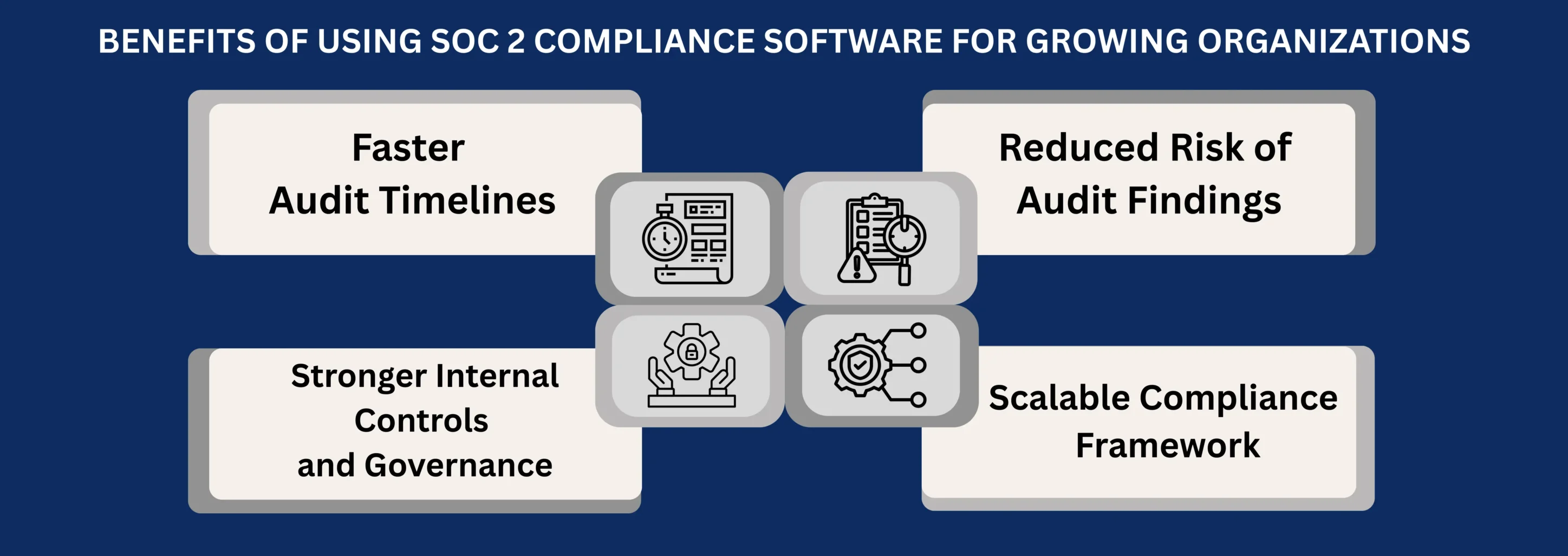
Growing companies face increasing complexity as new systems are added and customer requirements evolve. As a result, compliance becomes harder to manage without structured automation and centralized visibility.
Faster Audit Timelines
When evidence remains organized throughout the year, preparation time decreases significantly. Instead of gathering documents for weeks, teams can provide access immediately. As a result, fieldwork commences earlier, auditors can complete fieldwork more efficiently, and the attainment of certification accelerates the overall time to market.
For example, one company reduced preparation from eight weeks to two, while another cut total audit time in half. These efficiencies translate directly into cost savings and allow teams to focus on higher-value priorities.
Reduced Risk of Audit Findings
Incomplete or inconsistent documentation often leads to audit findings. However, software reduces this risk by prompting regular reviews and securely storing historical evidence. As a result, auditors encounter complete records and raise fewer clarification requests.
Prevention is crucial because findings can impact customer contracts and postpone certification. Continuous documentation and structured tracking significantly reduce the likelihood of costly surprises during fieldwork, thereby ensuring that auditors can complete their assessments more efficiently and with greater accuracy.
Stronger Internal Controls and Governance
With continuous monitoring, controls operate under consistent oversight. Management gains greater visibility, and failures are detected earlier, allowing remediation before audits begin. Consequently, governance improves and risk management becomes proactive rather than reactive.
Leadership and board members can review compliance status at any time, which supports faster decision-making and stronger stakeholder confidence. For instance, if a control fails, the system alerts the owner immediately, enabling same-day remediation and preserving a clean control history.
Scalable Compliance Framework
As organizations expand into new systems or regions, compliance requirements increase. Software supports this growth by integrating additional systems and managing multiple frameworks within the same structure. Therefore, processes remain consistent even as complexity rises.
An organization may start with five cloud systems and later expand to thirty. Because integrations scale naturally, the underlying compliance framework does not require annual rebuilding, ensuring long-term stability and efficiency.
CHOOSING THE RIGHT SOC 2 COMPLIANCE SOFTWARE
Not every platform will be the right fit for every organization. Your team’s technical capacity and the expected complexity of your compliance environment will determine the most important features.
A few things are worth evaluating carefully before making a decision.
Integration Depth: Focus on the systems or platforms that generate the most audit-relevant evidence: cloud infrastructure, identity management, ticketing, and endpoint management.
Platform Security: You’re storing sensitive compliance data in this system. Confirm that data is encrypted, that security controls are strong, and that the vendor maintains its own SOC 2 report. A compliance platform that can’t demonstrate its compliance can be difficult to justify to auditors.
Control Flexibility: Look for a platform that lets you map controls to your specific environment, adjust workflows, and support additional frameworks as your compliance program matures.
Auditor Access: The audit itself is the moment that matters. Platforms that allow auditors to access evidence directly through a secure portal, rather than requiring documents to be shared through email, significantly streamline fieldwork.
Vendor Support: Finally, take vendor support seriously. Compliance is not a one-time project. You need a vendor who responds quickly when questions arise mid-audit or when implementation encounters a snag. Check references and ask specifically about support responsiveness.
CONCLUSION
Many organizations struggle during a SOC 2 audit for one simple reason. Their security controls exist, but the supporting documentation is incomplete or scattered. Evidence lives across cloud systems, inboxes, and shared drives. When auditors request it, teams must scramble to assemble months of records under tight timelines.
SOC 2 compliance software addresses this challenge by organizing evidence and monitoring controls throughout the year. Instead of collecting documentation weeks before the audit, organizations maintain a continuous record of how their controls operate. As a result, audit preparation becomes structured and predictable.
However, software alone cannot deliver a SOC 2 report. The formal examination must still be conducted by an independent CPA firm. Their role is to evaluate the design and effectiveness of controls and issue the attestation report that customers and partners rely on for assurance.
This is where an experienced audit firm becomes critical. CertPro, a CPA firm registered under the AICPA Peer Review Program, specializes in conducting SOC 2 examinations for audit-ready organizations. With extensive experience working with global clients, CertPro has successfully delivered SOC 2 reports across a wide range of technology and service environments. The firm focuses on clear communication and structured audit processes throughout the engagement.
Organizations that combine strong documentation practices with an experienced SOC 2 auditor often see a smoother audit process. Controls are easier to validate, evidence is readily available, and fieldwork moves faster.
SOC 2 should not feel like a yearly scramble. When the right systems support your controls and the right auditors guide the examination, compliance becomes a steady and manageable process that builds long-term trust with customers and partners.
FAQ
What is the difference between SOC 2 compliance software and manual compliance tracking?
Manual tracking uses spreadsheets, shared folders and email threads. It requires lots of manual work and is prone to human errors.
In contrast, SOC 2 compliance software automates collection. It provides real-time monitoring and sends instant alerts. It’s also more accurate, and the growing organizations benefit most.
When should a company implement SOC 2 compliance software?
Companies often adopt SOC 2 compliance software before their first audit or when manual tracking becomes difficult. Implementing software early helps organize evidence, monitor controls continuously, and reduce preparation time before auditors begin the examination.
Can SOC 2 compliance software replace SOC 2 audit services?
No, SOC 2 compliance software does not replace auditors. It supports preparation by organizing documentation and monitoring controls. However, licensed CPA firms must still conduct independent examinations and issue SOC 2 reports under professional auditing standards
What features should I look for in SOC 2 compliance software?
Look for automated evidence collection through integrations, continuous control monitoring with alerts, scalable policy management workflows, and vendor risk tracking. The platform should also provide audit-ready reporting and integrate smoothly with systems such as cloud infrastructure, identity management, and ticketing tools.
How much time can SOC 2 compliance software save during audits?
Time savings depend on company size and system complexity. However, many organizations report 40–60% faster audit preparation. Continuous evidence collection reduces manual work, helps teams respond to auditor requests quickly, and shortens overall audit cycles from weeks to days.
HOW SOC 2 TYPE II CERTIFICATION IMPACTS CUSTOMER CONFIDENCE AND DATA SECURITY
Enterprise buyers changed how they evaluate vendors. They no longer trust self-reported security claims. Instead, vendor risk management became a top priority. Consequently, procurement teams demand independent proof. They need verification that vendors protect their...
SOC 1 VS SOC 2: WHICH REPORT YOUR CUSTOMERS ACTUALLY ASK FOR
If you sell SaaS or provide outsourced services, you have likely been asked for a SOC report. However, the follow-up question is rarely easy to answer: do they mean SOC 1 or SOC 2? Both reports fall under the AICPA’s System and Organization Controls (SOC) reporting...
SOC COMPLIANCE EXPLAINED FOR GROWING SAAS COMPANIES
If you run a growing SaaS company, you have likely heard the term "SOC compliance." It comes up in sales calls, vendor reviews, and enterprise contracts. However, many SaaS teams are not sure what it means in practice, what it costs, or when they actually need it. The...