
SOC COMPLIANCE EXPLAINED FOR GROWING SAAS COMPANIES

If you run a growing SaaS company, you have likely heard the term “SOC compliance.” It comes up in sales calls, vendor reviews, and enterprise contracts. However, many SaaS teams are not sure what it means in practice, what it costs, or when they actually need it.
The process of SOC compliance is not universally applicable. The right report type, the right scope, and the right timeline all depend on your product, your customers, and where you are in your growth stage. So, getting clarity on these factors early saves time and avoids costly delays later.
This guide answers the key questions in plain terms. It covers what SOC compliance is, who needs it, which framework fits your situation, what the audit process involves, and how SOC compares to SOX. Also, it walks through the common challenges growing SaaS teams face. Whether you are preparing for your first audit or just starting to explore your options, this article gives you a grounded starting point.
Tl; DR:
Concern: Growing SaaS companies often face confusion about when SOC compliance is required, which report to choose, and how much SOC 2 compliance cost will impact their budget. Many only act when an enterprise client demands it, causing delays and rushed preparation.
Overview: This guide explains SOC compliance in practical terms for growing SaaS companies. It covers what SOC compliance means, who needs it, the differences between SOC 1 compliance and SOC 2 compliance, how the cost of SOC 2 compliance is structured, how the audit process works, and how SOC compares to a SOX compliance checklist. It also outlines common challenges and how to manage them as your company scales.
Solution: By understanding the SOC framework early, SaaS companies can approach compliance strategically rather than reactively. This guide helps you choose between SOC 1 and SOC 2, plan for SOC 2 compliance costs, prepare for audits, and align controls with regulatory expectations.
WHAT IS SOC COMPLIANCE AND WHY DOES IT MATTER FOR SAAS COMPANIES
SOC (System and Organization Controls) refers to a set of assurance reports issued by an independent CPA firm to evaluate a service organization’s controls. SOC reports are performed by licensed CPA firms under AICPA assurance standards and are commonly used to assess a service provider’s control environment. Licensed CPA firms run these audits and issue reports that customers and business partners use to review vendor risk.
For growing SaaS companies, SOC compliance comes up often. For example, enterprise customers ask for it during sales. Procurement teams request it before signing contracts. Also, security reviews include it as a standard step. So, the question is no longer whether to pursue it. The real question is when and how.
SOC reports are not laws or regulations. They are independent assurance reports issued by a CPA firm. They help customers evaluate whether your controls are designed appropriately and operating as expected.
For SaaS teams, a SOC 2 report often reduces friction in enterprise procurement. It can also shorten security reviews because it provides structured evidence of your control environment.
WHO NEEDS SOC COMPLIANCE? IS IT MANDATORY FOR SAAS COMPANIES?
For most private SaaS companies, SOC compliance enters the picture through customer demand. It becomes part of the sales process earlier than many founders expect. If your SaaS product stores customer data or processes sensitive records, customers may ask for a SOC report during vendor reviews. In many cases, large enterprises will not sign contracts without a current SOC 2 report. So, the decision is less about legal obligation and more about market access.
Early-stage startups may not need SOC compliance right away. However, once you move into mid-market or enterprise sales, it becomes part of standard procurement reviews. In fact, some industries face these requests earlier than others. For example, fintech, health tech, payroll services, and core infrastructure SaaS are the most common examples. Therefore, outside proof of security becomes a key part of any vendor review in these sectors.
UNDERSTANDING THE SOC FRAMEWORK: SOC 1, SOC 2, AND SOC 3
The SOC framework includes three report types. Each serves a different purpose. So, knowing the difference helps SaaS companies choose the right path.
SOC 1 Reports
SOC 1 reports focus on controls that are likely to be relevant to a customer’s internal control over financial reporting (ICFR). They are most relevant when your service could affect a customer’s financial statements. Common examples include payroll processing, billing platforms, claims processing, and transaction processing systems.
If your SaaS does not influence customers’ financial reporting, SOC 1 is usually not the right starting point.
SOC 2 Reports
SOC 2 compliance is the most common choice for SaaS companies. It is based on the AICPA Trust Services Criteria: Security, Availability, Processing Integrity, Confidentiality, and Privacy. Security is included in every SOC 2 engagement, while the remaining criteria are included based on your services and customer expectations. However, the other four are optional depending on what your product does. SOC 2 reports come in two forms. A Type I report looks at control design at one point in time. A Type II report checks whether controls worked well over a review period of six to twelve months. Also, SOC 2 reports are generally intended for specified parties such as customers, prospects, and business partners evaluating vendor risk, and they are issued by a licensed CPA firm under AICPA assurance standards.
SOC 3 Reports
SOC 3 reports cover the same criteria as SOC 2. However, they are written for a general audience and can be shared publicly. Instead of detailed control results, they give a high-level summary suitable for websites or marketing use.
For most growing SaaS companies, SOC 2 compliance is the right starting point. SOC 1 compliance applies mainly to financial-impact products. SOC 3 is supplementary. So, when comparing SOC 1 vs SOC 2, the right choice comes down to what your product does and who your customers are.
SOC 2 COMPLIANCE REQUIREMENTS FOR SAAS COMPANIES
Preparing for a SOC 2 examination takes structured prep work. It is not just about passing an audit. Instead, it is about building controls that work every day.
Selecting the Right Trust Services Criteria
Security is included in every SOC 2 engagement. Many SaaS companies also include Availability and Privacy based on customer expectations and contractual commitments. The criteria you select define the scope of your audit. Therefore, choosing the right ones early saves time and effort later.
Once you have set the scope, you need to build and document controls. This includes writing clear policies, defining who owns each control, and setting up risk review processes. Also, every control must have written records to back it up. For a Type II report, those controls must run well throughout the entire review period.
SOC 2 Readiness Review and Report Type
Before the formal audit, most SaaS companies benefit from a SOC 2 readiness review. Also, this step finds gaps in controls or missing records before auditors arrive. In fact, fixing issues at this stage is far less disruptive than finding them during a live audit.
Type I vs Type II: Type I is a good starting point for first-time audits or when a prospect needs a report fast. However, enterprise customers almost always ask for Type II, as it proves controls worked over time. So, if closing large deals is a goal, plan for Type II from the start.
SOC 2 Compliance Cost
SOC 2 compliance cost is one of the most common questions SaaS founders ask. However, the answer depends on several factors. Company size, system scope, the criteria selected, report type, and the audit firm all shape the total spend. In general, Type I reports cost less because they cover one point in time. However, Type II reports cost more since they require months of evidence and extended testing.
Also, SOC compliance is not a one-time spend. After your first report, plan for annual re-audits, staff time, tracking tools, and policy updates. Building this into your budget early prevents surprises later. Therefore, view SOC 2 compliance cost as a recurring operational investment required to maintain a quality SOC 2 audit year after year.
SOC COMPLIANCE PROCESS: STEP – BY – STEP FOR SAAS GROWTH
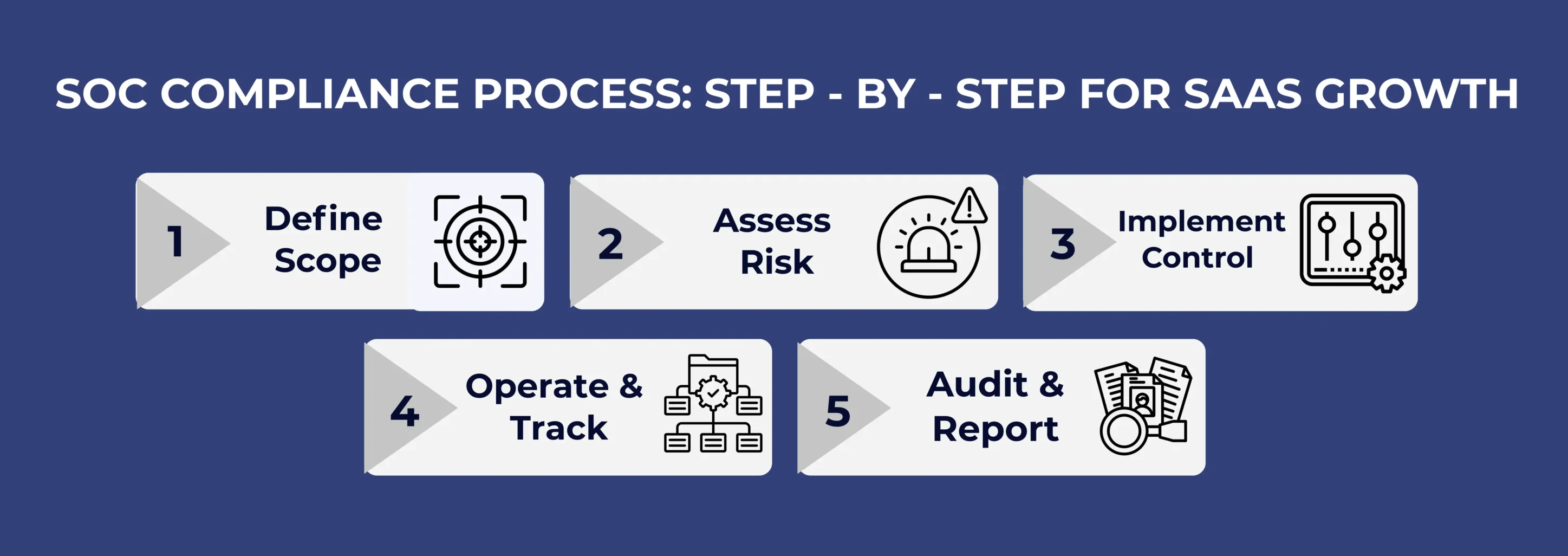
A structured approach makes a SOC examination more manageable for SaaS companies. Below is how organizations typically progress through the process.
1. Defining Audit Scope
The first step is determining what systems, services, infrastructure, and third-party vendors fall within scope. A clearly defined boundary ensures that testing focuses only on relevant environments that impact customer data or financial reporting, depending on the report type.
2. Performing Risk Assessment
Management conducts a formal risk assessment to identify threats and vulnerabilities within the scoped environment. These risks are mapped to appropriate internal controls designed to address security, availability, processing integrity, confidentiality, or privacy criteria, as applicable.
3. Implementing and Documenting Controls
Controls must be formally implemented and supported by documented policies and procedures. Responsibilities are assigned, logging mechanisms are configured, and monitoring activities are established to ensure consistent operation.
4. Operating Controls and Collecting Evidence
During the examination period, controls must operate consistently. Organizations retain evidence such as access reviews, change management records, and incident logs to demonstrate operating effectiveness over time.
5. Audit Fieldwork and Reporting
Auditors evaluate control design and operating effectiveness through documentation review, inquiry, and sample testing. Based on testing results, a formal SOC report is issued, reflecting the auditor’s opinion on the controls examined.
SOC COMPLIANCE VS SOX COMPLIANCE CHECKLIST: KEY DIFFERENCES
SOC compliance and SOX compliance are different. They are often confused because the terms sound similar.
SOX is the Sarbanes-Oxley Act, a U.S. federal law that applies to public companies. It requires management to assess internal control over financial reporting (ICFR). In many cases, external auditors also attest to those controls under SOX requirements. SOX is a legal obligation, not an optional assurance report.
Most private SaaS companies do not need to follow SOX. However, if a SaaS company goes public or gets acquired by a public company, the SOX compliance checklist becomes a binding requirement. So, for most growing SaaS companies, SOC 2 is the right focus. In contrast, SOX is a legal rule for publicly traded firms.
COMMON CHALLENGES SAAS COMPANIES FACE WITH SOC COMPLIANCE
Even well-prepared SaaS teams run into issues. Knowing the common ones helps you plan around them. The most common challenges include:
– Scope creep as systems and vendors grow
– Uneven evidence collection across teams and tools
– Control gaps that show up when new features launch
– Team resistance when compliance is seen as a one-off task
– Keeping controls current as headcount and systems change
Scope is one of the hardest things to manage. As SaaS products grow, the audit boundaries expand, and so does the workload. So, regular internal reviews help keep scope tight. Also, collecting proof across teams is difficult when records are stored in different tools. Therefore, setting up a central evidence system early is worth the time. In fact, many SaaS companies find that controls that worked well at fifty employees need updates at two hundred. So, treat SOC compliance as an ongoing process, not a one-time project.
CONCLUSION
SOC compliance is not a single event. Instead, it is an ongoing commitment that evolves as your business grows. For most SaaS companies, it begins as a customer request. Over time, however, it becomes a standard part of how the business runs.
The key is to approach it with the right mindset from the start. Treat it as a process, not a one-time project. Build controls with evidence collection in mind. Choose your scope carefully and revisit it as your product and team grow.
Also, the framework you choose matters. SOC 2 is the right fit for most data-driven SaaS products. However, your industry, your customers, and your growth plans may shift that decision over time. So, review your compliance posture regularly and stay aligned with what your customers actually need.
FAQ
What is SOC compliance in simple terms?
A SOC report is the result of an independent examination performed by a CPA firm. It evaluates whether a service organization’s controls are designed appropriately and, in some cases, operating effectively over time. It is based on standards set by the AICPA.
What are compliance regulations, and how do they apply to SaaS?
Compliance regulations are rules, legal or industry-based, that govern how companies manage data, financial records, and internal processes. For SaaS companies, they often show up as customer contract needs or security review steps. So, knowing which ones apply to your product helps you choose the right audit framework from the start.
What is the difference between SOC 1 and SOC 2 compliance?
SOC 1 compliance focuses on internal controls over financial reporting. It applies mainly to products that affect a customer’s financial statements, such as payroll or payment tools. SOC 2 compliance, on the other hand, covers security and day-to-day operational controls. It is the more common choice for data-driven SaaS products.
How much does SOC 2 compliance cost?
The SOC 2 compliance cost varies based on company size, the number of systems in scope, the criteria selected, and whether you pursue Type I or Type II. In general, Type II costs more because it requires extended testing and evidence collection.
How long does SOC 2 Type II take?
A SOC 2 Type II audit usually takes between 6 and 12 months from start to final report. The observation period can range from 3 to 12 months, depending on scope and readiness. After that, auditors complete fieldwork in a few weeks and issue the report within one to three months.
WHAT IS SOC COMPLIANCE AND WHY DOES IT MATTER FOR SAAS COMPANIES
WHO NEEDS SOC COMPLIANCE? IS IT MANDATORY FOR SAAS COMPANIES?
UNDERSTANDING THE SOC FRAMEWORK: SOC 1, SOC 2, AND SOC 3
SOC 2 COMPLIANCE REQUIREMENTS FOR SAAS COMPANIES
SOC COMPLIANCE PROCESS: STEP – BY – STEP FOR SAAS GROWTH
SOC COMPLIANCE VS SOX COMPLIANCE CHECKLIST: KEY DIFFERENCES
HOW SOC 2 COMPLIANCE SOFTWARE CHANGES AUDIT READINESS
There's a version of SOC 2 preparation that most security teams know too well. The audit date is approaching. Someone sends a spreadsheet asking for access logs, vendor assessments, and approval records. People scramble. Documentation gaps appear. What should take...
HOW SOC 2 TYPE II CERTIFICATION IMPACTS CUSTOMER CONFIDENCE AND DATA SECURITY
Enterprise buyers changed how they evaluate vendors. They no longer trust self-reported security claims. Instead, vendor risk management became a top priority. Consequently, procurement teams demand independent proof. They need verification that vendors protect their...
SOC 1 VS SOC 2: WHICH REPORT YOUR CUSTOMERS ACTUALLY ASK FOR
If you sell SaaS or provide outsourced services, you have likely been asked for a SOC report. However, the follow-up question is rarely easy to answer: do they mean SOC 1 or SOC 2? Both reports fall under the AICPA’s System and Organization Controls (SOC) reporting...