
From the industrial revolution to today’s age of AI, one factor has stayed common to business success. This factor is called quality. Across industries, from startups to global enterprises, delivering high-quality products and services is a must. Yes, without delivering good quality, businesses can’t attain success and profitable growth. Also, the customers around the world only value businesses that provide them with high-quality products and services. Therefore, organizations must ensure product quality to build customer trust and strengthen their reputation. But how can you achieve this? One logical and well-structured solution is to implement Total Quality Management (TQM). A key strength of TQM is that it promotes data-driven decision-making, where choices are guided by facts and not guesswork.
The ultimate aim of TQM is to provide long-term growth by satisfying the customers’ needs. For this, businesses need integrated business systems that align their processes and share quality data in real time. This enables different departments to work as a cross-functional team instead of operating in silos. In parallel, we also have the ISO 9001. It is a global standard for establishing a strong Quality Management System (QMS). Integrating TQM with ISO 9001 and implementing them could assist businesses in achieving their long-term growth and success. Also, it supports data-driven decision-making by providing guidelines to collect and analyze key performance data.
So, it is essential for modern businesses to clearly understand these concepts and practices. Organizations that rely on integrated business systems are better able to coordinate their teams and manage quality across departments. In fact, this improves collaboration in cross-functional teams by removing duplicate efforts and improving workflow clarity. Therefore, this blog talks about Total Quality Management (TQM) and its core principles. Furthermore, it also guides businesses on how to combine TQM with ISO 9001 to ensure long-lasting success.

WHAT IS TOTAL QUALITY MANAGEMENT?
FUNDAMENTAL PRINCIPLES OF TOTAL QUALITY MANAGEMENT
WHAT IS ISO 9001 AND WHY IS IT IMPORTANT?
BENEFITS OF INTEGRATING TQM WITH ISO 9001
IMPLEMENTING ISO 9001 WITH A TOTAL QUALITY MANAGEMENT APPROACH
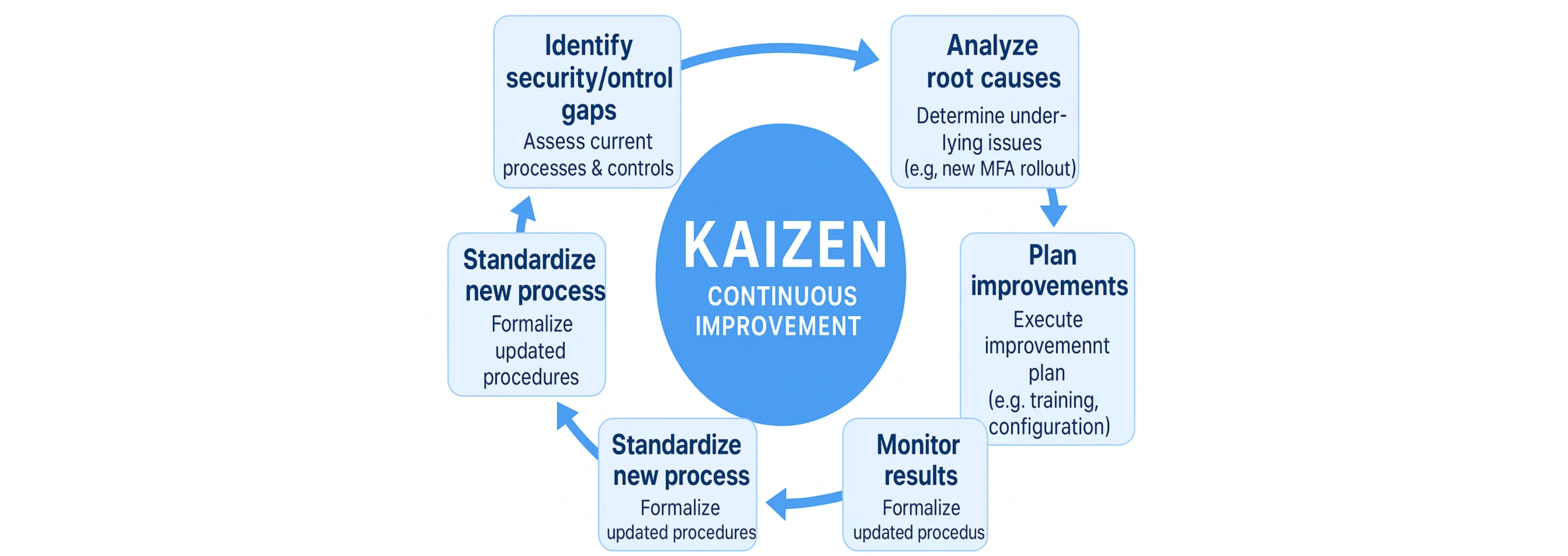
HOW KAIZEN PRINCIPLES DRIVE CYBERSECURITY AND COMPLIANCE IMPROVEMENTS
TL; DR:
Concern: Modern businesses struggle to maintain consistent quality, meet customer expectations, and pass audits while managing complex, siloed processes.
Overview: Total Quality Management (TQM) is a company-wide approach focused on continuous improvement and customer satisfaction. ISO 9001 is a global standard that outlines structured requirements for building a strong Quality Management System (QMS). While TQM promotes a quality-focused culture, ISO 9001 ensures consistency and audit-readiness through clear guidelines.
Solution: Combining TQM with ISO 9001 enables businesses to boost process efficiency, improve product quality, build customer trust, and stay compliant. This integrated approach supports data-driven decisions, cross-functional teamwork, and long-term business growth.
WHAT IS TOTAL QUALITY MANAGEMENT?
Total Quality Management (TQM) is a management framework that helps organizations achieve long-term success by focusing on improving the overall quality. This process involves the commitment of all the members of the firm, from employees to top-level executives. This results in the delivery of customer satisfaction and sustained growth. Additionally, TQM helps improve various internal processes, including supply chain management, customer service, and product development. It also helps in detecting, removing, and resolving the errors involved in managing the supply chain. TQM benefits organizations by promoting teamwork and collaboration, making sure that all employees contribute to achieving quality goals.
Moreover, TQM focuses on the continuous improvement of internal processes, thereby advancing the quality of products and services. Data-driven decision-making supports businesses in quickly identifying areas for improvement and effectively tracking the results. TQM benefits companies by helping them stay competitive, as it encourages consistent quality improvements and adherence to industry standards. It supports integrated business systems, allowing various departments to work together using shared data and tools for better outcomes. Notably, TQM became popular around the world after Japanese companies used it successfully, following the ideas of W. Edwards Deming and Joseph Juran. They helped the companies to understand the real meaning of quality.
By following this concept, the Japanese business boomed with success. For instance, Toyota’s Kaizen method of continuous improvement is a classic example of the TQM business approach. These efforts are often led by cross-functional teams that include staff from various departments working together toward common goals. Over time, this method becomes more powerful when data-driven decision-making is integrated into daily operations. Additionally, there are several key principles that companies must follow to establish a standard of total quality management. Let’s learn about them in detail in the following section.
FUNDAMENTAL PRINCIPLES OF TOTAL QUALITY MANAGEMENT
Total Quality Management focuses on putting customers first. It helps companies to continuously improve and work hard to exceed the customer expectations. The following principles will guide your business in implementing this structured approach.
1. Customer Focus: The customer decides on what the real quality of a product or service means. We must value their inputs as they enhance our understanding of their needs. So, your company’s goal is to meet their needs and go beyond their expectations.
2. Employee Involvement: All the employees must take part in this process of improving quality. From junior staff to top leaders, everyone matters in the process. Additionally, we must conduct proper training and provide necessary resources to ensure timely completion of tasks. When all employees follow total quality management principles, the entire organization becomes more efficient and productive.
3. Focus on Process: TQM focuses on developing a strong process-centered approach. We must thoroughly check the processes for any weaknesses. This process leads to the delivery of better results.
4. Integrated QMS: The process of improving quality is built into every part of the firm using a well-planned and active Quality Management System (QMS).
5. Strategic Approach: To achieve the business goals, develop a proper plan and approach based on quality improvement.
6. Continual Improvement: There is always scope for improvement. So, total quality management focuses on consistent improvement according to changing market trends.
7. Data-Driven Decision-Making: Using data to ensure fact-based and accurate decision-making. Therefore, we must collect, document, and analyze quality data. Total quality management principles encourage using real data to solve problems and improve operations.
8. Communication: We must ensure effective and seamless communication. Clear communication of information, methods, and timelines keeps everyone on the same page. Further, it helps build trust and employee morale and solves problems faster.
WHAT IS ISO 9001 AND WHY IS IT IMPORTANT?
ISO 9001 is a global standard for establishing and maintaining a strong Quality Management System (QMS). It provides a clear set of rules for the companies to improve quality, satisfy customer needs, and ensure smooth business operations. In addition, the ISO 9001 standardizes how businesses manage quality, irrespective of their size, industry, and location.
Furthermore, the 2015 version of the Quality Management System highlights several key components. These components include the Plan-Do-Check-Act (PDCA) cycle, risk-based approaches, and proper documentation. To clarify, the PDCA approach guides companies in ongoing improvement, while risk-based thinking helps them address problems at an early stage. Besides, clear documentation is much needed for consistency and clarity across business operations. Obtaining ISO 9001 certification shows that your company is committed to ensuring quality. This commitment to quality builds customer trust and paves the way for new business opportunities. The seven quality management principles of ISO 9001 include customer focus, leadership, people engagement, process approach, improvement, decision-making, and relationship management. Furthermore, these principles help companies to deliver better results, satisfy customers, and improve overall performance.
Both total quality management and ISO 9001 focus on improving quality. But their approach is unique, with a different set of rules. TQM is a broad management philosophy focused on continuous improvement. In contrast, ISO 9001 is a certifiable international standard that defines the structure and requirements for a Quality Management System. However, many organizations use Total Quality Management as the initial step to build a culture of quality and lay the foundation for a successful ISO 9001 certification process.
BENEFITS OF INTEGRATING TQM WITH ISO 9001
Combining TQM with ISO 9001 provides several benefits for an organization. Let’s study them in detail.
The benefits of implementing TQM and ISO 9001 can be achieved in the following ways.
- Efficiency of Process: The primary benefit of this approach is the increased efficiency of business processes. Businesses could now fix problems early, reduce waste, and simplify workflows. This is done by combining the continuous improvement, data-driven decision-making, and cross-functional teams of total quality management with the organized methods of ISO 9001.
- Customer Trust: When people notice that your company is improving quality and meeting ISO standards, then they feel more confident. By showing quality as your top priority, you can advance customer trust and brand reputation.
- Audit Readiness: With strong documentation, clear controls, and a culture of quality, organizations face minor issues during internal and external audits. So, they become more audit-ready. Thus, following total quality management principles improves audit readiness by ensuring clear documentation, strong processes, and continuous quality checks.
- Accountability: The integrated approach pushes for strong leadership commitment in improving the quality. Consequently, total quality management focuses on accountability by encouraging employees at all levels to take responsibility for quality improvement.
Some of the notable real-world benefits of TQM include
- Improvement in product quality through consistent process monitoring
- Cost-effective with a reduction in the amount of defects and rework
- Production delays are avoided using better planning and teamwork
- As all teams are involved in continuous improvement, there is an increase in employee involvement
- Boost in customer satisfaction as issues get resolved in a quick and effective manner
Moreover, combining TQM with ISO 9001 helps organizations to demonstrate regulatory conformance with top standards. Accordingly, total quality management focuses on maintaining regulatory requirements through continual process improvement.

IMPLEMENTING ISO 9001 WITH A TOTAL QUALITY MANAGEMENT APPROACH
The process of combining and implementing TQM with ISO 9001 requires proper planning, leadership commitment, and teamwork. Together, they create a solid foundation for improving quality and satisfying the customer’s needs. For example, take the global firm Toyota. They are well known for their focus on quality and customer satisfaction. They achieved those goals by implementing TQM principles and eventually obtaining ISO 9001 certification. Thus, reducing waste, improving business processes, and building brand reputation throughout the world.
The key steps to be followed in this process are as follows:
- Assess current quality processes against ISO 9001 requirements.
- Secure leadership buy-in and define measurable quality goals.
- Right knowledge and tools are pivotal in this process. So, conduct organization-wide training for employees on TQM methods and ISO 9001 requirements.
- Build controls and monitoring systems to track the performance and identify problems at an early stage.
- Prepare your firm for the ISO 9001 certification process through internal and external audits.
Now, let’s learn how the principles of Kaizen and continuous improvement could help businesses in ensuring cybersecurity and staying compliant.
HOW KAIZEN PRINCIPLES DRIVE CYBERSECURITY AND COMPLIANCE IMPROVEMENTS
When you think of cybersecurity compliance, you probably picture huge piles of policy documents and tasks. But real security is about implementing smart procedures and staying ahead. That’s where Kaizen, a Japanese concept meaning continuous, incremental improvement, shines.
Understanding Kaizen in a Cybersecurity Context
Kaizen in cybersecurity means creating a culture of small, smart changes that build up over time. It’s not about enormous upgrades and changes. Rather, it’s the mindset of constantly asking, “How can we do this better?”
Such continuous monitoring is crucial for maintaining compliance. With threats evolving every day, waiting for the next audit isn’t enough. A Kaizen compliance mindset helps teams stay proactive, not reactive.
Linking Kaizen to Key Cybersecurity Compliance Frameworks
Frameworks such as ISO 27001, SOC 2, NIST, and GDPR all require monitoring, conducting reviews, and implementing updates. That’s essentially Kaizen! For instance, ISO 27001’s Clause 10.2 discusses the concept of improvement, which provides an ideal foundation for applying Kaizen. Accordingly, small fixes after internal audit reports can close gaps before they become major risks. That’s the power of continuous improvement in action.
Core Kaizen Principles Applied to Cybersecurity
Kaizen encourages employee involvement, which is great for things like threat reporting. It also values standardization, which strengthens protocols, and enables root cause analysis to prevent incidents from recurring. Think of it as building muscle memory for security.
Benefits of Using Kaizen in Compliance Programs
A Kaizen-driven compliance program can adapt quickly to new regulations, maintain strong audit trails, and reduce chaos during assessments.
For instance, consider a SaaS company preparing for SOC 2 audit. By adopting Kaizen, they could make weekly improvements, like documenting, patching, and improving access logs. This helps them in acing their audit. Likewise, firms can also implement the PDCA (Plan-Do-Check-Act) loops to handle errors and compliance gaps.
PROs AND CONs OF TOTAL QUALITY MANAGEMENT (TQM)
The process of Total Quality Management provides long-term growth and value. Yet, its adoption and implementation come with certain challenges. The following table explains the real benefits and compromises that organizations face while implementing TQM.
| Pros of Total Quality Management | Cons of Total Quality Management |
|---|---|
| TQM improves cross-functional collaboration by supporting teamwork between the departments. This helps to avoid communication gaps that often lead to errors in process or customer dissatisfaction. | Most organizations face internal resistance, especially from legacy teams. So, a need for cultural change is required while implementing TQM. As a result, shifting mindset toward shared quality ownership takes time and leadership support. |
| Rather than just fixing the problems, TQM emphasizes the importance of conducting root-cause analysis. This helps in reducing costly reworks and defects. | You can’t expect a short-term return on investment (ROI) with Total Quality Management (TQM). It requires a phased rollout process that involves internal training and feedback loops. |
| It strengthens supplier and vendor reliability. One of TQM’s core principles is building quality into the supply chain. This process reduces delays, compliance risks, and variation in output. | TQM is a resource-intensive process. Adopting TQM means allocating time, staff, and budget to process audits, training, data collection, and tool upgrades. |
| TQM leads to consistent quality delivery, better service standards, and proactive problem-solving, resulting in customer satisfaction and retention. | Improvements in employee morale or inter-team alignment are valuable but hard to quantify, which can create challenges in justifying the initiative to leadership. |
| TQM naturally supports compliance and certification goals. It helps align with ISO 9001, Six Sigma, and similar quality standards. This makes certification smoother and strengthens your audit trail. | If not balanced well, TQM can lead to excessive documentation or bureaucracy that slows innovation, especially in agile environments. |
CONCLUSION
Blending TQM with ISO 9001 is undoubtedly a smart move for modern businesses. On the one hand, TQM paves the way for continuous improvement, and on the other hand, ISO 9001 provides a structure to achieve it. And by combining them, organizations could build a strong framework. This integrated approach serves as a foundation for teamwork, quality, and customer satisfaction. In the long run, it increases customer trust and brand image and puts you ahead of your competitors. Moreover, this integrated approach also helps you with smooth business operations and reduces waste. It makes it easier to comply with top standards like GDPR, SOC 2, and HIPAA, thereby keeping you prepared for regulatory audits.
With the principle of continuous improvement from Total Quality Management and the framework of ISO 9001, your firm could smoothly comply with complex compliance regulations. For instance, for GDPR, TQM will make privacy safeguards your everyday practice. For SOC 2, TQM consistently improves data storage, access, and security through regular checks and updates.
But, as we discussed earlier, this process demands proper planning and a structured approach. Not all companies possess the resources and expertise to understand the details of the process. Therefore, proper guidance from industry experts is necessary. This is where CertPro steps in as the epicenter of providing industry-best compliance auditing services. We help you bring your quality improvement goals into action. In particular, our ISO 9001 experts guide you through every step, from gap analysis to audit preparation. We use standardized audits, and modern automation tools simplify the complex compliance process. This approach saves you time and helps you obtain ISO 9001 certification more quickly and effectively. Reach out to us today to experience compliance-driven business growth based on the fundamental principles of total quality management.
FAQ
What is the relationship between TQM and ISO 9001?
Total Quality Management (TQM) focuses on improving products, services, and culture to ensure customer satisfaction, while ISO 9001 sets global standards for building an effective Quality Management System (QMS).
What do you mean by total quality management?
Total Quality Management (TQM) is a management approach focused on long-term success through customer satisfaction. It involves all members of an organization in a continuous effort to improve processes, products, and services.
What are the four types of quality management?
The 4 types of quality management are
- Total Quality Management (TQM)
- Six Sigma
- ISO 9000 & Quality Management Systems (QMS)
- Quality Function Deployment (QFD)
What is PDCA cycle in TQM?
The PDCA cycle in Total Quality Management (TQM) stands for Plan, Do, Check, and Act. It’s a continuous improvement model used to identify problems, implement solutions, evaluate results, and standardize successful changes for better quality.
How does TQM differ from Six sigma or Lean?
TQM focuses on long-term, organization-wide quality culture and customer satisfaction. Six Sigma targets defect reduction using data-driven methods. Likewise, Lean emphasizes waste elimination and process efficiency. Each has unique tools but shares continuous improvement goals.

About the Author
RAGHURAM S
Raghuram S, Regional Manager in the United Kingdom, is a technical consulting expert with a focus on compliance and auditing. His profound understanding of technical landscapes contributes to innovative solutions that meet international standards.

GRC IN CYBERSECURITY: WHAT IT MEANS AND WHY IT MATTERS IN 2026
In 2026, the pressure on companies to manage cyber risk responsibly has never been greater. Regulators demand structured controls, boards want clear risk reporting, and threat actors are becoming more sophisticated. Against this backdrop, GRC in cybersecurity has...
HOW COMPLIANCE AUDIT SOFTWARE IMPROVES AUDIT READINESS
Today, most companies deal with a growing number of compliance regulations. From data privacy standards to security frameworks like SOC 2 and ISO 27001, the list of compliance obligations keeps expanding. At the same time, regulators and external auditors now expect...

Compliance Best Practices in 2026: How to stay ahead of regulatory changes
Why is the implementation of compliance best practices critical for 2026? Compliance in 2026 demands operational proof, not the documentation intent. Regulations change faster, audit scrutiny is higher, and reporting timelines are tighter across privacy,...