HOW SOC 2 AUDITORS REVIEW EVIDENCE OVER TIME

Most businesses pursuing a SOC 2 report spend months building security controls but overlook a fundamental reality: SOC 2 auditors do not just verify that safeguards exist on paper. They dig into whether those controls actually worked day after day throughout an entire observation window. This distinction catches many organizations off guard, especially during their first Type 2 examination.
The difference between documenting what you plan to do versus proving what you actually did matters enormously. Organizations that grasp this temporal dimension prepare smarter, avoid frustrating evidence gaps, and complete audits faster. Understanding how SOC 2 auditors review evidence over time transforms compliance from a theoretical exercise into a continuous operational discipline.
Whether you’re starting your first engagement with a SOC 2 compliance audit service or maintaining an existing SOC 2 report, knowing what auditors scrutinize across review periods saves headaches and budget overruns.
Tl; DR:
Concerns: Organizations struggle to prove cyber security maturity to customers and stakeholders. Internal assessments lack credibility, while customers demand independent verification of security controls. Without recognized assurance methods, sales cycles extend and enterprise opportunities disappear.
Overview: This guide explains how SOC audits demonstrate cybersecurity maturity through independent verification. Learn about SOC 2 requirements, Trust Services Criteria, audit processes, and how organizations use SOC reports to build customer trust and accelerate vendor evaluations.
Solution: Pursue SOC 2 Type 2 audits conducted by licensed CPA firms. Implement documented controls, collect evidence throughout examination periods, and address exceptions promptly. Use resulting reports to prove sustained security discipline to customers and stakeholders.
WHAT DO SOC 2 AUDITORS DO DURING AN AUDIT?
SOC 2 auditors are licensed CPA firms that perform examinations under AICPA attestation standards. They evaluate controls related to security, availability, processing integrity, confidentiality, and privacy. This work requires technical knowledge of IT systems, risk assessment, and control testing.
Who Can Perform a SOC 2 Audit?
Licensed CPAs who work for authorized firms conduct these examinations. These professionals train extensively on information security frameworks, risk evaluation methods, and control assessment techniques.
Type 1 vs Type 2 Evidence Review
A Type 1 report examines controls at a specific point in time. SOC 2 auditors confirm the existence and suitability of controls at that specific date. Type 2 reports span extended periods, usually six to twelve months, and require substantially more evidence. During this window, SOC 2 auditors examine whether controls functioned consistently as described.
How SOC 2 Auditors Evaluate Operating Effectiveness
Testing goes beyond checking the existence of controls. The independent audit team must determine whether controls achieved their intended security objectives throughout the review period. They verify reviews happened on schedule, covered appropriate systems, received proper approvals, and triggered timely remediation when issues surfaced.
What to Expect During Fieldwork
Organizations should expect detailed documentation requests covering various points throughout the review period. Auditors conduct interviews with control owners, walk through key processes, and sometimes observe controls operating in real time. Moreover, preliminary findings often emerge during this phase that require management response before final reporting begins.
What a SOC 2 Compliance Audit Includes
A SOC 2 compliance audit service provides independent attestation regarding control effectiveness. This includes planning the examination, testing controls, evaluating evidence, and issuing a formal report expressing the auditor’s opinion. The deliverable is an official SOC 2 report you share with customers, partners, and prospects.
HOW DO SOC 2 AUDITORS REVIEW EVIDENCE OVER TIME?
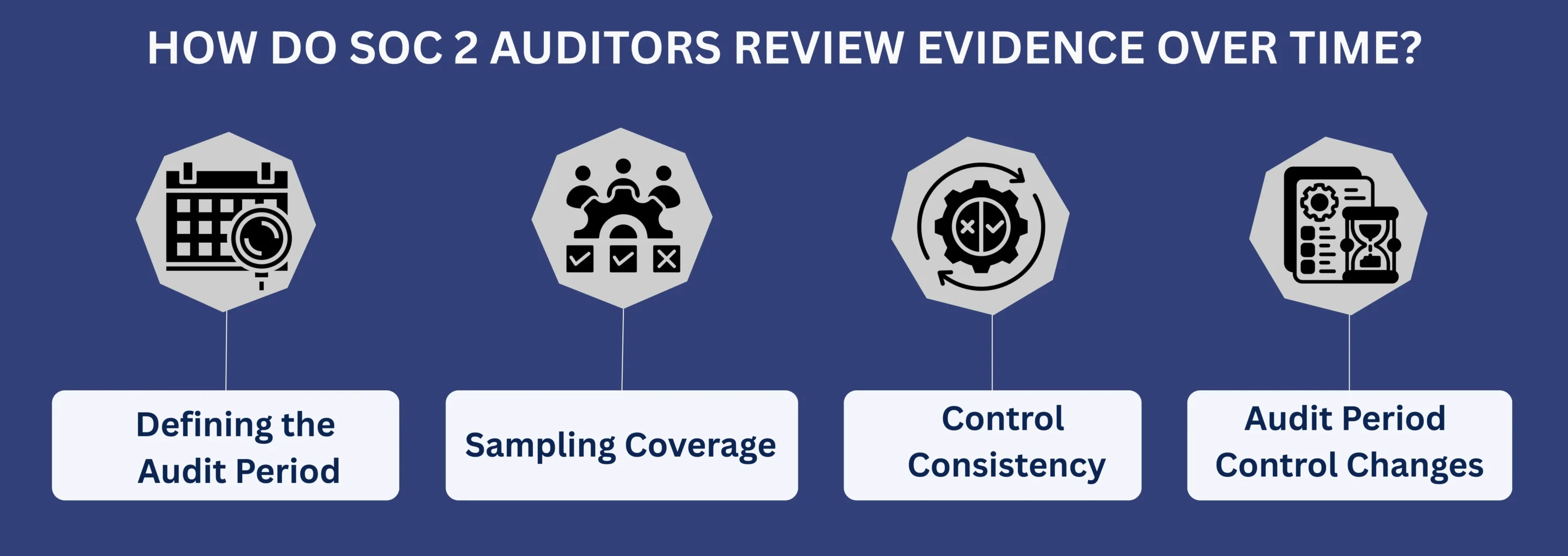
The temporal dimension of Type 2 work fundamentally shapes how SOC 2 auditors approach their evaluation. Grasping these time-based methods helps structure compliance programs effectively.
Defining the Audit Period
Your audit period establishes the exact timeframe when controls must prove they operated effectively. Most organizations choose six to twelve-month periods, though standards allow flexibility. SOC 2 examiners cannot issue Type 2 reports until this full period concludes. Controls implemented mid-period only receive attestation from their implementation date forward. Organizations engaging a SOC 2 compliance audit service should select the right performance period early during planning conversations.
Sampling Controls Across the Review Period
Rather than examining every control instance, SOC 2 auditors sample strategically. Sample sizes vary based on how often controls operate and risk levels. Daily controls need larger samples than quarterly ones because more instances occur. Additionally, auditors spread samples across the entire period rather than clustering them recently.
Evaluating Consistency of Control Performance
Auditors assess whether controls operated consistently throughout the review period. Significant fluctuations, exceptions, or declining remediation performance may indicate weak oversight or process immaturity. Significant exceptions or inconsistent performance may result in qualified opinions or disclosed control deviations within the final SOC 2 report.
Handling Changes in Controls During the Audit Period
During extended audits, organizations may modify controls. SOC 2 auditors assess both the original and updated versions, verifying that the changes underwent proper documentation, approval, testing, communication, and adherence to formal change management procedures.
TYPES OF EVIDENCE SOC 2 AUDITORS EXAMINE
SOC 2 auditors examine multiple evidence categories to evaluate control effectiveness throughout the audit period. Because different controls require different documentation, organizations must design evidence collection systems that consistently capture required evidence from day one.
| Evidence Category | Examples | Review Focus |
|---|---|---|
| Policies | Security policies and access standards | Approval dates and distribution records |
| System Logs | Authentication logs and change logs | Completeness, timestamps, and retention |
| Reviews | Access reviews and vulnerability scans | Frequency, findings, and remediation |
| Incidents | Tickets and response documentation | Detection time and resolution process |
| Vendors | Risk assessments and SOC 2 reports | Evaluation frequency and contract terms |
PREPARING FOR A SOC 2 TYPE 2 AUDIT
Thorough preparation significantly influences audit success and efficiency. Organizations that invest time before the formal engagement begins typically experience smoother examinations, fewer documentation gaps, and less disruption during fieldwork. Because a SOC 2 Type 2 audit evaluates how controls operate over time, preparation must focus on consistency, documentation, and accountability.
Aligning Controls Before the Audit Period Begins
Controls must operate consistently throughout the defined audit period. SOC 2 auditors cannot attest to control effectiveness for timeframes in which controls did not exist or were not functioning properly. Starting the audit period too early often results in evidence gaps that weaken the final report.
Many organizations conduct an internal audit or pre-audit readiness assessment before committing to a formal audit window. These assessments help identify policy gaps, incomplete procedures, missing documentation, and operational weaknesses. Addressing these issues before the audit period begins ensures that controls are functioning as designed when evidence collection starts.
Selecting the Right SOC 2 Audit Firm
Choosing the right audit firm is important. Since SOC 2 auditors evaluate control performance across an extended period, their familiarity with technology environments and evidence testing methods directly affects how smoothly the audit proceeds.
Experience With Technology Environments: SOC 2 auditors should understand the technologies your organization uses. Firms familiar with cloud platforms, DevOps workflows, containerized systems, and modern IT infrastructure can conduct more efficient reviews because they recognize common control implementations and risk areas. Their experience reduces unnecessary clarification requests and improves audit coordination.
Approach to Evidence Testing: Audit firms use different methodologies to test operating effectiveness. Some rely on automation and data analytics, while others emphasize manual sampling and walkthroughs. Understanding how a firm selects samples, evaluates logs, and reviews documentation helps set realistic expectations for evidence requests and timelines. It is also helpful to clarify how evidence will be submitted and organized during the engagement.
Professional Standards and Communication Practices: All SOC 2 auditors must follow AICPA attestation standards, but firms vary in internal quality controls and communication practices. Confirm that assigned personnel hold active CPA licenses and that the firm maintains strong review procedures. Clear communication throughout the audit period minimizes delays and improves collaboration.
Maintaining Evidence Throughout the Review Period
Continuous evidence collection is one of the most critical success factors in a SOC 2 Type 2 audit. Organizations should establish systematic processes to capture documentation as controls operate rather than attempting to reconstruct evidence retroactively.
Automated logging systems, ticketing platforms, access management tools, and monitoring software generate timestamped records that auditors prefer. Additionally, assign clear ownership for evidence collection and schedule regular internal reviews to confirm documentation completeness. Monthly or quarterly reviews help identify the missing evidence while there is still time to correct gaps.
Internal Roles and Responsibilities During the Audit Period
Although SOC 2 auditors conduct the examination, successful audits require coordination across multiple internal stakeholders.
Management’s Role: Management defines control objectives, allocates resources, approves policies, and responds to audit findings. At the conclusion of the engagement, management also provides written representations confirming the accuracy of information provided during the audit.
Control Owners and IT Teams: Control owners handle the daily execution of controls and maintain supporting evidence. These individuals may include IT administrators, security analysts, HR personnel, and department managers. Their consistency in documenting activities directly impacts the auditor’s ability to verify operating effectiveness.
Common Documentation Gaps Organizations Face
Even well-prepared organizations encounter recurring documentation challenges. Understanding common gaps helps reduce risk before the audit begins.
Frequent issues include missing evidence from the early months of the audit period, incomplete access review documentation without proof of remediation, change management records lacking approval signatures, incident response documentation without resolution details, and vendor risk assessments that were performed but not formally documented. In some cases, organizations possess the required evidence but struggle to retrieve it promptly when auditors request it.
Proactive documentation management and consistent review practices significantly reduce these risks and strengthen the overall audit outcome.
HOW DO THE EVIDENCE REVIEW AFFECTS THE COST OF SOC 2 AUDIT
The number of criteria included directly impacts testing volume. An audit covering only security requires less work than one addressing security availability, confidentiality, processing integrity, and privacy. Therefore, broader scopes increase the cost of SOC 2 audit engagements. Organizations should select criteria aligning with customer expectations and contractual requirements.
Longer periods require more evidence review and sampling. A twelve-month Type 2 examination involves more testing than a six-month one because controls must demonstrate sustained effectiveness over extended timeframes. However, longer periods provide more opportunity to demonstrate control maturity and consistency. Organizations new to SOC 2 often begin with shorter periods to limit initial costs and complexity.
In addition, well-organized evidence repositories significantly reduce audit costs because SOC 2 auditors spend less time searching for documentation. When organizations maintain structured folders with clear naming conventions, auditors locate requested items quickly. Properly indexing controls further improves efficiency. Conversely, disorganized evidence requires additional time for sorting and clarification, increasing billable hours. Furthermore, complete and accurate evidence reduces follow-up requests. Organizations that gather evidence throughout the audit period instead of rushing to do so at the end usually have smoother audits and lower costs.
Technical complexity also influences the cost of SOC 2 audit engagements. Organizations operating multiple data centers, complex cloud architectures, numerous third-party integrations, or custom applications require more extensive testing than those with simpler environments. SOC 2 auditors must understand system architectures, evaluate technical controls, and assess security configurations across all in-scope components. Additionally, distributed teams, multiple offices, and international operations introduce geographic complexity affecting audit logistics.
CONCLUSION
SOC 2 Type 2 audits demonstrate that compliance is a continuous process, not a point-in-time achievement, as described in the Trust Services Criteria. SOC 2 auditors check how well the controls are working over the entire examination period because their customers need to be sure that the operations remain secure all the time, not just at a single moment. Those organizations that view SOC 2 compliance as a continuous process, rather than a project, are more ready for an examination.
For many organizations, the process of preparing for the first independent CPA examination under SOC 2 helps improve internal processes. Maintaining continuous evidence, procedures, and control performance creates a structured system that supports sustained compliance. In the long run, the process of completing audit cycles becomes less of a disruption. Engaging an experienced licensed CPA firm helps organizations establish a structured compliance framework that supports ongoing audit readiness.
FAQ
How long does a typical SOC 2 Type 2 audit period last?
Most SOC 2 Type 2 audit periods span six to twelve months. Organizations select periods based on customer requirements, operational maturity, and readiness. Shorter periods reduce initial costs but may require more frequent renewals to maintain a current SOC 2 report.
Can SOC 2 auditors test controls that changed during the audit period?
Yes, SOC 2 auditors evaluate both original and modified control versions to verify each operated effectively during their respective timeframes. Organizations must document changes, including timing, rationale, testing, and approvals, to support auditor review and demonstrate appropriate change management throughout the period.
What happens if evidence is missing from part of the audit period?
Missing evidence creates gaps that SOC 2 auditors cannot ignore. Depending on significance, gaps may result in qualified opinions, extended audit periods to collect additional evidence, or recommendations to delay examination until documentation is complete. Continuous evidence collection prevents these issues and supports smoother audits.
What factors most significantly affect the cost of SOC 2 audit engagements?
The cost of SOC 2 audit depends primarily on scope breadth, audit period length, evidence organization quality, and system complexity. Organizations with well-documented controls, organized evidence repositories, and mature processes typically experience lower costs than those requiring extensive auditor time for evidence gathering and clarification.
How often should organizations get SOC audits?
Most organizations undergo SOC examinations annually. Enterprise customers generally expect a report that covers a recent 12-month period. After one year, procurement teams usually request an updated report for ongoing vendor risk assessment.