
WHAT IS THIRD - PARTY RISK MANAGEMENT (TPRM)? A COMPLETE PLAYBOOK

Imagine trusting a vendor with sensitive data, only to find out weeks later that they’ve been hacked, and your customer information is floating around the dark web. This is not some imaginary situation. Instead, such an event is a reality and is a headline for many companies in the modern business world. This is exactly why third – party risk management (TPRM) is essential for businesses.
In this globalized world, a vast majority of businesses are interdependent. They are increasingly outsourcing key business operations and entrusting their sensitive data to third parties. KPMG’s recent survey has found that more than 73% of their respondents had faced reputational risks due to inefficient third party risk management programs. A weak link in your vendor network can shut down your operations, damage your brand, or land you in trouble with regulators.
So, what exactly is third – party risk management (TPRM)? In simple terms, it’s the process of identifying, assessing, and mitigating risks arising from external partners. This includes vendors, suppliers, contractors, cloud providers, and even consultants. If they touch your data, your systems, or your customers, they’re part of your risk surface. Because if they fail to ensure a secure business, then it’s your problem too.
This playbook was created to make TPRM less overwhelming and more doable. It helps you understand what TPRM is and why it is vital now. Furthermore, it guides you on how to build a solid third – party risk management program that is suitable for your business. You’ll get a fully structured guide with clear steps, best practices, tools to adopt, and ways to measure progress.

Tl; DR:
Concern: Modern businesses rely heavily on vendors, cloud providers, and service partners to operate efficiently. But one weak link in this chain can expose sensitive data, disrupt operations, and damage reputation. Majority of organizations have faced reputational harm due to poor vendor risk management.
Overview: Third – Party Risk Management (TPRM) helps identify, assess, and control risks that arise from external partners. It covers everything from onboarding and monitoring to off – boarding vendors, ensuring regulatory compliance, cybersecurity resilience, and operational continuity.
Solution: A strong TPRM framework backed by governance, automation, and compliance certifications (like ISO 27001, SOC 2, GDPR, and HIPAA) turns risk into opportunity. CertPro supports businesses in simplifying compliance, securing vendor ecosystems, and building trust through structured, audit – ready programs.
WHAT IS THIRD PARTY RISK MANAGEMENT (TPRM)? A COMPLETE PLAYBOOK
Third – party risk management, or TPRM, is the process of identifying, assessing, monitoring, and reducing risks that come from external relationships. These third parties include vendors, contractors, suppliers, consultants, and service providers. So, basically, it includes anyone outside your organization who has access to your systems, data, or customers.
In today’s business world, nearly every company relies on others to deliver products or services. For instance, a bank might depend on a cloud provider to host customer data. Similarly, a manufacturer could source materials from overseas suppliers. Each connection adds efficiency but also creates risk. If one of these third parties fails, let’s say through a data breach, supply – chain delay, or compliance lapse, then your business too could face serious consequences.
While TPRM overlaps with vendor risk management (VRM), supplier risk, and broader supply chain management, it’s slightly wider in scope. To clarify, VRM often focuses on individual vendors and contracts. Conversely, supply chain risk looks at physical logistics and delivery.
TPRM ties them together, emphasizing ongoing oversight of all external relationships from a risk perspective. The main goals of a third – party risk management program are to protect compliance, strengthen security controls, maintain operational continuity, and safeguard brand reputation.
With increased outsourcing, cloud dependency, and regulatory scrutiny, businesses can’t just rely on their partners without proof. Thus, effective TPRM is required to know who you’re working with, what access they have, and how their actions affect your risk posture.
WHY THIRD – PARTY RISK MANAGEMENT IS IMPORTANT FOR BUSINESSES TODAY?
Third – party risk management (TPRM) has become one of the biggest concerns for modern businesses. In today’s interconnected economy, almost every company depends on a network of vendors, cloud providers, and service partners. This interconnected setup not only saves money and accelerates growth, but also creates opportunities for risks that are more difficult to identify or manage.
Cybersecurity risks are the most visible. For example, a single breach of a third – party platform can expose sensitive or customer data, as occurred when Qantas suffered a cyberattack via a platform used by one of its contact centers. The Guardian reported hackers leaked over 5 million customer records following that breach. Operational risk comes next. If a logistics partner fails, production or deliveries can stop overnight.
The next potential issues could be compliance and legal risks. This is particularly true for industries that are highly regulated and subject to strict rules, such as GDPR or financial outsourcing regulations, which hold businesses accountable for the mistakes of their vendors. Eventually, these issues will lead to a loss of reputation, too. When a vendor fails, the customer places the blame on you, not the vendor.
Regulators have made this clear time and again. Companies must take responsibility for their extended networks. Financial institutions, for example, must prove that their vendors handle data securely. Likewise, manufacturers face supply chain mandates. Even small tech firms handling EU data must meet GDPR’s third – party clauses.
Beyond compliance, though, good TPRM builds smarter businesses. To elaborate, it improves decision – making by giving leaders better visibility into who they work with. It strengthens resilience, cuts downtime, and helps control costs by preventing surprises. In the upcoming section, let’s learn about the key components of a TPRM lifecycle.
KEY COMPONENTS OF A TPRM LIFECYCLE
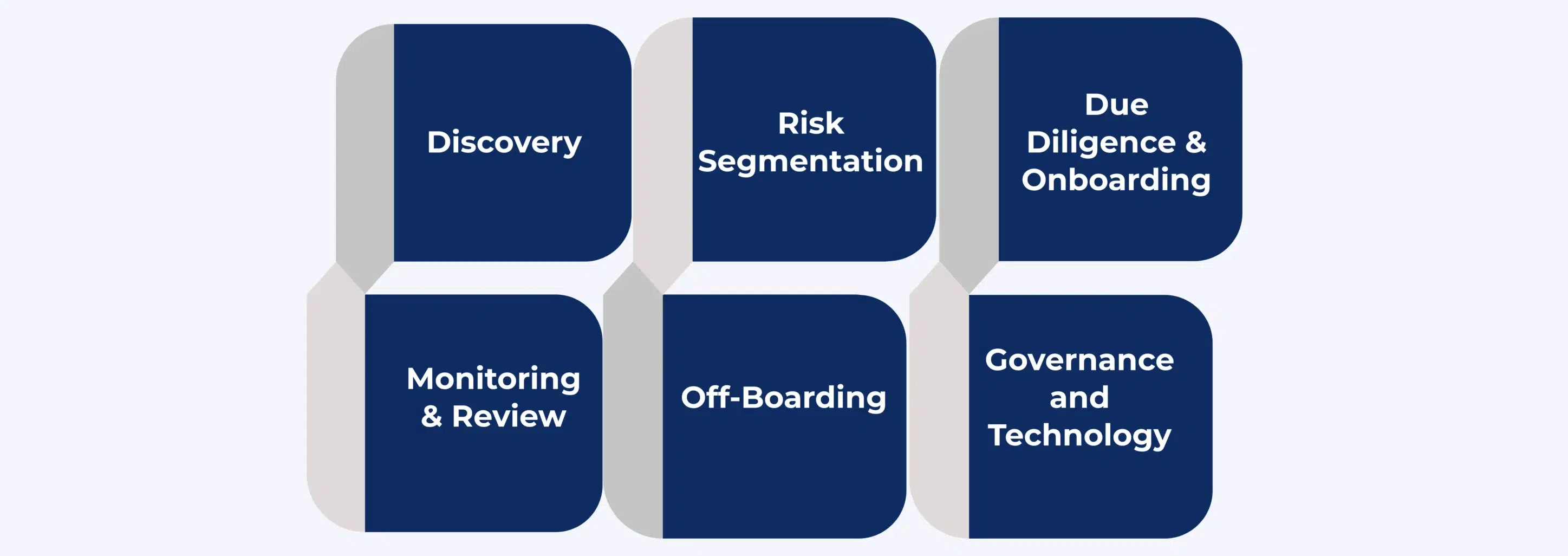
A strong third – party risk management (TPRM) program grows, adapts, and matures as your business and vendor ecosystem evolve. This lifecycle approach helps you manage every phase of a vendor relationship, from discovery to off – boarding, consistently and transparently.
Discovery
Everything starts with visibility. Many companies don’t even have a complete list of all their third – party vendors, especially when teams independently bring in new tools or contractors. Hence, the discovery phase focuses on identifying every vendor and capturing what services they provide, what data they access, and how critical they are to your operations.
Risk Segmentation
Once you’ve mapped your vendor profiles, the next step is to filter them by risk. Not all vendors pose the same threat. For instance, a catering service doesn’t hold the same risk as a cloud provider that manages customer data. You can then focus your attention and resources where they are most needed thanks to this segmentation.
Due Diligence & Onboarding
Before onboarding a vendor, you assess their controls, certifications, and contractual obligations. Thereby, you confirm that they meet your security, compliance, and operational standards. Skipping this step can expose your business to costly data breaches or compliance penalties later.
Monitoring & Review
Modern – day risks are dynamic and sophisticated. Therefore, what you need is a continuous monitoring method to keep a check on vendor performance, control changes, and emerging threats. Accordingly, regular reviews, performance reports, and alerts help you catch issues early.
Off-Boarding
Off – boarding carries equal importance as on – boarding in third – party risk management. When a vendor relationship ends, off – boarding ensures it’s done securely. Consequently, you must revoke system access, recover company assets, and verify data deletion processes. It’s also the time to reflect on the benefits and challenges involved while dealing with that particular vendor.
Governance and Technology
Behind every effective third party risk management program lie clear policies, defined roles, and shared accountability across procurement, risk, compliance, and IT teams. Technology ties it all together with automation, dashboards, and vendor portals that centralize risk data, saving time and improving accuracy.
A lifecycle mindset turns third party risk management from a compliance task into a business advantage, helping you build safer, more resilient vendor relationships.
BENEFITS OF THIRD-PARTY RISK MANAGEMENT
Third – party risk management (TPRM) has become a smart strategy for business growth in 2025. Companies that manage vendor risks effectively save money, strengthen resilience, and earn more trust from both regulators and customers. Here’s how a well – built TPRM program creates real value.
Better Regulatory Compliance
What it delivers: Clear audit trails, organized documentation, and transparent reports that keep regulators and boards satisfied.
Outcome: Faster audits, fewer compliance issues, and greater confidence from senior leaders.
Stronger Cyber Resilience
What it delivers: Ongoing monitoring of vendors and quick alerts when risky behavior appears.
Outcome: Lower chances of data breaches, faster incident response, and stronger data security across your supply chain.
Operational Continuity
What it delivers: Vendor segmentation based on risk, backup strategies, and ready – to – use crisis plans.
Outcome: Less downtime and quicker recovery when suppliers fail or regions face disruptions.
Smarter Decision – Making Through Automation
What it delivers: Automated evidence collection, data storage, AI – based risk scoring, and prioritized follow – ups.
Outcome: Less manual work, faster vendor onboarding, and clearer visibility into key risks.
Improved Vendor Performance
What it delivers: Vendor scorecards that connect performance, compliance, and sustainability measures.
Outcome: Higher accountability, better ESG insights, and a stronger, more trusted brand image.
A mature TPRM framework helps your business perform better, respond faster, and grow seamlessly rather than just protecting it.
HOW TO MEASURE SUCCESS AND CONTINUOUSLY IMPROVE TPRM
To make Third – Party Risk Management (TPRM) work well, focus on what truly matters and keep improving through real results and feedback.
Define Key Metrics and KPIs: Track simple, clear numbers that show how your vendor risk program performs. These include how many vendors you’ve assessed, their risk levels, the number of vendor – related incidents, how long it takes to fix issues, and the percentage of critical vendors under constant monitoring.
Reporting for Leadership: When reporting to senior leaders, skip the technical terms. Instead, highlight how vendor risks impact the business. For example, show how a vendor’s outage could delay product delivery or cause a compliance issue. Moreover, use short summaries, charts, or dashboards to make the message easy to understand.
Building Awareness: Treat TPRM as a shared responsibility of the firm. Therefore, utilize vendor scorecards to foster transparency, disseminate insights from incidents, and conduct periodic evaluations to gauge the progress of your program. Involve teams from procurement, IT, legal, and compliance so everyone stays aligned and informed.
Emerging Trends: Monitor emerging risks such as those posed by your vendors’ own suppliers, intricate digital networks, disruptions in the supply chain, and evolving regulatory requirements.
Businesses must realize that continuous improvement in third – party risk management is a process of staying alert, adapting quickly, and learning from every challenge along the way.
CONNECT WITH CERTPRO TO BUILD SECURED THIRD-PARTY RELATIONSHIPS
In today’s connected world, a single weak vendor can expose your business to cyber threats, financial loss, and reputational harm. Many organizations realize this only after a breach or compliance failure. The real loss is customer trust, operational disruption, and lasting brand damage. But, rather than focusing on just third – party risk management, businesses must strive to attain a secure business ecosystem that focuses on enterprise – level security in all domains. This could be achieved only through adhering to global compliance frameworks and regulatory standards.
At CertPro, we help you take control of vendor and regulatory risks with clarity and confidence. Our experts simplify compliance with global standards such as ISO 27001, SOC 2, GDPR, and HIPAA, helping you build a resilient and audit – ready third – party risk management program from day one.
This approach boosts investor confidence and accelerates growth for startups while providing established enterprises with continuity, regulatory assurance, and reduced supply chain risk. With CertPro, you gain a reliable partner focused on protecting your reputation, data, and customer relationships.
Start building a safer, compliant, and future – ready vendor ecosystem today. Partner with CertPro to strengthen your third – party risk management program.
FAQ
Who is responsible for third-party risk management?
Responsibility for third – party risk management is shared across the organization. Senior management sets strategy, procurement manages vendor engagement, IT oversees cybersecurity, and dedicated TPRM teams handle risk assessments and ongoing monitoring to ensure vendor compliance.
What are some examples of third-party risks?
Third – party risks include cybersecurity breaches, regulatory non – compliance, operational disruptions, financial instability, reputational damage, and supply chain failures. These risks can arise from vendors, suppliers, partners, or service providers impacting business continuity and data security.
What is the difference between TPRM and GRC?
TPRM focuses specifically on identifying and managing risks from third – party vendors and suppliers. GRC (Governance, Risk, and Compliance) is a broader framework encompassing overall organizational risk management, policies, compliance, and governance, including internal and external risks.
What is a TPRM lifecycle?
The TPRM lifecycle includes onboarding, ongoing monitoring, risk assessment, performance management, and offboarding of third – party vendors. This structured approach ensures continuous evaluation and mitigation of risks throughout the vendor relationship.
How do AI and Automation enhance third-party risk management?
AI and automation improve TPRM by speeding up risk assessments, providing real – time monitoring, analyzing large data sets for anomalies, automating compliance checks, and enabling predictive insights. This leads to faster decision – making and improved risk mitigation.
WHAT IS THIRD-PARTY RISK MANAGEMENT (TPRM)?
WHY THIRD-PARTY RISK MANAGEMENT IS IMPORTANT FOR BUSINESSES TODAY?
KEY COMPONENTS OF A TPRM LIFECYCLE
BENEFITS OF THIRD-PARTY RISK MANAGEMENT
HOW TO MEASURE SUCCESS AND CONTINUOUSLY IMPROVE TPRM
CONNECT WITH CERTPRO TO BUILD SECURED THIRD-PARTY RELATIONSHIPS
WHY RISK QUANTIFICATION MATTERS FOR SECURITY, COMPLIANCE, AND BOARD DECISIONS
Today, most companies deal with a complex security environment. Cloud tools, third-party vendors, and strict rules all add to their risk exposure. At the same time, boards and senior leaders need a clearer view of how those risks are being handled. Most traditional...
Data Breach Costs and Impact IN 2025: Global Insights for Business
A data breach can be defined as an incident where sensitive information is leaked or compromised by unauthorized users. In simple words, it happens when someone gets access to data they should not have. The data include customer records, employee files, payment...
SHADOW AI: DETECTION, RISK CONTROLS AND A PLAYBOOK FOR SAFE ENTERPRISE AI
Imagine that you are a busy team member rushing to meet a deadline. To complete the task, you have copied a chunk of sensitive project data and pasted it into a generative AI chatbot to “speed things up.” And as expected, you have also finished the tasks. The whole...