
WHO IS A COMPLIANCE AUDITOR? DEFINITION, ROLES, AND BUSINESS IMPACT

Most businesses don’t recognize the importance of a compliance audit until they lose a significant deal due to a buyer’s request for SOC 2. This phase is typically the point at which the role of a compliance auditor gains prominence.
In simple terms, a compliance auditor is an independent professional who checks whether your business adheres to all the relevant legal standards, internal governance policies, and industry – specific compliance frameworks. These rules can come from laws, contracts, or industry standards. For instance, consider a compliance auditor like a neutral referee who doesn’t play the game but makes sure everyone follows it.
The modern corporate world is characterized by strict regulations, evolving compliance frameworks, and sophisticated cyber attacks. In this era, to run a business in a safe and secure manner, compliance audits are essential.
If you sell software, handle sensitive data, or work with global clients, compliance sits right in your path. Moreover, both regulators and customers demand proof of your cybersecurity posture. In this context, a promise on your website isn’t enough anymore. They want authentic evidence, such as reports and certificates gained from a structured compliance audit process.
Most companies start searching for a compliance auditor only after a security incident. Most often, it’s a new regulation or a customer security questionnaire that lands in the inbox. At other times, the sales team may be unable to proceed because a prospect has requested compliance with SOC 2, ISO 27001, GDPR, HIPAA, or PCI DSS. At that point, compliance stops being a theory and becomes an urgent business requirement.
In this blog, you’ll learn what a compliance auditor actually does day to day. Next, you’ll see how audits work in real life and understand why this role affects revenue, risk, and trust.

Tl; DR:
Concern: Businesses often postpone compliance until a security incident occurs or they encounter a regulatory fine. A lost enterprise deal, a failed security review, or a sudden regulatory request often exposes gaps. By then, teams rush, remediation costs escalate, and trust suffers. Compliance becomes reactive instead of planned.
Overview: A compliance auditor is an independent professional who checks whether your business truly follows required laws, standards, and contracts. They review policies, test controls, identify gaps, and issue proof that customers and regulators trust. Their role directly affects risk, sales velocity, credibility, and long – term growth. For SaaS, healthcare, and data – driven companies, audits like SOC 2, ISO 27001, GDPR, HIPAA, and PCI DSS are necessary.
Solution: Working with the right compliance auditor early changes outcomes. CertPro acts as a strategic audit partner, not just an examiner. As a registered CPA firm, CertPro helps you scope audits, prepare controls, test evidence, and deliver trusted reports. These actions result in fewer risks, faster enterprise deals, and stronger governance. Acting early with an experienced compliance auditor like CertPro turns compliance from a growth blocker into a clear business advantage.
WHAT IS A COMPLIANCE AUDITOR?
A compliance auditor is someone who checks whether your business is actually following the rules it claims to follow. To elaborate, they look at how work gets done, how data moves, and how decisions are documented. Then they compare that nature of daily operations against laws, standards, and contractual obligations.
At its core, the role is simple. A compliance auditor reviews your policies, controls, and evidence to confirm they match regulatory, legal, and industry requirements. If something doesn’t fall in line, they call it out. If it does, they document it clearly. As a result, their work becomes proof you can show regulators, customers, and partners.
Such an inspection is different from a general internal audit. Internal audits usually focus on efficiency, cost, or internal risk. Moreover, they’re often done by your own internal security team. Compliance audits are about accountability. They ask, “Are you meeting external regulatory requirements?” and “Can you prove it?” That difference matters when a customer, investor, or authority is watching.
There are two common types.
- Internal compliance auditors work inside the company and help teams prepare for audits and find gaps early.
- External compliance auditors come from independent firms, who provide an unbiased opinion and issue formal reports.
- Most certifications and regulatory audits require an external auditor.
Many industries rely on compliance auditors every year. SaaS companies need them for SOC 2 and ISO 27001. Healthcare firms depend on them for HIPAA. In this context, if your company handles personal data of EU citizens, then you are obliged to follow GDPR.
KEY ROLES AND RESPONSIBILITIES OF A COMPLIANCE AUDITOR
A compliance auditor’s job is to govern and lead the whole compliance audit process.
- Planning and Scoping: First, the compliance auditor plans the audit by defining which systems are included in the audit scope and the standards that will be followed. Additionally, they identify the areas within your business structure that could potentially pose risks. Thus, a competent auditor doesn’t look at everything. They focus on areas that affect business growth and trust.
- Policy Review: Next, they review your policies, procedures, and controls. But they don’t read them in isolation. They ask a simple question: Does this paper reflect what people really do? Day – to – day business fails to adhere to relevant security policies. Auditors are trained to spot that gap quickly.
- Testing Controls: Then comes the process of testing your security controls. For operational controls, an auditor might check how user access is approved or how incidents are handled. In parallel, for technical controls, they could review your logs, system settings, and evidence from tools. In a SOC 2 audit, these steps could mean testing access reviews or change management records over several months.
- Gap Identification: After testing, the compliance auditor identifies gaps, risks, and nonconformities. This part can feel uncomfortable, yet it carries real business value. In an ISO 27001 Annex A review, for example, a missing risk assessment, is a signal that decisions may lack structure.
- Reporting: Reporting is not about recording issues on a page. An experienced compliance auditor explains what failed, why it matters, and how it affects the business. For instance, in GDPR, these steps could mean showing how weak consent tracking creates regulatory exposure.
- Validating Remediations: Finally, there’s follow – up. Auditors validate fixes and confirm they function as intended. When remediation is done right, audits stop feeling like hurdles. They start acting as safeguards that keep growth stable.
CORE SKILLS AND QUALIFICATIONS OF A COMPLIANCE AUDITOR
A strong compliance auditor won’t depend on tools or templates. Rather, they start with real in – depth knowledge. To clarify, they understand the rules that apply to your business and how they show up in your daily work. That means knowing regulations, frameworks, and standards well enough to explain them in plain language. SOC2, ISO 27001, and GDPR aren’t just acronyms for them. Moreover, they know what each one expects and why it exists.
Technical knowledge matters, but it’s only part of the job. A competent compliance auditor also thinks about risk. They look at a system and ask, “What could go wrong here?” Consequently, they trace that risk back to controls, people, and decisions.
Communication is another core skill. Auditors write reports, but more importantly, they explain them. They know how to speak with engineers, legal teams, and founders without losing the point.
Certifications help signal this depth. Expert compliance auditors hold CISA credentials and are ISO Lead Auditors. For SOC engagements, a CPA license is often required to show formal training and accountability.
Trust also comes through accreditation and licensing. Accredited auditors follow strict rules and standards. In contrast, inexperienced or unqualified auditors can miss serious gaps or raise false alarms. Both outcomes waste time and money.
To sum up, a skilled compliance auditor brings clarity. They don’t add noise. They help you see where you stand and what actually needs attention.
BUSINESS IMPACT OF A COMPLIANCE AUDITOR
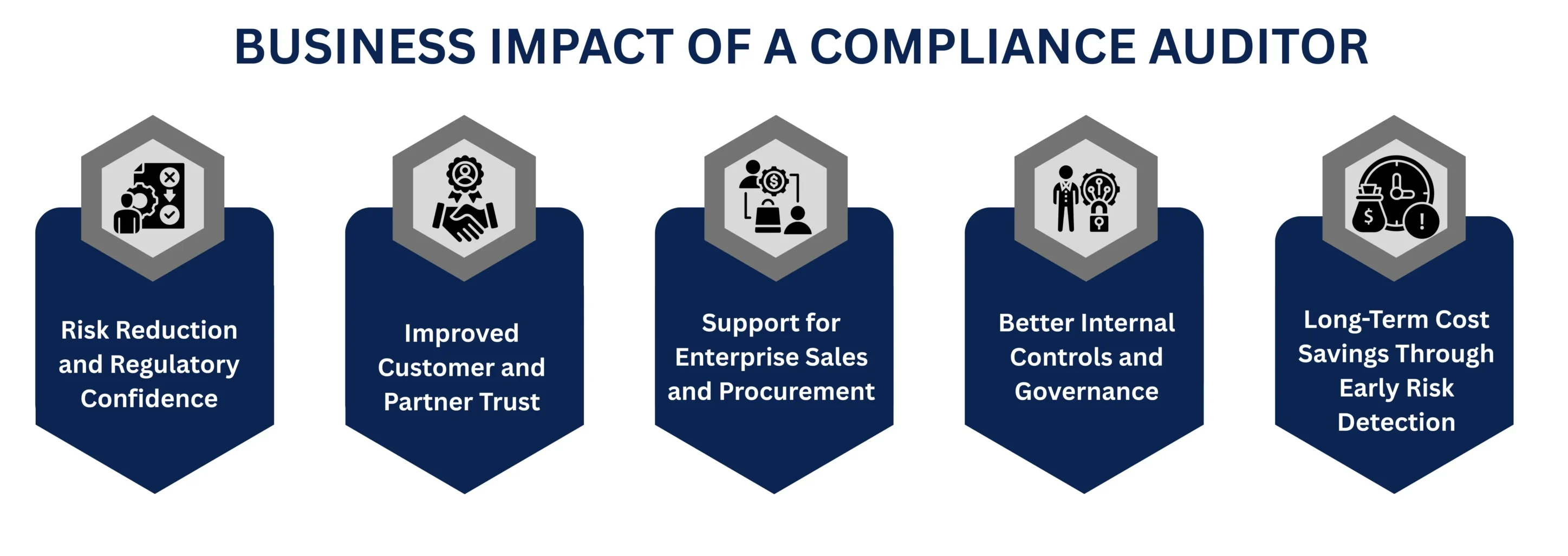
A compliance auditor’s impact shows up where it matters most. These areas include risk management, trust building, and sales deals. This section explains how their work directly shapes real business outcomes.
Risk Reduction and Regulatory Confidence
A compliance auditor helps you spot problems before they turn serious. They look at how rules apply to your daily work and where things could fail to follow them. This reduces surprises during external regulatory audits. Therefore, your firm could stay secure once an independent compliance auditor has reviewed your posture.
Improved Customer and Partner Trust
One unanswered security question can stall a deal and deteriorate your long – earned trust. A compliance auditor gives you proof in the form of clear reports and certificates to demonstrate the thoroughness of your cybersecurity posture with your partners and regulators.
Support for Enterprise Sales and Procurement
Enterprise buyers move slowly and ask numerous security questions. Procurement teams want authentic evidence to seal the deal. A compliance auditor helps you meet those demands faster. In particular, SOC 2 reports and ISO certificates help you accelerate enterprise business deals.
Better Internal Controls and Governance
Auditors guide you on identifying weak access reviews, unclear ownership, and missed approvals. These insights help leaders resolve how work flows inside the company. Over time, teams act with more structure and discipline. As a result, your business decisions become clearer, and accountability improves without adding challenges.
Long – Term Cost Savings Through Early Risk Detection
Resolving small security issues early costs less than fixing big failures later. A compliance auditor helps catch risks while they’re still manageable. That saves money on fines, rework, and emergency consulting. More importantly, it protects your business momentum.
CONCLUSION
Compliance today is a core business requirement. Business deals could slow down, buyers might hesitate to collaborate with you, and regulators could fine you for not meeting their expectations.
This is where CertPro steps in with expertise and intent. CertPro works as a strategic compliance audit partner and registered CPA firm. Our auditors understand how startups and growing businesses actually operate. We know tight timelines, limited teams, and real pressure from regulators and customers. That context shapes how we audit, report, and deliver recommendations.
With CertPro, you get licensed, experienced auditors who speak plainly and focus on what matters. Furthermore, we specialize in SOC 2, ISO 27001, GDPR, and HIPAA audits. We help you define a clear audit scope, guide you in control implementation, test controls, create audit reports, and help you gain compliance certifications.
If compliance is blocking growth, delaying it will only cost more later. The smarter move is to act early, with the right partner, like us. Talk to CertPro. Let’s turn compliance from an obstacle into a growth lever your business can rely on.
FAQ
What does a compliance auditor do?
A compliance auditor checks whether a business follows required laws, standards, and contracts. They review policies, test controls, examine evidence, and report gaps. Their work helps companies prove trust, reduce risk, and pass customer or regulatory reviews.
How many years does it take to become a compliance auditor?
It usually takes three to five years. This includes a relevant degree, hands – on audit or risk work, and exposure to standards like SOC 2 or ISO 27001. Many auditors build experience first, then add certifications.
What is the difference between a financial audit and compliance audit?
A financial audit checks whether financial statements are accurate. Meanwhile, a compliance audit checks whether a business follows rules, laws, and standards. Financial audits focus on numbers, while compliance audits focus on processes, controls, and evidence.
How to get into compliance auditing?
Start with a background in IT, risk, accounting, or security. Gain experience in controls, policies, and audits. Then work on compliance projects and pursue certifications. Many auditors begin in internal audit, security, or risk roles.
What are the certifications that boost the value of a compliance auditor?
Common certifications that increase a compliance auditor’s value include CISA, ISO 27001 Lead Auditor, and, for SOC 1 and SOC 2 engagements, a licensed CPA credential. These demonstrate formal audit training and credibility, and they help auditors qualify for regulated, high ‑ assurance engagements and contribute to reports that enterprise customers and regulators rely on for trust and assurance.

GRC IN CYBERSECURITY: WHAT IT MEANS AND WHY IT MATTERS IN 2026
In 2026, the pressure on companies to manage cyber risk responsibly has never been greater. Regulators demand structured controls, boards want clear risk reporting, and threat actors are becoming more sophisticated. Against this backdrop, GRC in cybersecurity has...
HOW COMPLIANCE AUDIT SOFTWARE IMPROVES AUDIT READINESS
Today, most companies deal with a growing number of compliance regulations. From data privacy standards to security frameworks like SOC 2 and ISO 27001, the list of compliance obligations keeps expanding. At the same time, regulators and external auditors now expect...

Compliance Best Practices in 2026: How to stay ahead of regulatory changes
Why is the implementation of compliance best practices critical for 2026? Compliance in 2026 demands operational proof, not the documentation intent. Regulations change faster, audit scrutiny is higher, and reporting timelines are tighter across privacy,...