
To ensure a complete assessment of your organization’s procedures and compliance during a surveillance audit, careful attention to important areas is essential. That’s not what happens after implementing any management standard. It must go through an audit by a certified auditor in order to be certified. It takes a lot of work for both your business and the certification authorities to maintain the certification itself. The process of managing compliance is continuous. It doesn’t stop. Certification authorities conduct an annual audit to see if the businesses are following the laws and regulations.
Particularly, they will be appointing an auditor who will be coming to the company to check if the company meets the key requirements and whether the management system is functional or not. The company’s policies, practices, and controls are carefully evaluated throughout the auditing process. Key areas, including financial reporting, internal controls, risk management, and legal compliance, are all thoroughly examined by the auditor. To ascertain if the business is running in accordance with the stated standards, they examine the documentation, conduct staff interviews, and evaluate the use of established processes.
Despite the fact that these audits are quite thorough, they do not examine all aspects of the organizations. This article discusses surveillance audits, how they benefit businesses, why they should be carried out, and, most importantly, the important factors we should take into account while conducting surveillance audits.
For example, during a surveillance audit ISO 27001, auditors focus on the ongoing effectiveness of information security controls, while in ISO 9001 or ISO 45001, attention may shift toward process consistency and employee safety practices. This balance ensures that each system’s unique intent, whether security, quality, or safety is being continuously upheld.

WHAT IS A SURVEILLANCE AUDIT?
In simple words, Surveillance audits are annual audits that are done by auditors appointed by certification bodies. In order to make sure that organizations remain true to the rules and standards that were originally set, surveillance audits will be carried out regularly. These audits act as a means of continuous observation and assessment, enabling the confirmation of a company’s sustained compliance with regulations and the efficacy of its management system. These audits help organizations sustain compliance with the standards. By doing so, these organizations can demonstrate their commitment to meeting regulatory requirements and industry standards consistently. These audits can also help organizations by introducing a culture of continuous improvement. By reviewing them periodically and assessing the management system, companies can address the risks of non – compliance, non – conformities, and so on. They also play a crucial role in risk management. They allow organizations to evaluate the effectiveness of risk mitigation.
In the case of a surveillance audit ISO 27001, the process is designed to confirm that an organization’s Information Security Management System (ISMS) continues to function as intended. Similarly, surveillance audits for ISO 9001 and ISO 14001 focus on verifying that quality and environmental controls remain effective year after year. Typically, these audits take a sample – based approach, auditors don’t review every control or clause but concentrate on high – risk areas, previously identified nonconformities, and any major operational changes since the last audit.
SCOPE AND OBJECTIVES OF THE SURVEILLANCE AUDIT
A surveillance audit’s scope and goal usually concern the continuing evaluation and confirmation of a management system’s adherence to a certain set of standards or regulations. Here is an explanation of each component:
The Scope, According to the needs of the management system being audited, the scope of a surveillance audit can be restricted to specific departments, functions, or locations, and it defines the audit’s boundaries and point of focus by specifying the specific processes, activities, or areas within the organization that will be examined during the audit.
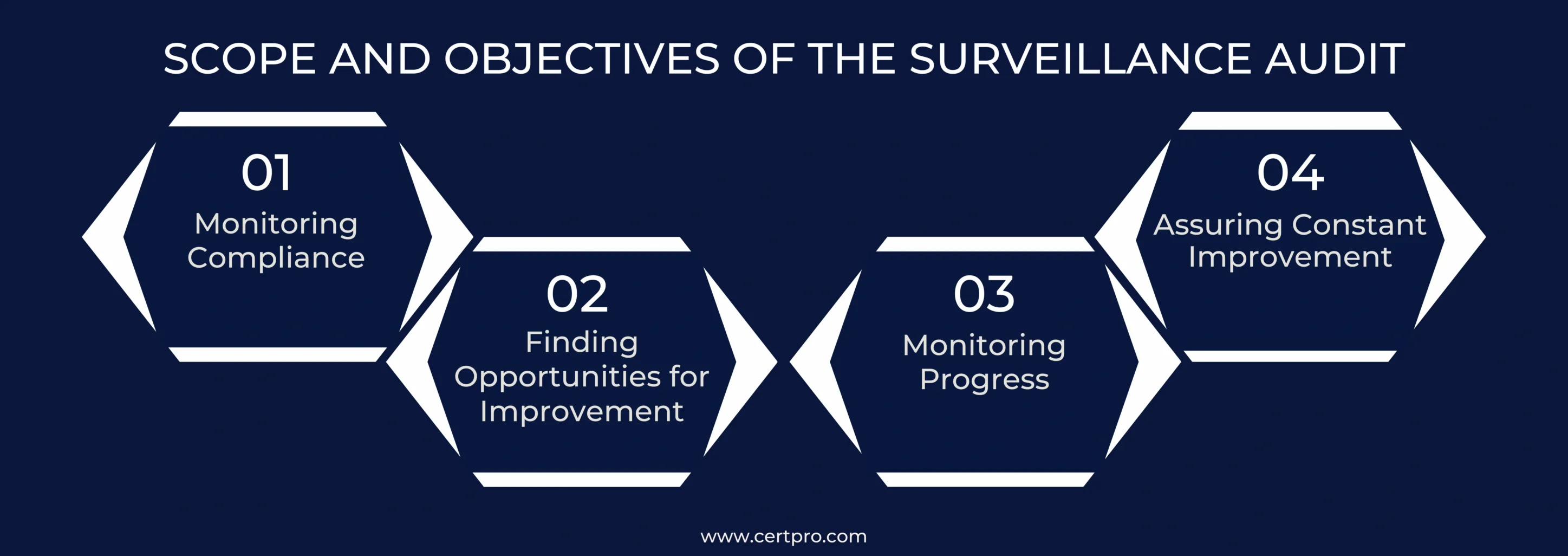
The Objectives, A surveillance audit’s goal is to evaluate the management system that is the subject of the audit’s ongoing conformance and effectiveness. The main objectives are:
- Monitoring Compliance: The audit seeks to confirm that the organization continues to abide by the pertinent standards, laws, or specifications. It checks to see if the predefined procedures, processes, and controls are still being carried out successfully.
- Finding Opportunities for Improvement: The surveillance audit looks for opportunities to enhance the management system. It could identify any flaws, vulnerabilities, or inconsistencies in the system and make suggestions for remedies.
- Monitoring Progress: By carrying out routine surveillance audits, auditors may keep track of how well the organization is doing at resolving non – conformities from earlier audits or chances for improvement. It enables the monitoring of the application and efficiency of remedial measures.
- Assuring Constant Improvement: The goal of surveillance audits is in line with the idea of constant development. It encourages a continual dedication to improving the management system’s functionality, effectiveness, and efficiency over time.
During a surveillance audit ISO 27001, for instance, the auditor may review how effectively the organization has closed previous audit findings related to access control or risk assessment. In contrast, ISO 9001 surveillance audits might evaluate the effectiveness of corrective actions in quality control processes. Across all standards, the emphasis remains the same, ensuring that the management system remains dynamic, relevant, and capable of supporting long – term compliance.
THE CRITERIA AND STANDARDS TO BE REVIEWED
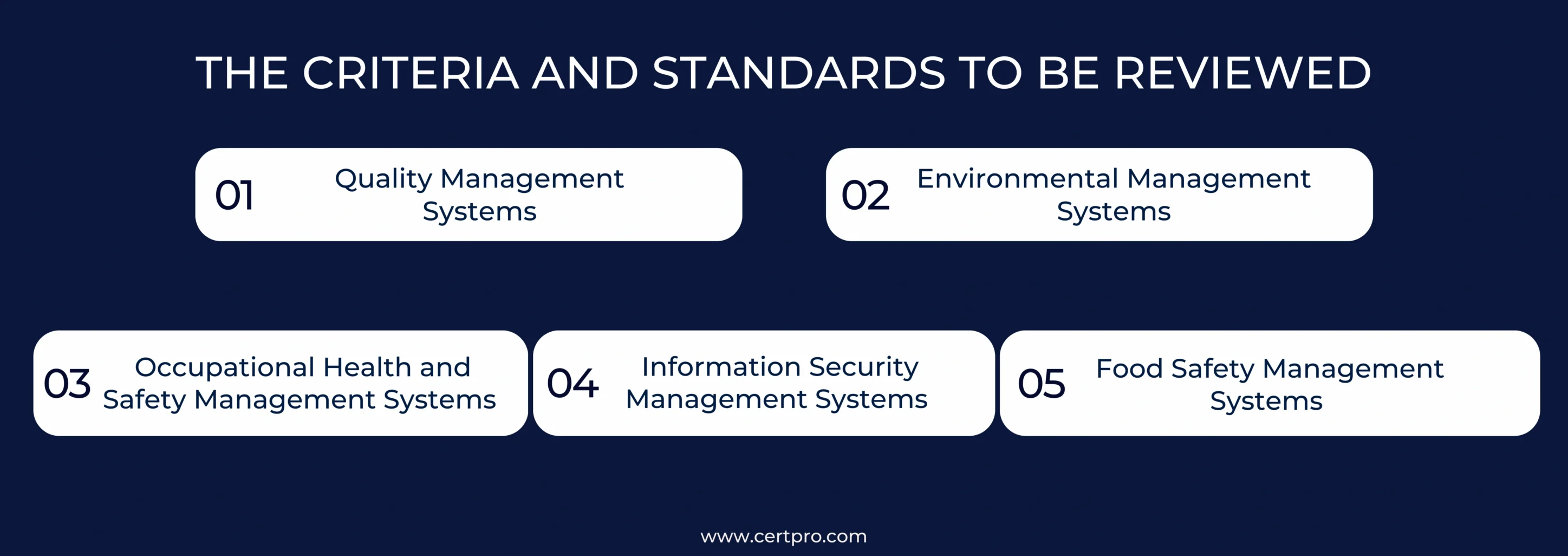
Depending on the particular management system or framework being audited, there may be differences in the criteria and standards to be examined during a surveillance audit. Here are several standards and criteria that are often audited across various domains:
1. Quality Management Systems (ISO 9001):
- Compliance with ISO 9001 requirements
- Implementation of quality policy and objectives
- Customer satisfaction and feedback
- Control of processes and documented procedures
- Corrective and preventive actions
- Management review of the quality management system
2. Environmental Management Systems (ISO 14001):
- Compliance with ISO 14001 requirements
- Identification and assessment of environmental aspects and impacts
- Implementation of environmental objectives and targets
- Monitoring and measurement of environmental performance
- Management of environmental incidents and emergencies
- Legal and regulatory compliance related to environmental aspects
3. Occupational Health and Safety Management Systems (ISO 45001):
- Compliance with ISO 45001 requirements
- Hazard identification, risk assessment, and risk control
- Implementation of health and safety policies and objectives
- Training and competence of employees
- Incident reporting and investigation
- Emergency preparedness and response
4. Information Security Management Systems (ISO 27001):
- Compliance with ISO 27001 requirements
- Risk assessment and treatment of information assets
- Implementation of information security controls
- Security awareness and training programs
- Incident management and response
- Monitoring and review of information security performance
5. Food Safety Management Systems (ISO 22000):
- Compliance with ISO 22000 requirements
- Hazard analysis and critical control points (HACCP)
- Prerequisite programs for food safety
- Implementation of food safety plans
- Verification and validation of control measures
- Management of food safety incidents and product recalls
There are many other standards and criteria that, depending on the particular business, sector, or management system being audited, may be pertinent. Before performing a surveillance audit, it is crucial to determine the appropriate standards and criteria unique to the setting of your firm. Addressing these common issues before a surveillance audit ISO 27001 or any other standard helps organizations maintain compliance readiness and demonstrate their commitment to continual improvement.
WHAT IS AUDIT EVIDENCE
The information and associated documentation that auditors acquire and examine during an audit to serve as a foundation for their findings and views are referred to as audit evidence. It consists of written or verbal assertions, financial statements, records, internal controls, and other pertinent information. For the following reasons, audit evidence is crucial to the auditing process:
- Audit evidence is crucial for supporting the auditor’s findings, conclusions, and opinions. It offers a foundation for evaluating the fairness, correctness, and compliance with applicable rules and regulations, as well as the efficiency of internal controls of the financial statements.
- Audit evidence ensures the audit process’s neutrality and dependability. Accurate and verifiable facts can support auditors opinions, which lessens the possibility of subjectivity or prejudice.
- The assertions made in the financial statements, such as their completeness, correctness, existence, rights and duties, and valuation, are assessed using audit evidence. It makes it possible for auditors to assess if the financial statements are accurately presented and devoid of significant errors.
- It enables auditors to create working papers that serve as an accurate and thorough record of the steps taken, the findings drawn, and the reasoning behind those conclusions. Audit evidence also makes it easier for managers, internal quality assurance teams, or external regulatory agencies to assess the audit work.
The audit process needs certainty and credibility, which is where audit evidence comes in. It aids in the development of audit views, raises the credibility of financial data, and assures adherence to legal and auditing standards. In modern surveillance audits, particularly under ISO 27001, auditors rely increasingly on digital evidence such as system access logs, change management records, and incident reports. Likewise, ISO 9001 and ISO 45001 auditors may depend on dashboards, automated logs, and training records to verify that processes are being monitored effectively.
THE TYPES OF EVIDENCE THAT ARE USEFUL DURING AN AUDIT
A variety of types of evidence may support the auditor’s conclusions and recommendations during an audit. Auditors may depend on several sorts of evidence, including:
- Documentary Evidence: Written records, including financial statements, invoices, contracts, bank statements, receipts, and other supporting papers, are referred to as documentary evidence.
- Physical Evidence: Auditors can inspect and verify tangible goods, assets, or properties as physical evidence. To verify their presence, state, or value, goods, machinery, or other assets may need to be physically inspected.
- Oral Evidence: While this evidence may be helpful for understanding processes and controls, it is generally regarded as less reliable than documentary evidence and is frequently corroborated with other types of evidence.
- Electronic evidence: In the current digital era, electronic evidence is extremely important. Emails, databases, system logs, electronic transactions, and other digital sources are all included. Auditors can study electronic evidence and judge the trustworthiness, correctness, and completeness of electronic data using specific tools and methods.
These are a few types of audit evidence. It’s crucial to remember that auditors frequently compile a variety of pieces of evidence and assess their adequacy, appropriateness, and dependability. The integration of various types of data provides a comprehensive and well – rounded basis for developing audit judgments and conclusions. Whether it’s a surveillance audit ISO 27001 focusing on data protection or an ISO 9001 review emphasizing process quality, a well – organized evidence repository digital or physical ensures smoother audit execution and stronger compliance posture.
FAQ
What is the purpose of a surveillance audit ISO certification?
A surveillance audit verifies that an organisation continues to meet the requirements of its ISO – certified management system after initial certification, maintaining compliance and driving continual improvement rather than simply re – certifying.
How does a surveillance audit differ from a certification audit?
A certification audit is the comprehensive first assessment for ISO – certification, while a surveillance audit is a periodic, less extensive review focused on ongoing adherence and corrective actions between full certification cycles.
What steps should you follow to conduct an ISO surveillance audit?
Prepare by reviewing scope and prior findings, conduct opening meeting, execute audit with sampling of processes and controls, hold closing meeting, report nonconformities, and monitor corrective actions for continual improvement.
What is an ISO 27001 surveillance audit and why is it important?
An ISO 27001 surveillance audit assesses an organisation’s ongoing Information Security Management System (ISMS) to ensure risk – treatment plans, controls and documentation remain effective and aligned with evolving threats and standard requirements.
What is the difference between monitoring and an audit in compliance practices?
Monitoring is continuous observation of processes in real time, while an audit is a periodic, independent evaluation of processes and controls to confirm compliance and effectiveness.

About the Author
GANESH S
Ganesh S, an expert in writing content on compliance, auditing, and cybersecurity, holds a Bachelor of Arts (BA) in Journalism and Mass Communication. With a keen eye for detail and a knack for clear communication, Ganesh excels in producing informative and engaging content in the fields of compliance, auditing, and cybersecurity, with particular expertise in ISO 27001, GDPR, SOC 2, HIPAA, and CE Mark.
WHAT IS CONTROL TESTING? A PRACTICAL GUIDE FOR COMPLIANCE AUDITS

AUDIT SAMPLING EXPLAINED: WHY AUDITORS TEST ONLY SELECTED EVIDENCE

How CertPro Conducts an Effective SOC 2 Type II Audit: A CPA-Led Playbook for SaaS
A SOC 2 Type 2 examination results in an independent CPA - issued attestation report on whether your controls are suitably designed and operated effectively over a period of time. It’s based on the AICPA Trust Services Criteria. This requirement is essential, as in...