The rise and growth of AI technology is reaching unprecedented levels. Microsoft’s recent report has stated that more than 85% of Fortune 500 firms are using AI tools in their key business operations. And the CEOs have reported that they are experiencing measurable benefits from using AI tools. Specifically in improving operational efficiency and customer satisfaction. Businesses have learned to use AI in making smarter and faster decisions. From automating hiring to IT help desks, AI is everywhere. But the real question is how are these firms ensuring AI ethics? When systems are built and used carelessly, they can cause serious damage. Similarly, using AI systems with a lack of proper governance structure could pose risks regarding the ethics of AI. These risks include unfair decisions made out of biased AI systems, lack of transparency, and data privacy. For example, biased AI tools deny deserving candidates due to inaccurate data. And your AI-driven credit scoring system flags users unfairly due to outdated data
These technical glitches will ultimately lead to discrimination, lost customer trust, public backlash, and legal trouble. To summarize, overlooking AI ethics and bias results in major financial and reputational consequences for businesses. This is where ISO/IEC 42001 gains prominence. It’s a pioneering standard that guides businesses in ethical AI governance.
In this blog, let’s understand how ISO 42001 certification can help your business reduce bias, avoid legal risks, and build long-term trust with customers, partners, and regulators. You may be an AI developer, an AI service provider, or a decision-maker who relies on AI tools. This blog will guide you through the process of turning ethical risks into competitive advantages.

WHAT IS AI ETHICS AND WHY DO BUSINESSES NEED ETHICAL AND UNBIASED AI SYSTEMS?
UNDERSTANDING ISO 42001 AND WHY IT MATTERS FOR AI GOVERNANCE
KEY ISO 42001 PRINCIPLES TO TACKLE AI ETHICS AND BIAS
ISO 42001 TECHNICAL CONTROLS AND OPERATIONAL PRACTICES TO REDUCE BIAS
BENEFITS OF IMPLEMENTING ISO 42001 FOR COMPLIANCE AND TRUST
Tl; DR:
Concern: AI is powering everything, from hiring tools to credit scoring systems to IT help desks. But without proper controls, it can also cause bias, privacy violations, and unfair decisions that break trust, invite lawsuits, and destroy reputations. Today, even one bad AI call can put your entire business at risk.
Overview: ISO/IEC 42001:2023 is the first international standard focused on AI ethics, governance, and bias control. It gives your business a structured way to develop and use AI responsibly, with principles like transparency, accountability, risk management, and fairness. It helps you avoid costly compliance mistakes and meet regulations like the EU AI Act, GDPR, and more.
Solution: CertPro helps you get ISO 42001 certified with ease. We help you remove bias from AI, follow global rules like ISO 27001, and build trusted, audit-ready systems without slowing down your work. Delaying ethical AI will definitely cost you more in the long run. Conversely, early adopters gain trust, meet compliance faster, and stand out in the market. Work with CertPro to build AI that earns trust.
WHAT IS AI ETHICS AND WHY DO BUSINESSES NEED ETHICAL AND UNBIASED AI SYSTEMS?
AI ethics is all about using artificial intelligence in a fair, transparent, and respectful way that values human rights. It asks simple but powerful questions like, “Is this AI decision fair? Is it safe? Can it be explained?”
Algorithmic bias, on the other hand, happens when an AI system makes unfair decisions because of incorrect data, poor design, or biased assumptions. That’s what biased AI does. It picks patterns from limited or one-sided data and applies them blindly. Let’s look at real examples. A hiring tool trained mostly on male resumes started rejecting female applicants. Facial recognition software misidentified people based on colors. These are more than normal glitches; they’re harmful, costly, and deeply unfair.
When AI goes wrong, the damage is real. Businesses can face lawsuits, regulatory fines, public shame, and massive loss of trust. One poor AI decision can ruin years of your hard work. Because of these risks, the world is already pushing for ethical AI frameworks. The EU AI Act demands strict rules for high-risk AI. The OECD principles urge fairness, transparency, and accountability in AI systems. Governments and industry leaders now know that building AI without ethics is like building a house on sand.
Hence, balancing innovation by combining AI and ethics is mandatory for safety, success, and sustainability. And that’s exactly where global standards like ISO 42001 certification can help you stay ahead.
UNDERSTANDING ISO 42001 AND WHY IT MATTERS FOR AI GOVERNANCE
ISO/IEC 42001:2023 is the world’s first international standard for managing Artificial Intelligence (AI) in organizations. Consider it a smart blueprint for building systems based on the ethics of AI. This is particularly true when business decisions, customer trust, and legal exposure heavily depend on AI. ISO 42001 certification is a management system standard, unlike guidelines that merely recommend best practices. That means it gives you a clear framework to plan, control, and improve how AI is developed and used inside your company. It’s not just about writing the ethics of artificial intelligence, but also putting them into action.
With this standard, businesses can build transparent, accountable, and auditable systems based on AI ethics. You’ll know who’s responsible for what, how AI decisions are made, and how risks are handled. And if something goes wrong, you’ll have documented proof showing you acted responsibly. Such a process is necessary for ensuring both legal and reputational safeguards.
Here are three key goals of ISO 42001 certification:
- Ethical oversight by making sure AI decisions are fair and respect human rights
- Managing AI risks by identifying and fixing possible harms before they reach users
- Making sure your AI systems are ready to meet global rules like the EU AI Act.
It’s also worth noting that ISO standards aren’t new to this space. As a globally trusted body, it created famous standards like ISO 27001 for information security. To add on, ISO 42001 blends with these information security guidelines, helping companies to create a unified system that covers data, AI ethics, security, and compliance. Therefore, ISO 42001 certification helps you turn AI risk into responsible innovation, and that’s something every forward-thinking business needs today.
KEY ISO 42001 PRINCIPLES TO TACKLE AI ETHICS AND BIAS
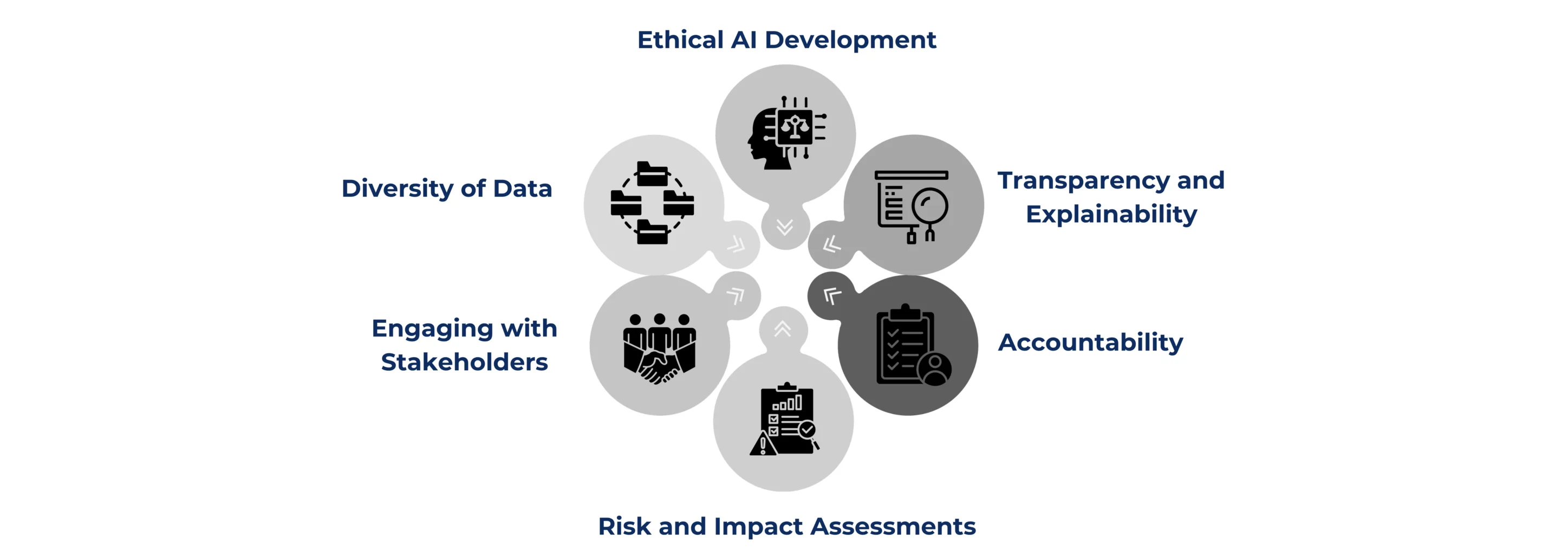
ISO 42001 standards have well-structured principles to guide organizations on upholding AI ethics. Following these further helps your firm to stay audit-ready for the upcoming ethical AI frameworks in the future.
Ethical AI Development: If you are developing an AI model, make sure that it is built upon AI ethics. To clarify, it must respect the rights of people and uphold privacy and fairness in its decisions. For example, your AI tool for customer success must treat all its users equally irrespective of their gender and background.
Transparency and Explainability: AI-based decisions in your firm must not be a mystery. You must be able to explain how and why the system did something. In simple terms, your AI system must show how it has arrived at a certain decision.
Accountability: Clear roles must be defined to administer the AI-based functions. Someone in your firm must be responsible for what AI does. You can’t simply blame it and shy away from being accountable.
Risk and Impact Assessments: Regularly check and update your AI systems to identify and fix weaknesses based on bias. In this context, consistent risk management and mitigation plans are ideal for ensuring AI ethics in your firm.
Engaging with Stakeholders: Involve all the key parties in making decisions regarding the use of AI. Communicate with the users, employees, customers, investors, and vendors. Consequently, ask for their feedback on AI systems, and include them in your process of ensuring ethics and AI.
Diversity of Data: While building AI models, strive for ensuring AI ethics by design. One way of achieving this is by training your AI tools on diverse and real-world data to avoid biased decisions.
Now that we’ve explored the principles, let’s look at the technical side of how they translate into practice with Annex A controls.
ISO 42001 TECHNICAL CONTROLS AND OPERATIONAL PRACTICES TO REDUCE BIAS
Following ISO 42001:2023 Annex A controls play a major role in understanding AI ethics. It provides hands-on tools to deal with one of AI’s biggest threats: bias and unfair outcomes. These technical controls help you build AI systems that work fairly for everyone. A big focus is on diversifying datasets. This is because biased data leads to biased decisions. If your AI is trained only on data from one group, say, young men, it might treat women or older adults unfairly. Therefore, Annex A urges you to include a wide range of real-world data so your AI learns to treat all users equally.
But good data alone isn’t enough. You need to catch bias early and often. That’s where the need for bias detection methods and ongoing monitoring comes in. Annex A encourages the use of fairness metrics, audits, and test cases to track how AI behaves. If your model starts favoring one group over another, you’ll catch it before it causes harm. Documentation and traceability also hold equal importance here. Businesses must understand the exact process of AI decision-making and being able to explain it. Such clarity builds trust with users, regulators, and stakeholders. It also gives you cover when something goes wrong.
ISO 42001 certification is built to connect with data privacy laws like GDPR, information security standards like ISO 27001, and quality management systems like ISO 9001. That makes integration easier and compliance smoother. Hence, Annex A of ISO has 38 technical controls that focus on addressing
- Protecting personal data
- Avoiding discrimination
- Making AI decisions visible and traceable
- Assigning clear roles for AI management
- Documenting everything they perform to ensure accountability
When businesses address these issues diligently, they can build a strong foundation for upholding AI ethics in their key operations.
BENEFITS OF IMPLEMENTING ISO 42001 FOR COMPLIANCE AND TRUST
Just informing that your business follows AI ethics is no longer enough. You need to demonstrate that ethical AI frameworks genuinely guide the development and application of your systems and processes. This is where ISO 42001 certification helps you the most. It is a well-structured way to show your customers and regulators that you are committed to upholding the ethics of artificial intelligence. By following it, you can avoid bias, protect user rights, and build fair AI algorithms. And these factors are crucial if your firm operates in industries like healthcare, finance, and HR where trust is everything.
Moving forward, following the principles of AI ethics also helps you reduce legal risks. Global regulations like the EU AI Act are getting stricter. So, if your AI causes harm, you could face heavy fines or lawsuits. But with ISO 42001 certification, you’ll have a clear record showing that your systems meet global expectations in AI ethics. Furthermore, we knew that your customers want assurance that they are not judged or mistreated by the AI tools. By following ISO 42001 standards, you are sending a clear sign to your customers, partners, and investors regarding your commitment to AI ethics. Thereby building trust and credibility. Moreover, it positions your brand as a responsible innovator. You’re not just using AI; rather, you’re using it wisely. That sets you apart in a noisy, competitive market. Finally, it brings structure and clarity to your AI processes.
You’ll know who is responsible for what and how to fix problems fast. That saves time, avoids confusion, and makes your entire AI operation run smoother. Hence, obtaining ISO 42001 certification is your ultimate investment for building trust and safety with the ethics of artificial intelligence.
PARTNER WITH CERTPRO FOR ETHICAL AND AUDIT-READY AI SYSTEMS
If you still consider it the future, then you are mistaken. Because it is already making a huge impact on reality. This rapid growth has also paved the way for stricter regulations, customer concerns regarding privacy, and ethical issues. Yes, even one wrong or biased AI decision is enough to cripple your reputation, trust, and credibility. This is why investing in ISO 42001 certification becomes essential to avoid compliance failure and reputational damage. Furthermore, we must not deny the fact that no business has fully understood AI. As a result, many businesses are struggling to manage or regulate AI effectively. We understand your concerns. What you need is an expert to guide you in this AI compliance process and explain how your business can uphold the principles of AI ethics.
At CertPro, we understand that managing AI responsibly is complex, especially for startups and enterprises striving to scale. Many businesses are still learning how to regulate and govern AI effectively. This is where CertPro excels as your ISO 42001 assessment and certification partner for audit-ready clients.
We specialize in verifying and certifying your AI management systems against ISO 42001 requirements. Our process is transparent, efficient, and aligned with your business objectives.
CertPro isn’t just a certification provider. We’re your strategic partner in auditing AI to ensure safety, fairness, and compliance. Delaying this process of following ethical AI frameworks will throw you out of a market filled with huge opportunities. So, stop thinking and start taking action. Connect with CertPro today for an impeccable ISO 42001 certification process. Thereby, build ethical, trusted, and bias-free AI systems.
FAQ
What are examples of ethical AI?
Ethical AI includes systems designed to be fair, transparent, inclusive, and privacy-focused. Examples include hiring algorithms trained on diverse datasets to reduce bias, explainable AI models that show how decisions are made, and tools that protect user privacy by design.
What is the black box problem in AI?
The black box problem refers to AI systems, especially deep learning models, where it’s hard to understand how they arrive at specific decisions. This lack of transparency makes it difficult to ensure fairness, explain outcomes, or hold systems accountable.
What are the pillars of ethical AI?
The main pillars of ethical AI include transparency, fairness, privacy, accountability, reliability, and sustainability. These principles help ensure that AI systems respect human rights, avoid bias, and function safely in real-world settings.
What is AI ethics and governance?
AI ethics involves the values and moral principles guiding how AI is designed and used. The policies, processes, and oversight mechanisms that align AI systems with legal, ethical, and societal expectations are known as AI governance.
What is ISO AI risk management?
ISO AI risk management refers to standards like ISO/IEC 23894, which help organizations identify, assess, reduce, and monitor risks related to AI systems throughout their lifecycle. It ensures that AI is deployed responsibly, safely, and in line with legal and ethical standards.

About the Author
Abhijith Rajesh
Abhijith Rajesh is an Associate Manager at CertPro, specializing in ISO 27001, SOC2, GDPR, and other Information Security Compliance standards. He leads a dedicated team, ensuring the delivery of top-tier information security solutions. Abhijith excels in managing projects, optimizing security frameworks, and guiding clients through the complexities of the ever-evolving threat landscape.