
ISO 42001 Certification in Christchurch
CertPro is a Licensed CPA Firm conducting independent ISO 42001 certification audits for organizations in Christchurch, New Zealand. CertPro assesses, verifies, and issues ISO 42001 Certification to businesses that demonstrate conformance with the AI Management System (AIMS) requirements established in ISO/IEC 42001:2023. ISO 42001 Certification in Christchurch is available to organizations across all industries that develop, deploy, or operate AI-based products and services.
OUR CLIENTS










What Is ISO 42001 Certification?
ISO 42001 Certification is the formal, third-party attestation that an organization’s Artificial Intelligence Management System (AIMS) conforms to the requirements of ISO/IEC 42001:2023 — the first internationally recognized standard specifically designed to govern the development, deployment, and operation of AI systems. Certification is issued by an accredited or licensed certification body following a structured audit process that independently evaluates the organization’s policies, controls, risk management practices, and governance structures for AI. ISO 42001 Certification in Christchurch provides organizations with externally verifiable evidence that their AI operations are governed responsibly, ethically, and in alignment with international best practices.
Definition and Scope of ISO 42001
ISO/IEC 42001:2023 is the international management system standard that establishes requirements for an Artificial Intelligence Management System (AIMS). The standard was formally published in December 2023 by the International Organization for Standardization (ISO) in collaboration with the International Electrotechnical Commission (IEC). It applies to any organization — regardless of size, sector, or geographic location — that develops, provides, or uses AI-based products and services as part of its operations.
The scope of ISO 42001 encompasses the full lifecycle of AI systems, from initial design and data governance through model development, deployment, monitoring, and decommissioning. The standard addresses four foundational dimensions of AI governance: risk management, transparency, accountability, and ethical AI operation. Organizations seeking ISO 42001 Certification must define the boundary of their AIMS — specifying which AI systems, processes, and organizational units fall within the scope of certification — and demonstrate that this scope is adequately governed by documented controls and management practices.
Unlike prescriptive technical regulations, ISO 42001 is a management system standard. This means it establishes what an organization must achieve — responsible AI governance outcomes — rather than dictating specific technical implementations. This approach makes the standard applicable to organizations using any type of AI technology, from machine learning and natural language processing to computer vision and predictive analytics. The standard also integrates with other ISO management system standards, including ISO 27001 (information security) and ISO 9001 (quality management), enabling organizations to adopt a harmonized approach to governance and certification.
ISO 42001 Certification vs. ISO 42001 Compliance
ISO 42001 compliance refers to an organization’s internal conformance with the requirements of the standard — achieved through self-assessment, documentation, and operational implementation of AIMS controls. ISO 42001 Certification, by contrast, is the formal, externally verified attestation of that conformance, issued by an independent, licensed certification body following a structured third-party audit. These two concepts are distinct and serve different purposes within an organization’s AI governance program.
ISO 42001 compliance alone does not constitute certification and cannot substitute for third-party attestation in contexts where independent verification is required — such as enterprise procurement, regulatory submissions, or cross-border AI governance declarations. ISO 42001 Certification in Christchurch, issued by CertPro as a Licensed CPA Firm, provides organizations with a formal certificate backed by the authority of an independent audit. This distinction is particularly important for Christchurch organizations operating in regulated sectors such as healthcare, financial services, and public administration, where stakeholders require verified evidence of AI governance conformance rather than self-declared compliance statements.
Who Developed ISO 42001 and Why It Matters
ISO/IEC 42001:2023 was developed through a collaborative process involving ISO’s Joint Technical Committee JTC 1, Subcommittee SC 42, which is specifically dedicated to Artificial Intelligence standardization. The development involved contributions from national standards bodies, industry experts, governments, and academic institutions across more than 50 countries. New Zealand participated in the international standardization process through Standards New Zealand, reflecting the country’s commitment to responsible AI governance at a national level.
The standard was developed in direct response to the absence of a globally recognized framework for AI risk management, transparency, and ethical governance. Prior to ISO 42001, organizations deploying AI faced fragmented regulatory landscapes — individual national regulations, sector-specific guidelines, and voluntary codes of conduct — with no single internationally recognized management system standard against which they could certify. ISO 42001 fills this gap by establishing a consistent, internationally auditable framework. Organizations in Christchurch and globally can use this framework to demonstrate responsible AI governance to customers, regulators, investors, and the public.

ISO 42001 and the AI Management System (AIMS) Framework
The AI Management System (AIMS) is the structured organizational framework required by ISO 42001 to govern all AI-related activities within a defined scope. An AIMS is not a software platform or a single policy document — it is a comprehensive management system that integrates AI governance into an organization’s operational processes, risk management practices, and organizational culture. Building and maintaining an effective AIMS is the foundation of ISO 42001 Certification. CertPro’s ISO 42001 audit in Christchurch evaluates the completeness and operational effectiveness of an organization’s AIMS across all required components.
Core Components of an AI Management System
An ISO 42001-conformant AI Management System comprises interconnected components that collectively establish governance, oversight, and accountability for AI systems throughout their lifecycle. The core components include: organizational context and stakeholder analysis, AI policy and objectives, roles and responsibilities, risk and opportunity assessment, AI impact assessment, operational controls, performance evaluation, and continual improvement mechanisms. Each component must be documented, implemented, and demonstrably operational for an organization to achieve ISO 42001 Certification.
Organizational context requires the organization to identify internal and external factors that affect its AI governance obligations, including applicable laws and regulations, stakeholder expectations, and the nature of the AI systems it operates. In Christchurch, this includes New Zealand’s Privacy Act 2020, the Office of the Privacy Commissioner’s guidance on automated decision-making, and emerging expectations from the New Zealand Government’s Algorithm Charter. The AI policy must clearly articulate the organization’s commitment to responsible AI, define governance objectives, and be communicated to all relevant personnel and stakeholders.
AI Risk Assessment and Impact Assessment Requirements
ISO 42001 requires organizations to conduct both AI risk assessments and AI impact assessments as distinct but complementary processes within the AIMS. The AI risk assessment identifies risks to the organization arising from its AI operations — including risks to data integrity, system reliability, and security — and determines appropriate controls to manage those risks. The AI impact assessment evaluates the potential effects of AI systems on individuals, groups, and society, addressing dimensions such as fairness, bias, privacy, and human rights implications.
For Christchurch organizations, the AI impact assessment is particularly relevant given New Zealand’s strong data privacy framework and public expectations around the use of AI in sensitive sectors such as healthcare, education, and public services. The standard requires that impact assessments be conducted before new AI systems are deployed, reviewed when AI systems undergo significant changes, and documented in a manner that supports audit verification. CertPro’s ISO 42001 audit evaluates whether risk and impact assessments are methodologically sound, consistently applied, and integrated into the organization’s decision-making processes for AI deployment.
Operational Controls and Performance Monitoring
Operational controls within the AIMS define how AI systems are developed, tested, deployed, and monitored in a manner consistent with the organization’s AI policy and governance objectives. These controls address areas including data quality and governance, model documentation and explainability, human oversight mechanisms, incident management, and supplier and third-party AI governance. Each control must be implemented in practice — not merely documented — and must be verifiable through audit evidence such as records, logs, and demonstrated operational procedures.
Performance monitoring requires organizations to define measurable indicators for AI governance effectiveness, conduct periodic internal audits of the AIMS, and subject the management system to regular management review. Monitoring outcomes — including nonconformities, incidents, and corrective actions — must be documented and used to drive continual improvement of the AIMS. The standard’s continual improvement requirement ensures that ISO 42001 Certification represents an ongoing commitment to AI governance excellence, not a one-time compliance exercise. This aligns with the long-term operational needs of technology companies and institutions pursuing AI management system certification in Christchurch.
Why ISO 42001 Certification Matters for Christchurch Organizations
Christchurch has emerged as one of New Zealand’s most active technology and innovation ecosystems, with a growing concentration of SaaS companies, agritech innovators, health technology providers, research institutions, and digital infrastructure organizations. As AI adoption accelerates across these sectors, the demand for demonstrable AI governance has intensified — driven by enterprise customers requiring supplier AI governance evidence, regulators increasingly scrutinizing automated decision-making, and the public expecting transparency in AI-powered services. ISO 42001 Certification in Christchurch provides organizations with the formal, internationally recognized evidence of responsible AI governance that these stakeholders require.
Christchurch’s Technology Ecosystem and AI Governance Needs
Christchurch’s technology sector has grown significantly since the post-earthquake rebuild, with the city developing a distinct identity as a hub for deep technology, agritech, and innovation-driven enterprise. Organizations such as software development firms in the Addington and Sydenham precincts, research spinouts from the University of Canterbury and Lincoln University, and health technology companies serving both domestic and international markets are increasingly integrating AI into their core operations. For these organizations, ISO 42001 Certification in Christchurch represents a competitive differentiator and a foundational governance credential.
The Christchurch technology sector’s export orientation amplifies the importance of internationally recognized AI governance certification. Organizations supplying AI-powered products and services to customers in Australia, Europe, North America, and Asia face growing requirements to demonstrate conformance with recognized AI governance standards. ISO 42001 Certification — as a globally recognized, independently audited standard — provides Christchurch organizations with a governance credential that is accepted across these markets. This supports export growth and international business development without requiring market-specific compliance programs for each jurisdiction.
Regulatory Context: New Zealand Privacy Act and AI Governance
New Zealand’s Privacy Act 2020 establishes obligations for organizations handling personal information, including information processed by AI systems. The Office of the Privacy Commissioner has issued specific guidance on automated decision-making and the use of AI in privacy-sensitive contexts, reflecting regulatory concern about the governance of AI systems that process personal data. ISO 42001 compliance directly supports an organization’s ability to demonstrate Privacy Act conformance by establishing documented controls for data governance, AI impact assessment, and individual rights management within the AIMS framework.
New Zealand’s Algorithm Charter for Aotearoa New Zealand — voluntarily adopted by numerous government agencies — establishes expectations for transparency, explainability, and human oversight in algorithmic decision-making. While the Charter applies directly to government agencies, its principles have influenced procurement expectations across the public sector supply chain, including many Christchurch-based organizations that supply technology services to government. Achieving ISO 42001 Certification in Christchurch provides a structured, auditable framework that aligns with the Charter’s governance principles and supports organizations in demonstrating conformance with public sector AI governance expectations.
ISO 42001 Certification Requirements
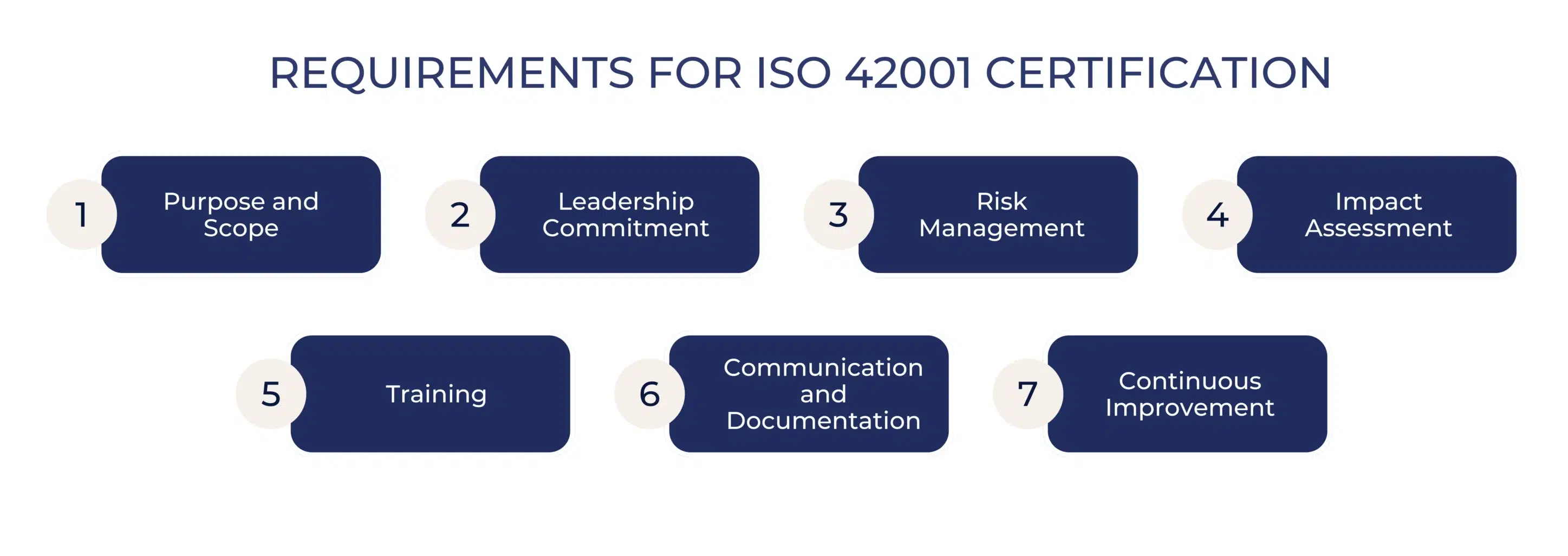
To achieve ISO 42001 Certification in Christchurch, organizations must satisfy the requirements established across all clauses of ISO/IEC 42001:2023. The standard is organized using the High-Level Structure (HLS) common to all ISO management system standards, comprising ten clauses: Scope, Normative References, Terms and Definitions, Context of the Organization, Leadership, Planning, Support, Operation, Performance Evaluation, and Improvement. Clauses 4 through 10 contain the normative requirements that must be met for certification eligibility.
ISO 42001 requires organizations to maintain documented information sufficient to demonstrate the effective planning, operation, and control of their AI Management System. Mandatory documented information includes: the scope of the AIMS, the AI policy, AI risk assessment methodology and results, AI impact assessment results, AI objectives and plans to achieve them, evidence of competence of personnel responsible for AI governance, operational planning and control records, internal audit results, management review outputs, and records of nonconformities and corrective actions. Each document must be controlled, versioned, and available for inspection during the ISO 42001 audit.
Documentation requirements extend to the AI systems themselves. Organizations must maintain system documentation covering the purpose and intended use of each AI system within scope, data sources and data governance practices, model design and training documentation where applicable, testing and validation records, deployment and configuration records, and monitoring and incident logs. This AI system documentation forms the evidentiary foundation of the ISO 42001 audit and enables auditors to verify that governance controls are operationally implemented — not merely stated in policy.
ISO 42001 places explicit requirements on top management to demonstrate leadership and commitment to the AIMS. Top management must establish and communicate the AI policy, assign accountability for AI governance roles and responsibilities, ensure adequate resources for AIMS implementation and maintenance, and promote a culture of responsible AI within the organization. The standard requires that at least one senior role is formally designated with overall accountability for AI governance — comparable to a Chief AI Officer or AI Governance Lead — with defined authority and reporting lines to top management.
Leadership requirements also extend to the management review process. Top management must conduct periodic reviews of the AIMS to assess its continuing suitability, adequacy, and effectiveness. Management reviews must consider inputs including changes in internal and external context, AI governance performance indicators, risk and impact assessment outcomes, audit findings, and recommendations for improvement. Outputs from management reviews — including decisions on AIMS improvements, resource needs, and policy updates — must be documented and tracked to completion. CertPro’s ISO 42001 assessment evaluates the management review process as a key indicator of organizational commitment to AI governance maturity.
Technical requirements under ISO 42001 address the operational governance of AI systems across their full lifecycle. Organizations must implement controls for AI system design and development — including requirements for data quality, bias assessment, fairness evaluation, and explainability — as well as controls for deployment, including human oversight mechanisms and operational monitoring. The standard also requires organizations to establish incident response procedures for AI-related failures, unexpected behaviors, or adverse outcomes, including processes for reporting, investigating, and remediating AI incidents.
- ✓Defined AIMS scope covering all in-scope AI systems and organizational units
- ✓Documented AI policy approved by top management and communicated organization-wide
- ✓Assigned AI governance roles with formal accountability and reporting structures
- ✓Completed AI risk assessment using a documented, consistent methodology
- ✓Completed AI impact assessments for all in-scope AI systems
- ✓Operational controls for data governance, model documentation, and human oversight
- ✓Internal audit program with qualified internal auditors and documented findings
- ✓Management review records demonstrating top-level AIMS oversight
- ✓Corrective action process for addressing nonconformities and audit findings
- ✓Continual improvement mechanisms integrated into AIMS operational cycles
- ✓Documentation Requirements
- ✓Leadership and Governance Requirements
- ✓Technical and Operational Requirements
The ISO 42001 Certification Process
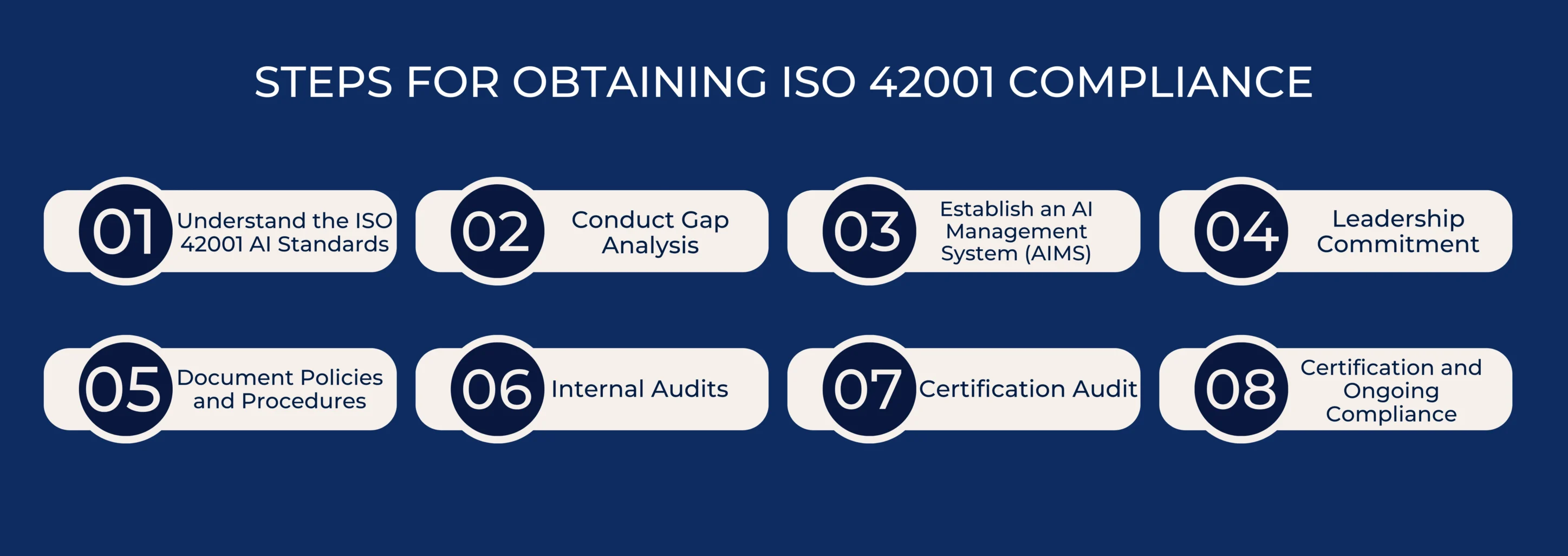
The ISO 42001 certification process follows a structured, multi-stage audit methodology conducted by CertPro as a Licensed CPA Firm. Each stage is designed to independently evaluate the organization’s AIMS against the requirements of ISO/IEC 42001:2023, progressing from scope determination and documentation review through operational audit, certification decision, and ongoing surveillance. Organizations seeking ISO 42001 Certification in Christchurch complete the following stages in sequence.
The certification process begins with the organization formally defining the scope of its AIMS — specifying which AI systems, business processes, organizational units, and geographic locations fall within the certification boundary. Scope definition is a critical determinant of audit complexity and certification cost, and must accurately reflect the organization’s AI operations to produce a meaningful certification outcome. Organizations submit a certification application to CertPro specifying the proposed scope, organizational details, and relevant contextual information about their AI systems.
CertPro reviews the application to determine the appropriate audit program — including audit duration, team composition, and audit methods — based on the complexity of the defined scope, the types of AI systems involved, and the organization’s existing management system maturity. This audit program determination is communicated to the organization prior to Stage 1 audit commencement, ensuring transparency about the process and enabling appropriate organizational preparation.
The Stage 1 audit is a documentation and readiness review conducted by CertPro auditors to assess whether the organization’s AIMS documentation is complete, adequate, and aligned with the requirements of ISO/IEC 42001:2023. During Stage 1, auditors review the AIMS scope statement, AI policy, risk and impact assessment methodology and results, documented procedures and controls, and records of internal audits and management reviews. The Stage 1 audit identifies areas where documentation is insufficient or where the AIMS does not yet meet the standard’s requirements — before the more intensive Stage 2 audit commences.
Stage 1 audit findings are communicated to the organization in a formal findings report, which identifies any documentation gaps or areas requiring attention prior to Stage 2. The Stage 1 audit does not result in a certification decision — it is an evaluative checkpoint that ensures the organization is sufficiently prepared for the operational audit. Organizations that address Stage 1 findings within an agreed timeframe proceed to Stage 2 scheduling. Organizations with significant documentation deficiencies may require a re-assessment of Stage 1 materials before Stage 2 commences.
The Stage 2 audit is the principal operational assessment during which CertPro auditors evaluate whether the organization’s AIMS is implemented, operational, and effective in practice. Stage 2 auditors conduct interviews with personnel across AI governance roles, review operational records and system documentation, observe AI governance processes in operation, and test the effectiveness of implemented controls against the requirements of ISO/IEC 42001:2023. The Stage 2 audit assesses conformance across all applicable clauses of the standard, with particular focus on risk and impact assessment implementation, operational controls, monitoring and measurement, and continual improvement.
Stage 2 audit findings are classified as major nonconformities (where a requirement of the standard is not met or a control is absent), minor nonconformities (where a requirement is partially met or a control is implemented inconsistently), or observations (improvement opportunities that do not constitute nonconformities). Major nonconformities must be resolved before a certification decision can be made. Minor nonconformities are addressed through a documented corrective action plan submitted to CertPro for review. The ISO 42001 audit in Christchurch conducted by CertPro uses evidence-based evaluation methods to ensure certification decisions are grounded in objective audit findings.
Following completion of the Stage 2 audit and resolution of any major nonconformities, CertPro’s certification decision process is initiated. The audit team’s findings are reviewed by CertPro’s independent certification decision-maker — who is separate from the audit team to ensure impartiality — and a certification decision is made based on the totality of audit evidence. Successful organizations receive an ISO 42001 certificate specifying the certified AIMS scope, the certification standard version (ISO/IEC 42001:2023), and a certification validity period of three years.
ISO 42001 Certification is maintained through annual surveillance audits conducted during years one and two of the three-year certification cycle. Surveillance audits evaluate the continued effectiveness of the AIMS, verify closure of previously identified nonconformities, and assess any significant changes to the organization’s AI systems or governance practices. At the end of the three-year cycle, a recertification audit is conducted to renew the certificate for a further three-year period. CertPro conducts surveillance and recertification audits for all ISO 42001 certified organizations in Christchurch as part of the ongoing certification relationship.
| Certification Stage | Activity | Outcome |
|---|---|---|
| Application & Scope Definition | Organization defines AIMS scope; CertPro determines audit program | Audit program agreed and confirmed |
| Stage 1 Audit | Documentation and readiness review by CertPro auditors | Findings report; readiness for Stage 2 confirmed |
| Stage 2 Audit | Operational assessment of AIMS implementation and effectiveness | Nonconformity report; certification recommendation |
| Certification Decision | Independent review of audit findings by CertPro decision-maker | ISO 42001 certificate issued (3-year validity) |
| Surveillance & Recertification | Annual surveillance audits; recertification at 3-year cycle end | Continued certification or recertification issued |
- ✓Stage 1: Scope Definition and Application
- ✓Stage 2: Documentation Review and Stage 1 Audit
- ✓Stage 3: Operational Audit (Stage 2 Assessment)
- ✓Certification Decision, Issuance, and Surveillance
Benefits of ISO 42001 Certification in Christchurch
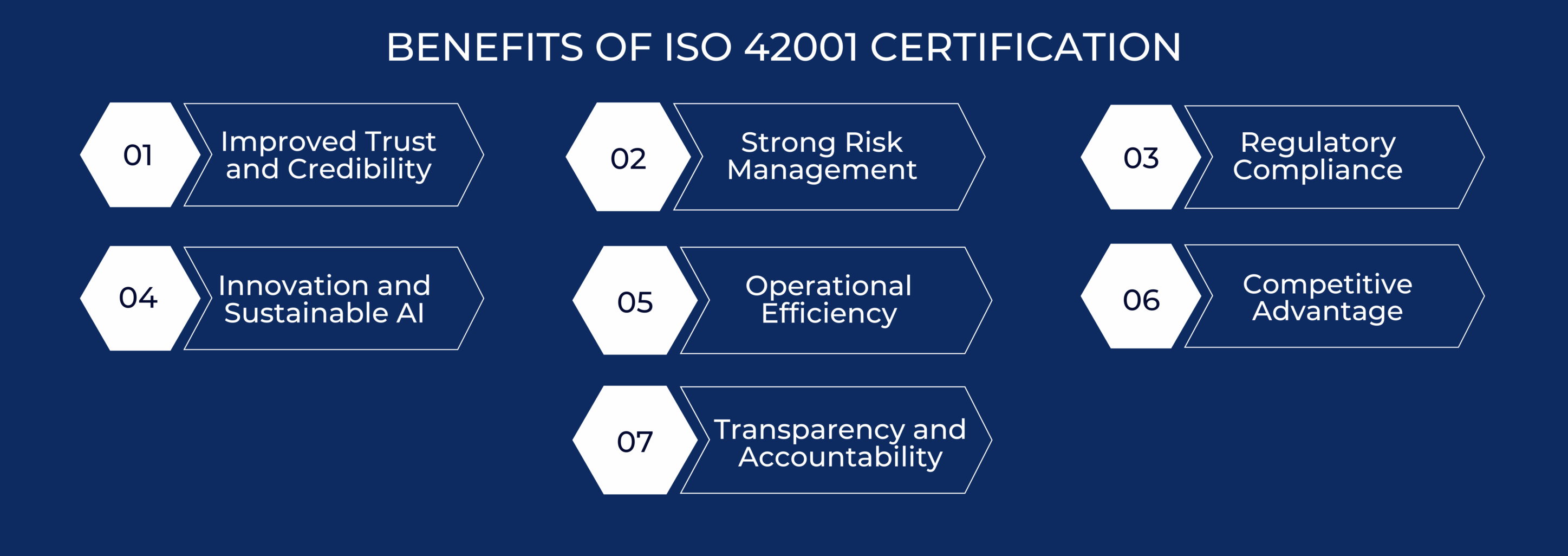
The benefits of ISO 42001 Certification in Christchurch extend across commercial, regulatory, operational, and reputational dimensions. For organizations in Christchurch’s technology-driven economy, certification delivers tangible value by establishing verified AI governance credentials that support market access, stakeholder trust, and operational risk management. The following sections detail the primary categories of benefit that ISO 42001 Certification delivers for Christchurch-based organizations.
ISO 42001 Certification provides Christchurch organizations with a recognized governance credential that opens access to enterprise and government procurement processes where AI governance certification is required or preferred. As global enterprises implement supplier AI governance requirements — driven by their own regulatory obligations under the EU AI Act, proposed Australian AI governance frameworks, and evolving New Zealand expectations — certified suppliers gain a competitive advantage in procurement evaluations. ISO 42001 Certification in Christchurch enables local organizations to qualify for procurement opportunities that would otherwise be inaccessible due to the absence of formal AI governance certification.
The commercial advantage of certification is particularly pronounced for Christchurch organizations with export ambitions. Technology companies, SaaS providers, and agritech innovators seeking to enter international markets — including Australia, Europe, and North America — benefit from ISO 42001 Certification as evidence of governance maturity that satisfies international customer due diligence requirements. Certification reduces the time and cost associated with responding to customer AI governance questionnaires, providing a single, internationally recognized credential in place of bespoke documentation packages for each customer or market.
The AIMS framework required by ISO 42001 delivers direct operational benefits by embedding structured risk assessment and incident management into AI operations. Organizations that achieve ISO 42001 Certification have, by definition, implemented documented processes for identifying, assessing, and treating risks associated with their AI systems — including risks of model failure, data bias, privacy breaches, and adverse societal impacts. These processes reduce the probability and impact of AI-related incidents that can result in financial losses, regulatory penalties, and reputational damage.
Operational resilience is further enhanced by the AIMS requirements for human oversight, monitoring, and incident response. ISO 42001-certified organizations maintain active monitoring of deployed AI systems, with defined escalation and response procedures for anomalous behaviors or adverse outcomes. This operational discipline is increasingly valued by insurers and risk managers as AI systems take on higher-stakes decision-making roles in areas such as healthcare diagnostics, financial risk assessment, and infrastructure management — sectors with active AI deployment in the Christchurch context.
Public trust in AI systems is a critical determinant of technology adoption in consumer-facing markets. ISO 42001 Certification in Christchurch provides a tangible signal of organizational commitment to responsible AI. For organizations serving healthcare patients, financial services customers, agricultural producers, or public sector users, the ability to demonstrate third-party verified AI governance directly supports user confidence and reduces resistance to AI-powered service delivery. The certification demonstrates that an independent auditor has verified the organization’s AI governance practices — not merely that the organization claims to follow responsible AI principles.
- ✓Internationally recognized AI governance credential accepted in global markets
- ✓Verified evidence of responsible AI practices for enterprise and government procurement
- ✓Reduced AI operational risk through structured risk and impact assessment processes
- ✓Alignment with New Zealand Privacy Act 2020 and Algorithm Charter expectations
- ✓Enhanced stakeholder trust through independent third-party certification audit
- ✓Competitive differentiation in Christchurch’s technology export sector
- ✓Structured framework for AI incident management and human oversight
- ✓Foundation for AI governance integration with ISO 27001 and ISO 9001
- ✓Demonstrated commitment to ethical AI for investors, partners, and regulators
- ✓Continual improvement culture embedded in AI operations through AIMS requirements
- ✓Market Access and Commercial Advantage
- ✓Risk Reduction and Operational Resilience
- ✓Stakeholder Trust and Reputational Value
Industries Served in Christchurch
ISO 42001 Certification in Christchurch is applicable to organizations across all industries that develop, deploy, or use AI-based products and services. Christchurch’s diverse economic base — spanning technology, agritech, health technology, financial services, manufacturing, and public administration — encompasses a wide range of AI use cases that benefit from the governance framework established by ISO/IEC 42001:2023. CertPro conducts ISO 42001 audits for organizations across all of the following sectors.
Technology and SaaS Companies
ISO 42001 Certification applies broadly and increasingly to Christchurch’s technology and SaaS sector. Technology companies and SaaS providers that build AI capabilities into their products — whether as core functionality or AI-enhanced features — face customer and regulatory expectations to demonstrate that their AI development and deployment practices are governed responsibly. ISO 42001 Certification provides these organizations with a recognized governance credential that satisfies enterprise customer procurement requirements and supports expansion into international markets where AI governance certification is increasingly expected. The certification is particularly relevant for Christchurch software companies developing AI products for healthcare, financial services, and public sector customers.
Agritech and Primary Industries
ISO 42001 Certification is directly relevant to Christchurch’s agritech sector, reflecting the Canterbury region’s position as a center of agricultural innovation. Agritech companies developing AI-powered precision agriculture, livestock monitoring, crop yield prediction, and supply chain optimization solutions face growing expectations from export market customers — particularly in Europe and the United Kingdom — to demonstrate responsible AI governance. ISO 42001 Certification provides agritech organizations with the governance credentials required to access premium international markets and satisfy agricultural buyer due diligence requirements for AI-powered technology providers.
Health Technology and Research Institutions
ISO 42001 Certification carries significant relevance for Christchurch’s health technology sector, given the concentration of health technology innovation in the region — including organizations affiliated with the University of Canterbury, Canterbury District Health Board, and independent health technology ventures. AI applications in healthcare — such as diagnostic support systems, patient risk stratification, clinical decision support, and administrative automation — operate in a high-stakes governance environment where AI failures can directly affect patient outcomes. ISO 42001 Certification provides health technology organizations with a structured governance framework that aligns with clinical governance expectations and regulatory requirements for AI in medical contexts.
Research institutions in Christchurch — including university departments, Crown Research Institutes, and independent research organizations — that develop or deploy AI systems benefit from ISO 42001 Certification as evidence of research integrity and responsible innovation. International research funding bodies and collaborative research partners increasingly expect evidence of AI governance frameworks from research organizations. ISO 42001 Certification provides a recognized, auditable credential that supports research partnerships and funding applications.
Financial Services and Public Sector Organizations
Financial services organizations in Christchurch — including banks, insurance companies, investment managers, and fintech providers — that deploy AI for credit assessment, fraud detection, customer service automation, or financial risk modeling face regulatory expectations from the Reserve Bank of New Zealand and the Financial Markets Authority for responsible and explainable AI governance. ISO 42001 Certification demonstrates to these regulators that AI systems are governed by documented, audited controls — supporting regulatory compliance and reducing the risk of regulatory intervention.
| Industry Sector | Common AI Applications | ISO 42001 Relevance |
|---|---|---|
| Technology & SaaS | AI-powered product features, NLP, recommendation systems | Procurement eligibility, export market access |
| Agritech & Primary Industries | Precision agriculture, livestock monitoring, yield prediction | Export market governance requirements |
| Health Technology | Diagnostic support, patient risk stratification, clinical AI | Clinical governance, regulatory alignment |
| Financial Services | Credit assessment, fraud detection, risk modeling | Regulatory expectations (RBNZ, FMA) |
| Public Sector & Research | Automated decision-making, research AI, public services | Algorithm Charter alignment, funding requirements |
ISO 42001 Compliance and New Zealand Regulatory Alignment
ISO 42001 compliance in Christchurch operates within a regulatory environment defined by New Zealand’s Privacy Act 2020, the Algorithm Charter for Aotearoa New Zealand, and emerging international AI governance frameworks that affect New Zealand-based organizations operating in global markets. Understanding how ISO 42001 aligns with and supports these regulatory requirements is essential for organizations seeking to use certification as a foundation for comprehensive AI governance and regulatory compliance management.
Alignment with New Zealand’s Privacy Act 2020
New Zealand’s Privacy Act 2020 establishes 13 Information Privacy Principles governing the collection, use, storage, and disclosure of personal information. AI systems that process personal data — including most commercial AI applications — must operate in conformance with these principles. ISO 42001’s AI impact assessment requirements directly address privacy implications of AI systems, requiring organizations to evaluate and document the privacy risks associated with their AI operations and implement controls to manage those risks. ISO 42001 compliance achieved through certification in Christchurch provides a documented, auditable record of privacy impact assessment for AI systems — directly supporting Privacy Act compliance obligations.
Principle 1 of the Privacy Act — relating to the purpose of collection — and Principle 12 — relating to unique identifiers — have particular relevance for AI systems that use personal data for training or inference. ISO 42001’s data governance controls require organizations to document the purposes for which personal data is used in AI systems and to implement access controls that limit data use to documented, authorized purposes. Organizations that have achieved ISO 42001 Certification are able to demonstrate to the Office of the Privacy Commissioner that their AI data governance practices are subject to independent audit oversight — a meaningful indicator of governance maturity in any privacy investigation or inquiry context.
Alignment with International AI Regulations Affecting New Zealand Organizations
New Zealand organizations that supply AI products or services to customers in the European Union are subject to the EU AI Act — the world’s first comprehensive AI regulation — which imposes governance, transparency, and risk management requirements on AI systems based on their risk classification. ISO 42001 Certification provides a recognized governance framework that aligns with the EU AI Act’s requirements for high-risk AI systems, including requirements for risk management systems, data governance, technical documentation, human oversight, and accuracy and robustness standards. While ISO 42001 Certification does not automatically satisfy EU AI Act compliance, it provides a substantive governance foundation that reduces the incremental compliance effort required.
Australian AI governance frameworks — including the Australian Government’s Voluntary AI Safety Standard and proposed mandatory AI governance regulations — similarly align with ISO 42001’s AIMS requirements and are directly relevant to Christchurch organizations with Australian operations, customers, or market exposure. Given Australia’s position as New Zealand’s largest trading partner, AI governance alignment with Australian requirements is a practical commercial necessity for many Christchurch technology organizations. The ISO 42001 audit in Christchurch conducted by CertPro provides evidence of governance conformance that satisfies Australian customer and regulatory AI governance expectations.
Why CertPro for ISO 42001 Certification in Christchurch
CertPro is a Licensed CPA Firm that conducts ISO 42001 certification audits for organizations in Christchurch and across New Zealand. CertPro’s institutional positioning as a certified public accounting firm — distinct from consulting or advisory organizations — ensures that ISO 42001 certification audits are conducted with the independence, objectivity, and methodological rigor required for internationally credible certification outcomes. Organizations seeking ISO 42001 Certification in Christchurch benefit from CertPro’s combination of certification body authority, regional presence, and sector-specific AI governance audit expertise.
CertPro’s Certification Methodology and Independence
CertPro’s ISO 42001 certification methodology follows a structured, evidence-based audit process grounded in the requirements of ISO/IEC 42001:2023 and ISO 17021-1 (requirements for bodies providing audit and certification of management systems). CertPro auditors are trained and qualified in AI management system auditing and bring sector-specific knowledge of the industries served by Christchurch’s technology economy. The certification process is managed independently — audit team members are separate from certification decision-makers — ensuring that certification decisions are objective and free from audit team influence.
CertPro’s status as a Licensed CPA Firm provides an additional layer of professional accountability and regulatory oversight that distinguishes its certification activities from those of unregulated certification bodies. CPA licensing imposes professional standards for independence, objectivity, and due professional care that directly support the integrity of ISO 42001 certification audits. Organizations that receive ISO 42001 Certification from CertPro can therefore reference not only the certification standard itself, but also the professional standards framework governing CertPro’s audit activities as evidence of certification credibility.
ISO 42001 Assessment Services for Christchurch Organizations
CertPro’s ISO 42001 assessment in Christchurch is conducted with a clear understanding of the local organizational context, regulatory environment, and industry-specific AI governance considerations that characterize Christchurch’s technology sector. CertPro’s auditors bring knowledge of the region’s key industries — including agritech, health technology, SaaS, and research — and apply this contextual understanding when evaluating the adequacy and effectiveness of organizations’ AIMS implementations. This local expertise, combined with CertPro’s international certification methodology, produces certification outcomes that are both regionally relevant and internationally recognized.
CertPro conducts ISO 42001 assessment activities on a fixed-scope, clearly priced basis, providing organizations with certainty about the cost and timeline of the certification process before audit activities commence. This pricing transparency enables Christchurch organizations — including startups, growth-stage technology companies, and established enterprises — to plan and budget for ISO 42001 Certification as a defined organizational investment. CertPro’s certification scope is strictly limited to audit and certification activities; CertPro does not provide consulting, implementation, or advisory services that would compromise audit independence.
CertPro’s Track Record and Sector Coverage
CertPro has conducted ISO management system certification audits for organizations across New Zealand and internationally, covering a range of management system standards including ISO 27001, ISO 9001, SOC 2, and ISO 42001. This breadth of certification experience means that organizations in Christchurch seeking integrated governance certification — for example, combining ISO 42001 Certification with ISO 27001 information security certification — can engage CertPro as a single certification body for multiple standards. This streamlines the audit process and reduces the administrative burden of managing multiple certification relationships.
ISO 42001 Certification Cost in Christchurch
The cost of ISO 42001 Certification in Christchurch is determined by several key factors, including the size of the organization, the number of AI systems within the defined AIMS scope, the complexity of the AI technologies involved, and the existing maturity of the organization’s management system documentation and governance practices. CertPro provides fixed-price certification proposals based on a scope assessment, ensuring that organizations receive transparent cost information before committing to the certification process.
Cost Factors and Pricing Determinants
The primary cost determinants for ISO 42001 Certification are audit duration and team composition. Audit duration is driven by the complexity and breadth of the AIMS scope — organizations with a single AI system in a well-defined operational context require less audit time than organizations with multiple AI systems across diverse business functions. Audit team composition is determined by the technical expertise required to evaluate the AI systems within scope. For example, AI systems in healthcare or financial services may require auditors with sector-specific knowledge in addition to AI management system audit competence.
Organizations with existing ISO management system certifications — such as ISO 27001 or ISO 9001 — typically incur lower ISO 42001 Certification costs due to the transferability of established documentation practices, internal audit programs, and management review processes to the AIMS framework. The High-Level Structure shared by all ISO management system standards enables integration of AIMS requirements with existing management systems, reducing the incremental documentation and audit effort required. CertPro’s integrated audit program for organizations with existing ISO certifications optimizes audit efficiency and reduces total certification cost.
Certification Investment and Return on Investment
ISO 42001 Certification represents an organizational investment that delivers returns across multiple dimensions. The direct commercial return — through access to procurement processes, enterprise customer qualification, and export market entry — frequently exceeds the cost of certification for organizations operating in competitive AI-powered markets. The risk management return — through reduced AI incident probability and consequence — provides a financial offset in the form of avoided incident costs, regulatory penalties, and reputational damage. The operational return — through improved AI governance discipline and documentation — reduces the ongoing cost of managing AI governance across the organization.
For smaller Christchurch technology companies and startups, the cost of ISO 42001 Certification is typically lower than for larger enterprises, reflecting the more limited scope of AI systems and organizational complexity involved. CertPro structures certification proposals to reflect the genuine scope of the organization’s AI operations, avoiding overestimation of audit requirements that would inflate costs unnecessarily. Organizations are encouraged to contact CertPro directly to obtain a scope-specific certification proposal that accurately reflects their ISO 42001 assessment requirements in Christchurch.
Secure Your ISO 42001 Certification in Christchurch with CertPro
ISO 42001 Certification in Christchurch is available to organizations that are ready to demonstrate responsible AI governance through an independent, rigorous audit process. CertPro, as a Licensed CPA Firm, conducts ISO 42001 certification audits with the institutional authority, methodological integrity, and sector-specific expertise required to issue internationally credible certification outcomes. Organizations across Christchurch’s technology, agritech, health technology, financial services, and public sector industries are eligible for ISO 42001 Certification through CertPro’s structured audit program.
CertPro’s ISO 42001 assessment process in Christchurch is designed to provide clarity, transparency, and efficiency at every stage — from initial scope definition and audit program determination through Stage 1 documentation review, Stage 2 operational audit, and certificate issuance. CertPro issues ISO 42001 certificates that specify the certified AIMS scope, the applicable standard version, and the certification validity period, providing organizations with a formal credential that can be referenced in procurement responses, regulatory submissions, investor communications, and market-facing materials.
To initiate the ISO 42001 certification process for your organization in Christchurch, contact CertPro to schedule a scope assessment and receive a fixed-price certification proposal tailored to your organization’s AI management system requirements. CertPro’s audit team will confirm the proposed scope, audit timeline, and certification cost — providing the information needed to make an informed decision about ISO 42001 Certification in Christchurch as the foundation of your organization’s responsible AI governance program.
FAQ
▶
What is ISO 42001 certification and who needs it?
▶
How long does the ISO 42001 certification audit take?
▶
What is the difference between the Stage 1 and Stage 2 ISO 42001 audits?
▶
How does ISO 42001 certification align with New Zealand’s Privacy Act?
▶
Does ISO 42001 certification cover all AI systems in an organization?
▶
Is ISO 42001 certification a one-time process or ongoing?
▶
Can ISO 42001 certification be integrated with ISO 27001 or ISO 9001?
▶
How does the ISO 42001 assessment evaluate AI ethics and bias?

MindSec Launches AI Compliance for Law 25 & ISO 42001
Excerpt from Barchart Article, Published on December 3, 2025 Today, Canadian organizations face increasing pressure to comply with stringent privacy a…

UNDERSTANDING ISO 42001: A GUIDE FOR RESPONSIBLE AI MANAGEMENT SYSTEMS
The invention of artificial intelligence (AI) has changed the operational processes of many industries. However, the rapid growth of technology increa…
ENSURING AI DATA PRIVACY COMPLIANCE WITH ISO 42001
According to Stanford’s AI report, the private AI investment in the U.S. alone reached more than $109 billion last year, which is equal to 12 times th…
Get In Touch
have a question? let us get back to you.