
AI FOR AUDITORS: HOW AI IN AUDITING IS TRANSFORMING COMPLIANCE

According to PwC’s Global Compliance Survey 2025, 71% of respondents say AI will have a net positive impact on compliance. This trend demonstrates that AI is increasingly embedded in core compliance operations and leaders are focusing on its integration into key business operations.
Traditional compliance audits can feel like running a marathon with a backpack full of paperwork. They are resource-heavy and sometimes painfully repetitive. Auditors spend countless hours collecting evidence, cross-checking spreadsheets, and verifying controls, only to observe that a minor human error slipped through.
It’s not their lack of skill but the nature of the process. When every document, policy, and log requires review, time becomes the biggest enemy of accuracy.
So, is there a solution to this? It lies in the process of integrating AI in auditing. It acts as a digital partner that can sift through thousands of transactions in seconds, flag unusual patterns, and even help predict compliance gaps before they turn into issues. This integration is no longer science fiction; it is currently occurring within leading audit and compliance teams worldwide.
AI and auditing won’t just automate the repetitive tasks. Moreover, AI reshapes the way auditors think, plan, and make decisions. This gives them more room for judgment, ethics, and human insight.
In this blog, we’ll explore how AI is transforming compliance workflows from end to end. You’ll learn about its core applications, real-world benefits, and the step-by-step implementation methods. Let’s start.

Tl; DR:
Concern: Traditional compliance audits drain time, money, and morale. Auditors spend endless hours buried in spreadsheets and manual evidence checks, which pave the way for a slow and tiring process that is repetitive and prone to human error. This results in missed anomalies, delayed findings, and wasted effort on low-value tasks.
Overview: Here’s where AI in auditing steps in. Acting as a smart assistant, AI automates evidence collection, analyzes massive data in seconds, and detects compliance gaps before they escalate. It doesn’t replace human judgment; instead, it sharpens it. Technologies like machine learning and Natural Language Processing (NLP) now help compliance teams monitor controls continuously, scan new regulations, and create clear, actionable audit reports with remarkable precision.
Solution: For compliance leaders and audit professionals, AI is a strategic investment. Businesses that use AI-powered audit systems now can manage compliance more quickly, accurately, and on a larger scale, while those that wait will face higher costs, risks, and inefficient workflows. In short, AI turns auditing from a manual burden into a proactive, intelligent, and future-ready compliance process.
AI IN AUDITING: AN OVERVIEW IN A COMPLIANCE CONTEXT
When the talk about AI in auditing entered the corporate world, people imagined robots replacing auditors or algorithms taking care of all the tedious tasks. But in reality, it’s far more nuanced and requires a focused approach.
AI in auditing means using technologies like machine learning, natural language processing (NLP), and agentic AI systems to simplify, speed up, and sharpen how audits are performed. To clarify, instead of spending days with endless spreadsheets, auditors can now use AI to scan massive datasets, spot unusual patterns, and even predict potential compliance risks before they occur.
Unlike financial auditing, which focuses mainly on numbers and statements, compliance auditing goes deeper. Accordingly, it examines whether processes, systems, and policies follow global regulations, standards, and frameworks, such as ISO 27001, ISO 42001, SOC 2, HIPAA, or GDPR. This area is where AI reveals its potential capabilities.
AI in auditing is not just about analyzing data. Moreover, it learns from it. Furthermore, it can pull logs from systems, analyze communication trails, and detect gaps in policy enforcement.
Consider AI as the ultimate audit assistant handling tasks such as data ingestion, risk management, anomaly detection, process automation, and regulatory monitoring. For instance, AI compliance software can flag suspicious access attempts in real time and track changes to evolving data protection laws.
AI in compliance will help the auditors to focus on what really matters, like judgment, ethics, and trust. With constant regulatory updates and growing evidence demands, compliance workflows are tailor-made for AI. The process of blending AI and auditing is not about replacing human insight. Instead, it amplifies it. This process paves the way for a real transformation that culminates in the convergence of AI efficiency and human judgment.
AI IN AUDITING: REAL-WORLD APPLICATIONS IN COMPLIANCE WORKFLOWS
During every audit, the auditors are bombarded with enormous amounts of data. Thousands of files, scattered systems, and relentless deadlines are making their compliance work exhausting. What they need is a powerful tool that eases their work without compromising on quality.
This is precisely where AI in auditing feels like a savior rather than a trend. Therefore, in this section, let’s explore how AI in risk and compliance is transforming everyday audit challenges into manageable, intelligent workflows.
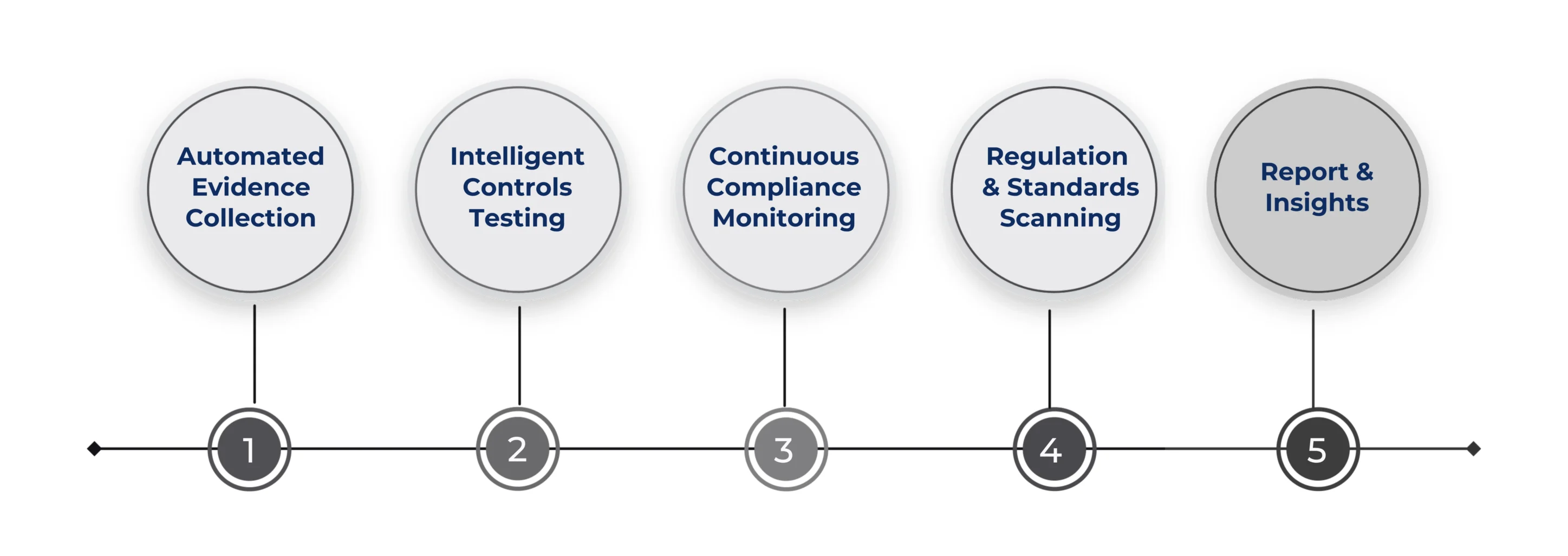
Automated Evidence Collection
Challenge: Gathering audit evidence often feels like searching for puzzle pieces across ten different databases.
AI Solution: AI compliance software crawls through your systems, extracts relevant documents, and automatically links them to the right control points.
Benefit & Risk: While it saves hours and reduces manual errors, auditors must ensure that the process does not compromise sensitive data.
Intelligent Controls Testing
Challenge: Traditional audits rely on a sampling process for testing data. This is a risky process in heavily regulated industries where the compliance stakes are high.
AI Solution: Machine learning reviews entire datasets, spots hidden anomalies, and learns to flag suspicious behavior over time. It is to be noted that AI can analyze full populations where data and systems allow; otherwise, it augments sampling.
Benefit & Risk: It gives near real-time visibility into risks, though models must be monitored to avoid false positives.
Continuous Compliance Monitoring
Challenge: Regulations change fast, but audits often lag months behind.
AI Solution: In such cases, continuous auditing platforms powered by AI track control effectiveness daily, alerting teams the moment a deviation occurs.
Benefit & Risk: It builds a proactive compliance culture, though constant alerts need fine-tuning to avoid fatigue.
Regulation & Standards Scanning
Challenge: Keeping up with evolving laws like GDPR or ISO updates is overwhelming.
AI Solution: AI in compliance reads and maps new regulatory texts to existing control frameworks.
Benefit & Risk: It ensures compliance stays current, but misinterpretations still require human oversight.
Report & Insights
Challenge: Summarizing audit results into clear, actionable reports drains your team’s time and energy.
AI Solution: AI drafts compliance summaries, builds visual dashboards, and even predicts future risk patterns by analyzing historical data.
Benefit & Risk: It turns raw data into actionable insight, but final judgments still belong to human auditors. Because experience and ethics matter more.
BENEFITS OF USING AI IN AUDITING
The amount of time saved is the most profound aspect when considering the key benefits of using AI in auditing. For instance, consider those repetitive, copy-paste tasks like checking reports, tracking logs, and documenting evidence. AI in compliance will alleviate this burden from your workload. In simple terms, automation in AI audit cuts hours of manual work and speeds up reviews. This allows your team to focus on tasks that actually require human judgment.
Now let’s unwrap the potential benefits of using AI in risk and compliance workflows.
- Accuracy: At times, even the most experienced auditor could miss critical details after tiring hours of analyzing data. But AI tools and solutions won’t get drained over time. Even a minor change or unusual pattern will be recorded. This ultimately reduces errors and boosts precision and accuracy in audit outcomes.
- Scalability: AI in auditing offers a paradigm shift while testing and scanning reports. Unlike traditional audits that depend on sampling, AI tools monitor every access, log, transaction, and update.
- Risk Reduction: AI compliance software excels in giving clear warnings regarding risks and non-compliance issues. This is because it is capable of learning from past security incidents and predicting future issues.
- Evidence Management: AI and auditing will allow you to organize evidence in a better way. Furthermore, it improves collaboration by allowing stakeholders to share and access the crucial evidence in a safe and secure manner.
KEY CHALLENGES FOR BUSINESSES WHILE USING AI IN AUDITING
Every smart technology comes with its own risks, and AI in auditing is not an exception to this. While it can make compliance faster and more efficient, it also introduces new challenges that businesses can’t afford to ignore. Here are some major risks and challenges associated with integrating AI in auditing and compliance workflows.
Model Bias and Drift: This is an incident where an AI model starts making inaccurate decisions over time. To prevent that, companies should validate models before deployment, monitor drift regularly, and retrain them on a fixed schedule.
Hallucination: Here, the AI models would make some wrong predictions. Therefore, businesses must ensure human checkpoints, understandable outputs, and confidence thresholds are in place.
Data privacy and Residency: Always sign strong data processing agreements, ensure regional data handling, and minimize personal data use. To control access and misuse, apply single sign-on, multi-factor authentication, and least privilege rules along with immutable logs.
Third-Party Management: When relying on third-party AI tools, demand SOC 2 or ISO reports and hold vendors accountable with clear incident response (Service Level Agreements) SLAs.
Over-Reliance on AI: Business leaders must use AI tools to assist auditors, not to replace them. Hence, keep human judgment at the center, backed by training, awareness, and a healthy dose of professional skepticism.
STEP-BY-STEP ROADMAP FOR AI ADOPTION IN COMPLIANCE
Integrating AI in auditing is the process of solving real problems in compliance workflows. Here’s a clear, step-by-step roadmap to help you move from interest to meaningful results.
- Assessment & Strategy Phase:
Begin by reviewing your current audit and compliance posture. Identify where delays occur and what consumes the most time or resources. Since AI depends on structured, accurate data, assess your data readiness early. More importantly, bring key stakeholders together and define clear goals. Then, choose one or two areas where AI can create a quick, visible impact. Finally, set up a basic risk and governance framework before you start testing. - Pilot & Proof of Concept
Always start small by focusing on use cases like automated evidence extraction or control testing. Build a pilot program, monitor the results, and adjust as per requirements. Don’t aim for perfection; rather, focus on the learning. - Scaling & Integration
Once the pilot program works, expand gradually into other compliance activities. Integrate AI into your broader audit systems, compliance tools, or Enterprise Resource Planning systems. - Governance, Oversight & Continuous Monitoring
Keep transparency as the fundamental principle. So, record how AI makes decisions and when humans step in. Prefer retraining models regularly, ensuring they stay compliant with evolving regulations and free from bias. - 5. Training & Cultural Adoption
AI adoption succeeds only when people trust it. Therefore, train auditors to interpret AI insights and work alongside the technology.
KEY TAKEAWAYS: TOOL SELECTION CHECKLIST
Use the tool selection checklist below to vet pilot tools before you ingest real data while integrating AI into your compliance workflows.
- Data Connectors: For smooth integration into your existing systems, connect to tools like Security Information and Event Management (SIEM) systems, Identity Providers (IDPs), IT Service Management (ITSM) platforms, and cloud log sources. This setup helps with security monitoring, workflow automation, and complete audit visibility.
- Evidence Immutability: Capture and store evidence snapshots with digital hash verification for every important activity.
- Permissions: Use Single Sign-On (SSO), Multi-Factor Authentication (MFA), and Role-Based Access Control (RBAC). Combine these with clear segregation of duties so only authorized people can make changes, reducing insider risks.
- Explainability: Every AI action should include a human-readable explanation. Also, keep structured, exportable evidence of these decisions so auditors can easily review and verify them later.
- Lifecycle Controls: Track every stage of an AI model’s life, from creation to updates. Accordingly, maintain model versions, detailed “model cards” that explain purpose and behavior, retraining approvals, and continuous drift monitoring to ensure consistent performance.
- Audit Logging: Record every AI activity, including manual overrides and escalations. Make these logs easy to export for independent audits and compliance checks.
- Data Protection: Follow data protection rules by processing data in approved regions, encrypting it both during transfer and storage, and signing Data Processing Agreements (DPAs) with vendors.
- Reporting: Offer simple reporting through Application Programming Interfaces (APIs), downloadable Excel or CSV files, and scheduled compliance reports to meet regulatory requirements.
CONCLUSION
AI in auditing is not the future; it’s already happening now. Every month businesses delay adopting AI-driven compliance systems, they risk falling behind. Manual audits will eat up hours, increase human error, and leave gaps that regulators can easily identify. On the other hand, companies that embrace AI in auditing gain sharper visibility, faster responses, and solid risk management procedures. These benefits are crucial in today’s dynamic compliance environment.
This proves that AI in auditing is not about replacing human oversight. Rather, it enhances and amplifies it.
FAQ
What is the role of AI and automation in the future of auditing?
AI and automation in auditing help auditors analyze massive data quickly, detect errors, predict compliance risks, and automate evidence collection. They improve accuracy, save time, and let auditors focus more on strategic judgment and ethical decision-making.
How to conduct an AI audit?
To conduct an AI audit, assess your existing processes, identify areas where AI can add value, and start with a pilot project. Then integrate AI tools for data analysis, risk monitoring, and evidence management while maintaining human oversight and compliance governance.
What are some AI in auditing examples?
Common examples of AI in auditing include automated evidence collection, anomaly detection, continuous compliance monitoring, and predictive risk analysis. AI tools also generate audit summaries, test controls, and map new regulations to existing compliance frameworks efficiently and accurately.
How is AI used in compliance?
AI in compliance helps organizations track regulatory updates, analyze data patterns, and detect policy violations. It automates compliance workflows, minimizes manual effort, reduces human error, and ensures continuous monitoring across systems to maintain real-time regulatory adherence.
What is ISO compliance for AI?
ISO compliance for AI refers to meeting international standards like ISO/IEC 42001, which guides responsible AI management. These standards ensure AI systems are ethical, transparent, secure, and aligned with global governance principles to reduce risks and enhance accountability.
WHAT IS CONTROL TESTING? A PRACTICAL GUIDE FOR COMPLIANCE AUDITS
AUDIT SAMPLING EXPLAINED: WHY AUDITORS TEST ONLY SELECTED EVIDENCE

How CertPro Conducts an Effective SOC 2 Type II Audit: A CPA-Led Playbook for SaaS
A SOC 2 Type 2 examination results in an independent CPA - issued attestation report on whether your controls are suitably designed and operated effectively over a period of time. It’s based on the AICPA Trust Services Criteria. This requirement is essential, as in...