Vendor Relationship Management: A Practical Guide for Businesses

Vendor relationship management is more than just keeping a list of suppliers. It’s a system to grow value, control risk, and stay compliant with clear owners, metrics, and evidence. If you are a procurement lead, vendor manager, or part of a risk or compliance team, let’s consider this. Then, you already know how challenging the process could be. This is because vendors often fail to respond promptly. Additionally, contracts often disappear from your inboxes, and the metrics are unclear. The constantly changing regulations often leave you feeling behind.
Most businesses work with dozens, sometimes hundreds, of vendors but have no clear way to track performance, manage risks, or measure value. Therefore, the absence of a robust vendor relationship program leads to an increase in business costs and disruptions in communication. Consequently, this paves the way for poor risk management.
Therefore, strong and tailored vendor relationship management is inevitable for modern businesses. Independent research by Coherent market insights predicts that the global vendor management systems (VMS) market will be worth US$10.42 billion in 2025 and will grow to US$20.69 billion by 2032, highlighting why mature VRM programs are now business – critical.
For example, imagine switching from scattered email chats to a clear performance dashboard where every vendor is ranked by delivery timelines, contract terms, and risk scores. Here you don’t just react to problems; you predict and fix them before they affect your business.
Hence, this guide focuses on vendor relationship management in the real world. Furthermore, we will define the concept of vendor relationship management, explain its significance, and demonstrate how to establish a strong process from the beginning.

Tl; DR:
Concern: Many businesses work with multiple vendors but lack clear processes to manage them. This leads to missed deadlines, higher risks, poor communication, and compliance issues.
Overview: Vendor Relationship Management (VRM) provides a structured approach to select, onboard, track, and improve vendor performance. It combines governance, communication, performance metrics, and compliance alignment to build long – term value.
Solution: By adopting a strong VRM framework and aligning with standards like ISO 27001 and SOC 2, businesses can reduce risks, improve service quality, and stay compliant. CertPro supports this with expert guidance, templates, and certification services, helping you build predictable, secure, and growth – focused vendor partnerships.
WHAT IS VENDOR RELATIONSHIP MANAGEMENT?
Vendor relationship management (VRM) is a structured approach to select, onboard, measure, and grow vendor partnerships. It combines performance metrics, governance, and evidence – ready controls to improve service quality, reduce risk, and keep you compliant across the vendor lifecycle. Moreover, it’s about making sure that every vendor you work with delivers real value over time. Therefore, consider treating vendors like long – term partners rather than one – off suppliers.
Having said that, VRM is often confused with vendor management, supplier relationship management (SRM), or Third – Party Risk Management (TPRM). Vendor management focuses on transactions like controls, due diligence, and assurance. SRM, on the other hand, is more prevalent in the manufacturing industry and concentrates on supply continuity and cost control. In practice, VRM and TPRM should run in parallel: one grows value; the other reduces risk.
Third – party management is broader and includes all external partners, even contractors or affiliates. VRM offers a more strategic and human perspective, focusing on the entire lifecycle of the relationship. This is particularly relevant in situations where technology, compliance, or service delivery are involved.
Why does vendor relationship management matter today? First, it helps reduce costs. When there is trust involved, your vendors are more likely to offer better pricing, terms, or support. Next, it improves service delivery because regular feedback and communication resolve issues early. For instance, imagine you have multiple pain points while using a SaaS product. With solid vendor relations, your SaaS vendor will immediately solve them.
Additionally, VRM also strengthens your compliance and risk posture. In regulated industries, auditors assess how effectively you manage vendor risk. External partners manage some of the most crucial security controls, including data privacy, uptime commitments, and cybersecurity measures. So, if the vendor – client relationship is weak or reactive, it opens gaps in your risk framework.
Understanding what is vendor relationship management helps create better alignment, faster escalation paths, and more predictable outcomes with vendors. This is what every procurement head, compliance officer, or risk manager deeply values.
LIFECYCLE OF A VENDOR RELATIONSHIP MANAGEMENT
A solid Vendor Relationship Management (VRM) framework follows a clear lifecycle. Each stage has its own tasks, decisions, and risks.
1. Selection and Onboarding
Everything starts with defining your scope. Accordingly, you first define what you need and then screen potential vendors based on clear criteria. These could include cost, experience, data security, financial health, or technology maturity. Furthermore, check their due diligence by conducting background checks, reviewing certifications, and assessing risk early on. For example, check their Data Processing Agreement (DPA), Standard Contractual Clauses (SCCs) for cross – border transfers, BAAs for HIPAA entities, and right-to-audit clauses.
Once selected, onboarding kicks in. This involves setting up system access, introducing teams, sharing expectations, and documenting roles.
2. Contract Negotiation
This phase sets the tone for managing vendor relations and the entire vendor – client relationship. Good contracts define roles, timelines, service levels, KPIs, and compliance requirements. If you’re in a regulated industry, clarify how they’ll protect data or meet audit demands. It would be beneficial to allow some room for flexibility while ensuring that vendor relationship management best practices are clearly explained in simple terms. A clear contract helps avoid arguments and reduces finger – pointing later.
3. Ongoing Relationship and Performance Management
This is where VRM earns its value. Hold performance reviews and track metrics like uptime, delivery, or cost savings. You must treat different vendors differently. To elaborate, a strategic vendor deserves more time and partnership than a one – off supplier. If a software vendor manages your core platform, involve them in planning and feedback. Simultaneously, you can monitor transactional vendors using simple scorecards. Because of this, your auditors might look at things like Quarterly Business Review notes, SLA reports, CAPAs, termination certificates, and summaries of penetration tests as proof. This process helps them understand how well you are managing vendor relations.
4. Renewal or Exit
As the contract ends, review results honestly. Ask questions like, was the partnership worth it, and did they improve over time? When renewing, consider adjusting the terms based on the insights you’ve gained. If you want to end the relationship, then plan the transition well. Handoffs, data access, and knowledge transfer all matter. Moving forward, plan handover, revoke access, obtain data deletion/return certificates, and capture lessons learned. This is because a smooth exit leaves less risk and stress behind.
This lifecycle gives you structure without becoming rigid. It helps you build partnerships that perform, adapt, and protect your organization over time.
STEP BY STEP IMPLEMENTATION GUIDE FOR VENDOR RELATIONSHIP MANAGEMENT
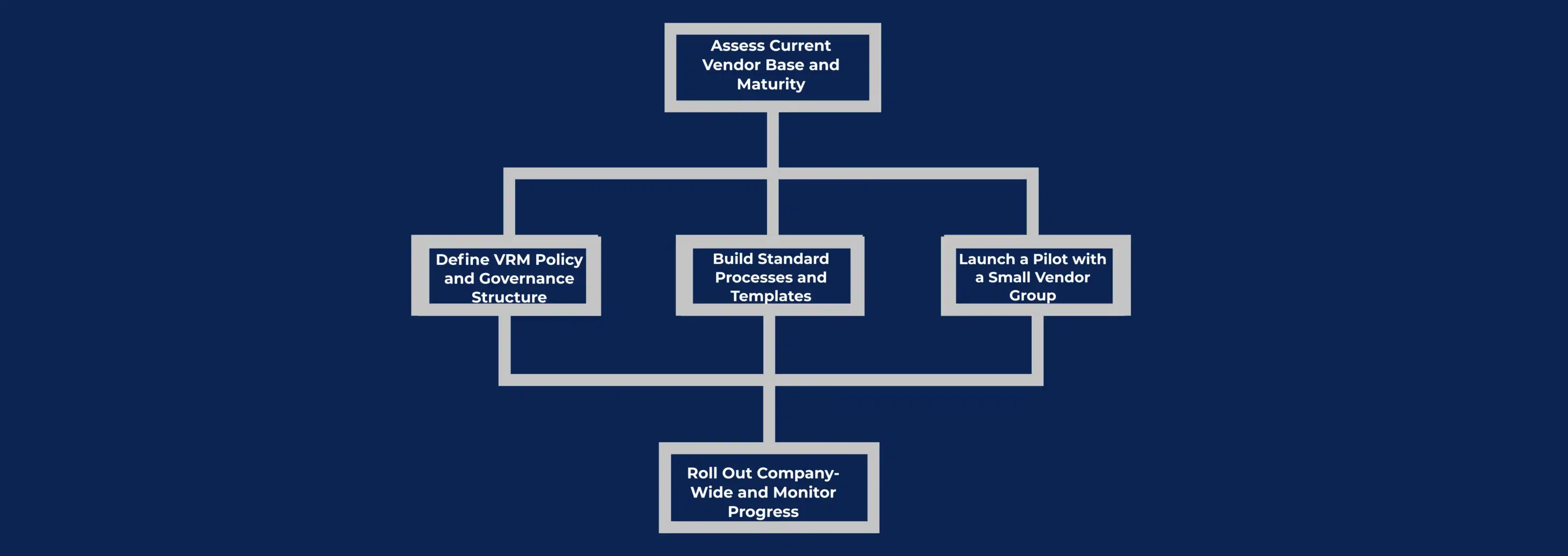
Rolling out Vendor Relationship Management (VRM) is a complete mindset shift in how you work with external partners. Here is a clear, step – by – step guide to help your business adopt Vendor Relationship Management (VRM) without becoming bogged down in theory or bureaucratic red tape.
Step 1 – Assess Current Vendor Base and Maturity: Before jumping into new processes, understand where you stand.
- First, make a full list of current vendors.
- Then classify them by amount spent, risk, and importance.
- Map risks like data access, delivery delays, or legal exposure.
- Also, note gaps such as missing contracts, unclear Key Performance Indicators, or expired Service Level Agreements.
This process could help you identify the unused vendors that are still active in the system or important ones with no formal reviews. This creates real friction when audits or issues arise.
Step 2 – Define VRM Policy and Governance Structure: This step is all about creating clear policies. Accordingly,
- Assign ownership (e.g., Procurement, Security, or Ops).
- Define roles for who approves, who monitors, and who escalates.
- Also, build a simple escalation path for vendor issues.
This is essential because clear policies avoid confusion during security incidents. Moreover, it earns trust with internal audit teams who want to see accountability.
Step 3 – Build Standard Processes and Templates: This process builds consistency, saves time and keeps vendors aligned.
- Create an onboarding checklist.
- Draft reusable contract templates with standard clauses (data, security, KPIs)
- More importantly, build a quarterly review form for performance and compliance
These templates also help your firms align with ISO/IEC 27001:2022 or SOC 2 controls like supplier security or audit traceability.
Step 4 – Launch a Pilot with a Small Vendor Group: Don’t go overboard. Instead, start small and learn fast.
- Select 5 – 10 vendors across different types.
- Apply new processes.
- Track issues, delays, and questions.
- Finally, collect feedback and adjust
A pilot ensures that a large-scale implementation doesn’t backfire. It helps build internal buy-in.
Step 5 – Roll Out Company – Wide and Monitor Progress: After a successful pilot program, scale slowly. But don’t stop improving.
- Roll out training and documentation.
- Add VRM metrics to dashboards (risk scores, performance, and spend).
- Assess the VRM outcomes every quarter with compliance or audit teams.
When you align VRM with internal audits and standards like ISO 27001 or SOC 2, you protect the business, reduce costs, and give teams more confidence in every external partnership. As a result, you could transform your vendor management into real vendor value.
BEST PRACTICES FOR VENDOR RELATIONSHIP MANAGEMENT
Businesses have to understand that efficient vendor relationships can’t happen by chance. Instead, clear habits, intelligent tools, and consistent effort shape them. Let’s now examine some of the most effective real – world practices.
Communication and Transparency: You cannot fix something that you don’t communicate or share about. Therefore, regular check – ins, shared dashboards, and candid updates help in making a huge difference while managing vendor relations. It’s crucial to schedule regular calls to discuss issues and address them promptly.
Set Clear Expectations: Knowing how to measure success helps vendors deliver better services. Therefore, agree on KPIs like uptime, delivery rates, or clear user feedback. Utilize scorecards as well, and review them quarterly.
Focus on Risk and Compliance: Each vendor provides access to your business. Some might have surprises behind them. Hence, make periodic risk assessments a culture. Ensure that the contract language covers data privacy, uptime, or audit requests.
Build Real Relationships: Treat vendors as your partners, rather than invoice numbers. Accordingly, work on joint improvements and give them space to innovate. Because when a vendor feels like part of the team, they’ll solve problems faster and bring new ideas.
Use Technology to Scale: Manual tracking will break as you grow in your business. Here, vendor management tools could help automate onboarding, contracts, performance reports, and risk scoring. Moreover, they also make it easier to share updates across teams. Think of it as a central nervous system for your vendor ecosystem.
With the help of these vendor relationship management best practices, you could move from a reactive to a proactive partnership. They boost performance, reduce operational stress, and make audits straightforward.
CONCLUSION
A strong vendor relationship program is a shield that protects your business from risks and a smart engine for growth. If you fail to fix the vendor issues early, it will ultimately lead to missed deadlines, unexpected expenses, failed audits, and frustrated teams. Yet, the process of building strong vendor management is not an easy task.
One strategic move is to comply with global frameworks and standards. By aligning your vendor management with global standards like ISO 27001, ISO/IEC 42001:2023, SOC 2, and GDPR, you reduce risks and boost transparency, streamline procurement, and build stronger vendor trust Here ISO 42001 is irreplaceable if your firm handles AI vendors and focuses on building strong AI governance. But the process demands tailored guidance from experts. That’s where CertPro steps in as your partner.
CertPro helps you get certified and makes sure your vendor program meets top standards for long – term compliance and smooth operations. Furthermore, we offer tailored support that suits your business nature and scope. This includes assistance with defining vendor KPIs and aligning with global frameworks. Our expert team brings hands – on experience across industries, fast deployment, and real deliverables that earn the trust of your clients and regulators.
If you’re scaling a startup or managing vendors across multiple teams, CertPro gives you structure without affecting your productivity. So, don’t wait for the next audit or vendor breach to push you towards VRM. Connect with CertPro experts today and get a roadmap for turning vendor chaos into a predictable, risk – aware, and value – driving process.
FAQ
How do you maintain relationships with vendors?
Strong vendor relationships could be maintained by establishing regular, structured communication, setting clear expectations, conducting periodic performance evaluations, and fostering trust through transparency.
What is the difference between CRM and VRM?
Customer Relationship Management (CRM) systems focus on optimizing customer experiences to drive sales, retention, and loyalty. Meanwhile, Vendor Relationship Management (VRM) systems are designed to manage relationships with third – party suppliers, aiming for improved service quality, cost optimization, risk reduction, and regulatory compliance.
How to handle vendor conflict?
We can effectively handle vendor conflicts by initiating open and respectful communication, reviewing contract terms, and agreeing on a fact – based resolution plan.
What is vendor management software?
Vendor management software is a tool that helps businesses organize vendor data, automate onboarding, track performance, monitor compliance, and manage contracts. With this tool, companies streamline communication, reduce risks, and make smarter decisions with vendors throughout the entire partnership.
What is vendor security?
Vendor security comprises the controls and processes that ensure third – party vendors safeguard customer data, internal systems, and business operations. This includes rigorous cybersecurity screenings, data protection protocols, legal contracts, and continuous monitoring to uphold standards such as ISO 27001 or SOC 2, reducing the risk of supply – chain breaches and regulatory violations.