TRUST MANAGEMENT: HOW MODERN GRC BUILDS CUSTOMER TRUST AND REDUCES RISK

Most business leaders know one secret to turning customers into loyal fans: trust. But what if the real power lies in how you build and manage it? So, management of trust is a critical factor for business success. This process is called trust management. It is a company – wide program that proves reliability and ethics through measurable controls, continuous monitoring, and transparent reporting, enabled by modern GRC.
Today’s businesses operate in a world where customers, partners, and regulators carefully assess every decision on the basis of trust and credibility. Therefore, even one wrong decision, one minor data breach, or one unethical practice is enough to destroy years of credibility and reputation. That’s why trust has become a key deciding factor in the modern business world.
Trust management means actively building, maintaining, and proving your organization’s trustworthiness. To elaborate, it’s the process of aligning actions, systems, and policies so that customers and stakeholders can believe in your integrity, reliability, and transparency.
Previously, the focus of traditional governance, risk, and compliance (GRC) programs was on meeting regulatory requirements and passing audits. But that old approach is no longer effective. Today, GRC is more about building trust and brand reputation rather than just keeping the regulators happy. Modern businesses use the GRC framework to boost trust management by showing that they handle data responsibly, manage risks wisely, and make ethical business choices.
If your business struggles with customer retention after a compliance lapse, then you must adopt a trust – first GRC framework. As a result, your employees will become more accountable, processes will become transparent, and customers will start to believe in them again.
This blog will help you understand what trust management is all about. Furthermore, it explains why and how trust management helps businesses achieve success in the current corporate world. You will also discover how modern GRC is essential to establishing this trust with clients and other important stakeholders.

Tl; DR:
Concern: Businesses today face a major challenge. They must earn and keep customer trust while managing constant data risks and strict regulations. Even a single security lapse or compliance failure can destroy years of credibility and damage brand reputation.
Overview: This is where trust management plays a vital role. It focuses on proving your organization’s reliability and integrity through consistent actions, transparent policies, and responsible risk handling. Modern Governance, Risk, and Compliance (GRC) systems make this possible by connecting leadership accountability, risk management, and compliance monitoring within one unified framework. As a result, trust becomes a measurable and sustainable business strength. Companies that invest in GRC – driven trust management often see fewer breaches, faster issue resolution, and stronger customer loyalty.
Solution: However, building and measuring trust require the right approach and guidance. That’s where CertPro helps. We turn compliance into long – term trust. With certification support for SOC 2, ISO 27001, and GDPR, CertPro helps startups and enterprises simplify compliance, strengthen credibility, and build brands that succeed in today’s high – risk business environment.
WHAT IS TRUST, AND WHY DOES IT MATTER FOR MODERN BUSINESSES?
Trust is nothing but your customers’ belief that your company will protect their data, act responsibly, and deliver ethical services. In today’s business, a customer’s decision to purchase a product or service is not the result of flashy promotions or advertising. Rather, it’s purely based on the trust and confidence that they have in your organization.
That belief can’t be gained. It must be earned through consistent, transparent actions that show your company values integrity as much as performance.
When customers trust you, they stay longer, pay more willingly, and are less likely to move to a competitor. Moreover, trust gives you pricing power, improves customer retention, reduces churn, and even shortens sales cycles. This is because prospects feel safe doing business with you. It also attracts better partners who want to align with companies that have proven reliability and ethics.
Customers and partners look for visible signs of that trustworthiness. Complying with SOC 2 or ISO 27001 standards, having clear data protection policies, and maintaining strong incident response records demonstrate that you take security seriously.
But when trust breaks, the damage is fast and deep. A single data breach, a vague public statement, or a slow incident response can erode years of credibility. Even a vendor’s mistake could be detrimental to your reputation.
The takeaway is clear: when you treat trust as a measurable business asset, you can manage, strengthen, and defend it like a revenue or risk. That’s where trust management begins.
TRUST MANAGEMENT: A BASIC UNDERSTANDING
Trust management, in simple terms, is how a company earns and keeps the confidence of its customers, partners, and regulators. It’s the process of proving, through consistent actions, that your business is reliable, transparent, and ethical in its operations.
Unlike traditional compliance or risk management, which often focuses on meeting standards or avoiding penalties, a trust management program looks at the bigger picture. It’s about building relationships that last because people believe in your company’s intent and integrity. While compliance asks, “Are we following the rules?” trust management asks, “Would our customers still believe in us if no one was watching?” That’s a big difference in mindset.
When done right, trust management brings tangible business rewards. It strengthens customer loyalty because clients feel safe sharing data or investing in your services. Thereby, it improves your reputation in the market, making it easier to expand into new regions or industries.
You can often spot weak trust before it becomes a crisis. Maybe customers start asking for extra security reports. Maybe vendors or regulators increase audit frequency. Or maybe your churn rate rises because clients quietly lose confidence. These are all warning signs that trust is slipping.
That’s where a strong Governance, Risk, and Compliance (GRC) framework plays a foundational role. To clarify, GRC is the structure that supports trust management. When your policies, risks, and ethics work in harmony, trust becomes a measurable business strength.
MODERN GRC: AN ENGINE FOR TRUST MANAGEMENT
Modern GRC is an integrated system that connects governance, risk, and compliance through technology, data, and continuous oversight. In simple terms, modern GRC helps organizations stay alert, agile, and accountable by giving leaders real – time visibility into their businesses.
The real shift is from reacting to problems after they happen to preventing them before they cause harm. Old GRC models lived in silos. To clarify, the risk teams operated independently from the compliance teams, and the IT department had minimal communication with the legal team. Modern GRC frameworks and systems break those walls. It connects departments, automates data flow, and creates a shared understanding of risk and responsibility.
This change is at the heart of trust management. When an organization can show it’s transparent, responsive, and audit – ready at any moment, trust naturally grows. As a result, the stakeholders could see the proof through accessible data, clean documentation, and timely communication.
Let’s break this process down further.
- Governance establishes the tone by outlining ethical principles, ensuring leadership accountability, and providing decision – making standards. Thus, trust grows naturally when people see consistent behavior from the top.
- Risk management ensures that potential threats, from cyberattacks to vendor failures, are spotted early and handled properly, showing reliability under pressure.
- Compliance monitoring keeps everything in check, providing evidence that security controls are working and compliance regulations are being followed. This approach helps you monitor controls, collect evidence, and remain audit – ready for ISO/IEC 27001, SOC 2, GDPR, HIPAA (US), and other obligations.
HOW MODERN GRC SYSTEMS ENABLE CONTINUOUS TRUST MANAGEMENT
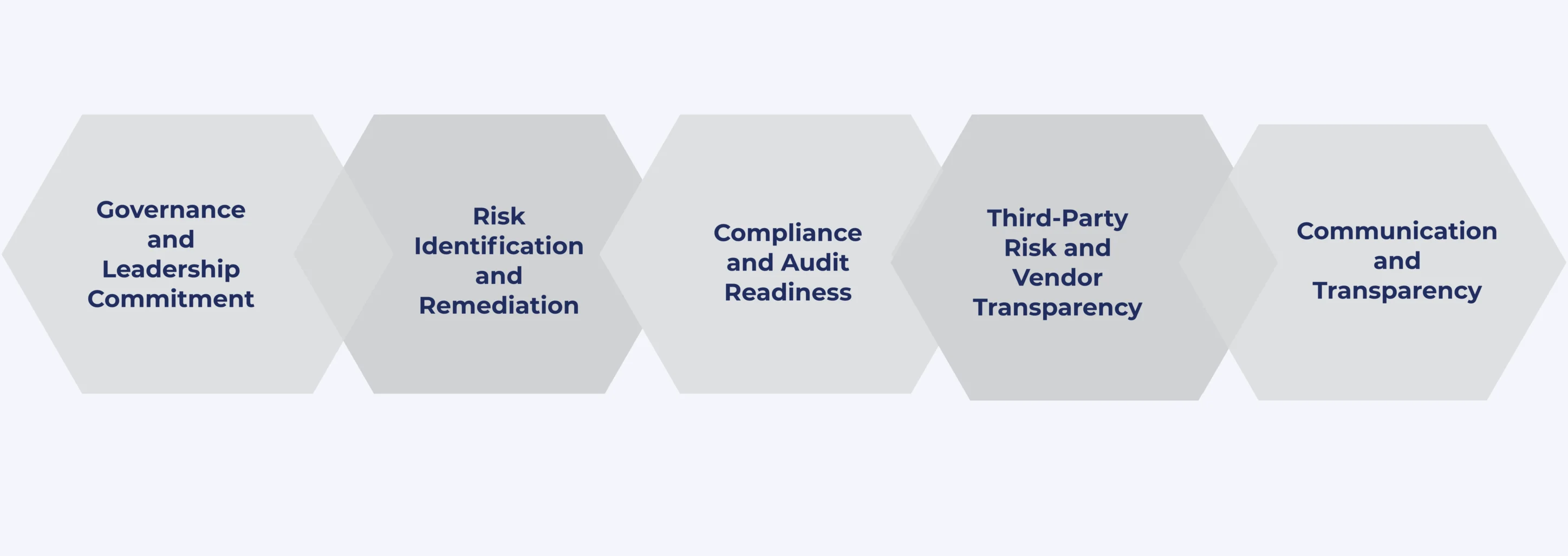
Trust is not a result of chance. It’s actively built through consistent actions, clear decisions, and strong systems. Within a GRC framework, trust management depends on a few powerful levers that turn policies into real – time progress. When these levers work together, they make the organization reliable, transparent, and accountable to the key stakeholders.
Governance and Leadership Commitment
Trust begins at the top. Accordingly, when leaders make integrity and accountability a visible priority, it sends a strong message across the company. Leadership commitment means setting clear values, enforcing ethical conduct, and taking ownership when things go wrong. For instance, a tech firm can establish credibility by publicly reporting its data security policy, identifying control owners, and ensuring quarterly board reporting.
Risk Identification and Remediation
You can’t build trust if you don’t understand your risks. Hence, mapping enterprise, operational, cyber, and third – party risks helps businesses act before problems escalate. For example, a financial institution that spots vulnerabilities in its online payment system and fixes them before any breach earns both customer loyalty and regulator respect. Hence, a unified risk register, SLA – based remediation, and tracking of residual risk could be implemented.
Compliance and Audit Readiness
Compliance demonstrates that your verbal assurance matches your real – time actions. When you can show auditors and customers that your processes meet global compliance standards and regulations, you signal legal commitment and safety. A healthcare provider in the US staying ready for HIPAA audits at any time proves that its privacy and data controls are ingrained in daily operations. E.g., continuous control testing, evidence library, exception management
Third – Party Risk and Vendor Transparency
Your vendors can make or break your reputation. So, a GRC system that monitors vendor risks and enforces transparency helps build a solid Third – Party Risk Management (TPRM) program. More often, a vendor breach becomes your breach. Therefore, tier vendors by criticality, require security attestations, add data – processing clauses, and monitor changes (ownership, location, incidents). Furthermore, track the vendor incident rate and time to remediate.
Communication and Transparency
Seamless and transparent communication is crucial for trust management. Thus, regular dashboards, risk reports, and status updates keep stakeholders in the loop. When a company shares both wins and setbacks honestly, it earns respect even in tough times. Hence, transparency will help you keep trust alive because silence and inaction ultimately breed doubt.
BENEFITS OF TRUST MANAGEMENT IN THE CURRENT CORPORATE WORLD
Running a successful business today is all about the trust that customers and stakeholders have in it. They want to know how you protect data, treat customers, and handle mistakes. Moreover, stronger customer relationships and lower operational and regulatory risks are the direct results of good trust management. Now, let’s learn about some real – time benefits of building trust management.
Revenue and Retention: Trust directly impacts sales and loyalty. This is to say, the customers prefer to buy from companies they believe will keep their data safe and act responsibly. So, a trusted brand faces fewer objections during the sales process, which shortens sales cycles. It also keeps customers longer, improving lifetime value. For example, a SaaS firm that consistently communicates its compliance and security posture often sees higher renewal rates than competitors who stay quiet about it.
Operational Resilience: Trust management strengthens your internal systems. As a result, your teams spot issues faster and know how to respond when something goes wrong. That means fewer disruptions and quicker recovery from security incidents like outages or breaches. Hence, the faster your organization detects and resolves problems, the less it faces financial and reputational damages.
Cost Savings: When you manage trust proactively, audits go smoother, and remediation costs are reduced. Furthermore, insurers view trusted organizations as less risky, potentially leading to lower premiums. Over time, these savings compound and directly support the business growth.
Competitive Advantage: In the B2B space, trust often decides who wins. Your vendors and partners prefer working with organizations that are transparent and compliant. Many RFPs (Request For Proposal) now include security and compliance questions, and having strong trust management often tips the scales in your favor. Note that RFP security sections are easier to win with current attestations and clear TPRM.
Reputation and Legal Protection: Companies that manage trust effectively face fewer regulatory penalties and handle crises better. A transparent and ethical culture builds goodwill, making it easier to regain public confidence if something goes south.
These benefits make trust management an investment with direct ROI and a driver of long – term success. Track measurable outcomes like audit findings, remediation time, customer trust scores, and vendor incident rates to see progress.
HOW TO TRACK TRUST MANAGEMENT IMPACT AND RISK REDUCTION
Measuring trust sounds simple, but in practice, it’s one of the toughest things to implement. You can’t see trust on a balance sheet, yet its absence shows up everywhere, from lost deals to customer churn to employee burnout and regulatory trouble. So, how do you know if your trust management program is actually working? Let’s clarify the process in detail.
Always begin with the basics. Track customer trust indicators like satisfaction scores, net promoter ratings, and post – incident surveys. Consequently, combine that with internal metrics such as audit findings, vendor incident frequency, control failure rates, and how long it takes to fix audit issues. These help you find the effectiveness of your controls and the speed at which your teams react when things go wrong.
Better trust management almost always leads to fewer risks. You’ll notice fewer breaches, fewer regulatory penalties, and faster partner onboarding because strong controls and transparent governance breed credibility.
Modern GRC dashboards make these insights visible in real time. With continuous monitoring, automated control testing, and vendor risk scoring, you can track performance without waiting for an annual review. The key is to turn trust metrics into decision – making tools, not vanity reports. In simple words, don’t just measure trust. Use trust data to make smarter decisions, reduce risk, and strengthen your organization’s overall strategy.
When reporting to senior leadership or the board, frame trust as strategic value, not just compliance cost. Highlight how certifications like ISO 27001, ISO 42001, and SOC 2 reports, or GDPR compliance, serve as external proof of credibility.
A simple trust management KPI table is attached here for your reference.
| Category | KPI Metric | Target / Goal |
|---|---|---|
| Controls | Control test pass rate | More than 95% for key controls |
| Risk | High - risk items overdue | 0 after 90 days |
| Incidents | Critical incident recovery | Under 4 hours |
| Audit | Audit exceptions trend | Decreases each quarter |
| Vendor (TPRM) | Vendor task overdue | 0 tier - 1 volume items |
| Customers | Renewal / Expansion rate | Increase yearly |
| Attestation | SOC 2 type 2 clean period | Achieved / Not achieved |
In short, measuring success in trust management is the process of showing that your organization means what it says when it promises to be trustworthy.
BUILD UNPARALLELED TRUST WITH CERTPRO’S EFFECTIVE COMPLIANCE GUIDANCE
Building and maintaining trust is the foundation of long – term business success. In today’s world of constant scrutiny, data risks, and strict regulations, companies can’t afford to treat compliance as an option. It’s how you prove your integrity and show that your promises mean something. But each business is different in its size and nature. So, one uniform plan might not suit them all. Hence, a customized compliance plan must be tailored strategically, and it demands expert guidance. This is where CertPro shines.
At CertPro, we help startups and growing businesses simplify compliance so they can focus on growth without losing customer confidence. From SOC 2 to ISO 27001 and GDPR, we guide you through every stage, from gap assessment to final certification, so your business meets global standards and earns lasting trust. Our certified experts help you build systems that make compliance part of your daily operations.
In a time when one small breach can destroy years of reputation, proactive trust management is your strongest defense. Partner with CertPro today to turn compliance into your biggest competitive edge.
FAQ
What is meant by trust management?
Trust management is the process of establishing, maintaining, and monitoring confidence between parties, systems, or organizations by setting rules, policies, and technical controls to ensure secure, transparent, and reliable interactions in business or digital environments.
How does trust management work?
Trust management uses policies, digital certificates, and automated verification tools to assess identities, permissions, and system integrity, enabling organizations to control access, detect risks, and safeguard data in digital transactions and collaborations.
How does GRC help in Trust management?
GRC (Governance, Risk, and Compliance) frameworks help organizations build trust by enforcing policies, monitoring regulatory compliance, and managing risks, ensuring accountability, transparency, and secure business operations across internal and external relationships.
What are the challenges of trust management?
Key challenges in trust management include verifying identities, managing access rights, preventing unauthorized actions, maintaining regulatory compliance, and protecting sensitive data against evolving threats, especially in complex, digital, and third – party business networks.
What is a trust management platform?
A trust management platform is a software solution that automates the evaluation, monitoring, and enforcement of trust policies, access controls, and compliance rules to secure user identities, data, and interactions within digital and business ecosystems.
WHAT IS TRUST, AND WHY DOES IT MATTER FOR MODERN BUSINESSES?
TRUST MANAGEMENT: A BASIC UNDERSTANDING
MODERN GRC: AN ENGINE FOR TRUST MANAGEMENT
HOW MODERN GRC SYSTEMS ENABLE CONTINUOUS TRUST MANAGEMENT
BENEFITS OF TRUST MANAGEMENT IN THE CURRENT CORPORATE WORLD
HOW TO TRACK TRUST MANAGEMENT IMPACT AND RISK REDUCTION
BUILD UNPARALLELED TRUST WITH CERTPRO’S EFFECTIVE COMPLIANCE GUIDANCE