
HOW CERTPRO CONDUCTS AN EFFECTIVE SOC 2 TYPE II AUDIT: A CPA-LED PLAYBOOK FOR SAAS

A SOC 2 Type 2 examination results in an independent CPA – issued attestation report on whether your controls are suitably designed and operated effectively over a period of time. It’s based on the AICPA Trust Services Criteria. This requirement is essential, as in the modern business era, customers, clients, and regulators won’t just ask, “Do you have proper security controls in place to protect their sensitive data?” Instead, they question whether those controls function as intended over time.
In SOC 2, Type 1 shows you how well your controls are designed. Type 2 shows your controls actually operated consistently. To elaborate, it checks whether access reviews happened on schedule, changes were approved, alerts were investigated, and incidents were handled using defined procedures. This is why SOC 2 Type II assesses the effectiveness of your internal control plan and its execution.
As you likely know, achieving SOC 2 type 1 compliance is smaller in scale when compared to SOC 2 type 2. Yet, what builds more trust and value is SOC 2 type 2. It exposes habits such as missed reviews, Slack approvals, and security tasks done late on Fridays. Thus, a clean SOC 2 Type 2 report often reduces back – and – forth in security reviews and can speed up enterprise procurement.
This blog walks through a CPA – led playbook that shows how CertPro conducts SOC 2 Type II audits. You will see how scoping actually works and how readiness gaps show up. Furthermore, we clarify the evidence management process along with industry best practices for executing a SOC – 2 Type 2 audit.
A CPA – led audit approach matters because SOC 2 is an AICPA – outlined attestation standard. Therefore, when CPAs lead the audit, the report communicates in a language that is trusted by audit committees, investors, and enterprise buyers. That trust is often the difference in business deals and pushes your enterprise buyers’ reply from “We’ll get back to you” to “Let’s move forward.”

Tl; DR:
Concern: Enterprise buyers no longer trust security claims or one – time audits. They ask for proof that your controls work consistently over time. Without a SOC 2 Type II report, SaaS companies face stalled deals, long security reviews, lost revenue, and growing pressure from customers, investors, and regulators.
Overview: The SOC 2 Type II audit tests both the design and ongoing operation of your internal controls based on the AICPA Trust Services Criteria (TSCs) over a specific period of time. Unlike Type I, it validates the effectiveness of the internal controls, not just their design and description. It answers a critical buyer question: “Can we trust you with data when no one is watching?” This SOC 2 Type 2 audit report is also a key requirement in long – term enterprise business deals.
Solution: CertPro delivers SOC 2 Type II audits as a licensed CPA firm registered with AICPA. Our quality audit approach covers scoping, readiness, evidence strategy, control testing, and remediation. We focus only on what buyers care about, reduce audit challenges, prevent scope reworks, and help you stay audit – ready year – round. This results in a defensible SOC 2 Type II report that speeds sales, builds trust, and supports long – term growth without disrupting daily operations.
WHAT IS SOC 2 TYPE 2 COMPLIANCE, AND WHY DOES IT MATTER?
A SOC 2 Type II audit checks whether your security and privacy controls actually work over time. It doesn’t assess the security posture for one day. Instead, it reviews how your systems, people, and processes behave across months. That is why partners and clients value SOC 2 Type 2 report more. Anyone can look organized once, but staying consistent is harder.
Furthermore, if your business operates in the US market or focuses on delivering services to US – based users, then SOC 2 type 2 is critical to ensure safe and secure business practices. Enterprise firms often demand SOC 2 type 2 reports due to their thoroughness in demonstrating the security posture before signing long – term business contracts. In simple terms, SOC 2 Type II report helps you answer a tough security questionnaire. Therefore, this SOC 2 report could be the biggest sales obstacle or the most effective sales tool for SaaS teams while scaling their business.
SOC 2 is built on the Trust Services Criteria (TSCs), where security is a mandatory criterion. The rest depend on your business model and service commitments.
- Security: Protects systems from unauthorized access and misuse.
- Availability: Confirms systems stay up and usable as promised.
- Processing Integrity: Shows data is processed accurately and on time.
- Confidentiality: Keeps sensitive business data restricted and controlled.
- Privacy: Governs how personal data is collected, used, and shared.
Any tool or consulting firm can help you prepare for a SOC 2 audit, but a SOC 2 report is issued only by an independent examination performed by a CPA firm under AICPA attestation standards. CertPro runs a quality and end – to – end audit approach throughout your SOC 2 compliance journey. Our expert team will help you define audit scope, choose the right trust service criteria, manage evidence, and test your controls to meet the SOC 2 requirements.
WHO NEEDS A SOC 2 TYPE II REPORT?
Cyber risks are ranked as the top priority by 66% of the global tech leaders, as reported by PwC’s global digital trust insights. This trend is not surprising. The evolution of risks and the threat landscape in the current business world is reaching unimaginable heights. Furthermore, with the migration of businesses into cloud – native infrastructure, the need to secure their business is a board – level concern.
In this context, the most obvious and practical way for any business to protect their sensitive data is to get a third – party validated security proof in the form of SOC 2 type 2 report. In particular, it is most suitable for cloud – computing solutions, IT service providers, SaaS, and data centers to prove that they have proper internal controls in place to keep sensitive data secure. It also helps them to gain the trust and reputation of their customers, clients, and enterprise partners.
Now let’s understand the difference between SOC 2 Type I and SOC 2 Type II reports. While considering SOC 2 type 2 vs type 1, you must understand that each one is unique and serves a different purpose.
- SOC 2 Type 1 Report: A type 1 report is suitable for early – stage businesses that are just beginning their process of establishing the right security controls. A type 1 report provides an overview of the design of your controls at a specific point in time. This report has a system description, internal controls, criteria, control objectives, management assertion, and auditor’s opinion.
- SOC 2 Type 2 Report: Meanwhile, a Type 2 report also explains the operating effectiveness of the internal controls over a specific period of time (usually 3 to 12 months). Along with the elements of the Type 1 report, it also has the detailed testing procedures used to assess the operating effectiveness of the controls over a period of time.
Are you confused about choosing the right SOC 2 type for your business? Don’t worry, our expert team is there to guide you.
Once the report type is chosen, the next process is to begin the audit. Therefore, in the upcoming section, let’s learn about the key steps involved in SOC 2 Type 2 audit process.
KEY STEPS INVOLVED IN A SOC 2 TYPE 2 AUDIT PROCESS
Businesses need a proper plan, clear structure, more time, and coordination to achieve success in a SOC 2 audit process. Here are the steps that we follow in our standard audit workflow.
Business Process Discovery and Scoping
The first and foremost step is to define a clear scope for the audit that aligns with your business needs and client expectations. Our team helps you identify the systems, services, and processes that fall under the SOC 2 audit scope. Also, we help you choose the right Trust Service Criteria that are suitable for your product and service.
Readiness Assessment
Next comes a gap analysis. After defining the scope, our auditors proceed to compare your current controls with the requirements of SOC 2. This phase reveals gaps such as missing reviews, inconsistent access controls, and informal processes. Our expert team will guide you toward implementing the right security controls.
Control Implementation and Evidence Strategy
Having the right policies alone does not pass a Type II audit. Therefore, our auditors guide you in choosing the right evidence to prove that your controls worked over time. Access reviews, change records, and incident tickets all matter here. As a result, teams must centralize documents, track versions, and maintain clean logs.
Remediation and Pre – Audit Assessment
After implementing controls and resolving gaps, we carry out a pre – audit assessment prior to the start of the observation window. The findings from the pre – audit assessment will assist your teams in addressing gaps, documenting changes, and improving workflows. Usually this audit observation period is 3 to 12 months. Once the observation period is completed, then the actual audit begins, which results in the final SOC 2 type 2 report.
CPA Audit Execution and Communication
In this phase, our auditors will walk through your systems and interview the owners. Consequently, we test your internal controls, review your logs, and pull out samples to evaluate the due diligence of the process.
Reporting, and Continuous Improvement
Upon completion of the observation period, our team performs the final audit to assess the effectiveness of the controls, and a final report is made based on this evaluation.
As a business leader, you could have this question in mind: “How do I prepare my SaaS company for a SOC 2 Type 2 audit? We know what you want. Connect with our experts to begin getting clarification on this SOC 2 compliance journey.
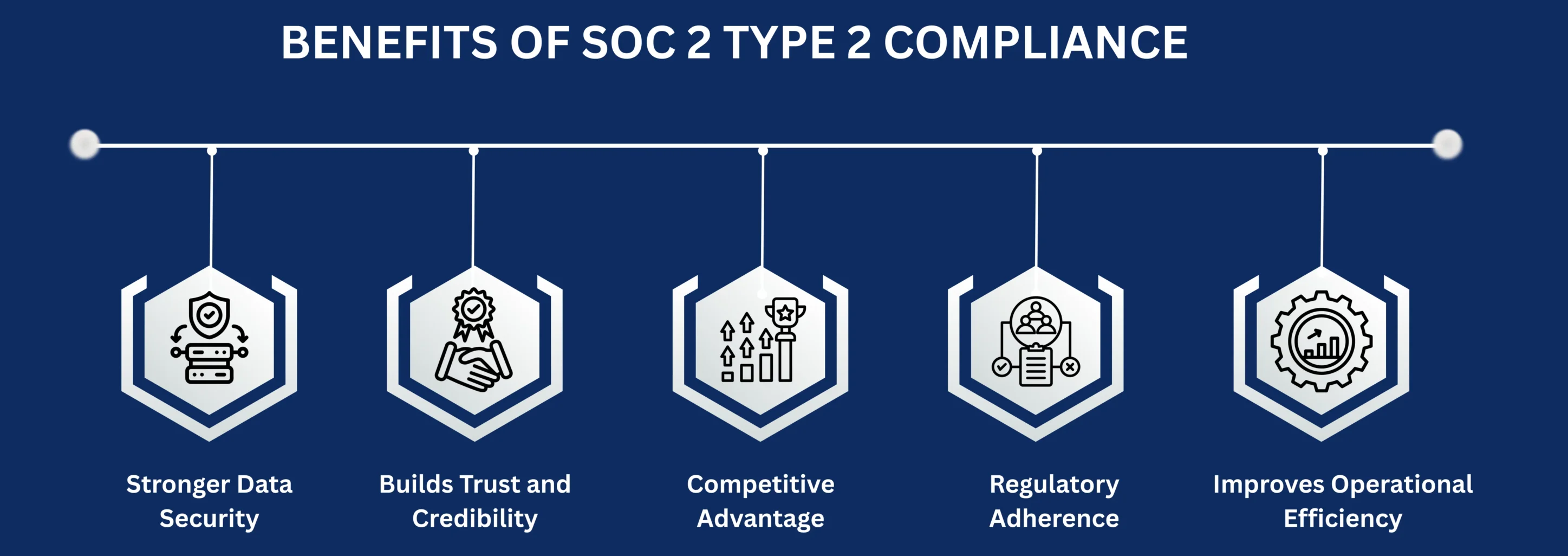
BENEFITS OF SOC 2 TYPE 2 COMPLIANCE
SOC 2 Type II compliance delivers value far beyond an audit report. It fixes real problems that your business faces every day. In this section, let’s learn about the potential benefits of achieving SOC 2 Type 2 compliance.
Stronger Data Security: SOC 2 Type II demands controls to function appropriately over time. Therefore, teams are obliged to track access, monitor systems, test incident response procedures, and protect data with encryption. For example, access reviews must happen on schedule, and security teams must respond promptly when an incident occurs. Such an approach delivers a solid security posture.
Builds Trust and Credibility: A SOC 2 Type II report gives your enterprise buyers and regulators independent third – party proof. It shows a licensed CPA firm like CertPro has tested your controls over the audit period. Such evidence matters in security reviews and enterprise business deals. Because, when you are SOC 2 type 2 compliant, your clients trust you with their data and show zero hesitation in collaborating with you.
Competitive Advantage: Many enterprise buyers now require SOC 2 Type II before approval. As a result, being SOC 2 Type 2 compliant will open new business deals, speed up sales cycles, and reduce the security questionnaires.
Regulatory Adherence: SOC 2 controls map well to GDPR, HIPAA, and ISO frameworks. That overlap helps your teams to reuse policies, logs, and reviews across programs. Thus, being SOC 2 type 2 compliant aligns your security efforts with broader compliance frameworks and standards. Thereby creating a strategic benefit for businesses aiming for multi – standard compliance.
Improves Operational Efficiency: The SOC 2 audit helps you to observe unstructured workflow, weak accountability, and inconsistent governance practices. Consequently, teams rectify those gaps to improve documentation and enhance decision – making and risk management procedures.
COST AND TIMELINE OF SOC 2 TYPE 2 COMPLIANCE
The cost of SOC 2 Type 2 audit varies by organization’s size, scope, controls, and tools used. It involves a preparation period and a longer audit observation window. Still, businesses worry about the cost of the SOC 2 Type 2 audit and the time required to complete it. Both depend on a few practical factors. Let’s learn about them in this section.
Factors That Influence Audit Cost
- Scope is the biggest lever here. Considering AICPA (TSCs), Security is a mandatory criterion for all. When you add availability, confidentiality, or privacy according to your requirements, the scope of the audit expands, leaving room for a rise in prices.
- Company size matters too. A SaaS firm with ten members, operating on one cloud platform, moves faster than a global team running on multi – cloud systems. An increase in users and tools leads to a larger volume of evidence requiring review. Thereby stretching both the time and cost required for SOC 2 type 2 audit.
- Control maturity also affects cost. In this context, teams with clear policies, clean access reviews, and automated logs spend less. In contrast, teams fixing gaps mid – audit often pay more due to rework.
- The auditor you choose to collaborate with also plays a key role here. Experienced firms often balance the cost, pace, and quality of an audit well.
Timeline Breakdown
Most time goes into the preparation period. The audit – readiness phase takes four to eight weeks, or more. This phase is the stage where controls are implemented, evidence is managed, and gaps are resolved to help your firm align with the SOC 2 requirements.
Next comes the observation period. SOC 2 Type II requires an observation period of a minimum of three months to a maximum of twelve months. Then comes the audit testing and reporting phase.
Hence, a thorough SOC 2 compliance journey could last six to twelve months or longer.
How to Optimize Cost and Time
- Using a compliance automation platform plays a key role here to manage evidence and policies.
- Early and mutual agreement on evidence formats and policies avoids last – minute rejections.
- Communicate effectively and define the scope before the process. Any drift in the later period will affect the cost and time.
BEST PRACTICES FOR ACHIEVING SUCCESS IN SOC 2 TYPE 2 COMPLIANCE
SOC 2 Type 2 success comes from calm planning, honest reviews, and consistent governance practices. Below are practical best practices that guide your firm in achieving success in SOC 2 type 2 compliance.
1. Early Agreement on Scope and Criteria
Always begin the SOC 2 audit process by defining the scope. This step shapes everything that follows. As mentioned previously, security is mandatory for all. Beyond that, choose only those that fit your service commitments. Auditors appreciate clarity and mutual agreement. Therefore, early scoping is essential to keep the audit focused and helps your team channel their efforts to the right areas.
2. Conduct a Gap Assessment
A gap assessment is necessary to compare your current security posture and governance structure with the SOC 2 requirements. This process is necessary to catch the hidden gaps, such as unchecked access reviews, weak encryption, and unstructured incident response plans. As a result, early discovery of such issues will guide you in preparing solid remediation plans.
3. Implementation and Validation of Controls
Controls must work in daily operations, not just on documents.
For example, access approvals should follow the same process every time. Furthermore, documentation of procedures plays a key role here.
4. Automate Evidence Collection & Continuous Monitoring
Manual screenshots fail quickly as systems and access change. Therefore, utilize automation to keep evidence accurate and up – to – date without constant manual effort.
5. Prepare Your Team and Internal Communication
Audits demand clear accountability, and they require well – trained and committed people. For instance, a developer should know how to explain code reviews. Similarly, a support lead should explain incident handling.
Apart from these practices, maintaining seamless communication with your auditors and tracking the key compliance metrics will help your firm achieve success in SOC 2 type 2 compliance.
CONCLUSION
In the current business world, buyers are asking for proof and security reviews are happening before contracts. Any delay in delivering the proof will cost your enterprise deals, business reputation, and operational momentum. Hence, SOC 2 Type 2 has become an essential factor in deciding long – term growth and success for SaaS – based businesses operating in the US market.
So, how to begin this journey? This is where CertPro steps in as a strategic audit partner. CertPro is a licensed CPA firm and participates in the AICPA Peer Review Program. This means your SOC 2 Type II audit report is delivered by a licensed CPA firm.
CertPro helps you focus only on what matters for your business needs. Furthermore, we help you understand the SOC 2 requirements better, help collect necessary evidence, and fix gaps and vulnerabilities found in your current posture. Moreover, CertPro also helps in commitment to continuous monitoring and compliance efforts.
If you want a quality, standard, and cost – effective SOC 2 compliance journey, connect with CertPro today. Talk to our expert team. We will help you move from uncertainty to audit – ready, without affecting your daily operations.
FAQ
What is the difference between ISO 27001 and SOC 2 Type 2?
ISO/IEC 27001 is a global framework for establishing, maintaining, and continually improving an Information Security Management Systems (ISMS). Meanwhile, SOC 2 Type II is an AICPA based attestation standard used to assess the design and efficiency of the internal controls of service organizations.
How long is a SOC 2 Type 2 report valid for?
A SOC 2 Type 2 report is typically valid for 12 months from the report date. However, many buyers expect continuous coverage, so companies usually renew the audit annually to maintain trust and meet vendor risk requirements.
What is included in a SOC 2 Type 2 report?
A SOC 2 Type 2 report includes the auditor’s opinion, management’s assertion, system description, tested controls, testing results, and any exceptions. It shows whether controls worked consistently throughout the defined audit observation period.
How to evaluate a SOC 2 report?
SOC 2 report could be reviewed by checking the audit period, scope, and Trust Services Criteria first. Then check tested controls, exceptions, and remediation notes. Additionally, verify that the report is delivered by a licensed CPA firm and that it meets your security and compliance requirements.
What is the difference between SOC 2 and SOC 3?
SOC 2 provides a detailed report for customers under NDA, including control tests and results. SOC 3 is a public, high – level summary with no sensitive details, used mainly for marketing and trust signaling on websites.
WHAT IS CONTROL TESTING? A PRACTICAL GUIDE FOR COMPLIANCE AUDITS
AUDIT SAMPLING EXPLAINED: WHY AUDITORS TEST ONLY SELECTED EVIDENCE

AUDIT REPORTING BEST PRACTICES FOR ACCURACY & COMPLIANCE
Audit reporting is important for every business organization. For business leaders, clear audit reporting is essential to understand risks, controls, and issues that need remediation. A simple and direct reporting process turns audit work into plain insights that...