COMPLIANCE BEST PRACTICES IN 2026: HOW TO STAY AHEAD OF REGULATORY CHANGES

Why is the implementation of compliance best practices critical for 2026? Compliance in 2026 demands operational proof, not the documentation intent. Regulations change faster, audit scrutiny is higher, and reporting timelines are tighter across privacy, cybersecurity, and AI governance (Source).
- Privacy laws expand across regions.
- Cybersecurity rules turn from guidance into enforceable obligations.
- AI governance moves from theory into real oversight.
As a result, most businesses struggle to track what applies, what changed, and what regulators expect next.
For instance, in the current compliance – driven business world, a SaaS company may face GDPR, new AI regulations, sector – specific cybersecurity rules, and customer security demands. Each regulation is unique and has different expectations. Yet regulators expect one clear answer: show how your controls work in real time. What they need is to follow compliance best practices to overcome these challenges.
Stricter enforcement has led to regulators asking for evidence, timelines, and documented changes. They now expect leaders to know how risks are handled and who approved key business decisions. When gaps appear, regulators may require remediation, impose penalties, or escalate oversight, especially when issues repeat or impact customers.
In practice, a static compliance program characterized by annual audits and spreadsheet – based evidence management could lead to audit and framework fatigue rather than compliance confidence.
Hence, modern compliance best practices focus on embedding compliance into daily operations. Here, teams understand their role in risk management, controls align with real – time processes, evidence management is continuous, and leaders gain visibility instead of unforeseen issues.
This guide takes a regulatory – first view of compliance in 2026. It explains how to stay prepared, reduce last – minute panic, and respond with clarity when regulators approach you.

Tl; DR:
Concern: Regulatory compliance in 2026 brings constant pressure. Privacy laws expand across regions. Cybersecurity rules carry penalties. AI governance now faces real oversight. Businesses must meet multiple regulations at once while regulators demand real – time proof, clear audit trails, and leadership accountability. Static programs fail under this pressure and lead to audit stress, missed gaps, and reputational risk.
Overview: Modern compliance reaches daily operations. Regulators focus on controls, evidence, and decisions rather than policies alone. Organizations must show how controls work, who approved actions, and how risks are managed. Continuous monitoring, consistent controls across regions, and clear documentation define effective compliance in 2026. Leadership involvement has become central to audit outcomes.
Solution: Organizations stay ahead by adopting compliance best practices such as control – first compliance, embedding compliance into workflows, and maintaining continuous readiness. Technology plays a key role through centralized evidence, automated monitoring, regulatory intelligence, and AI governance. Working with an experienced audit firm like CertPro strengthens this approach. CertPro delivers high – quality SOC 2 audits, ISO certifications, and privacy compliance for businesses.
WHAT CHANGED IN REGULATORY COMPLIANCE IN 2026
Regulatory compliance feels more complex, stricter, and closer to daily operation in 2026. Rules no longer sit within one country or function. They stretch across regions, industries, and technologies. A single business may answer to privacy authorities in Europe, cybersecurity regulators in the US, and AI oversight bodies in parallel.
Privacy regulations now extend well beyond GDPR focused requirements. New rules cover data sharing, cross – border transfers, and automated decision – making. Privacy compliance in 2026 often means tracking consent and preference signals, vendor and data sharing terms, cross ‑ border transfer controls, and automated decision ‑ making disclosures across websites, apps, CRM tools, and analytics platforms.
To add on, the cybersecurity regulations have also matured, reiterating the need to follow compliance best practices. Guidance documents have turned into enforceable rules with deadlines and penalties. Incident reporting windows have narrowed. Accordingly, the risk assessments must reflect real systems, not theoretical diagrams. When a breach happens, regulators ask how controls were performed before the event, not how they were designed.
AI governance adds another layer of complexity and pushes the organization to adopt compliance best practices. Businesses using AI for hiring, pricing, or fraud detection must explain how models work, how bias is managed, and how decisions are reviewed. Safe and ethical use has become a regulatory expectation, not a voluntary effort.
Compliance has also shifted from policy – based programs to control – based operations. Regulators focus on proof, such as logs, access records, approvals, and change histories, which carry more weight than written intent. Therefore, teams need to show what happened, when, and who approved it.
Personal accountability has also increased. Senior leaders face direct questions during audits and investigations. Thus, weak governance leads to fines, sanctions, and lasting reputational damage. In 2026, compliance touches leadership decisions as much as operational ones. Thus, following compliance best practices is essential to handle this complex environment.
TOP COMPLIANCE BEST PRACTICES FOR 2026
Audit pressure in 2026 feels constant. Most teams blink when an auditor asks, “Show me how this actually works.” Here are some clear compliance best practices that help you handle such situations.
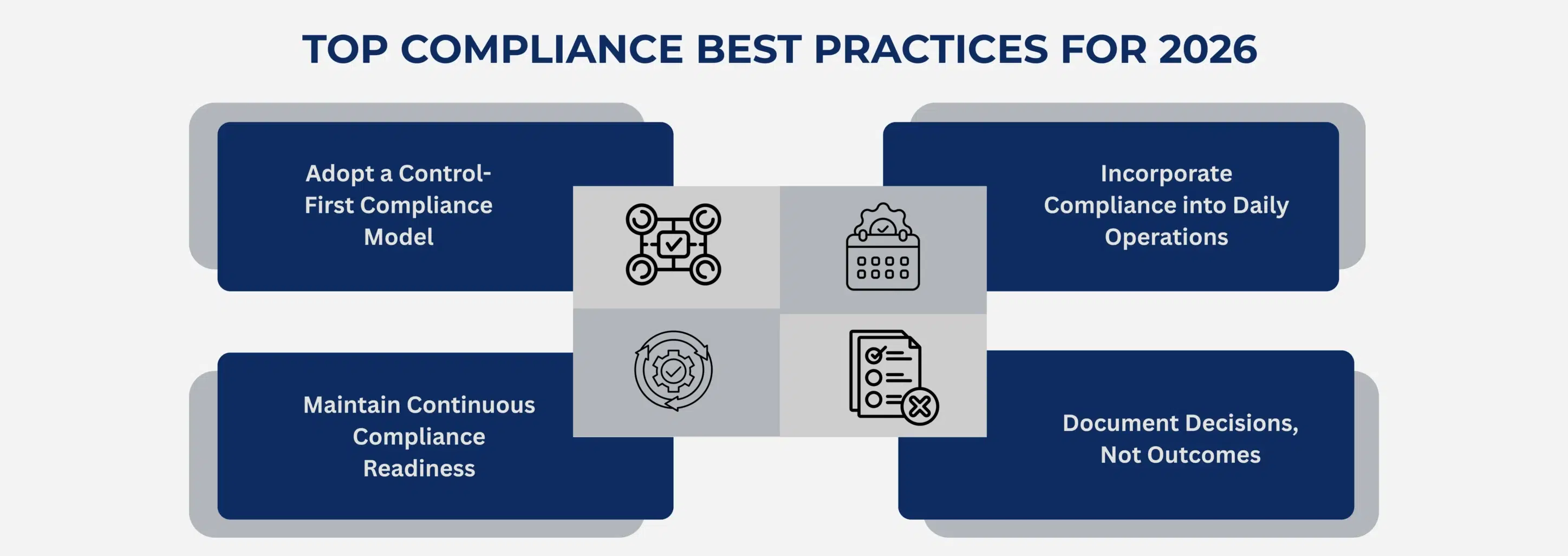
Adopt a Control – First Compliance Model
Controls act like the wiring inside a building. You don’t redesign them for every inspection. You build them once and let them support everything. A well – built control library can map to major frameworks like SOC 2 and ISO/IEC 27001 while also supporting legal obligations like GDPR, HIPAA, or CCPA through documented evidence and consistent processes.
Incorporate Compliance into Daily Operations
Compliance works best when it fits into daily business operations. Access reviews happen during onboarding. Risk assessments happen before new launches and updates. Incident logs update as events occur. Ownership sits with product, IT, and operations teams because they touch the systems daily. The idea is to stop managing compliance as an extra task and start treating it like routine hygiene.
Maintain Continuous Compliance Readiness
Annual audits feel like preparing for finals. Instead, adopting continuous compliance readiness feels like steady training. Monitoring tools check the controls’ health every week. As a result, gaps show up early, fixes happen smoothly, and audits feel like routine checkups.
Document Decisions, Not Outcomes
Auditors care about judgment calls. They verify who approved access, why a risk was accepted, and when controls changed. Clear decision records answer those questions quickly. During an investigation, such an audit trail and evidence management protect leadership. It shows intent, context, and accountability.
In 2026, these practices could help you in building compliance confidence.
HOW TO USE TECHNOLOGY IN IMPLEMENTATION OF COMPLIANCE BEST PRACTICES
In 2026, constantly changing regulations, frequent audits, and intricate security questionnaires overwhelm compliance teams. To tackle this, leveraging technology during implementation of compliance best practices is essential.
Centralize Compliance Data: This process of compliance best practices ensures that one unified system holds policies, controls, risks, and evidence. With such an increase in access and visibility, teams stop searching across folders, emails, and tools. As a result, evidence could be identified in less time during an audit.
Automate Evidence Capturing: Automation adds another layer of efficiency while rolling out compliance best practices. Modern GRC tools track control performance in real time. Access reviews, system changes, and security checks leave clear records. Connect your GRC or compliance platform to identity, ticketing, and cloud systems to automatically capture access reviews, ticket changes, and approvals.
Monitor Control Health: Use alerts for control failures such as missed backups, disabled logging, and overdue access reviews. Identify and fix these issues early instead of discovering them during an audit.
Using Compliance Automation Tools: Integrating your business workflow with a compliance automation tool is unavoidable while operationalizing compliance best practices. Laws now change across regions and industries at once. Reading every update feels impossible. These tools track legal changes and highlight what applies to your business. Even better, they help translate legal text into control updates.
Implementing AI Governance: Ensuring a solid AI governance model has also become essential in the current business market. Many businesses use AI tools for hiring, pricing, or fraud detection. Regulators expect clear explanations of how these systems reach decisions and how risks are controlled. Technology supports this work by tracking data flows from input to output and how bias checks happen. Such transparency is important for building trust.
KEY STEPS IN BUILDING A FUTURE – PROOF COMPLIANCE POSTURE
Implementation of compliance best practices in 2026 needs solid steps to avoid audit stress and framework fatigue from the beginning.
Compliance – Driven Business Strategy
Adopting the compliance best practices supports growth, market access, and trust. It works best when teams involve it early in the process. For example, if you are a product firm, then consider compliance as early as in your planning meetings. This method makes sure that the launch stays on track, no rework follows, and no late approvals slow things down. When regulators review your controls later, they tend to move on quickly. Early alignment of compliance saves time and keeps momentum strong.
Conduct Training in Simulated Environments
People learn through real situations. Slides fade fast, but stories stick in the memory. A developer understands risk when training shows how missing logs delay breach reports. Likewise, a sales lead learns consent rules faster when examples mirror live demos. To sum up, role – based scenarios feel real, and teams gain clarity as risks start feeling familiar.
Conduct Internal Audits Regularly
Conducting frequent Internal audits are one of the key elements of compliance best practices. They reveal gaps early and help you fix them before external audits. For instance, if you run a quarterly access review, then you could identify extra permissions and fix them quietly before audits. These reviews guide steady progress. They lower stress and build readiness over time.
Prepare for Multi – Regulator Scrutiny
Regulators now share information. A privacy issue can trigger a security review. A cyber incident can raise governance questions. Therefore, maintaining a uniform and standard compliance posture across regions matters. Your teams must not struggle with compliance requirements by country. Ensure the implementation of a few solid security controls that answer multiple regulatory and region – specific compliance requirements. Auditors and regulators look for aligned controls and uniform and updated logs with scalable processes.
CLOSING THOUGHTS
Regulatory compliance in 2026 demands structure, clarity, and accountability. Therefore, organizations that adopt modern compliance best practices stay calm under this pressure. They reduce risk early and build trust with customers, partners, and regulators.
Failed audits slow sales, delay enterprise deals, and weaken market confidence. Often, the cleanup costs far exceed the effort of getting it right early. This is where CertPro steps in.
CertPro CPA LLC works as a strategic and independent audit firm, not a distant reviewer. Our team performs standard and quality compliance audits with precision and clarity. CertPro assists organizations in obtaining SOC 2 attestation reports and adhering to ISO frameworks and other privacy standards, such as GDPR, HIPAA, and CCPA, by providing clear examination controls and practices for achieving compliance certifications. Our audit workflow mirrors the key strategies of operationalizing compliance best practices.
Startups use CertPro to close enterprise deals faster. Growing businesses rely on CertPro to scale compliance without chaos. Mature organizations trust CertPro to strengthen governance and withstand regulator scrutiny.
If audits feel stressful or compliance feels scattered, now is the time to act. Connect with CertPro today and move from compliance pressure to compliance control.
FAQ
What are the best practices for compliance?
Compliance best practices include using a control – first approach, aligning compliance with daily operations, maintaining continuous readiness, documenting decisions clearly, and using technology to track evidence. These practices help reduce audit risk and improve trust.
What is compliance management?
Compliance management is the process of identifying regulatory requirements, applying internal controls, monitoring compliance activities, and maintaining evidence. It helps organizations meet legal obligations, pass audits, and manage risk consistently across teams and regions.
What do you mean by compliance reporting?
Compliance reporting means collecting and presenting evidence that shows how controls operate. It includes logs, approvals, audit results, and metrics. Regulators and auditors use these reports to verify compliance status and decision accountability.
What are the best practices of risk management in compliance?
Compliance risk management best practices include identifying regulatory risks early, linking risks to controls, monitoring changes continuously, documenting risk decisions, and reviewing risks regularly. This approach helps organizations prevent violations and respond faster to audits.
What is regulatory compliance?
Regulatory compliance refers to following laws, regulations, and standards that apply to a business. It includes privacy, cybersecurity, financial, and industry rules. Organizations must prove compliance through controls, evidence, and documented processes.