SOC 2 TYPE 2 COMPLIANCE FOR SAAS COMPANIES: FROM GAP ASSESSMENT TO AUDIT

When you run a SaaS business that deals with customer data, trust is the priority. But how do you prove that your security controls work consistently over time? SOC 2 Type 2 compliance serves as a crucial validation mechanism in this situation. While a simple snapshot review may not be enough, SOC 2 Type 2 compliance will ensure that your security controls are not just written down on paper but are actually functioning as intended.
For most businesses, this means that they need to demonstrate their effectiveness over a period of six to twelve months. However, before starting the actual audit process, it is essential to perform an SOC 2 gap analysis that can save you a lot of time, money, and headaches. At CertPro, we are an independent CPA firm registered with AICPA, and we can help SaaS businesses navigate through this entire SOC 2 compliance. Understanding the process from readiness assessments to final attestation can significantly enhance your success. In this guide, you will learn all about the steps, pitfalls, and strategies that can help your business achieve SOC 2 Type 2 compliance.
Tl; DR:
Concern: Many SaaS organizations find it difficult to show that controls work consistently over time. Common challenges include unclear ownership of controls, gaps in evidence, reliance on manual processes, and limited understanding of auditor expectations, all of which can affect audit outcomes.
Overview: SOC 2 Type 2 compliance follows a structured path that typically starts with a gap assessment, followed by remediation and evidence collection, and ends with an independent audit. The emphasis remains on control effectiveness, documentation accuracy, and alignment with the Trust Services Criteria.
Solution: A methodical approach that includes early gap identification, clear audit scope, ongoing control monitoring, and well – organized evidence supports a smoother audit process. Documented controls and consistent execution help organizations maintain SOC 2 Type 2 compliance over time.
SOC 2 TYPE 2 COMPLIANCE
SOC 2, or System and Organization Controls 2, is an attestation standard developed by AICPA (American Institute of Certified Public Accountants). It guides auditors in evaluating the effectiveness of data protection measures for organizations on the basis of five Trust Services Criteria, including, Security, Availability, Processing Integrity, Confidentiality, and Privacy.
The difference between Type 1 and Type 2 certification is important when considering SOC 2 Type 2 compliance. A Type 1 audit simply looks at the design of the controls at a given point in time. However, a Type 2 audit looks at much more, testing whether those controls were functioning correctly over a period of time, usually between six and twelve months.
Understanding SOC 2 Type 2 Meaning
The SOC 2 Type 2 meaning is more than just a simple compliance certification. In essence, it is a promise of operational excellence in data protection. In addition, the SOC 2 Type 2 meaning also includes organizational maturity. Organizations that are able to successfully navigate this process usually have excellent internal processes, documentation, and collaboration between the security, engineering, and compliance teams.
Key Differences: Type 1 vs Type 2
Understanding the differences between SOC 2 Type 1 and Type 2 helps companies choose the right path. Although both reports validate security practices, they serve distinctly different purposes.
The differences are listed below:
| Aspect | Type 1 | Type 2 |
|---|---|---|
| Scope | Control design | Design and operating effectiveness |
| Time Period | Single point in time | Extended period (6-12 months) |
| Testing | Assessment of control design | Continuous operational testing |
| Business Value | Establishes baseline | Provides ongoing assurance |
While Type 1 reports help establish baseline compliance, most enterprise customers specifically request SOC 2 Type 2 compliance because it demonstrates sustained commitment to security controls. Therefore, many SaaS companies view Type 1 as a stepping stone rather than a final destination.
Why SaaS Companies Need SOC 2 Type 2 Compliance
The business case for pursuing SOC 2 Type 2 compliance extends beyond mere compliance. As a result, companies in the SaaS industry identify the following reasons to pursue this level of certification:
- Enterprise procurement requirements often include SOC 2 Type 2 attestation as a prerequisite for contract approval.
- Security questionnaires become much shorter and less burdensome when you can point to a recent report.
- Competitive advantage in regulated markets such as healthcare and finance.
- Customer confidence grows when third – party auditors verify your security procedures.
- Sales cycles accelerate because prospects will spend less time assessing security controls.
In addition, companies that maintain SOC 2 Type 2 compliance improve their overall security position by creating processes and accountability that benefit the entire company.
THE ROLE OF A SOC 2 GAP ASSESSMENT IN AUDIT READINESS
Before diving headfirst into a full – fledged SOC 2 Type 2 audit, successful businesses usually perform what’s called a SOC 2 gap assessment first. This is your guide to audit readiness. In essence, SOC 2 gap assessment is where your current security posture is measured against the AICPA’s Trust Services Criteria, pinpointing areas that require improvement. Rather than discovering issues during the actual audit, when the pressure is at its highest, a gap assessment assists you in addressing these issues before they become critical. At CertPro, we’ve watched many businesses reap the rewards of this forward – thinking strategy.
The procedure for conducting a gap assessment includes examining existing policies, assessing current controls, reviewing the collection of evidence, and analyzing documentation gaps. Later on, businesses are presented with a comprehensive report detailing the remediation process required before the audit period even begins.
What Is SOC 2 Gap Analysis and Why Does Your Business Need It?
A SOC 2 gap assessment is a systematic process of determining where your organization is now compared to where it needs to be to achieve success in the audit.
In this process, auditors will review your security controls, policies, procedures, and documentation. But instead of giving you a formal report with possible exceptions, a gap assessment offers constructive feedback and recommendations. It includes analysis of security policies and procedures, access control methods, user access reviews, logging and monitoring capabilities, incident response procedures, change management procedures, vendor risk management processes, and evidence collection systems.
Key Benefits of Conducting a Gap Assessment
Investing time and resources in a SOC 2 gap assessment delivers multiple advantages that extend throughout your compliance journey. The potential benefits include:
- When remediation options are limited, early identification prevents costly surprises during formal audits.
- Risk reduction improves overall security posture.
- Time savings accelerate the path to achieving SOC 2 Type 2 compliance.
- Cost efficiency reduces total audit expenses by minimizing exceptions and remediation cycles.
- Stakeholders’ confidence increases when teams understand expectations before the audit period begins.
In addition, the gap assessment procedure assists organizations gain an understanding of what the auditors are looking for.
Optimal Timing for Your Gap Assessment
Choosing the ideal time for your SOC 2 gap assessment strategically maximizes its value. Generally, organizations should schedule assessments during these key situations:
- Before beginning your observation period for the first time.
- When transitioning from SOC 2 Type 1 to Type 2 compliance.
- Organizational changes such as mergers, acquisitions, or leadership transitions.
- After major infrastructure changes like cloud migrations or system upgrades.
- When previous audits resulted in exceptions.
Furthermore, it is always best to perform your gap assessment at least three to six months prior to the beginning of the audit period. This will give you enough time to work on remediation and process implementation without having to rush through the critical stages of security improvement.
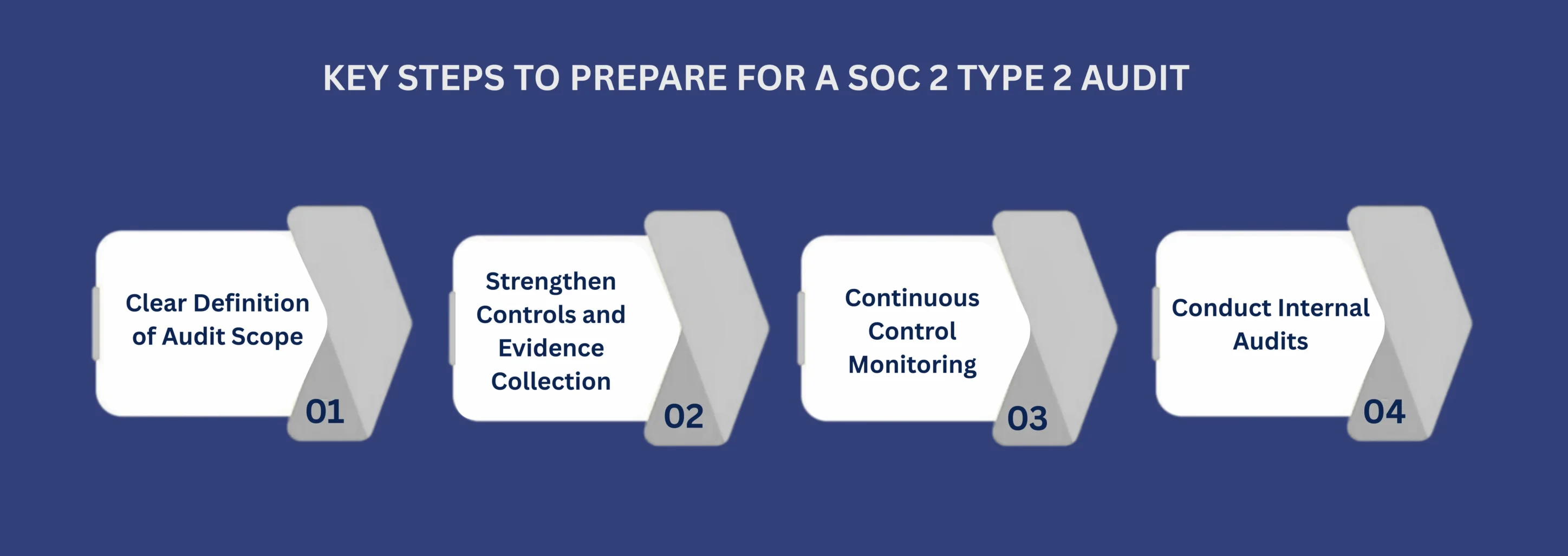
KEY STEPS TO PREPARE FOR A SOC 2 TYPE 2 AUDIT
Once the gap assessment identifies the areas of concern, the preparation for the actual SOC 2 Type 2 audit begins. As an independent CPA firm registered with AICPA, CertPro engages with the clients during these stages.
Clear Definition of Audit Scope
Defining your audit scope is the first significant preparation choice you make. Security is required for all SOC 2 audits, but you need to decide whether Availability, Processing Integrity, Confidentiality, or Privacy is relevant to your service obligations. This phase is something you will work with your audit firm to define.
Strengthen Controls and Evidence Collection
Once scope is defined, it is essential to implement effective controls and evidence gathering. Develop broad policies that are specific and actionable, aligned with your Trust Services Criteria. Develop technical and administrative controls to support these policies.
Continuous Control Monitoring
The controls must be working properly throughout the observation period and not just be on paper. Regular monitoring practices can be established by scheduling reviews, alerting on control failures, and remediation activities.
Conduct Internal Audits
Internal audits are an excellent means of preparation, as they mimic actual audit situations. Organize internal audits where team members demand proof, examine documents, and assess control efficiency. This approach identifies weaknesses early and prepares your team for the actual auditing process.
Common Challenges and How to Overcome Them
Despite thorough preparation, most organizations encounter similar challenges during their SOC 2 Type 2 compliance journey. Recognizing these common pitfalls helps you avoid them or respond effectively when they arise.
Over years of conducting audits at CertPro, we’ve observed recurring patterns that trip up even well – prepared teams. Documentation gaps, manual processes, coordination issues, and scope management problems appear frequently across different organizations and industries. However, these challenges are entirely manageable with proper awareness and planning. Below, we explore the most common challenges and provide practical strategies for overcoming each one effectively.
Inadequate Documentation Practices
The Challenge:
Inadequate or missing documentation is still the leading reason for audit delays. Problems include inconsistent documentation, missing documentation, missing or inaccurate timestamps, missing approvals, and dispersed evidence in multiple systems. It is impossible to confirm control effectiveness without proper documentation.
The Solution:
- Adopt documentation standards early and train the entire team.
- Develop templates for common types of evidence.
- Use version control systems for policies and procedures.
- Conduct regular documentation reviews to find missing documentation.
- Use a centralized location where all compliance evidence is stored and accessible.
- Assign a documentation coordinator to ensure consistency and completeness.
Reliance on Manual Control Processes
The Challenge:
Manual controls are a major source of risk for SOC 2 Type 2 compliance. When controls rely on people remembering to perform tasks, inconsistencies arise. They lead to bottlenecks, lack automated tracking, and are sources of variability that auditors are highly skeptical of.
The Solution:
- Automate controls as much as possible for tasks such as access provisioning, log reviews, backup verification, and vulnerability scans.
- For manual controls, design effective reminder systems, checklists, and verification procedures.
- Set up quarterly reviews of automated systems.
- Keep detailed records of changes to automated control configurations.
Lack of Cross – Team Alignment
The Challenge:
SOC 2 Type 2 compliance necessitates collaboration between security, engineering, operations, product, and customer success teams. When teams work in separate teams, there are significant gaps in critical areas because various teams use different tools, have different documentation, or have different procedures.
The Solution:
- Form a compliance steering committee with members from each department that meets once a month.
- Develop RACI matrices that define who is responsible, accountable, consulted, and informed for each control.
- Offer comprehensive training so that all team members are aware of their compliance obligations.
- Utilize collaboration tools where all teams view policies, procedures, and evidence requirements in one place.
- Mark compliance achievements together.
Evidence Quality and Completeness Gaps
The Challenge :
The evidence submitted to the auditors must be of high quality, and this should be able to show control operation clearly. Some of the common issues with quality include lack of context, lack of signatures, dates that lack important information, lack of specific control activities in the logs, and changes that lack explanations.
The Solution:
- Establish what constitutes acceptable evidence for each control type right from the beginning of the audit period.
- Train staff members on evidence requirements using examples of good and poor evidence.
- Establish quality checks where evidence is assessed.
- Develop comprehensive evidence collection guides that include essential information.
- Carry out evidence spot checks on a regular basis during the audit period.
Final Thoughts
Achieving SOC 2 Type 2 compliance is a major milestone for any SaaS company. The process takes planning, discipline, and sustained effort. However, the value goes far beyond passing an audit. Organizations that complete SOC 2 Type 2 build stronger security programs, gain customer confidence, and stand out in competitive markets.
A detailed SOC 2 gap assessment sets the right starting point. It highlights gaps early, when fixes are faster and less disruptive. During preparation and the audit itself, teams should focus on how controls operate in real workflows, not just how they look on paper. This approach helps controls protect customer data in practice.
As a licensed CPA firm registered with the AICPA, we perform SOC 2 audits and readiness assessments aligned with professional standards. We specialize in efficient audit execution and thorough control testing. The result helps organizations complete their SOC 2 report with clarity and confidence. A clear understanding of the audit process and common pitfalls supports smoother audits and long – term SOC 2 Type 2 compliance.
FAQ
What is the primary purpose of a SOC 2 gap assessment?
A SOC 2 gap assessment identifies control weaknesses before the formal audit begins. This early identification allows organizations to remediate issues when they still have time, significantly improving audit success rates.
How long does the SOC 2 Type 2 audit observation period typically last?
The observation period typically runs between six and twelve months. This extended timeframe demonstrates that controls operate consistently rather than just at a single point in time.
What types of evidence do auditors expect during a SOC 2 Type 2 audit?
Auditors expect dated, traceable evidence, including logs, policy documents, screenshots, approval records, review documentation, monitoring results, and incident reports covering the entire audit period.
Can small SaaS companies successfully achieve SOC 2 Type 2 compliance?
Absolutely. Small companies can achieve SOC 2 Type 2 compliance with proper planning and consistent documentation practices throughout the audit period.
What happens if controls fail during the audit period?
Control failures don’t automatically disqualify you. However, you must document the failure, remediate it promptly, and demonstrate effective remediation. Repeated failures or inadequate responses may result in audit exceptions.