SOC for Cyber Security: Using SOC Audits to Prove Cyber Security Maturity

For companies that handle sensitive data or run cloud-based services, the question “Can you provide your SOC 2 report?” carries enormous weight. Yet, many organizations are not sure what being SOC 2 certified really means. Having security controls in place is not enough. When a company is SOC 2 certified, it means those controls have been tested and confirmed to work over time, not just set up and left alone.
Implementing security controls is not enough; SOC 2 certification proves they operate effectively over time. It shows independent auditors examined your controls, tested their operation across months, and confirmed they meet professional standards. Understanding the SOC 2 attestation process, costs, and business impact enables organizations to plan effectively and meet customer expectations. This article breaks down what certification means practically, how it works, what it costs, and the benefits it delivers
Tl; DR:
Concern: Many businesses implement security measures but struggle to prove they work consistently. Without independent verification, customers question whether controls actually protect their data, creating barriers in sales conversations and partnership discussions.
Overview: SOC 2 certification represents independent validation that your security controls meet AICPA Trust Services Criteria. Organizations achieve this through formal attestation examining control design and operational effectiveness over defined periods.
Solution: Pursuing SOC 2 attestation provides third-party validation of your security posture. Independent auditors verify controls operate effectively throughout examination periods, giving customers concrete evidence your organization protects sensitive information reliably.
WHAT DOES SOC 2 CERTIFIED MEAN?
The term “SOC 2 certified” comes up often in business talks. But what it really means is more nuanced than most people think. Fundamentally, obtaining SOC 2 certification signifies that a licensed CPA firm has reviewed and tested your security controls. It is a formal process where external auditors examine how your controls are built and whether they work over a set period of time.
Auditors check your systems against AICPA Trust Services Criteria. These cover security, availability, privacy, processing integrity, and confidentiality. After their review, they issue a report with their view on whether your controls worked well during the audit period. So, when people say a company is SOC 2 certified, they usually mean the company has a current, valid report from qualified auditors.
The following section explains the key differences between SOC 2 certification and SOC 2 attestation, why that distinction matters, and what most people misunderstand about SOC 2.
SOC 2 Attestation vs SOC 2 Certification
Companies do not become SOC 2 certified like they earn a diploma. Instead, they go through an attestation process run by a licensed CPA firm. This difference is worth knowing.
In the standard sense, a single certificate does not exist for this framework. Instead, the process produces a full report. This report lists your systems, the controls tested, the steps used, and the results.
CertPro is a licensed CPA firm enrolled in the AICPA peer review program. We run these attestation processes in line with set rules.
Type 1 vs Type 2 Reports
Most customers want a Type 2 report. Because, customers expect evidence of ongoing control effectiveness. Type 1 reports are faster and less expensive but often serve as a stepping stone toward Type 2.
| Report Type | Focus | Timeframe | Best For |
|---|---|---|---|
| Type 1 | Control design & implementation | Single point in time | Organizations starting compliance or showing control design quickly |
| Type 2 | Operating effectiveness over time | 6–12 months | Organizations proving sustained control operation & meeting customer expectations |
BUSINESS IMPLICATIONS OF SOC 2 CERTIFICATION
Beyond the technical aspects, the following are the three key areas where SOC 2 certification makes a real difference for your business.
First, it speeds up your sales cycle. A current attestation report cuts long security questionnaires and speeds up due diligence. Therefore, your sales team can handle objections faster and close deals with more ease.
Second, it opens doors to new customers. Many large or regulated customers require SOC 2 compliance in their contracts. Without a current report, you simply cannot compete for that business. In fact, achieving this status directly grows your market reach and revenue potential.
Third, it makes your securitY posture becomes stronger. Getting ready for the process pushes your team to tighten controls, write down processes, and build clear ownership. So, your security gets better even before the final report comes out.
HOW SOC 2 CERTIFICATION WORKS
Understanding the mechanics of obtaining an SOC 2 audit helps organizations plan realistic timelines and allocate appropriate resources. The path to becoming SOC 2 certified starts long before auditors arrive. First, you need to set up your controls. Then, you let them run for the required period. Finally, you collect proof that they worked. This preparation is essential for organizations seeking to become SOC 2 certified.
Process and Timeline
Here is the typical flow:
Step 1 – Assess Gaps: Find out what is missing from your current security controls.
Step 2 – Set up Controls: Fix the gaps and put the right policies and tools in place.
Step 3 – Run Controls: Keep your controls running well during the audit period.
Step 4 – Bring in Auditors: Work with your CPA firm to start the formal audit.
Step 5 – Collect and Show Proof: Give your auditors the evidence that controls worked.
For first-time Type 2 reports, this process usually takes 8 to 14 months. If you need results sooner, a Type 1 report is a good place to start while you build toward a full Type 2 report. Also, do not try to rush the process. Cutting the audit period short or starting before controls are ready often leads to gaps in evidence and audit delays.
Key Audit Phases
Planning: First, auditors and your team set the scope together. Which Trust Services Criteria apply? What is the audit period? Which systems are in scope? Getting this right early prevents surprises later. It also helps you understand the SOC 2 certification cost more closely.
Readiness Assessment: Before the formal audit, many teams benefit from a readiness review. This step identifies control gaps, missing records, or policy issues that require resolution. In fact, it is much easier to fix problems here than during a live audit. A thorough readiness assessment increases your likelihood of becoming SOC 2 certified on schedule.
Evidence Collection: Throughout the audit period, you need to gather proof that your controls ran well. This includes system logs, access reviews, change tickets, incident reports, training records, and signed policies. Automated evidence collection through logging tools, ticketing systems, and monitoring platforms is far more reliable than manual records. So, set up automated tools early.
Control Testing: During this phase, auditors review your proof, talk to control owners, and check that controls worked as described. They pull samples from across the audit period. Then, they verify whether controls are functioning as intended.
Reporting: After completing testing, auditors draft the SOC 2 report. This document describes the system, lists controls tested, explains testing procedures, and presents findings. If controls operated effectively without significant exceptions, auditors issue unqualified opinions. Receiving an unqualified opinion is the final step toward becoming SOC 2 certified.
Evidence Quality and Organization
Good evidence makes audits faster and smoother. Here is what auditors look for:
- Complete Records: Evidence must cover every instance where a control should have run.
- Authentic Records: Timestamps and system data prove your records are real.
- Organized Records: Auditors must find specific proof quickly. Messy records slow things down.
One common mistake: Organizations aiming to become SOC 2 certified must avoid common documentation mistakes. Teams set up controls but forget to record them. So, plan your evidence collection at the same time you set up controls, not after.
SOC 2 CERTIFICATION COST
Understanding SOC 2 certification cost is an important part of planning. Several factors shape the total spend, and knowing them helps you set a realistic budget.
Key Cost Drivers
Several factors influence SOC 2 certification costs. The table below summarizes the key cost drivers and strategies to optimize expenses.
| Cost Factor | Impact | Optimization Strategy |
|---|---|---|
| Scope (Criteria) | High | Select only required criteria initially |
| Audit Period | Moderate | Start with 6 months, extend later |
| Complexity | High | Simplify architecture where possible |
| Evidence Organization | Moderate | Use structured repositories early |
| Control Maturity | Moderate | Conduct internal testing before audit |
BENEFITS OF BEING SOC 2 CERTIFIED
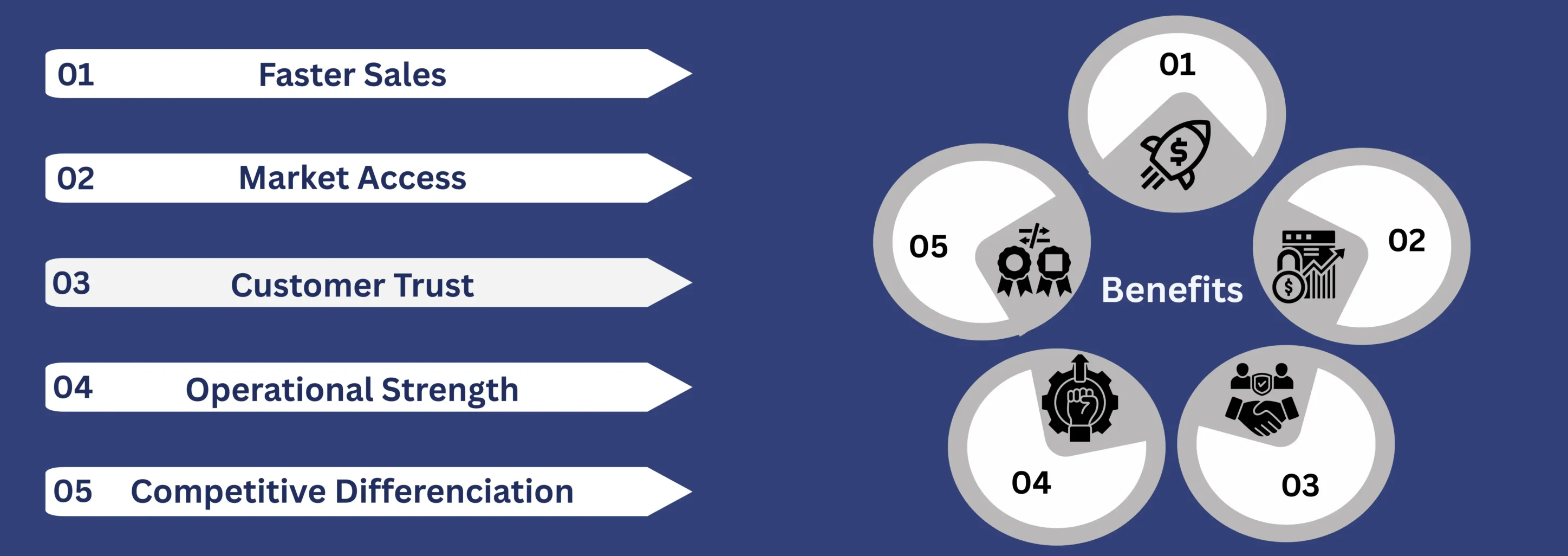
Holding SOC 2 certified status does more than satisfy customer requirements. In fact, it brings real, lasting value to your business in several ways.
Faster Sales Cycles and More Market Access
When prospects ask about security during sales conversations, providing a current SOC 2 report demonstrates commitment tangibly. Being SOC 2 certified strengthens this assurance and builds immediate credibility with prospects. This concrete evidence carries more weight than verbal assurances or marketing claims about security priorities. Consequently, sales cycles often accelerate because security objections resolve more quickly. Moreover, many customer agreements mandate SOC 2 compliance as a contract condition, meaning certification directly impacts addressable market size and revenue potential.
Enhanced Customer Trust and Retention
Many existing customers review their vendors each year. Having a current, valid report makes that review easier for them. Moreover, it gives them confidence in your partnership. In fact, annual reports can stop customer churn caused by security concerns or compliance changes.
Operational Security Improvements
The preparation process makes your company truly more secure. Going through this process helps teams to:
Formalize steps that were once done in an unstructured manner.
Write down processes that only live in people’s heads.
Set up steady monitoring across systems.
Build clear ownership of each control.
These changes stick. Also, the discipline needed to keep the status prevents security from slipping over time.
Competitive Differentiation
In markets where many vendors claim strong security, holding this status sets you apart. Being SOC 2 certified provides that independent validation. It is outside proof, not a marketing claim. Also, renewing each year shows ongoing commitment rather than a one-time effort. So, customers and partners know your security practices remain consistent.
Structured Risk Management and Continuous Improvement
The audit process itself is a useful risk management tool. Auditors often catch control gaps or weak spots that your own team might miss. Annual audit cycles, in turn, keep security practices strong. So, companies that maintain their audit status build a long-term security posture.
COMPARING SOC 2 AND ISO 27001
Organizations frequently ask whether to pursue SOC 2 attestation, ISO 27001, or both. While both frameworks address information security, they approach the subject differently and serve distinct purposes.
SOC 2 bases its evaluations on the AICPA Trust Services Criteria, focusing on operational controls within service organizations. Organizations that become SOC 2 certified must demonstrate adherence to these criteria. The SOC 2 audit process produces attestation reports issued by independent CPA firms that describe your system, controls tested, and audit results. Organizations share these reports directly with customers and partners. In contrast, ISO 27001 establishes requirements for Information Security Management Systems, emphasizing risk management processes and continuous improvement cycles. It results in certification issued by accredited certification bodies, with certificates valid for three years.
SOC 2 is U.S.-centric and preferred by SaaS and cloud providers, while ISO 27001 is globally recognized, especially for international or European markets.
Decision Factors:
Customer Requirements: If major customers or target markets explicitly request SOC 2 reports, that framework takes priority. Similarly, for organizations selling into European markets, ISO 27001 supports global credibility and structured governance.
Industry Norms: SaaS providers and technology service organizations typically pursue SOC 2 because it aligns with how technology buyers evaluate vendor security. Financial services organizations and manufacturing companies that aim for a security posture build on a global scale, more commonly pursue ISO 27001.
Strategic Goals: Companies planning international expansion might pursue ISO 27001 even if current customers only request SOC 2. However, becoming SOC 2 certified often remains a priority for serving U.S.-based enterprise customers. Many organizations ultimately pursue both frameworks as they grow and serve diverse markets.
| Aspect | SOC 2 | ISO 27001 |
|---|---|---|
| Framework Basis | AICPA Trust Services Criteria | ISO/IEC 27001 ISMS Requirements |
| Output | Attestation Report | Certification |
| Validity | Reports updated annually | 3-year certificate with annual surveillance audits |
| Geographic Focus | U.S.-centric | Global recognition |
| Detail Level | Tests specific controls based on TSC, service commitments and contractual requirements | Certificate confirms ISMS compliance |
CONCLUSION
Being SOC 2 certified means external auditors check your controls, test them over time, and confirm they meet set standards. The final report gives customers real proof that you protect their data. Moreover, this process strengthens your security, sets up clear steps, and improves how you manage risk.
This is an ongoing commitment to ensuring a robust security posture and control strength. Keeping it means running controls every day, collecting proof, and completing annual audit cycles. Connect with a licensed CPA firm like CertPro to begin your SOC 2 compliance journey. In the end, getting SOC 2 attestation proves your customers one thing: your security commitment is third-party verified in accordance with established auditing standards.
FAQ
What are the main challenges of SOC 2 certification?
The biggest challenges include defining the right audit scope, properly implementing and documenting controls, collecting consistent evidence over time, ensuring employees follow established policies, and maintaining control effectiveness throughout the audit period, especially during first-time Type 2 engagements.
What's the difference between SOC 2 certified and compliant?
Compliance means following internal controls or regulatory requirements without independent verification. Being SOC 2 certified means a licensed CPA firm attested that your controls were suitably designed and operated effectively during a defined period through formal examination.
Can small businesses afford SOC 2 certification?
Yes, though SOC 2 certification cost varies by scope and complexity. Small businesses with simple environments that pursue Type 2 reports spend less compared to huge firms with complex environments. Starting with Type 1 reports reduces initial investment while building toward Type 2.
Does SOC 2 certification expire?
SOC 2 reports don’t technically expire but lose relevance over time. Most customers expect reports covering periods ending within the last six to twelve months. Therefore, organizations must complete annual audit cycles to maintain current certified status and meet customer expectations.
Should we pursue SOC 2 or ISO 27001 first?
Consider customer requirements and target markets primarily. U.S.-focused SaaS companies typically prioritize SOC 2, while organizations serving international markets often choose ISO 27001. Both frameworks offer valuable security benefits, and many organizations eventually pursue both for comprehensive coverage.