
Most compliance teams aren't managing one framework. They're managing three, four, sometimes five — simultaneously. A SaaS company selling to enterprise buyers might need SOC 2 for procurement requirements, ISO 27001 for international contracts, and HIPAA if any healthcare data is in scope. Throw in PCI DSS for payment processing or GDPR for European users, and the operational weight multiplies fast.
Multi-framework compliance is no longer a niche concern for large enterprises. It's a front-and-center operational reality for technology companies, financial services firms, and healthcare organizations that serve regulated markets. The real question isn't whether you'll eventually manage multiple frameworks — it's whether you'll manage them intelligently or reactively.
This guide breaks down what multi-framework compliance means in practice, why it creates friction at the organizational level, and how forward-thinking compliance teams are building leaner, smarter programs in 2026 without burning out their people in the process.
Concern
Organizations must manage multiple frameworks such as SOC 2, ISO 27001, HIPAA, and GDPR at the same time. As a result, teams face duplicated controls, repeated evidence collection, and overlapping audit cycles. This leads to audit fatigue, resource drain, and higher risk of control gaps. Moreover, fragmented ownership slows response time and weakens audit readiness.
Overview
Multi-framework compliance means managing multiple standards through a shared structure. Most frameworks overlap in key areas such as access control, risk assessment, and incident response. However, each framework uses different terminology and audit expectations. Therefore, organizations must align controls, policies, and evidence across frameworks. A unified control model improves consistency, reduces duplication, and supports scalable compliance operations.
Solution
Build a centralized control library that maps controls across all frameworks. Then, write policies once and align them with multiple requirements. Next, centralize evidence collection using GRC platforms and automation tools. Also, assign clear ownership for control maintenance and audit coordination. Finally, adopt continuous monitoring to keep evidence current and audit-ready at all times. This structured approach reduces duplication, improves audit efficiency, and supports consistent compliance across frameworks.
What Is Multi-Framework Compliance?
Before you can streamline anything, you need a clear picture of what you're working with. What is the compliance framework, at its core? It's a structured set of controls, policies, and requirements that organizations follow to satisfy a specific regulatory or security standard. SOC 2, ISO 27001, NIST CSF, HIPAA, GDPR — each one defines its own language, scope, evidence requirements, and audit methodology.
Multi-framework compliance is the practice of managing two or more of these frameworks simultaneously — aligning controls, documentation, and audit readiness across all of them without treating each as a completely separate program.
The inherent challenge is that each framework was built by a different body, for a different audience. SOC 2 was designed for service organizations and their customer trust obligations. ISO 27001 comes from an international standards body focused on information security management systems. HIPAA is U.S. federal law. They overlap significantly in practice — access controls, risk assessments, incident response, vendor management — but they describe those overlaps in different terminology with different evidence expectations.
Security compliance frameworks like SOC 2 and ISO 27001 are built on a shared foundation of risk management and access governance. Regulatory compliance frameworks like HIPAA and GDPR layer legal obligations on top — data subject rights, mandatory breach notification timelines, data residency requirements. Understanding where these frameworks converge is the starting point for any unified compliance program.
The key mental shift that makes multi-framework compliance work: stop treating each framework as a standalone checklist and start building a control library that serves all of them at once. That shift in thinking changes everything about how your compliance program is designed, staffed, and sustained.
Why Multi-Framework Compliance Has Become A Strategic Priority
A few years ago, most mid-market technology companies managed one or maybe two compliance frameworks. Today, the average compliance scope across growing organizations has expanded considerably — and it's accelerating, not slowing down.
Enterprise procurement requirements are driving much of this. Large buyers now run comprehensive vendor risk programs. They ask for SOC 2 Type 2 reports, detailed security questionnaires, penetration test summaries, and sometimes ISO 27001 certifications — all before a contract is signed. If you're selling to healthcare systems or insurers, HIPAA compliance is often non-negotiable. Likewise, if your product processes European personal data, GDPR applies regardless of where your company is headquartered.
Multi-framework compliance has become a commercial differentiator as much as a legal obligation. Organizations that can demonstrate readiness across multiple frameworks close deals faster, reduce friction in enterprise procurement cycles, and build the kind of customer trust that shortens sales timelines. The compliance function, when structured well, directly supports revenue growth.
Internal pressure is equally real. CISOs and compliance leads operate with lean teams and limited budgets. Running each framework as a separate workstream — with its own documentation, evidence, and audit timeline — creates duplication, drains resources, and leads to sustained audit fatigue. Multi-framework compliance is how organizations absorb this expanding regulatory surface without fragmenting their programs into disconnected, redundant silos.
Key Challenges In Managing Multi-Framework Compliance
Even with the right intent and capable teams, multi-framework compliance is operationally difficult. Here's where most organizations consistently run into trouble.
Most major frameworks share a significant percentage of their controls. SOC 2 and ISO 27001 overlap to a great extent in practice. But teams running separate compliance programs for each framework end up gathering evidence twice, writing policies twice, and managing two separate auditor relationships. That duplication is expensive in time, money, and team bandwidth.
Control Mapping Gaps: Multi-framework compliance requires a precise map of which controls satisfy which requirements across which frameworks. Without that map, teams guess. They over-document some areas and leave gaps in others. Auditors find those gaps, and remediation under audit pressure is costly and stressful.
Fragmented Ownership: Security compliance frameworks involve people from IT, legal, HR, finance, and operations. When nobody owns the cross-functional coordination, auditor requests stall, documentation falls out of date, and the program becomes reactive — always catching up instead of staying ahead.
Evidence Collection Overload: A single SOC 2 Type 2 audit can require dozens of evidence samples across the observation period. Add ISO 27001 surveillance or a HIPAA assessment, and the volume grows significantly. Without centralized evidence management, the collection process becomes chaotic — especially when audit windows overlap.
Conflicting Audit Timelines: Multi-framework compliance means managing multiple audit cycles, sometimes simultaneously. SOC 2 Type 2 covers a defined observation period. ISO 27001 requires annual surveillance audits. HIPAA has ongoing documentation requirements. When these cycles collide, small compliance teams get stretched dangerously thin.
Best Practices For Streamlining Multi-Framework Compliance
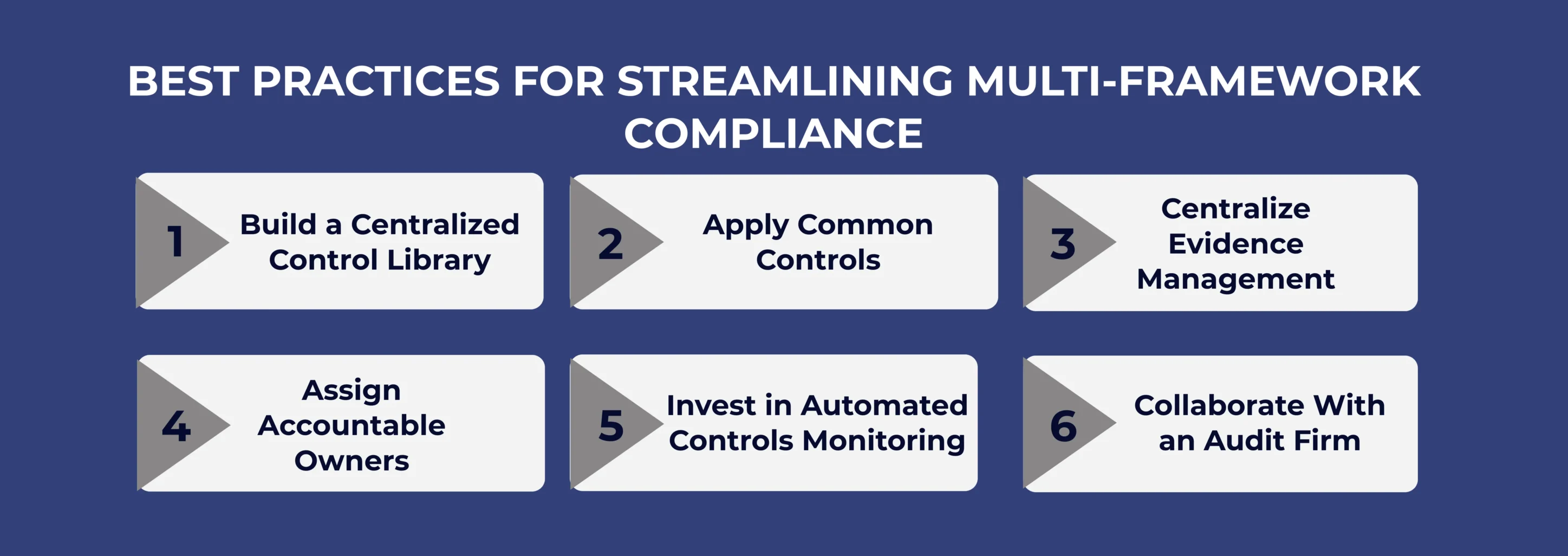
The organizations that handle multi-framework compliance well share a specific approach. They don't do more work — they do more thoughtful work, designed from the start to serve multiple frameworks at once.
-
Build a Centralized Control Library
Map your existing controls against every framework you need to satisfy. Most organizations find that a large percentage of their controls are shared across frameworks. A master control library — one that identifies which controls satisfy which requirements across which framework — becomes the structural backbone of your entire compliance program. Every policy, procedure, and evidence artifact connects back to this library.
-
Apply Common Controls
Regulatory compliance frameworks like HIPAA and SOC 2 both require access controls, audit logging, encryption, and incident response procedures. Write those controls once, with both frameworks in mind, and map a single policy to multiple requirements. A well-written access control policy satisfies both auditors. There's no reason to write it twice.
-
Centralize Evidence Management
Multi-framework compliance is substantially easier when evidence lives in one place, continuously updated. Use leading compliance automation and GRC platforms to automate evidence collection from cloud infrastructure, identity providers, HR systems, and endpoint management tools. That automation reduces manual effort significantly and keeps evidence current between audit cycles.
-
Assign Accountable Owners
Multi-framework compliance needs a clear owner for each framework — someone responsible for keeping controls current, tracking evidence, and managing auditor relationships. That doesn't mean a separate person per framework. One experienced compliance lead can manage multiple frameworks effectively with the right tooling and support structure. What it does mean is that accountability can't be diffuse or assumed.
-
Invest in Automated Controls Monitoring
Manual compliance processes don't scale as your organization grows and your framework footprint expands. Automated monitoring of security controls — MFA enforcement, patch management, encryption status, access reviews — generates continuous evidence and catches configuration drift before auditors do.
-
Collaborate With an Audit Firm
Multi-framework compliance is meaningfully easier when your audit partner has deep experience across frameworks. A knowledgeable partner identifies shared controls during scoping, surfaces opportunities to reduce audit overlap, and provides strategic guidance that a single-framework auditor simply can't offer. The right partner isn't just validating your controls — they're helping you build a program that works across all your requirements.
What Is Changing And What Compliance Leaders Should Watch
Multi-framework compliance in 2026 looks different. Several developments are actively reshaping how organizations build, maintain, and scale their compliance programs.
Rise of AI Governance: The EU AI Act rolled out in phases through 2025 and into 2026, introducing risk-based compliance requirements for AI systems operating in European markets. U.S. companies with AI-powered products serving EU customers need to think carefully about how AI governance fits into their existing security compliance frameworks.
Continuous Compliance Model: The traditional model — prepare for the audit, get the report, address the findings, repeat next year — is losing credibility with sophisticated buyers. Enterprise customers want real-time assurance, not an 18-month-old report. More organizations are moving to continuous monitoring, where control effectiveness is tracked daily and evidence is always current.
Convergence of Privacy and Security: GDPR, CCPA, and an expanding set of state privacy laws are increasingly intersecting with security frameworks at the control level. Data minimization principles affect how access controls and data retention policies are designed. Consent management touches identity and access management.
Tightened Third-Party Risk Management: Both SOC 2 and ISO 27001 require organizations to manage vendor risk — but auditors are asking harder, more specific questions about how organizations vet and continuously monitor their technology vendors, especially those with access to sensitive data or critical systems.
Conclusion
Managing multi-framework compliance is inherently complex. However, it becomes more manageable when organizations adopt a structured approach to control mapping, evidence management, and audit coordination. Organizations that perform well in multi-framework environments typically maintain centralized documentation, consistent control execution, and clearly defined audit scopes across frameworks.
CertPro is a licensed CPA firm that conducts independent audits and attestation engagements, including SOC 2 examinations and multi-standard compliance assessments. Our role is limited to evaluating control design and operating effectiveness based on evidence provided, in accordance with globally accepted auditing and assurance standards. For organizations with established compliance programs, independent audit and certification provide objective validation of controls, support stakeholder assurance, and enable consistent reporting across frameworks.