
Enterprise security reviews have changed significantly over the last few years. Buyers now evaluate vendors more aggressively before signing contracts, regulators expect stronger technical validation, and auditors increasingly focus on whether security controls operate effectively in production environments, not whether policies simply exist.
This shift has pushed ethical hacking into a more important role within compliance and audit assurance programs.
Many organizations discover this pressure during SOC 2 examinations, ISO 27001 audits, or HIPAA assessments. Access controls may appear properly documented while weak session management, exposed APIs, excessive privileges, or overlooked cloud misconfigurations still create exploitable conditions inside live systems. These weaknesses often remain undetected until realistic security testing occurs because attackers target operational gaps rather than written procedures.
Enterprise procurement teams understand this risk. As a result, vendors are now expected to provide evidence of security testing, remediation activities, and ongoing risk evaluation. A SaaS provider handling healthcare data, for example, may complete internal compliance reviews successfully while an unnoticed authentication weakness continues exposing sensitive records in the background.
Modern compliance programs now focus on operational truth. Hence, in this article, let's learn what ethical hacking is. Furthermore, let's understand how ethical hacking assists in validating whether implemented security controls respond to threat activity under operational conditions.
Concern
SOC 2, ISO 27001, and HIPAA assessments now place greater focus on operational control effectiveness. Auditors, regulators, and enterprise buyers increasingly expect proof showing that security controls function effectively in production environments under realistic attack conditions. Many organizations still rely heavily on policy documentation, screenshots, questionnaires, and automated vulnerability scans. However, these activities may not fully reveal whether weak authentication controls, exposed APIs, excessive privileges, cloud misconfigurations, or insecure data flows create exploitable conditions inside live systems. As a result, organizations often discover critical gaps during audits, vendor reviews, or security incidents rather than during internal compliance preparation.
Overview
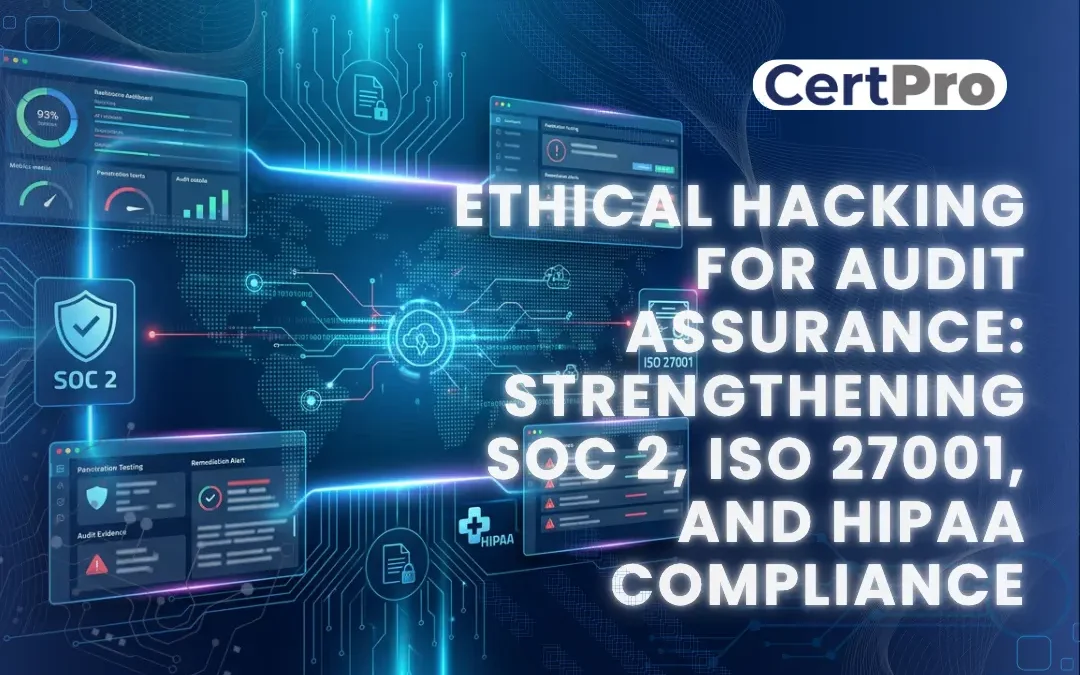
Ethical hacking is an authorized security testing process used to evaluate how systems, applications, and implemented safeguards respond under realistic attack conditions. Within SOC 2, ISO 27001, and HIPAA programs, it helps organizations validate the operating effectiveness of security controls, test authentication and privileged access safeguards, evaluate monitoring and incident response capabilities, and identify exploitable weaknesses that documentation reviews may overlook. Ethical hacking also supports technical risk assessments by generating operational evidence that shows how controls perform inside live environments. Additionally, the resulting findings, remediation records, and retesting documentation can strengthen audit evidence during formal compliance assessments. Unlike vulnerability scanning, which mainly identifies known technical weaknesses, ethical hacking evaluates whether those weaknesses can actually be exploited to bypass controls, gain unauthorized access, or expose sensitive systems and data.
Solution
Organizations improve audit readiness when they integrate ethical hacking into ongoing compliance activities. In contrast, last-minute testing often creates remediation delays and audit pressure. Well-scoped testing, remediation tracking, and documented retesting help produce stronger audit evidence across SOC 2, ISO 27001, and HIPAA assessments. As a result, auditors gain clearer visibility into how organizations identify risks, operate safeguards, and respond to security events under realistic conditions. Ethical hacking also improves visibility into higher-risk areas, including authentication systems, privileged access controls, cloud security exposure, API security, logging coverage, and sensitive data or ePHI protection. For modern compliance programs, ethical hacking supports evidence-based validation by showing how security controls perform in practice.
What Ethical Hacking Actually Means in Compliance Context
Ethical hacking is an authorized security testing process where trained professionals simulate realistic attack activity to evaluate how systems, applications, and security controls perform under pressure. The goal is simple. Find weaknesses before a real attacker does.
Consider a SaaS company with well-documented access control policies. On paper, the environment appears secure and properly governed. However, the production environment may still contain overlooked risks. For example, an old administrator account could remain active after an employee leaves the organization.
For that reason, modern compliance assessments place greater emphasis on operational control effectiveness.
Vulnerability scans identify known weaknesses such as outdated software or exposed services. Conversely, ethical hacking evaluates whether those weaknesses can actually be exploited to bypass controls or access sensitive systems. It tests how systems, teams, and controls behave during realistic attack conditions. Many audit and procurement reviews now evaluate whether organizations perform technical validation activities beyond automated scanning.
Additionally, ethical hacking also strengthens evidence quality during audits. It helps organizations validate remediation efforts, identify hidden risks, and demonstrate that security controls actually function in live operating environments.
Ethical Hacking as Evidence of Security Control Effectiveness
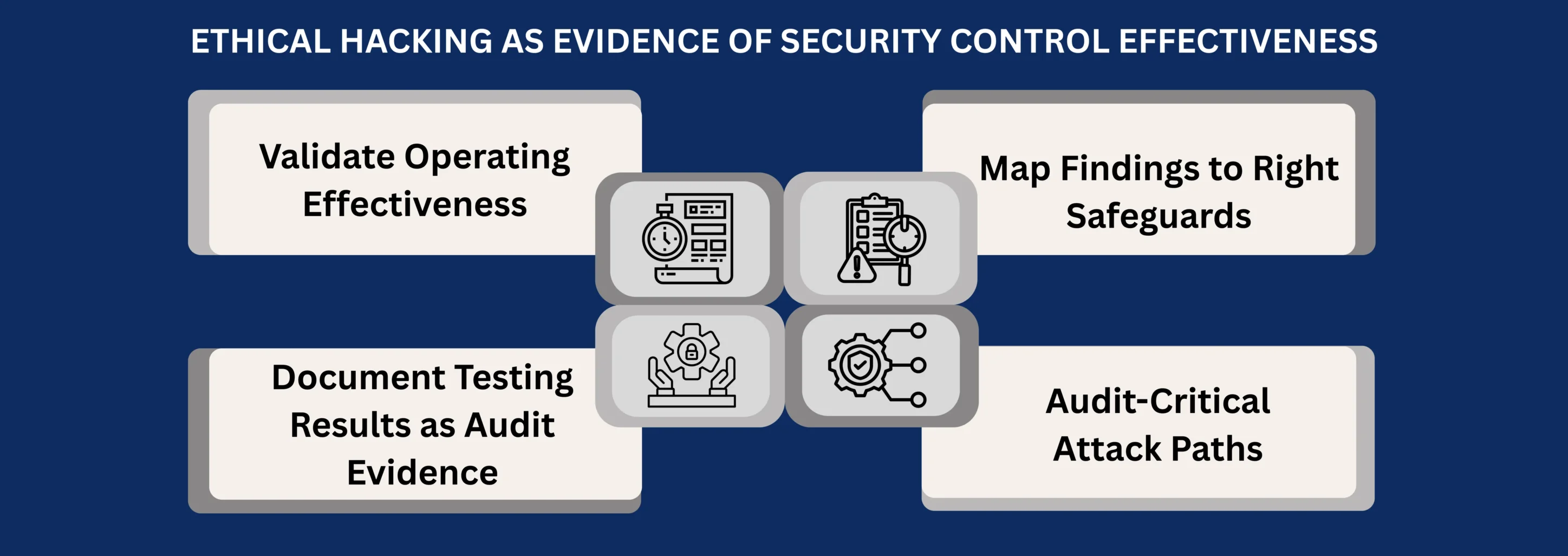
In this section, let's understand how ethical hacking could be used to demonstrate control effectiveness for SOC 2, ISO 27001, and HIPAA.
-
Validate Operating Effectiveness
A controlled ethical hacking assessment simulates how an attacker could move through your systems, APIs, cloud workloads, or employee accounts. For example, a tester may attempt privilege escalation after compromising a weak VPN credential. If monitoring tools detect the activity and access restrictions stop lateral movement, the organization can demonstrate that the control operates effectively in practice. This testing may support evidence related to SOC 2 Common Criteria CC7, ISO 27001 Annex A controls involving technical vulnerability management and security testing, and HIPAA security evaluation requirements.
-
Map Findings to Right Safeguards
Security findings become far more useful when they connect clearly to compliance safeguards. A discovered MFA gap may support remediation evidence for SOC 2 access monitoring, ISO 27001 vulnerability management, and HIPAA access control safeguards. Similarly, exposed APIs, weak data encryption paths, or logging failures help organizations prove that they actively evaluate technical risks instead of waiting for incidents to occur.
-
Document Testing Results as Audit Evidence
A penetration test report alone rarely satisfies an auditor. The real value comes from documenting the full lifecycle. This includes the scope, methodology, findings, remediation steps, approvals, and retesting results. For instance, if testers identify an exposed storage bucket containing sensitive healthcare records, auditors will expect proof that the issue was fixed, validated, and monitored accordingly.
-
Audit-Critical Attack Paths
Audit procedures frequently prioritize areas that present elevated risk to sensitive data and system integrity. That includes authentication systems, privileged accounts, cloud configurations, logging visibility, monitoring coverage, and ePHI transmission security. These areas frequently become the root cause of breaches. Therefore, testing them early helps organizations reduce audit risk before formal assessments begin.
Security Control Validation vs. Vulnerability Scanning: A Critical Distinction
Vulnerability scanning and security control validation are frequently treated as interchangeable activities within compliance programs. However, they both serve fundamentally different purposes within an assurance context.
Vulnerability scanning is an automated process designed to identify known weaknesses such as unpatched systems, exposed services, outdated software versions, or configuration issues. These scans remain an important component of a mature security program and often support ongoing monitoring activities.
However, scan results alone generally do not demonstrate whether broader control objectives function as intended during scoped assessment procedures. This involves authentication, privileged access management, segmentation, transmission security, or detection capabilities.
Whereas ethical hacking evaluates whether implemented safeguards operate effectively during structured testing procedures aligned to defined control objectives. Within ethical hacking, this testing may generate independently documented evidence regarding the operation of access controls, incident response procedures, or related security safeguards. The resulting documentation can then be evaluated alongside policies, inquiry procedures, remediation records, and supporting audit evidence during the broader assessment process.
This distinction becomes particularly important within SOC 2 Type 2, ISO 27001, and HIPAA assessments, where operating effectiveness and evidence sufficiency receive increased scrutiny. Therefore, a vulnerability scan identifies technical weaknesses at a specific point in time, while ethical hacking may provide additional evidence regarding whether related controls operated effectively during the assessment period.
Technical validation also helps identify security gaps that policy reviews, screenshots, and configuration checks may not fully detect. In particular, this becomes important within higher-risk areas such as authentication systems, privileged access controls, and sensitive data handling processes.
Ethical Hacking and Risk Assessment: Building a Strong Compliance Program
Risk assessment is a core part of SOC 2, ISO 27001, and HIPAA programs. In practice, it helps an organization identify where sensitive data, access paths, and system exposure create real risk. Ethical hacking adds value when it tests those risk areas in a controlled way and shows whether the related safeguards actually hold up. SOC 2 focuses on the design and operating effectiveness of controls, while HIPAA requires risk analysis and periodic evaluation of safeguards.
For example, an ISO 27001 risk review may flag unauthorized access as a serious threat. The organization may then apply Role-Based Access Controls (RBAC), authentication rules, and network segmentation. Ethical hacking can test whether those safeguards really block access or whether a weak account, session flaw, or misconfiguration still creates a path in.
That makes the testing more useful than a checklist review alone. Instead of repeating what the policy says, it shows how the environment behaves under pressure. When a test exposes a gap, the finding can feed back into the risk register, remediation plan, and retest cycle. That gives auditors a clearer trail from risk to control to action.
Used this way, ethical hacking does not replace risk assessment. It sharpens it and helps compliance teams see which threats should be addressed first and what evidence they can show when auditors ask how those risks were tested and addressed.
Integrating Security Testing into Compliance Program Design
Organizations handling compliance across multiple frameworks often make the same mistake. They treat security testing as a last-minute audit activity. The pressure builds as the assessment date approaches, teams rush to close gaps, and critical weaknesses surface when there is little time left to respond. That situation creates unnecessary audit risk and operational stress.
Organizations generally obtain stronger audit evidence when technical testing activities are integrated into ongoing compliance processes.
Timing, Frequency, and Audit Alignment
The timing of security testing matters significantly. Companies that conduct ethical hacking exercises months before formal audits gain valuable time for remediation, validation, and evidence collection. As a result, security teams could fix exposed weaknesses and retest affected controls. Moreover, they could also maintain documented proof of corrective actions before auditors begin fieldwork.
Areas Commonly Evaluated During Audit Procedures
Modern auditors evaluate whether organizations actively validate their security controls throughout the year. They look for evidence showing that controls operate effectively in live environments under realistic conditions. Periodic ethical hacking reports, remediation records, and retesting evidence help demonstrate the ongoing validation process clearly.
Incident Response Readiness as Assurance Evidence
Incident response readiness has become a major area of audit scrutiny. Businesses now maintain detailed response procedures but rarely test how teams perform during active attack scenarios. Ethical hacking helps close that gap. Accordingly, simulated attack exercises reveal how quickly teams detect threats, contain suspicious activity, and escalate incidents internally. This documentation provides additional evidence regarding how incident response procedures operate during realistic security events.
Conclusion
The audit environment has moved decisively toward evidence-based validation. Compliance programs that rely on documentation without demonstrating that controls perform as designed carry measurable assurance risk. These risks could surface during fieldwork, affect attestation outcomes, and ultimately undermine the trust relationships organizations work to build with customers, regulators, and enterprise buyers.
Ethical hacking gives compliance teams something policy documents cannot: evidence that security controls work in practice. When the testing is scoped properly, documented clearly, and tied to real control objectives, it can support audit evidence across SOC 2, ISO 27001, and HIPAA.
For organizations preparing for formal assessments, that kind of validation helps strengthen risk management, control remediation, and the effectiveness of security controls under realistic conditions.