
Governance accountability has moved from an internal discipline to an external expectation. Enterprise buyers, regulators, and audit committees are no longer satisfied with governance frameworks that exist only as documented policies. They want demonstrable evidence of operational oversight, accountability structures that are actively maintained, and governance programs that hold up under independent scrutiny.
This compliance and governance guide addresses a challenge that regulated enterprises increasingly face: how to evaluate, structure, and mature two distinct but interconnected governance domains — Data Governance and AI Governance — within the same operational environment.
Both compliance and governance address risk. Both require documented policies, assigned ownership, and measurable controls. Yet they operate under different accountability expectations, carry different regulatory obligations, and respond to different assurance frameworks.
Understanding this distinction — and where compliance and governance converge — is essential for CISOs, Chief Risk Officers, GRC teams, and governance leaders managing audit-ready operations. Enterprise procurement teams increasingly evaluate compliance and governance maturity before approving vendor relationships in regulated environments.

Concern
Enterprises face increasing pressure from regulators, enterprise buyers, and audit committees to prove real operational oversight. A major concern in modern compliance and governance programs is the gap between documented policies and actual execution. Weak accountability, inconsistent control enforcement, and poor evidence of oversight often lead to audit failures, procurement rejection, and regulatory exposure. This risk increases when Data Governance and AI Governance operate in isolation instead of a unified compliance and governance structure. AI systems further intensify this concern because automated decisions require explainability, human oversight, and model accountability. Without structured governance, enterprises face bias risks, compliance breakdowns, and reputational damage.
Overview
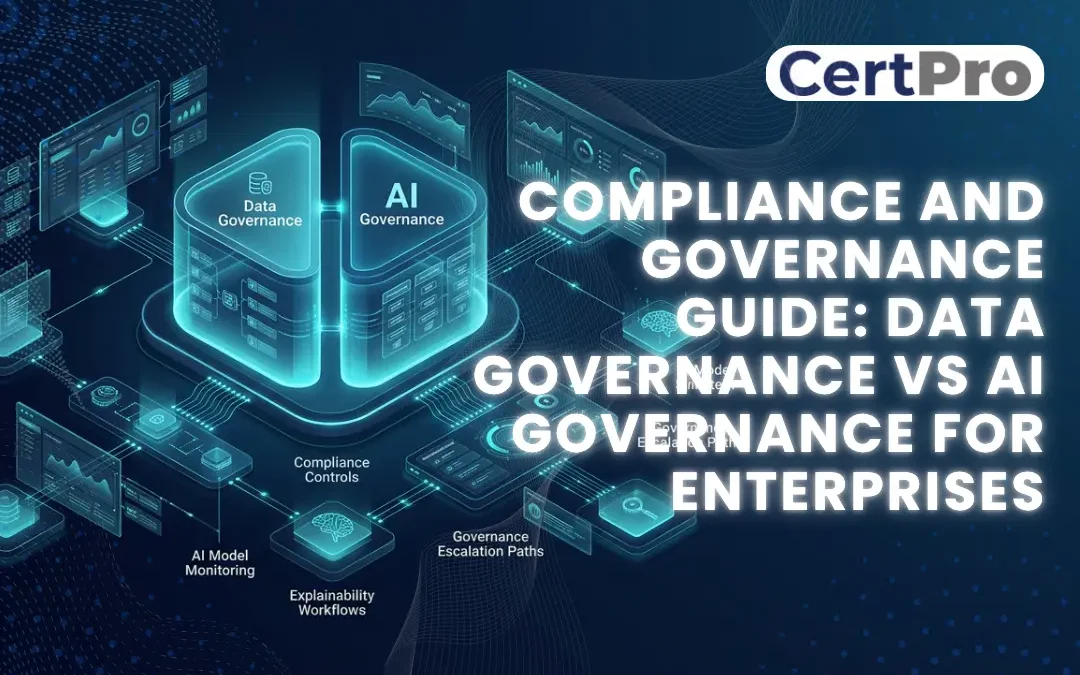
Data Governance focuses on data ownership, classification, privacy, lifecycle control, and regulatory compliance. It ensures data integrity and supports frameworks like GDPR, HIPAA, and ISO 27001. AI Governance focuses on model oversight, explainability, bias monitoring, lifecycle management, and human review of automated decisions. It ensures AI systems operate within acceptable risk and accountability boundaries. Both domains are interconnected. AI systems depend on governed data, meaning gaps in Data Governance directly impact AI outcomes. Within enterprise compliance and governance structures, both disciplines must operate under clear ownership, measurable controls, and continuous operational oversight. Regulators now evaluate governance maturity as part of enterprise assurance and procurement decisions, not just internal compliance reviews.
Solution
A unified compliance and governance model brings Data Governance and AI Governance under one operational accountability framework. Enterprises must assign clear ownership for both data and AI systems and set up governance committees with defined authority. They should also implement continuous control monitoring, supported by clear evidence of execution, so governance can be proven during audits. Human oversight is essential for AI decisions, while lifecycle governance must manage both data and models from creation to retirement. When these elements work together, compliance and governance shifts from documentation to real operational practice. This improves audit defensibility, reduces regulatory risk, and strengthens enterprise trust.
What Governance and Compliance Actually Mean in Enterprise Operations
The phrase "governance and compliance" is widely used but inconsistently defined. In assurance practice, governance refers to the structured system by which an enterprise directs, monitors, and controls its operations across defined risk domains. Compliance refers to adherence to applicable laws, regulations, contractual obligations, and internal policies that govern those operations. In mature enterprises, compliance and governance functions operate as continuous oversight mechanisms rather than isolated annual review activities.
Compliance governance and risk management are not three separate disciplines — they function as a unified accountability architecture. Governance defines the oversight model. Risk management identifies exposure. Compliance validates adherence to controls designed to manage that exposure. When these three functions operate in isolation, governance gaps become inevitable. Strong compliance and governance alignment reduces fragmented accountability across security, privacy, legal, and operational teams.
Governance as an Operational Accountability System
Effective governance requires more than a policy library. It requires assigned ownership — individuals or committees who are operationally accountable for governance outcomes. Without that accountability structure, governance frameworks remain aspirational documents rather than functional controls.
Operational governance accountability requires defined roles for data stewardship, risk ownership, and policy enforcement. It requires governance committees with documented authority, structured meeting cadences, and clear escalation paths that connect operational oversight to executive decision-making. The governance operating model itself must be documented, tested, and evidenced. This level of operational discipline is what separates mature compliance and governance programs from policy-driven governance initiatives with limited oversight capability.
The Compliance Evidence Standard
In any formal assurance engagement — whether a SOC 2 audit, ISO 27001 certification, or regulatory examination — auditors evaluate governance compliance through evidence, not intent. A well-written policy that cannot demonstrate operational execution does not satisfy control objectives.
What is governance and compliance without evidence of control activity? Auditors evaluate governance maturity through control testing results, activity logs, exception management records, and documented oversight reviews. This distinction between documented governance and practiced governance defines how assurance firms assess programs. Governance compliance strengthens enterprise trust because it demonstrates that controls are actively maintained and validated.
Data Governance: Ownership, Integrity, and Regulatory Control
Data governance is the foundational governance domain for any organization that collects, processes, stores, or shares data as part of its core operations. At its core, data governance is an operational accountability system for data — defining who owns it, how it is classified, how its lifecycle is managed, and how regulatory obligations attached to it are fulfilled. Within broader compliance and governance frameworks, Data Governance functions as the control layer that supports regulatory accountability and operational trust.
Enterprises that treat data governance as a records management function consistently underestimate its assurance implications. Understanding data governance vs AI governance begins here: Data governance concerns itself with the integrity, privacy, and regulatory defensibility of the information an enterprise holds and processes.
Data Quality, Classification, and Lifecycle Accountability
Sound data governance programs establish clear data ownership at both the enterprise and domain level. Data stewards carry accountability for classification accuracy, quality standards, and lifecycle controls — from initial collection through retention management and secure disposal.
Classification frameworks drive downstream regulatory compliance. Under GDPR, HIPAA, and similar regulatory regimes, how data is classified determines what protections apply, who may access it, and how consent and breach-notification obligations are managed. Without reliable classification controls and active data stewardship, regulatory defensibility weakens at precisely the moment it is most needed.
Privacy Governance and Regulatory Accountability
Data Governance is what makes privacy compliance operationally functional. GDPR and HIPAA compliance are not achievable through policies alone — they require governance infrastructure that enforces data subject rights, manages consent records, restricts access based on data sensitivity, and maintains evidence of active privacy controls.
This is where compliance governance and risk management converge in practice. Risk assessments tied to data processing activities — such as Data Protection Impact Assessments under GDPR — require governance structures that are already operational, not assembled reactively. Enterprises with mature Data Governance programs enter regulatory reviews with a clear advantage: their accountability structures are defined, and their control validation is audit-defensible.
AI Governance: Accountability, Explainability, and Model Oversight
AI governance is a distinct operational discipline, and its governance expectations differ substantially from traditional data governance frameworks. Where data governance focuses on data quality, ownership, and regulatory control, AI governance addresses accountability for automated decision-making, explainability requirements, bias management, model risk, and the human oversight structures necessary to maintain responsible AI operations. AI oversight now occupies a central role within enterprise compliance and governance strategies because automated systems directly influence regulated business operations.
As AI systems become embedded in enterprise operations — driving credit decisions, clinical recommendations, fraud detection, and customer interactions — the absence of structured AI governance creates material compliance and reputational exposure. Regulators have made clear that the technical complexity of AI systems does not reduce accountability for their outcomes.
Model Risk Management and Oversight Accountability
AI models require a governance operating model that addresses their full lifecycle: development, validation, deployment, performance monitoring, and retirement. This is model risk management in practice. Governance accountability here means documented approval processes, defined performance thresholds, and active monitoring for model drift, bias emergence, and unexpected outputs.
From an assurance standpoint, AI governance scrutiny focuses on whether oversight structures are operational — not whether policies exist. Auditors and regulators want evidence of human review, documented model performance assessments, and accountable escalation paths when model behavior falls outside accepted parameters. AI governance frameworks that exist only as written policies without operational controls do not satisfy governance maturity expectations.
Explainability, Transparency, and Regulatory Expectations
Regulatory frameworks increasingly require that AI-driven decisions be explainable — particularly when those decisions affect individuals in employment, lending, healthcare, or public benefit contexts. What is governance and compliance without transparency? For AI systems, it is an incomplete accountability structure. Regulators increasingly interpret weak explainability controls as a broader compliance and governance failure rather than a purely technical deficiency.
AI governance frameworks must build explainability controls into model design and deployment — not treat them as post-hoc documentation. AI systems that cannot produce interpretable outputs represent a growing regulatory and enterprise liability. Responsible AI is not a product feature. It is a governance accountability requirement.
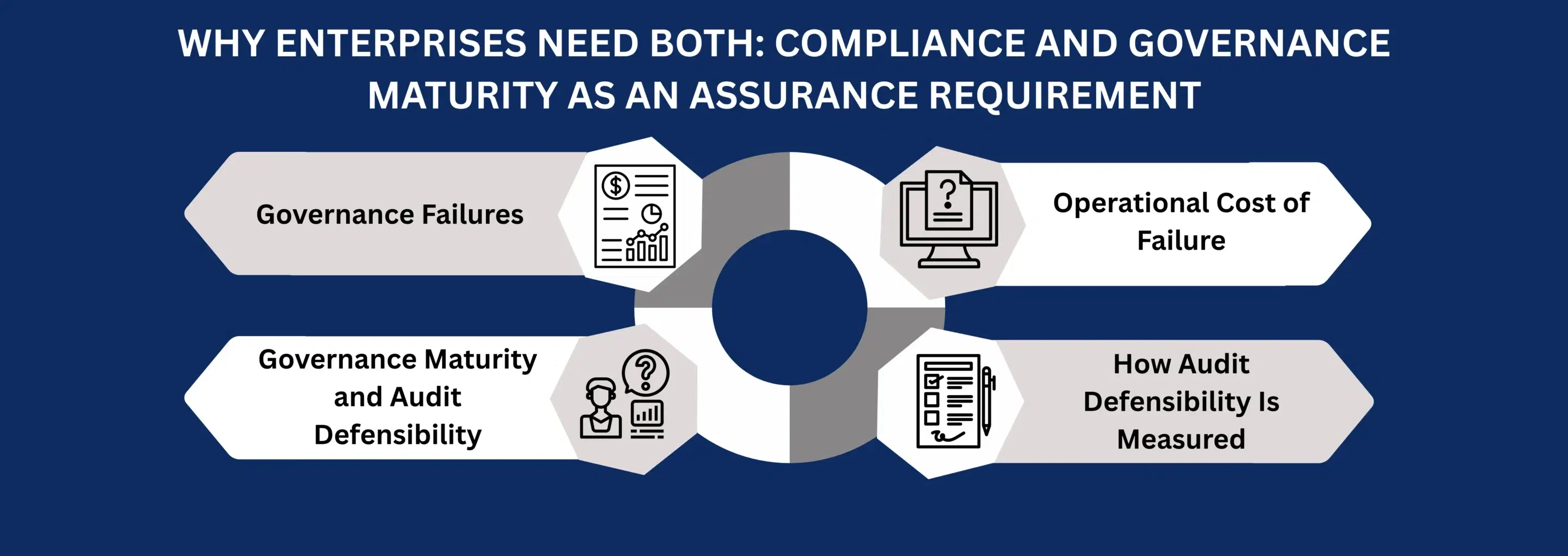
Why Enterprises Need Both: Compliance and Governance Maturity as an Assurance Requirement
Any practical data governance vs AI governance analysis must address one structural reality: AI systems consume governed data. The most common governance miscalculation enterprises make is treating these as sequential investments. When data inputs lack quality controls, classification discipline, and lifecycle accountability, every AI model operating on that data inherits the governance gaps that exist upstream.
This interdependency means that governance maturity across both domains is not optional for organizations deploying AI in regulated or enterprise-critical environments. It is a foundational architectural requirement. Enterprise compliance and governance maturity now depends on how effectively organizations coordinate oversight across both data controls and AI governance functions.
Governance Failures
Governance failures create exposure in two directions. First, they create direct regulatory risk — enforcement actions, consent orders, and mandatory remediation under GDPR, HIPAA, AI-specific regulatory frameworks, or sector-specific requirements. Second, they create enterprise trust risk — failed third-party risk assessments, adverse audit findings, and reputational consequences that affect revenue and customer retention. Failures in compliance and governance oversight frequently surface during procurement assessments, regulatory investigations, and independent assurance engagements.
Operational Cost of Failure
What is governance and compliance worth to an enterprise that loses a major contract because its governance evidence failed a procurement security review? The operational cost of governance failure consistently exceeds the investment required to build governance maturity in advance. This is not a theoretical risk calculation — it is reflected in enterprise procurement outcomes and regulatory enforcement records across industries.
Governance Maturity and Audit Defensibility
Mature governance programs share a consistent pattern: documented policies, assigned accountability, operational controls, evidence of active oversight, and structured governance committee activity. This pattern is precisely what assurance firms evaluate during SOC 2 audits, ISO 27001 certifications, AI governance reviews, and enterprise risk assessments.
Governance maturity is assessed through the lens of audit defensibility — not simply whether a program exists, but whether it functions under independent scrutiny. Enterprises that build governance operating models with assurance readiness as a design objective consistently earn stronger trust from enterprise buyers and audit committees. Governance compliance, in this context, is a measurable competitive differentiator.
How Governance Controls Are Evaluated During Audits and Assurance Reviews
Governance reviews have changed significantly over the last few years. Auditors examine how governance works during daily operations rather than reviewing just policy documents. Because of this shift, enterprise compliance and governance programs now face much deeper scrutiny during audits and assurance reviews.
Auditors Now Look for Operational Evidence
In practice, assurance teams want proof that governance controls actually function across the business. They review operational evidence such as:
- Governance committee records
- Risk escalation logs
- Access review activities
- Vendor oversight documentation
- Policy enforcement procedures
- Operational monitoring reports
The objective is straightforward. Auditors want to see whether accountability exists beyond written policies. However, this is where many organizations struggle. A company may have strong documentation, yet teams may follow different processes across departments. Mature compliance and governance programs focus heavily on consistency. Controls must operate the same way across teams, systems, and operational environments.
AI Governance Reviews Are Becoming More Detailed
At the same time, AI governance assessments are becoming more common. Enterprise buyers and regulators increasingly ask:
- Who reviews AI-driven decisions?
- How are bias risks monitored?
- What happens when models behave unexpectedly?
- Is human oversight clearly documented?
For instance, a healthcare AI platform may face procurement delays if it cannot explain how clinicians review automated recommendations before action is taken. Ultimately, governance failures rarely happen because policies are missing. More often, they happen because oversight becomes inconsistent over time. That is why effective compliance and governance programs prioritize operational visibility, measurable accountability, and evidence-backed control execution across the enterprise.
Conclusion
Both data governance and AI governance have matured from internal best practices into enterprise accountability requirements. Regulators expect operational evidence. Enterprise buyers expect demonstrated governance assurance. Audit committees expect structured, documented oversight with accountable ownership at every level. This shift continues raising the operational expectations attached to enterprise compliance and governance programs across regulated industries.
This compliance and governance guide reinforces a foundational assurance principle: governance maturity is not measured by the comprehensiveness of documented policies. It is measured by the operational accountability structures behind those policies — the data stewardship roles, the oversight committees, the control validation records, and the evidence that governance functions in practice, not just on paper.
CertPro operates as a licensed CPA firm delivering structured compliance audits, governance assessments, and independent assurance engagements for technology enterprises worldwide. Our assurance methodology evaluates governance programs at the operational level — examining whether accountability structures are functional, whether controls are validated, and whether governance evidence meets the expectations of regulators, enterprise buyers, and independent auditors across frameworks including SOC 2, ISO 27001, HIPAA, GDPR, and AI governance standards.
As AI systems deepen their role in enterprise operations, governance compliance will define which organizations earn trust at scale — and which carry avoidable risk. Long-term compliance and governance maturity now influence enterprise trust, procurement defensibility, and assurance credibility at a global scale.
Building governance maturity across both data and AI domains is a present-day operational and assurance imperative.