
ISO 27001 Certification in Dublin
Dublin’s technology and financial services ecosystem makes it one of Europe’s most ISO 27001-active certification markets. The city’s concentration of cloud infrastructure providers, SaaS platforms, fintech firms, regulated financial institutions, pharmaceutical companies, healthcare technology organisations, and multinational technology enterprises creates consistent, sector-wide demand for independently verified information security credentials. ISO 27001 Certification in Dublin is particularly prevalent among organisations that process, store, or transmit sensitive personal data, financial records, clinical data, or proprietary technology assets across European and international borders.
OUR CLIENTS










What Is ISO 27001 Certification and Why Does It Matter for Dublin Organisations?
ISO 27001 Certification in Dublin is issued by CertPro, a Licensed CPA Firm operating as an independent third-party certification body under ISO/IEC 27001:2022 — the internationally recognised standard for Information Security Management Systems (ISMS). Certification confirms that an organisation has established, implemented, maintained, and continually improved a structured ISMS, evaluated through an independent, accredited audit process. For Dublin organisations, ISO 27001 Certification in Dublin represents the primary independent mechanism for demonstrating structured information security governance to customers, regulators, and procurement stakeholders across domestic and international markets.
ISO/IEC 27001:2022 is published jointly by the International Organization for Standardization (ISO) and the International Electrotechnical Commission (IEC). The 2022 revision introduced a restructured Annex A, reducing the control count from 114 to 93 controls across four categories: Organisational, People, Physical, and Technological. Organisations previously certified under the 2013 version are required to transition to the 2022 standard, with a global transition deadline of 31 October 2025 set by accreditation and certification bodies. Companies seeking a strong security posture should adopt the updated 2022 standard without delay to maintain valid ISO 27001 Certification.
An Information Security Management System (ISMS) is the structured framework through which an organisation identifies, assesses, treats, and monitors information security risks. The ISMS is not a technology system — it is a management system built on documented policies, procedures, controls, roles, and responsibilities that govern how information assets are protected. ISO 27001 Certification confirms that this ISMS has been independently evaluated against the requirements of the standard and found to be effective, documented, and consistently applied throughout the organisation’s defined scope.
Dublin occupies a strategically significant position in the European and global technology economy. The city hosts European headquarters for some of the world’s largest technology enterprises, including cloud platform providers, SaaS companies, AI businesses, and digital financial services firms. Organisations operating in this environment face heightened scrutiny from enterprise customers, procurement teams, and regulatory bodies regarding information security governance. ISO 27001 Certification in Dublin provides independently verified evidence that an organisation meets internationally recognised security management requirements — a critical differentiator in competitive procurement and vendor qualification processes.
The certification process under ISO/IEC 27001:2022 involves a two-stage audit conducted by CertPro as an independent, accredited certification body. Stage 1 evaluates the organisation’s ISMS documentation, scope definition, and readiness for detailed assessment. Stage 2 is a comprehensive on-site or remote ISO 27001 audit that examines the operational effectiveness of controls, the adequacy of risk treatment, and the organisation’s adherence to all applicable clauses of the standard. Upon successful completion, CertPro issues a certificate valid for three years, subject to annual surveillance audits in Year 1 and Year 2, and a full recertification audit at the end of the three-year cycle. This structured lifecycle ensures that ISMS certification in Dublin remains current, relevant, and continuously verified.

ISO 27001 Certification for Dublin-Based Financial and Technology Organisations
Dublin’s technology and financial services ecosystem makes it one of Europe’s most ISO 27001-active certification markets. The city’s concentration of cloud infrastructure providers, SaaS platforms, fintech firms, regulated financial institutions, pharmaceutical companies, healthcare technology organisations, and multinational technology enterprises creates consistent, sector-wide demand for independently verified information security credentials. ISO 27001 Certification in Dublin is particularly prevalent among organisations that process, store, or transmit sensitive personal data, financial records, clinical data, or proprietary technology assets across European and international borders.
ISO 27001 Certification for Dublin Fintech and Financial Services
Dublin financial services organisations pursue ISO 27001 Certification to satisfy institutional due diligence requirements, regulatory expectations, and enterprise vendor qualification criteria. Banks, payment processors, insurance technology providers, investment management platforms, and regulated financial intermediaries operating from Dublin are expected by counterparties and regulators to maintain demonstrable information security governance. ISO 27001 compliance achieved by Dublin fintech firms through third-party certification provides an independently verified credential that satisfies procurement security questionnaires and enterprise risk management frameworks operated by global financial institutions and institutional investors.
For fintech organisations operating within the EU regulatory perimeter — including those subject to PSD2, DORA, or EBA ICT risk guidelines — ISO 27001 Certification provides a structured control framework frequently referenced in supervisory guidance as evidence of sound information security governance. ISO 27001 compliance does not automatically establish regulatory compliance with any specific financial regulation. However, the ISMS framework aligns closely with ICT risk management requirements under applicable regulatory frameworks, supporting organisations in maintaining consistent security documentation and audit evidence across regulatory examinations.
ISO 27001 Certification for Dublin Technology Companies and Multinationals
ISO 27001 Certification for Dublin companies operating as SaaS providers, cloud platform operators, AI businesses, and cybersecurity firms is frequently a mandatory requirement in enterprise sales and procurement cycles. Large enterprise customers — particularly those headquartered in the United States, United Kingdom, Germany, and other markets with mature vendor risk management practices — require third-party ISO 27001 Certification as a baseline condition of supplier onboarding. Dublin-based technology firms that achieve ISMS certification gain access to procurement frameworks that would otherwise be closed to organisations without independently verified security credentials.
Multinational technology enterprises with European headquarters in Dublin also pursue ISO 27001 Certification to consolidate global ISMS governance under a single internationally recognised framework. For organisations managing information security across multiple jurisdictions — including data centres, distributed cloud environments, and cross-border processing operations — ISO 27001 provides a common management system standard that supports consistent control application and unified audit reporting. An ISO 27001 assessment conducted by CertPro evaluates whether the ISMS operates effectively across the defined scope, including relevant organisational units, geographic sites, and technology environments.
ISO 27001 Certification for Healthcare, Life Sciences, and Pharmaceutical Organisations
Dublin’s healthcare technology, life sciences, and pharmaceutical sectors process highly sensitive clinical, research, and patient data requiring stringent information security controls. Organisations in these sectors — including contract research organisations, medical device companies, and digital health platforms — frequently pursue ISO 27001 Certification to establish independently verified information security governance that complements sector-specific requirements. In this context, ISO 27001 Certification provides a documented, auditable ISMS framework that supports the secure handling of clinical trial data, patient records, intellectual property, and regulatory submission materials across EU and international markets.
ISO 27001 Compliance and Regulatory Alignment in Dublin
Dublin organisations operate within a layered regulatory environment that includes EU GDPR, Ireland’s Data Protection Act 2018, the NIS2 Directive, and evolving European cybersecurity frameworks. ISO 27001 compliance demonstrated by Dublin organisations through certification is contextually relevant to these regulatory obligations, though it does not automatically establish compliance with any specific regulation. The standard’s risk-based approach to information security management aligns closely with the data protection principles and security obligations articulated in both GDPR and the NIS2 Directive.
GDPR and the Data Protection Act 2018
EU GDPR, enforced in Ireland by the Data Protection Commission (DPC), requires organisations to implement appropriate technical and organisational measures to protect personal data. ISO 27001 Certification provides a documented, independently audited ISMS framework that addresses many of the technical and organisational security measures referenced in GDPR Article 32. The ISO 27001 audit process evaluates controls relevant to access management, incident response, cryptography, physical security, and supplier management — all of which contribute to the security posture required under data protection law. ISO 27001 compliance maintained by Dublin organisations is frequently referenced in DPC regulatory correspondence and data processing agreements as evidence of security due diligence.
Ireland’s Data Protection Act 2018 supplements EU GDPR with domestic provisions governing law enforcement data processing, health research, and specific derogations applicable to Irish organisations. Organisations holding ISO 27001 Certification maintain a documented ISMS that supports structured evidence of compliance with security obligations under both frameworks. The Statement of Applicability (SoA) required under ISO/IEC 27001:2022 provides a documented record of which Annex A controls apply to the organisation, why specific controls have been included or excluded, and how each control has been implemented — a directly useful artifact in regulatory examinations and data protection audits.
NIS2 Directive and European Cybersecurity Expectations
The NIS2 Directive, which EU Member States were required to transpose into national law by October 2024, significantly expands cybersecurity obligations for essential and important entities operating across critical sectors. Dublin organisations in energy, transport, financial market infrastructure, health, digital infrastructure, and ICT service management are subject to NIS2 requirements covering risk management measures, incident reporting, supply chain security, and business continuity. ISO 27001 Certification provides a structured ISMS framework that addresses the risk management and security control requirements articulated in NIS2, supporting organisations in demonstrating structured cybersecurity governance to national competent authorities.
Third-party risk management is an area of particular regulatory focus in Dublin’s financial and technology sectors. Enterprise customers, regulated financial institutions, and government procurement bodies increasingly require ISO 27001 Certification as a condition of supplier engagement — reflecting the supply chain security requirements embedded in NIS2 and financial sector ICT risk frameworks. An ISO 27001 audit conducted by CertPro evaluates supplier management controls, third-party access controls, and contractual security requirements as part of the comprehensive ISMS assessment, providing independent verification of an organisation’s approach to managing vendor and supply chain risk.
ISO 27001 Certification Audit Process in Dublin
The ISO 27001 audit process conducted by CertPro follows a structured, stage-based methodology aligned with ISO/IEC 27001:2022 and international accreditation requirements. The process is designed to provide an independent, objective evaluation of an organisation’s ISMS — assessing documentation adequacy, control implementation, risk treatment effectiveness, and management system maturity. The following sequence describes the full certification lifecycle from initial audit through recertification.
Stage 1 of the ISO 27001 audit is a documentation-focused review conducted by CertPro auditors to evaluate the organisation’s ISMS design and readiness for Stage 2 assessment. The Stage 1 audit examines the defined scope of the ISMS, the organisation’s information security policy, risk assessment methodology, risk treatment plan, Statement of Applicability, and the completeness of required documentation under ISO/IEC 27001:2022 Clauses 4 through 10. Auditors assess whether ISMS documentation is internally consistent, appropriately scoped, and sufficiently detailed to support the Stage 2 evaluation. Findings from Stage 1 are documented and shared with the organisation before Stage 2 proceeds.
Stage 2 is the primary certification audit, conducted on-site or remotely depending on the organisation’s ISMS scope and operational structure. CertPro auditors evaluate the operational effectiveness of the ISMS — assessing whether controls defined in the Statement of Applicability are consistently implemented, whether risk treatment plans have been executed, and whether the organisation’s management system meets all requirements of ISO/IEC 27001:2022. The Stage 2 ISO 27001 audit involves document review, interviews with personnel across relevant functions, observation of operational processes, and testing of technical and organisational controls. Evidence gathered during Stage 2 forms the basis of the certification decision.
Nonconformities identified during Stage 2 are classified as major or minor. Major nonconformities represent failures to meet a requirement of the standard or systemic breakdowns in ISMS control effectiveness, and must be resolved before ISO 27001 Certification is issued. Minor nonconformities represent isolated gaps or partial compliance and are typically subject to corrective action verification during the first surveillance audit. CertPro auditors document all findings in a formal audit report, which forms part of the certification decision record. The ISO 27001 assessment process is conducted with strict objectivity — auditors document observed evidence against standard requirements without prescribing corrective actions.
Following successful completion of Stage 2, CertPro issues ISO 27001 Certification valid for a three-year certification cycle. The certification is subject to annual surveillance audits conducted in Year 1 and Year 2. Surveillance audits are targeted assessments that evaluate the continued effectiveness of the ISMS, verify closure of any minor nonconformities from previous audits, and confirm that the management system continues to meet the requirements of ISO/IEC 27001:2022. At the end of the three-year cycle, a full recertification audit is conducted, reassessing the entire ISMS against all standard requirements to determine whether certification should be renewed for a further three-year period.
| Audit Stage | Purpose | Timing |
|---|---|---|
| Stage 1 Audit | ISMS documentation review and scope evaluation | Initial certification |
| Stage 2 Audit | Operational effectiveness and control testing | Initial certification |
| Surveillance Audit 1 | Continued ISMS effectiveness verification | Year 1 of cycle |
| Surveillance Audit 2 | Continued ISMS effectiveness verification | Year 2 of cycle |
| Recertification Audit | Full ISMS reassessment for certificate renewal | Year 3 of cycle |
- ✓Stage 1 Audit: Documentation and Scope Review
- ✓Stage 2 Audit: Operational Effectiveness Assessment
- ✓Certification Decision, Surveillance Audits, and Recertification
ISO 27001 Certification Requirements and Evaluation Criteria
ISO/IEC 27001:2022 specifies requirements across ten clauses (Clauses 4–10) and a supplementary Annex A containing 93 information security controls. To achieve ISO 27001 Certification, organisations must demonstrate compliance with all mandatory clauses of the standard through documented evidence and operational practice. Controls from Annex A are applied selectively based on the organisation’s risk assessment outcomes, with all applicability decisions recorded in the Statement of Applicability. CertPro evaluates both the mandatory clause requirements and the organisation’s approach to Annex A control selection and implementation during the certification audit.
ISO/IEC 27001:2022 requires organisations to establish and maintain a defined set of documented information as evidence of ISMS implementation and operation. Mandatory documentation includes: the information security policy, ISMS scope definition, risk assessment process and results, risk treatment plan, Statement of Applicability, information security objectives, evidence of competence for personnel with ISMS responsibilities, operational planning and control records, monitoring and measurement results, internal audit programme and results, and management review records. Each document must be maintained in a controlled manner and made available during the ISO 27001 audit. CertPro auditors evaluate the completeness, currency, and operational relevance of all required documentation.
Leadership commitment is a mandatory requirement under Clause 5 of ISO/IEC 27001:2022. Top management must demonstrate active engagement with the ISMS — establishing the information security policy, assigning roles and responsibilities, integrating ISMS requirements into organisational processes, and ensuring adequate resources are allocated. CertPro auditors evaluate leadership involvement through interviews with senior management, review of management review meeting records, and assessment of resource allocation decisions. The management review process — required at planned intervals — must address ISMS performance, audit findings, risk treatment status, and opportunities for continual improvement.
Risk assessment is the foundational process of the ISO/IEC 27001:2022 ISMS. The standard requires organisations to define and apply a consistent information security risk assessment process that identifies risks associated with the loss of confidentiality, integrity, and availability of information assets within the ISMS scope. The risk assessment must produce comparable, reproducible results and must be fully documented. Risk owners must be assigned for each identified risk, and risk assessment results must be reviewed at planned intervals and when significant changes occur. CertPro auditors evaluate the risk assessment methodology, the completeness of risk identification, and the consistency of risk evaluation criteria during the ISO 27001 assessment.
Risk treatment under ISO/IEC 27001:2022 requires organisations to select appropriate risk treatment options — including risk modification through controls, risk avoidance, risk sharing, or risk retention — and to document selected controls in the Statement of Applicability. All controls selected from Annex A, as well as any controls identified from other sources, must be justified and documented. The risk treatment plan must be approved by risk owners and management, and evidence of risk treatment implementation must be available for audit review. Controls should reflect the risk assessment outcomes and meet all legal, regulatory, and contractual obligations applicable to the organisation’s operating context.
ISO/IEC 27001:2022 Annex A contains 93 controls organised into four categories: Organisational controls (37 controls), People controls (8 controls), Physical controls (14 controls), and Technological controls (34 controls). These controls address areas including information security policies, asset management, access control, cryptography, physical and environmental security, operations security, communications security, supplier relationships, information security incident management, business continuity, and compliance. The Statement of Applicability (SoA) records which Annex A controls are applicable to the organisation, the justification for their inclusion or exclusion, and the implementation status of each applicable control.
The Statement of Applicability is a critical document in any ISO 27001 audit — it provides CertPro auditors with the basis for determining which controls will be examined during the Stage 2 assessment. Controls must not be excluded from the SoA without documented justification, and the SoA must remain current, reflecting any changes to the risk assessment, risk treatment decisions, or operational environment. During the ISO 27001 audit, CertPro auditors cross-reference the SoA with the risk treatment plan and operational evidence to verify that stated controls are implemented as documented and operating effectively within the defined ISMS scope.
- ✓Documentation and Organisational Requirements
- ✓Risk Assessment and Risk Treatment Requirements
- ✓Annex A Controls and the Statement of Applicability
The ISMS Framework: Governance, Risk Management, and Security Controls
The Information Security Management System (ISMS) framework established under ISO/IEC 27001:2022 is built on the Plan-Do-Check-Act (PDCA) continual improvement model. This framework integrates governance, risk management, and security controls into a unified management system that operates across the organisation’s defined scope. The ISMS is not a static construct — it requires ongoing monitoring, measurement, internal audit, and management review to demonstrate continual improvement and sustained conformance with the standard’s requirements. CertPro’s ISMS certification evaluation for Dublin organisations assesses whether this dynamic management system is genuinely operational, not merely documented.
Organisational Context and ISMS Scope Definition
Clause 4 of ISO/IEC 27001:2022 requires organisations to determine their internal and external context — including interested parties, legal and regulatory obligations, contractual requirements, and the competitive environment — as the foundation for ISMS scope definition. The ISMS scope must clearly define the boundaries and applicability of the management system, including the organisational units, locations, technologies, and processes covered. Scope definition directly affects which risks are assessed, which controls are required, and which portions of the organisation are subject to the ISO 27001 audit. CertPro auditors evaluate whether the defined scope is appropriate for the organisation’s operating context and whether scope exclusions are properly justified.
For Dublin-based organisations with complex operating structures — including cloud-hosted services, distributed teams, international subsidiaries, and outsourced technology functions — ISMS scope definition requires careful consideration of boundaries and interfaces. The scope must include all organisational units and processes within the ISMS boundary, and must address how information flows between in-scope and out-of-scope elements. CertPro auditors evaluate the consistency between the defined scope, the organisation chart, the asset inventory, and the risk assessment to confirm that the ISMS boundary accurately reflects the operational reality of the organisation being certified.
Continual Improvement, Internal Audit, and Management Review
Continual improvement is a mandatory requirement of ISO/IEC 27001:2022, not an aspirational objective. Organisations must demonstrate through documented evidence that the ISMS is systematically evaluated and improved over time. Internal audit is the primary mechanism through which organisations assess ISMS conformance — the internal audit programme must cover the full ISMS scope at planned intervals and must be conducted by auditors independent of the functions being assessed. Internal audit findings must be reported to management and generate corrective actions where nonconformities are identified. CertPro auditors review internal audit records during the ISO 27001 audit to assess the rigour and independence of the internal audit process.
Management review is a formal evaluation of ISMS performance conducted by top management at planned intervals. The management review must consider inputs including audit results, security incidents, risk assessment status, stakeholder feedback, and opportunities for improvement. Outputs must include decisions on continual improvement actions, changes to the ISMS, and resource requirements. CertPro auditors evaluate management review records to determine whether top management demonstrates genuine engagement with ISMS performance data and whether review outputs lead to documented, trackable improvement actions. Organisations that treat management review as a procedural formality — rather than a substantive governance activity — frequently receive nonconformity findings during the ISO 27001 audit.
ISO 27001 Certification Scope Across Dublin Industry Sectors
ISO 27001 Certification in Dublin is pursued across a broad range of industry sectors, reflecting the diversity of the city’s technology and business ecosystem. While the standard’s requirements are universal, the specific controls, risk scenarios, and regulatory context vary significantly across sectors. CertPro conducts ISO 27001 certification audits across all major Dublin industry sectors, evaluating ISMS effectiveness against each organisation’s specific operational context, risk profile, and applicable legal and contractual obligations.
Cloud Services, SaaS, and Data Centre Operators
Cloud service providers, SaaS platform operators, and data centre operators in Dublin face particularly stringent customer security requirements due to the volume of customer data processed across their infrastructure. ISO 27001 Certification for these organisations must address cloud-specific controls introduced in ISO/IEC 27001:2022 Annex A — including controls related to cloud services security configuration, virtualisation security, data deletion and recovery, and multi-tenancy isolation. ISMS certification for cloud operators also requires robust supplier management controls, given that cloud infrastructure services frequently involve third-party technology dependencies that must be evaluated as part of the risk treatment framework.
Dublin’s position as a major European data centre hub — hosting facilities operated by global hyperscale providers and colocation operators — means that ISO 27001 compliance demonstrated by data centre operators is subject to rigorous audit scrutiny. Physical security controls, environmental management, access control, change management, and business continuity planning are among the most intensively evaluated control areas during data centre ISMS certifications. ISO 27001 audit assessments for data centre operators examine physical access logs, CCTV management procedures, environmental monitoring systems, and documented incident response procedures as key evidence of control effectiveness.
AI Companies, Cybersecurity Firms, and Digital Services
Artificial intelligence companies and cybersecurity firms operating in Dublin increasingly pursue ISO 27001 Certification to establish independently verified security credentials for their own operations — demonstrating that organisations providing security or AI-driven services maintain the same standard of information security governance they recommend to their customers. For AI companies, the ISMS must address risks associated with training data security, model intellectual property protection, algorithm integrity, and the security of AI-driven decision-making systems. CertPro’s ISO 27001 assessment evaluates whether the ISMS addresses these technology-specific risk scenarios within the defined scope.
| Sector | Key ISMS Focus Areas | Relevant Annex A Themes |
|---|---|---|
| Fintech / Financial Services | Access control, cryptography, incident response, supplier management | Organisational, Technological |
| SaaS / Cloud Providers | Cloud security, multi-tenancy, data lifecycle, change management | Technological, Organisational |
| Healthcare / Life Sciences | Clinical data protection, access management, research data security | People, Technological |
| Data Centres | Physical security, environmental controls, business continuity | Physical, Organisational |
| AI / Cybersecurity Firms | IP protection, algorithm integrity, training data security | Organisational, Technological |
Benefits of ISO 27001 Certification for Dublin-Based Organisations
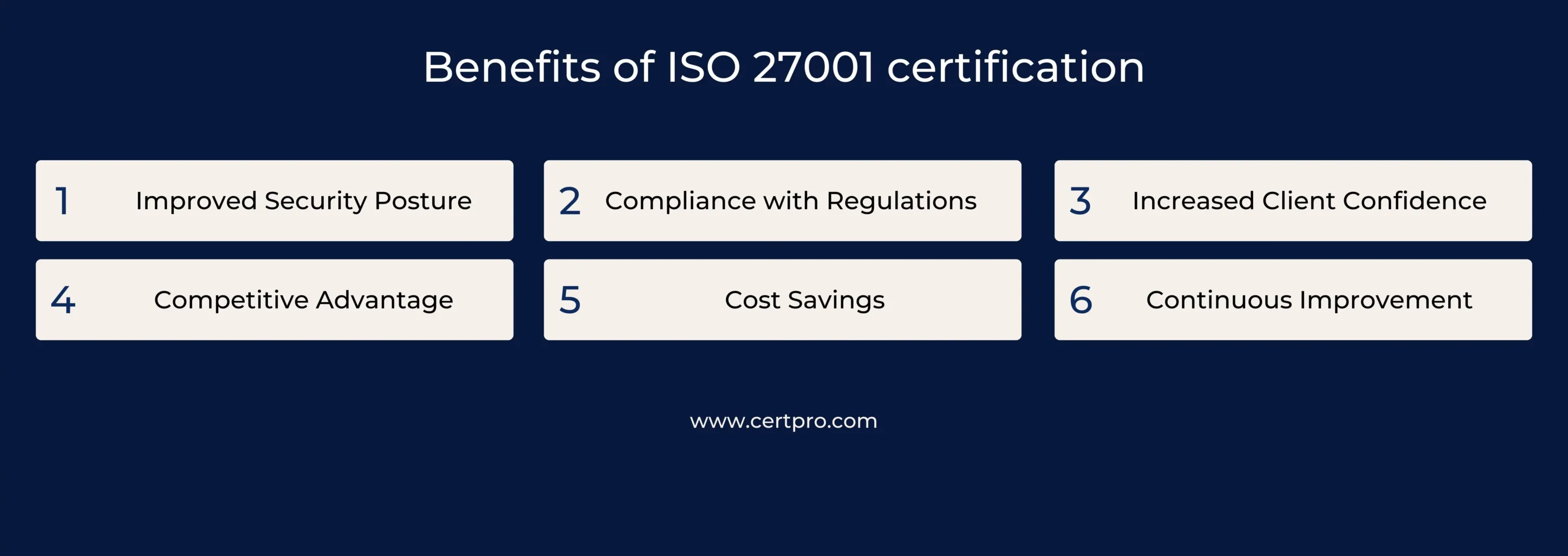
ISO 27001 Certification in Dublin delivers independently verified business outcomes that extend beyond information security management. Organisations that achieve ISMS certification demonstrate structured, auditable security governance to a wide range of stakeholders — customers, regulators, procurement teams, insurers, and investors. The following benefits are consistently observed across Dublin organisations that complete the ISO 27001 Certification process.
- ✓Independently verified information security credentials accepted in enterprise procurement and vendor qualification processes across EU and international markets
- ✓Structured risk management framework that identifies, evaluates, and treats information security risks systematically across the ISMS scope
- ✓Documented ISMS controls and policies that support regulatory due diligence requirements under GDPR, NIS2, and sector-specific frameworks
- ✓Competitive differentiation in technology, financial services, healthcare, and government procurement markets where ISO 27001 Certification is a baseline requirement
- ✓Reduced information security incident frequency through systematic control implementation and continual improvement processes
- ✓Enhanced customer and partner confidence through independently verified third-party ISO 27001 Certification from a Licensed CPA Firm
- ✓Structured internal audit and management review processes that drive measurable ISMS improvement over the certification cycle
- ✓Support for cross-border data transfer arrangements and international market access where certification is referenced in contractual security requirements
ISO 27001 Certification is recognised as the primary independent credential for information security governance in enterprise procurement across Europe, North America, and international markets. Dublin organisations that hold current ISO 27001 Certification are positioned to respond affirmatively to security questionnaires, vendor registration requirements, and contractual security clauses that reference third-party certification as a mandatory or preferred qualification. For technology firms competing for contracts with large enterprise customers — particularly in financial services, public sector, defence, and critical infrastructure — ISO 27001 Certification is frequently the threshold credential that determines whether an organisation is considered in competitive procurement processes.
The commercial value of ISO 27001 Certification extends to insurance and financial risk management. Cyber insurance underwriters increasingly reference ISO 27001 compliance and certification status in risk assessment questionnaires, and organisations holding current certification may qualify for more favourable underwriting terms based on demonstrated security governance maturity. The independently audited nature of ISMS certification — as distinct from self-assessed security frameworks — provides underwriters with objective evidence of control implementation that supports actuarial risk assessment. This financial dimension of ISO 27001 Certification is increasingly relevant as cyber insurance premiums rise across the technology and financial services sectors in Dublin and across Europe.
Organisations that implement and maintain a certified ISMS under ISO/IEC 27001:2022 demonstrate measurably structured security operations. The standard’s requirements for documented incident management procedures, business continuity planning, and supplier security controls create an operational framework that reduces the likelihood and impact of information security incidents. Internal audit and management review processes — both mandatory requirements under the standard — create systematic feedback mechanisms that identify control weaknesses before they result in security incidents. ISO 27001 audit findings, both internal and from CertPro’s certification audits, generate documented corrective action records that drive verifiable operational improvement across the ISMS lifecycle.
- ✓Customer Trust and Enterprise Procurement Access
- ✓Operational Resilience and Security Incident Reduction
Why Organisations in Dublin Pursue ISO 27001 Certification
The motivations for pursuing ISO 27001 Certification in Dublin are diverse, reflecting the city’s position at the intersection of European regulatory requirements, international technology markets, and a maturing enterprise procurement environment. Organisations pursue ISMS certification for a combination of market access, regulatory positioning, operational risk management, and customer trust objectives. Understanding these motivations helps clarify the business rationale for the investment required to achieve and maintain ISO 27001 Certification across the three-year certification cycle.
Regulatory and Contractual Drivers
Many Dublin organisations face direct contractual obligations to maintain ISO 27001 Certification as a condition of customer agreements — particularly in financial services, healthcare, government, and enterprise technology markets. Standard contractual security clauses in enterprise software agreements, data processing agreements, and outsourcing contracts frequently reference ISO 27001 Certification as a required or expected security credential. Organisations that fail to maintain current certification risk breach of contract claims, supplier disqualification, or loss of renewal rights under existing customer agreements. ISO 27001 compliance maintained through continuous certification also satisfies the due diligence requirements of EU-based customers managing their own regulatory obligations under GDPR and NIS2.
Public sector procurement in Ireland increasingly references ISO 27001 Certification in supplier qualification criteria, particularly for technology, cloud services, and data processing contracts. The Office of Government Procurement and individual government agencies expect technology suppliers to demonstrate independently verified information security governance as a condition of contract award. ISO 27001 Certification in Dublin provides the credential required to participate in public sector procurement processes where security governance standards are specified as mandatory requirements. This public sector driver is particularly relevant for technology firms seeking to expand their Irish government customer base.
International Market Access and Cross-Border Data Handling
Dublin’s role as a gateway to European and international markets means that many organisations process data across multiple jurisdictions and serve customers with diverse security requirements. ISO 27001 Certification provides a universally recognised credential that satisfies security due diligence requirements across EU, US, UK, Asian, and Middle Eastern markets simultaneously. For Dublin technology companies targeting North American enterprise customers — where SOC 2 and ISO 27001 certifications are commonly required in parallel — ISMS certification provides the internationally recognised framework that aligns with both European and global security governance expectations.
Cross-border data handling requirements under GDPR — including the use of Standard Contractual Clauses and Transfer Impact Assessments for data transfers outside the EEA — are supported by documented ISMS controls that ISO 27001 Certification validates. Organisations that maintain ISO 27001 compliance in Dublin can reference their certified ISMS controls in Transfer Impact Assessments, providing independently verified evidence of the technical and organisational measures applied to protect transferred personal data. This certification-supported documentation reduces the burden of demonstrating adequate data protection in cross-border transfer arrangements.
CertPro: Licensed CPA Firm Conducting ISO 27001 Certification Audits in Dublin
CertPro is a Licensed CPA Firm operating exclusively as an independent third-party ISO 27001 certification body. CertPro conducts ISO 27001 certification audits in Dublin and across Ireland under ISO/IEC 27001:2022, providing organisations with independently verified ISMS certification across all industry sectors. CertPro’s audit methodology is built on evidence-based evaluation, objective nonconformity assessment, and strict independence from consulting and advisory functions — ensuring that ISO 27001 Certification issued by CertPro reflects a genuine, independent assessment of ISMS effectiveness.
Independent Audit Methodology and Institutional Positioning
CertPro’s ISO 27001 audit methodology encompasses documentation review, personnel interviews, operational observation, technical control testing, and structured nonconformity evaluation. All audit activities are conducted by qualified auditors with sector-specific expertise, ensuring that the ISMS assessment accounts for the organisation’s specific operating context, technology environment, and risk profile. CertPro maintains strict separation between its certification audit function and any advisory or implementation activities — auditors do not prescribe corrective actions, design controls, or provide implementation guidance. This independence is fundamental to the integrity of ISO 27001 Certification issued by CertPro and to the credibility of the certificate in customer, regulatory, and procurement contexts.
CertPro’s institutional positioning as a Licensed CPA Firm brings the professional standards, objectivity requirements, and accountability frameworks of the accounting profession to the ISO 27001 certification function. This positioning is particularly relevant for Dublin organisations in financial services, regulated industries, and public sector markets where audit independence and professional accountability are fundamental requirements. An ISO 27001 assessment conducted by CertPro is supported by documented audit programmes, structured evidence records, and formal certification decision processes — providing organisations with a complete, defensible audit record for use in regulatory examinations and customer due diligence reviews.
Audit Scope, Evidence Collection, and Nonconformity Classification
During the ISO 27001 audit, CertPro auditors collect and evaluate evidence across multiple categories: documented ISMS policies and procedures, records of risk assessment and risk treatment activities, implementation evidence for Annex A controls, records of internal audits and management reviews, incident and corrective action records, and operational evidence from interviews and observation. Evidence is evaluated against the specific requirements of each applicable clause and control to determine whether the ISMS meets the standard’s requirements in documented form and in operational practice. The distinction between documented conformance and operational effectiveness is a critical aspect of ISO 27001 audit methodology — certification requires both.
Nonconformities identified during CertPro’s ISO 27001 audit are classified using a two-tier system. Major nonconformities indicate failure to satisfy a requirement of the standard or a systemic control failure that undermines ISMS effectiveness — these must be resolved and verified before a certification decision can be made. Minor nonconformities indicate isolated gaps or partial compliance that do not represent systemic failure — these are documented and tracked through the corrective action process, with verification typically scheduled during the first surveillance audit. Opportunities for improvement observed during the audit are recorded separately and communicated to the organisation without affecting the certification decision. This structured classification supports transparent, objective ISO 27001 Certification outcomes.
FAQ
▶
What is ISO 27001 certification?
▶
What is ISO 27001 Certification and what does it confirm?
▶
How long does the ISO 27001 certification process take for a Dublin organisation?
▶
What is the Statement of Applicability (SoA) and why is it important?
▶
What is the difference between Stage 1 and Stage 2 of the ISO 27001 audit?
▶
How long is an ISO 27001 certificate valid and what are surveillance audits?
▶
Does ISO 27001 Certification confirm GDPR compliance for Dublin organisations?
▶
What are the key Annex A control categories in ISO/IEC 27001:2022?
Get In Touch
have a question? let us get back to you.