
Enterprises deploying AI systems now face governance risks that traditional compliance programs never anticipated. AI models make high-impact decisions. They carry hidden assumptions. They evolve over time. Moreover, when failures occur, accountability falls on the organizations using the systems, not the vendors that developed them.
As a result, AI standard certification has become a formal governance discipline for modern enterprises. International Organization for Standardization ISO 42001, the international standard for AI Management Systems (AIMS), gives organizations a structured and auditable framework for governing AI responsibly. It covers the full AI lifecycle, from design intent and deployment to monitoring and long-term accountability.
From a licensed assurance perspective, AI standard certification is far more than a checklist exercise. ISO 42001 functions as an evidence-based governance framework. It evaluates whether an organization has built real operational oversight for AI risk, rather than producing policies that only describe governance in theory.
That distinction matters. Policies alone do not prove governance maturity. In practice, auditors evaluating AI standard certification readiness look for evidence that governance controls actively work. They assess whether oversight structures operate consistently, whether risk ownership is clearly assigned, and whether accountability mechanisms produce measurable outcomes.
A simple analogy explains the difference well. A company can install security cameras across a building. However, governance only becomes real when trained personnel actively monitor the footage, investigate incidents, and document corrective action. AI governance works the same way. Written controls mean little without operational accountability behind them.
AI standard certification, such as ISO 42001, has become a foundational trust signal for enterprises deploying AI at scale. This guide explains how ISO 42001 audits work, what evidence auditors examine, and what genuine AI governance and compliance maturity looks like in real-world operations.

Concern
Organizations using AI now face governance risks that traditional compliance frameworks do not fully address. AI systems influence business decisions, customer outcomes, hiring, lending, healthcare, and operational workflows. These systems can also introduce bias, explainability gaps, accountability failures, and uncontrolled model changes over time. As AI adoption grows, regulators, enterprise buyers, and audit teams increasingly expect organizations to prove that AI systems operate under structured governance controls. Policies alone do not satisfy audit or procurement expectations. Organizations must demonstrate operational oversight, documented accountability, risk monitoring, and evidence-based governance across the full AI lifecycle. Weak governance can create regulatory exposure, procurement delays, reputational damage, and failed compliance assessments.
Overview
AI standard certification under ISO 42001 provides a structured framework for AI governance and compliance. The standard establishes requirements for building and operating an AI Management System (AIMS). This includes AI risk classification, impact assessments, human oversight controls, lifecycle governance, monitoring, governance reviews, and continual improvement processes. ISO 42001 audits evaluate whether governance controls actively function in real operations. Auditors examine operational evidence such as AI inventories, governance committee records, monitoring outputs, bias assessments, oversight logs, and corrective action documentation. The certification process follows a two-stage audit structure that reviews both governance design and operational execution.
Solution
Organizations preparing for AI standard certification should focus on operational governance maturity. Effective readiness includes defined AI oversight roles, documented accountability structures, centralized AI inventories, risk ownership assignment, monitoring controls, and evidence preservation processes. Successful ISO 42001 programs generate consistent governance evidence, maintain active oversight, and support independent audit validation. These governance capabilities help organizations strengthen enterprise trust, improve procurement positioning, support regulatory readiness, and demonstrate responsible AI operations at scale.
What AI Standard Certification Actually Means Under ISO 42001
AI standard certification under ISO 42001 is the formal confirmation that an organization has designed, implemented, and operationalized an AI Management System that meets the requirements of the international standard. Certification is issued by an accredited third-party certification body following a structured audit process.
The standard defines requirements across the full AI governance operating model: governance policy, risk classification, impact assessment, human oversight controls, lifecycle management, bias and explainability considerations, and continual improvement processes.
What the AI Management System (AIMS) Encompasses
An AIMS is not a standalone compliance artifact. It is the operational governance structure through which an organization manages AI-related risks, responsibilities, and accountability. A functioning AIMS includes governance committees with defined AI oversight mandates, AI inventories that document active systems and their risk classifications, documented AI lifecycle governance procedures, and monitoring controls that generate ongoing compliance evidence.
Organizations frequently confuse having an AI governance policy with having an AIMS. They are not the same. Policy states intent. An AIMS demonstrates operational accountability through documented governance decisions, oversight records, and control validation evidence.
How ISO 42001 Differs from Traditional Compliance Frameworks
ISO 42001 fills a governance gap that frameworks like ISO 27001, SOC 2, and HIPAA do not address. Security frameworks govern data protection and system availability. ISO 42001 governs model accountability, AI decision fairness, deployment integrity, and human oversight. The risk domain is different. The audit evidence expectations are different. The governance accountabilities are different.
The Certification Audit Structure
ISO 42001 certification audits follow a two-stage structure. Stage 1 evaluates documentation completeness and AIMS design. Stage 2 evaluates operational implementation — whether the governance system is functioning as designed and producing the evidence that supports the controls being claimed. Organizations that pass Stage 1 but struggle at Stage 2 almost always share a common problem: governance exists on paper but not in practice.
How ISO 42001 Audits Evaluate AI Governance Maturity
Organizations pursuing AI standard certification often assume strong documentation guarantees audit readiness. However, ISO 42001 auditors look far beyond polished policies. They assess whether governance controls actively function across daily operations, whether AI oversight responsibilities are clearly assigned, and whether compliance evidence reflects real governance activity.
Governance Evidence Auditors Typically Examine
During an ISO 42001 audit, auditors examine operational evidence that demonstrates AI governance maturity. This evidence commonly includes:
- AI Inventory Documentation: A maintained inventory of AI systems, intended use cases, deployment environments, and risk classifications
- AI Impact Assessment Records: Documented evaluations of bias exposure, ethical concerns, fairness risks, and stakeholder impact completed before deployment
- Human Oversight Records: Evidence that review controls operate effectively, including escalation workflows, review logs, and exception handling procedures
- Governance Committee Minutes: Records showing oversight discussions, risk decisions, escalations, and governance approvals through formal channels
- Model Monitoring Outputs: Evidence of ongoing performance reviews, anomaly detection, drift monitoring, and corrective action activities
- Vendor AI Oversight Records: Documentation proving governance accountability for third-party AI systems within scope
Many organizations fail AI standard certification audits because governance exists only on paper. Policies may describe a strong framework. However, evidence proves whether that framework works under operational pressure.
Model Accountability and Lifecycle Governance
ISO 42001 places strong emphasis on lifecycle governance. In practice, this means organizations must govern AI systems from initial design through retirement. Auditors evaluate whether governance responsibilities transfer properly between teams, whether accountability remains documented at every stage, and whether system changes trigger reassessments of governance controls.
Lifecycle governance also includes explainability requirements. When AI systems influence healthcare, lending, employment, or public safety decisions, auditors expect clear explanation controls.
AI Risk Management and Governance Control Validation
Effective AI risk management forms the operational backbone of AI standard certification under ISO 42001. However, risk management is far more than maintaining a static risk register. Instead, it functions as a continuous governance process that connects risk identification with control implementation, ownership accountability, and ongoing monitoring.
Building an Auditable AI Risk Classification System
Organizations pursuing AI standard certification need a documented risk classification framework that categorizes AI systems by potential harm, autonomy level, data sensitivity, and decision impact. High-risk systems, especially those affecting individuals or critical operations, demand stricter governance oversight, stronger human review controls, and more frequent reassessments.
Classification frameworks must remain consistent across the organization. In addition, governance teams must reflect classifications within the AI inventory itself. Auditors often treat inconsistent classifications as an early warning sign of immature governance practices. For example, if two similar AI systems receive different risk ratings without justification, auditors will question whether the framework truly operates in practice.
Control Validation and Governance Traceability
During an ISO 42001 audit, auditors validate governance controls through traceability testing. They follow a governance chain that typically includes:
Policy commitment → implemented control → operational evidence → monitoring output → governance review documentation
If any part of that chain breaks, auditors cannot validate the control. In many failed audits, organizations document controls that teams never execute operationally. In other cases, monitoring systems produce alerts that nobody reviews or escalates. Successful AI standard certification depends on closing these operational gaps.
Bias Management and Responsible AI Governance
Responsible AI governance also requires documented bias management procedures. Auditors evaluate whether organizations assess AI systems for discriminatory outcomes, document bias testing methodologies, and maintain monitoring controls for deployed systems.
This area separates AI governance from traditional security compliance. Bias management does not function as a standard cybersecurity control. Instead, it operates as a model accountability process requiring dedicated governance ownership, documented review responsibilities, and continuous oversight evidence.
Procurement Scrutiny and Enterprise Trust in AI Governance
Enterprise buyers now treat AI governance as a core procurement requirement. Today, buyers ask more than whether a vendor protects data. They also want proof that the vendor manages AI responsibly and transparently. Because of this shift, many organizations now pursue AI standard certification to build trust and reduce procurement risk.
Procurement and vendor risk teams usually examine three areas:
- A documented AI governance framework
- Clear oversight and accountability processes
- Independent validation of governance controls
An AI standard certification based on ISO 42001 gives buyers independent proof that governance controls work in practice.
Governance Failures and Enterprise Risk Exposure
Weak governance creates several layers of risk. AI systems may produce biased or unreliable outcomes. As a result, organizations can face scrutiny under GDPR, the EU AI Act, and sector regulations. Public failures can also damage customer trust and brand reputation. Most governance failures happen because organizations create policies but fail to apply them consistently.
AI Governance as an Enterprise Trust Mechanism
A mature governance program signals accountability to buyers, regulators, and partners. Therefore, many enterprises now view AI standard certification as a strong trust indicator during procurement reviews and risk assessments. Moreover, companies with AI standard certification often gain stronger positioning in procurement reviews and enterprise compliance assessments.
Key Benefits of AI Standard Certification
-
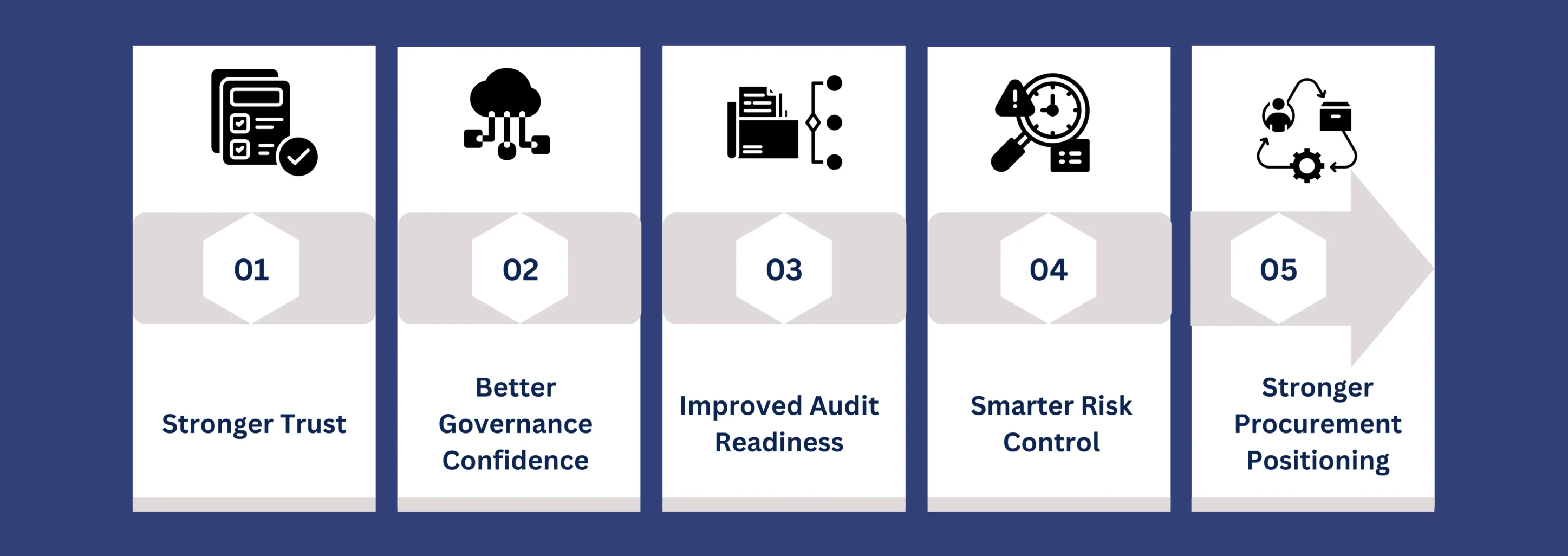
Stronger Trust
AI standard certification under ISO 42001 helps organizations show that AI is governed with clear rules, real oversight, and traceable accountability. ISO describes the standard as a way to manage AI risk while supporting innovation, trust, and accountability across organizations that develop, provide, or use AI systems.
-
Better Governance Confidence
For many teams, the biggest benefit is trust. Buyers, regulators, and internal leaders want proof that AI is handled responsibly, not just described in policy documents. ISO 42001 supports responsible AI governance, reputation protection, and structured risk management. This becomes especially important when AI influences customer decisions, operations, or public confidence.
-
Improved Audit Readiness
ISO 42001 audits evaluate both governance design and operational execution. As a result, organizations maintain updated AI inventories, impact assessments, oversight records, and monitoring evidence more consistently. This helps reduce the gap between documented policies and real operational behavior.
-
Smarter Risk Control
ISO 42001 gives organizations a structured way to classify AI risk, assign ownership, review outputs, and monitor systems across the AI lifecycle. Teams can identify governance gaps earlier, respond faster to emerging risks, and reduce exposure to bias, poor decision-making, or compliance failures.
-
Stronger Procurement Positioning
Enterprise buyers increasingly ask vendors to prove how AI systems are governed before contracts move forward. AI standard certification gives procurement teams and business partners greater confidence that governance controls operate consistently and accountability structures are already in place.
Building ISO 42001 AI Standard Certification Readiness
Governance Operating Model Design
Organizations pursuing AI ISO certification often discover that their biggest gaps are structural, not technical. In many cases, AI oversight roles remain unclear. Governance committees lack defined AI responsibilities. AI inventories stay incomplete. Monitoring controls also operate in silos across business units instead of following one enterprise governance structure.
To prepare for certification, organizations need a governance operating model with clear accountability. This model should include:
- A governance committee with a formal AI oversight mandate
- Defined AI risk owners for systems in scope
- Clear escalation paths for governance issues
- Monitoring processes that produce ongoing control evidence
The governance model must work in practice before the audit begins. During assessments, auditors review committee records, interview risk owners, and trace monitoring results to governance decisions. They want proof that governance operates consistently across the organization.
Preparing the AI Governance Evidence
Evidence preparation is one of the most important parts of AI ISO certification readiness. Organizations must maintain updated AI inventories, complete impact assessments, and collect governance records that show active oversight. They must also preserve monitoring outputs that confirm controls operate effectively over time. Organizations with polished documentation but weak operational evidence should focus on fixing execution gaps first.
Continual Improvement
ISO 42001 also requires continual improvement. Organizations must show that governance gaps, monitoring findings, and control failures lead to corrective action. Improvement records, governance reviews, and remediation activities all demonstrate governance maturity. A governance program that never identifies issues usually signals weak monitoring, not perfect governance.
Conclusion
ISO 42001 AI standard certification demonstrates that an organization operates an AI Management System designed for responsible, transparent, and accountable AI governance. However, certification is not the starting point of governance maturity. Instead, it reflects governance controls that already function consistently in practice.
Organizations that achieve and maintain AI standard certification move beyond policy documentation and theoretical governance models. They establish operational accountability across daily AI activities. This includes maintained AI inventories, documented risk and impact assessments, human oversight mechanisms, governance oversight structures, monitoring controls, and evidence-based review processes.
Today, AI standard certification is becoming a major indicator of enterprise AI governance maturity. Buyers, regulators, business partners, and board members increasingly evaluate whether organizations can demonstrate real governance controls, operational transparency, and accountability for AI-driven decisions.
Strong AI governance functions much like a flight control system. Policies may define direction, but oversight, monitoring, and accountability help maintain operational control under real conditions. Without operational evidence, governance frameworks often fail during audits, regulatory reviews, or enterprise due diligence assessments.
For organizations evaluating ISO 42001 readiness, the core question remains simple. Can governance operate consistently, generate evidence, and withstand independent audit review?
At CertPro, we deliver ISO 42001 assessments and certification support for audit-ready organizations. Our credentialed audit specialists evaluate your governance controls, policies, and operational evidence to assess whether they function effectively and consistently under real-world conditions.