
Disruptions no longer arrive with warning. Ransomware attacks, cloud outages, supply chain failures, and geopolitical events now interrupt operations across industries without notice. Therefore, organizations that lack a structured governance response to these events face extended downtime, regulatory exposure, and lasting reputational damage.
A business continuity policy establishes the governance foundation that determines how an organization responds when critical operations are threatened. Furthermore, it defines what continuity means for the organization, assigns accountability, and sets the scope of response. To add on, it connects the senior leadership commitment to the operational plans that teams execute on the ground.
Yet many organizations confuse having a business continuity plan with having a governance-grade policy. The two are related, but they are not the same. To clarify, one documents procedures. Meanwhile, the other establishes the organizational commitment, scope, and accountability structure that makes those procedures credible, enforceable, and defensible under audit scrutiny.
This guide explains the business continuity definition, what a well-structured policy must include, how it connects to risk management, and what best practices organizations should apply heading into 2026.

Concern
Organizations that treat business continuity as an operational checklist rather than a governance commitment consistently underperform during disruptions and compliance audits. Without a documented business continuity policy, recovery decisions are made informally, accountability is unclear, and audit evidence is difficult to produce. SOC 2, ISO 27001, and ISO 22301 all require organizations to demonstrate formal governance over continuity activities, not just plans that exist on paper.
Overview
A business continuity policy defines the organization's commitment to maintaining critical operations during and after a disruption. It establishes the scope of the business continuity program, assigns roles and responsibilities, sets the governance framework for continuity planning, and requires a business impact analysis to underpin all recovery decisions. Auditors examine the policy to verify that continuity activities are governed, tested, and reviewed rather than simply documented.
Solution
Organizations should develop a formal policy that connects leadership commitment to operational plans, defines clear recovery objectives, including RTO and RPO, and separates the governance layer from the procedural BCP plan. The policy must be reviewed at defined intervals, tested regularly, and updated when business operations change. Mature continuity governance reduces audit findings, accelerates recovery, and demonstrates organizational resilience to enterprise buyers and regulators.
Business Continuity Definition: What It Means in a Governance Context
The business continuity definition used in most governance and audit frameworks goes beyond disaster recovery. ISO 22301, the international standard for Business Continuity Management Systems, defines business continuity management as a holistic process that identifies potential threats and their impacts on operations, and provides a framework for building organizational resilience with the capability of an effective response.
In practical terms, a business continuity policy translates that definition into organizational action. It establishes what the organization is committed to protecting, which operations must be sustained or restored within defined timeframes, and who is accountable for continuity decisions at each level of the organization.
This distinction matters for audit purposes. BCM is not simply about having backup systems or recovery procedures. Moreover, it requires documented governance: a formal policy statement, defined objectives, assigned roles, and a structured process for reviewing and improving continuity capabilities over time. Auditors examining SOC 2 and ISO 27001 environments look specifically for this governance layer.
How Business Continuity Connects to Organizational Resilience
Continuity programs that operate without a governing policy tend to drift. Plans become outdated. Recovery objectives are set without reference to the business impact analysis. Testing schedules lapse. When a disruption occurs, the absence of a governance structure becomes immediately visible to regulators and auditors who evaluate the response.
A business continuity policy prevents this drift by creating formal accountability. Accordingly, it mandates testing cycles, defines escalation authority, and ensures that recovery objectives remain aligned with current business operations. Without this governance foundation, even well-documented procedures carry limited credibility under external scrutiny.
What Is a Business Continuity Policy and How It Differs from a BCP Plan
A business continuity policy is a governance document that defines organizational commitment, scope, objectives, and accountability for continuity management. A business continuity plan policy, in contrast, refers to the operational procedures and response instructions that teams follow when a disruption occurs. Both are necessary. But they serve different purposes in a compliance-grade continuity program.
The policy answers the strategic questions. What does the organization commit to protecting? Who has authority to activate continuity procedures? What standards govern how plans are developed, tested, and reviewed? What are the recovery objectives at the organizational level?
The BCP plan answers the operational questions. Which systems are prioritized for recovery? What are the step-by-step procedures for each team? Who are the contacts, and what are the escalation paths? A BCP plan is operationally specific. It belongs underneath the policy, not in place of it.
Auditors reviewing business continuity plan policy compliance under SOC 2 or ISO 27001 expect to see the policy governing the plans. Organizations that produce only plan documents, without a governance-level business continuity policy, typically receive nonconformities related to insufficient management commitment and undefined program scope.
Key Components of a Business Continuity Policy
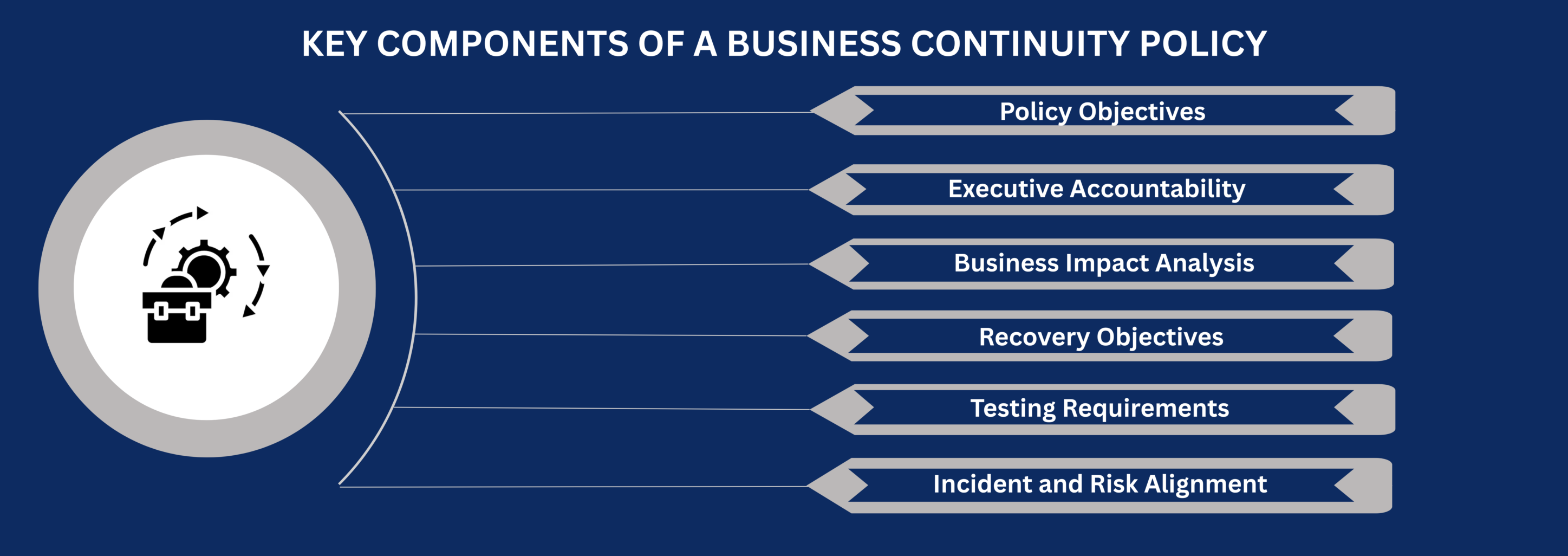
A business continuity policy that holds up under audit scrutiny includes several core elements. Each component contributes to the governance record that auditors and regulators expect to see when assessing continuity management maturity.
-
Policy Objectives
The policy must clearly define what the continuity program covers — which business units, locations, systems, and services fall within scope. It should state the organization's high-level continuity objectives, including the maximum acceptable downtime for critical operations and the recovery point tolerance for key data.
-
Executive Accountability
Formal commitment from senior management is a requirement under ISO 22301 and a strong signal auditors look for under ISO 27001 and SOC 2. The policy should be approved and signed at the executive or board level. It should also name the role or function responsible for owning, maintaining, and reviewing the continuity program.
-
Business Impact Analysis
A credible continuity program requires a documented business impact analysis. The BIA identifies which processes are critical, quantifies the impact of their disruption over time, and establishes the recovery time objectives and recovery point objectives that govern plan development. Auditors confirm that recovery objectives in operational plans trace back to BIA findings rather than assumptions.
-
Recovery Objectives
RTO defines the maximum acceptable time a critical system or process can remain unavailable before the impact becomes unacceptable. RPO defines the maximum acceptable data loss measured in time. Both must be defined at the policy level and carried through into individual BCP plan documentation. Inconsistencies between policy-level objectives and plan-level procedures are a common audit finding.
-
Testing Requirements
A business continuity policy must mandate regular testing of continuity plans and periodic review of the policy itself. Testing schedules, exercise types, and documentation requirements should be defined explicitly. Auditors request test records, gap findings, and evidence of corrective action to confirm that the policy is operationalized rather than archived.
-
Incident and Risk Alignment
Continuity plans do not operate in isolation. The policy should define how the business continuity program connects to the organization's incident response process, risk management framework, and information security controls. These linkages ensure that risk assessment outputs inform continuity planning and that incidents trigger the appropriate continuity response.
Objective of BCP: What Organizations Must Achieve
The objective of BCP extends well beyond restoring systems after an outage. BCP business continuity programs are designed to protect an organization's ability to deliver critical services to customers, meet regulatory obligations, and sustain its operational and reputational standing throughout a disruption and recovery period.
A well-defined objective of BCP addresses four distinct outcomes:
- Operational continuity: Maintain or rapidly restore critical business functions within defined recovery timeframes.
- Stakeholder protection: Ensure that customers, employees, and partners are protected from the downstream impacts of a business disruption.
- Regulatory compliance: Meet contractual and regulatory obligations that require demonstrated continuity capabilities, including those under SOC 2, ISO 27001, HIPAA, and GDPR.
- Organizational resilience: Build and maintain the institutional capacity to absorb disruptions, adapt operations, and improve continuity capabilities through structured review cycles.
When a business continuity policy aligns directly with these objectives, it gives the entire continuity program a measurable direction. Auditors can evaluate whether plans, testing activities, and governance reviews actually serve the stated objectives — or whether they exist purely as documentation.
Business Continuity Plan vs Risk Management: Understanding the Relationship
Understanding a business continuity plan vs risk management requires recognizing that the two disciplines are complementary but distinct. Risk management is primarily strategic and preventive. It focuses on identifying, assessing, and mitigating threats before they materialize. Whereas business continuity management is primarily tactical and reactive. It focuses on what the organization does when a threat has already disrupted operations.
Risk management asks: What could go wrong, and how can we reduce the likelihood or impact? Business continuity management asks: When something goes wrong, how do we keep operating and recover quickly?
The relationship between business continuity plan vs risk management becomes most productive when risk assessment outputs directly inform continuity planning. The highest-impact risks identified through enterprise risk management should drive the prioritization of continuity investments, shape BIA scenarios, and determine which processes receive the most rigorous recovery procedures.
In audit terms, a business continuity policy that references the organization's risk register as an input to BCP development demonstrates governance maturity. It shows that continuity planning is evidence-based rather than generic, and that recovery objectives reflect the actual risk profile of the organization rather than industry defaults.
Organizations that operate risk management and business continuity as entirely separate functions often produce continuity plans that do not address their most material risks. Auditors identify this gap during risk-alignment reviews. Bridging it at the policy level, by explicitly connecting the two programs, is a straightforward way to strengthen both governance posture and audit readiness simultaneously.
Business Continuity Policy Best Practices
Regulatory expectations and enterprise buyer scrutiny around business continuity governance have intensified. The following best practices reflect what auditors examine, what procurement teams request, and what mature organizations have found to be operationally effective.
-
Governance Separation
A business continuity policy should govern, not describe procedures. Keep the policy focused on commitment, scope, accountability, and objectives. Maintain operational BCP plans as separate documents underneath it. Auditors evaluate the policy on whether it creates the governance conditions for effective planning, not on whether it contains every recovery procedure.
-
BIA-Driven Continuity
Recovery objectives that are not supported by a recent business impact analysis are assumptions, not governance decisions. Ensure that every business continuity plan references a BIA that has been reviewed and approved within the past twelve months. Auditors specifically verify the connection between BIA findings and documented recovery timeframes.
-
Policy Validation
Testing schedules should include tabletop exercises that validate whether the governance framework itself works under pressure. Are escalation paths clear? Does the team know who activates the policy? Are communication protocols understood? These governance-level tests reveal gaps that procedure-level drills often miss.
-
Continuous Policy Review
Mergers, product launches, new cloud dependencies, regulatory changes, and vendor transitions all affect continuity risk. The policy should specify triggers for unscheduled reviews alongside the regular annual review cycle. Organizations that tie policy reviews to change management processes maintain more accurate and defensible continuity governance.
-
Compliance Alignment
SOC 2 availability criteria, ISO 27001 Annex A control on ICT readiness, ISO 22301, HIPAA contingency planning requirements, and GDPR resilience expectations all require evidence of documented and tested continuity capabilities. A policy aligned with these frameworks reduces duplicative effort and produces audit evidence that serves multiple compliance programs simultaneously.
Conclusion
A business continuity policy defines how an organization governs resilience during disruption. It establishes accountability, clarifies recovery priorities, aligns continuity objectives with business risk, and creates the structure required to keep operational response plans current, tested, and effective.
Organizations with mature continuity governance recover faster, reduce operational disruption, and perform more effectively during audits, regulatory reviews, and enterprise due diligence assessments. Strong continuity programs connect policy governance with risk management, testing discipline, executive oversight, and measurable operational readiness. Without that alignment, continuity planning often becomes fragmented, outdated, and difficult to execute under pressure.
As regulatory expectations continue to rise, business continuity governance is becoming a core indicator of organizational maturity. Enterprise buyers, regulators, investors, and audit teams increasingly evaluate whether continuity controls function operationally, produce defensible evidence, and reflect the organization's actual threat landscape.
Effective continuity governance therefore depends on more than maintaining documentation. It requires active ownership, regular testing, cross-functional coordination, and leadership commitment across the organization. Businesses that embed continuity into governance processes place themselves in a stronger position to manage disruption, maintain stakeholder trust, and support long-term operational resilience.