
Organizations today rely on dozens — sometimes hundreds — of third-party vendors. Each relationship carries a different combination of data access, operational dependency, and regulatory exposure. Applying the same level of scrutiny to every vendor is neither practical nor proportionate.
Vendor tiering solves this problem. It gives risk and compliance teams a structured, evidence-based method for classifying vendors by their actual risk profile, directing appropriate oversight to relationships that warrant it, and maintaining a defensible audit record under SOC 2, ISO 27001, and regulatory review.
Without a tiering framework, organizations often apply uniform due diligence across their entire vendor population. High-risk vendors receive insufficient scrutiny. Low-risk vendors consume resources that belong elsewhere. Audit evidence becomes inconsistent, and third-party oversight functions as a documentation exercise rather than an operational discipline.
This guide explains what vendor tiering is, how a structured tiering model is built, what criteria drive sound classification decisions, and what best practices risk and compliance teams should apply in 2026.

Concern
Most organizations manage third-party risk without a structured tiering approach. The result is inconsistent due diligence, misallocated resources, and audit findings tied to insufficient vendor oversight. As vendor ecosystems grow more complex and regulators raise their expectations, the absence of a formal vendor tiering framework creates measurable compliance and operational exposure.
Overview
Vendor tiering is the process of classifying vendors into risk categories based on defined criteria including data access, operational criticality, integration depth, and regulatory impact. The tier assigned to each vendor governs the frequency and depth of assessment, the evidence collected for audit, and the monitoring obligations that apply throughout the relationship lifecycle.
Solution
Organizations should build the program on a complete vendor inventory, consistent classification criteria, and tier-specific due diligence requirements. The model must be reviewed when vendor relationships change and updated at least annually. Connecting the program to SOC 2 and ISO 27001 evidence requirements ensures that third-party governance produces audit-ready documentation as a natural output of regular operations.
What is Vendor Tiering
What is vendor tiering? It is the practice of segmenting a vendor population into defined risk categories based on the potential impact each relationship has on data security, operational continuity, and regulatory compliance. The classification determines what level of governance, due diligence, and ongoing monitoring each vendor receives.
Vendor tiering matters because third-party risk is not uniform. A cloud infrastructure provider with access to sensitive customer data and deep system integration poses fundamentally different risks than an office supplies vendor with no system access. Making this distinction explicit creates a governance structure where oversight intensity scales with actual exposure, rather than with contract value or perceived importance.
Understanding what is vendor tiering also requires recognizing its audit function. SOC 2 auditors request a vendor inventory with risk classifications as a standard evidence item. ISO 27001 Annex A control 5.19 requires organizations to govern information security in supplier relationships, which presupposes a classification system that differentiates suppliers by risk. Without the framework, organizations cannot demonstrate that their third-party oversight is proportionate, risk-based, or consistent.
Organizations that apply identical due diligence across all vendors face two compounding problems. High-risk vendors with deep data access may not receive the rigorous annual assessments, SOC 2 report reviews, or contractual audit rights they require. Meanwhile, low-risk vendors consume review cycles that add no proportionate governance value. This misallocation is both an operational inefficiency and a compliance gap that external auditors consistently identify.
How a Vendor Tiering Model Works
A vendor tiering model translates risk criteria into a repeatable classification process. It begins with a complete vendor inventory. Every vendor the organization relies on — regardless of spend level or perceived importance — must be documented before any classification can occur. Gaps in the inventory create gaps in tiering coverage and, by extension, gaps in the audit record.
The model then applies defined criteria to each vendor relationship. These criteria evaluate the nature of the relationship rather than simply the category of goods or services being provided. Scoring should be objective and repeatable: two reviewers assessing the same vendor should reach the same tier assignment.
Core Criteria for Vendor Classification
Most mature third-party risk programs evaluate vendors across five primary dimensions:
- Data sensitivity: What types of data does the vendor access, process, or store? Personally identifiable information, protected health information, payment card data, and intellectual property each carry different regulatory and security implications.
- Operational criticality: How significantly would a disruption to this vendor's service affect the organization's ability to deliver products or services? Vendors that represent a single point of failure warrant the highest tier classification.
- Integration depth: Does the vendor have API access, single sign-on integration, network connectivity, or administrative privileges? Deep technical integration amplifies the risk surface and often elevates the tier independently of data sensitivity.
- Regulatory impact: Does the vendor's service fall under specific compliance frameworks such as HIPAA, PCI DSS, GDPR, or DORA? Regulatory obligations may independently drive a higher tier assignment regardless of other criteria.
- Substitutability: How easily could the organization replace this vendor? A vendor that is difficult or costly to replace introduces concentration risk that elevates its governance priority.
Once criteria are defined, the vendor tiering model assigns weighted scores and maps each relationship to a tier. Score thresholds for each tier should be set in advance and applied consistently. Ambiguity in classification criteria is one of the most common weaknesses auditors identify in third-party risk programs.
The Three-Tier Structure: Key Vendor Risk Categories
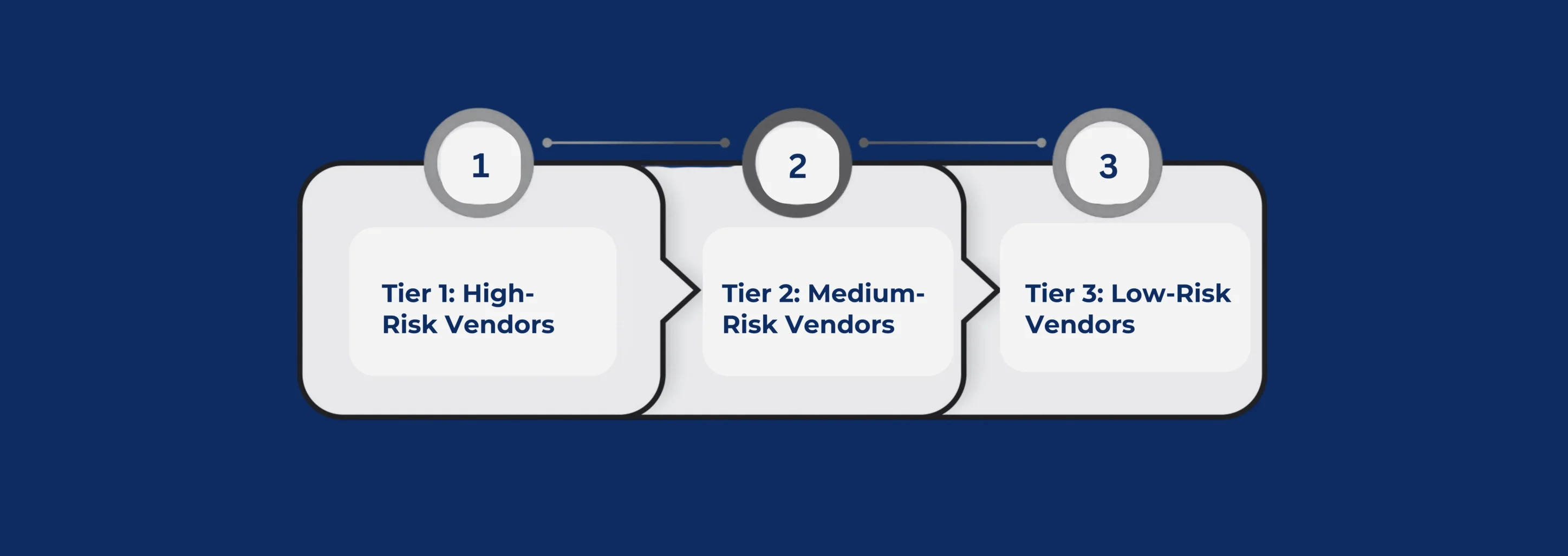
Vendor risk tiering frameworks most commonly use a three-tier structure. Some organizations add a fourth tier for vendors with negligible risk or no system access. The structure below reflects standard practice across SOC 2 and ISO 27001 audit environments.
-
Tier 1: High-Risk Vendors
Tier 1 is the highest vendor tiering classification. It applies to vendors with access to sensitive or regulated data, vendors providing critical infrastructure or operationally irreplaceable services, and any vendor whose failure would cause immediate regulatory exposure. Examples include cloud infrastructure providers, core security tool vendors, payment processors, and SaaS platforms with access to customer records. Tier 1 vendors require comprehensive risk assessments at least annually, SOC 2 Type II report or current ISO 27001 certificate reviews, contractual audit rights and incident notification obligations, and ongoing monitoring of security posture signals.
-
Tier 2: Medium-Risk Vendors
Tier 2 covers vendors that support important operations but do not reach the Tier 1 exposure threshold. In vendor tiering practice, these relationships typically involve limited access to non-sensitive systems, services that could be substituted within a reasonable timeframe, or operations under moderate regulatory obligations. Examples include professional services firms, HR platforms, and analytics tools with restricted data access. Tier 2 vendors require annual or semi-annual risk assessments, periodic compliance reviews, and standard contractual data handling obligations. Evidence requirements are less intensive than Tier 1, but remain structured and documented rather than informal.
-
Tier 3: Low-Risk Vendors
Tier 3 sits at the lowest end of the vendor risk tiering scale. Vendors in this tier have minimal data access, no system integration, and limited operational impact. Examples include office equipment suppliers, marketing content agencies with no data access, or training platform providers with public-facing content. The tiering model places Tier 3 relationships on a light-touch governance track: an onboarding questionnaire and a review at contract renewal rather than a formal annual assessment.
Vendor Tiering in SOC 2 and ISO 27001 Audit Environments
Vendor tiering is not only an operational best practice. It is a compliance requirement in most enterprise audit frameworks. Auditors evaluating SOC 2 and ISO 27001 environments consistently identify third-party oversight as one of the highest-risk control areas, and tiering is central to how they evaluate whether that risk is governed proportionately.
SOC 2 Vendor Risk Management Expectations
SOC 2 vendor risk management assessments expect organizations to maintain a complete vendor inventory with documented risk classifications. Auditors request evidence that high-risk vendors were assessed during the audit period, that third-party certifications and SOC 2 reports have been reviewed, and that identified findings have been addressed. Organizations without a classification system cannot demonstrate that their vendor oversight is risk-proportionate, which is the standard auditors apply.
ISO 27001 Supplier Relationship Requirements
ISO 27001 Annex A control 5.19 requires documented policies and procedures for managing information security in supplier relationships. Vendor tiering directly supports this control by providing the classification framework that determines which suppliers receive which level of scrutiny. Auditors reviewing ISO 27001 supplier controls will examine whether the tiering approach is documented, consistently applied across the vendor population, and reviewed at defined intervals.
Both frameworks also evaluate whether vendor classifications connect to contractual obligations. Tier 1 vendors should have service agreements that include specific security requirements, data handling obligations, audit rights, and incident notification timelines. Tier 3 vendors may require only standard data processing terms. Contracts should reflect the tier assignment rather than a uniform template applied regardless of risk level.
Vendor Tiering Best Practices for Risk and Compliance Teams
Regulatory expectations and enterprise buyer scrutiny around third-party oversight have intensified through 2025 and into 2026. The following practices reflect how mature risk and compliance programs build and maintain effective tiering frameworks.
-
Build a Complete Vendor Inventory
A vendor tiering program is only as reliable as its underlying inventory. Organizations that begin classification before completing their vendor inventory inevitably miss relationships and create coverage gaps that surface during audits. Document every vendor the organization relies on — across all business units and geographic locations — before applying scoring criteria or assigning tier boundaries.
-
Clear Criteria Definition
Classification decisions should trace back to documented criteria, not individual judgment calls. Build a scoring worksheet that captures data sensitivity, operational criticality, integration depth, regulatory impact, and substitutability in a format that produces repeatable outcomes. Ambiguous criteria weaken the defensibility of the entire program and are a consistent audit finding in third-party risk reviews.
-
Vendor Reclassification
Risk evolves with the relationship. A vendor that starts as Tier 3 may become Tier 1 when a new integration grants system access or a new product line touches regulated data. A tiering model that reflects historical classifications rather than current relationships produces misleading governance records and leaves genuine exposure unmapped. Reassessment should be triggered by any material change to data access, integration scope, or vendor ownership.
-
Evidence Alignment
Each tier should specify what evidence the organization collects, at what frequency, and in what format. Tier 1 vendors require SOC 2 Type II report reviews, annual risk assessments, and continuous monitoring outputs. Tier 2 vendors require annual questionnaires and certification reviews. Tier 3 vendors require onboarding documentation and renewal reviews. When tier assignments map directly to evidence requirements, audit preparation becomes systematic rather than reactive.
-
AI Vendor Governance
Vendors embedding AI into services that touch regulated data or critical operations introduce risks that standard tiering criteria may not fully capture. AI-enabled vendors combine runtime data access with automated decision-making and dynamic model behavior. Risk and compliance teams should classify these vendors as Tier 1 by default and extend due diligence criteria to include model transparency, data lineage documentation, and oversight mechanisms.
Conclusion
Vendor tiering is far more than an administrative exercise. It is the mechanism that transforms third-party risk management from a collection of individual assessments into a structured governance program. By aligning oversight activities with actual risk exposure, organizations create consistency in due diligence, accountability in decision-making, and transparency throughout the vendor lifecycle.
As third-party ecosystems continue to expand, the importance of effective tiering will only increase. Organizations now depend on cloud providers, SaaS platforms, AI vendors, data processors, and highly interconnected service partners whose risk profiles can change rapidly. At the same time, regulators, customers, and auditors increasingly expect organizations to demonstrate a clear rationale for how vendor risks are identified, categorized, monitored, and governed.
The most effective vendor tiering programs are therefore not static classification exercises. They evolve alongside the business, adapt to emerging technologies, and reflect changing operational dependencies. When maintained as an active governance process rather than a one-time compliance activity, vendor tiering provides the structure needed to focus resources where they matter most and maintain confidence in third-party oversight as risks continue to evolve.