
Autonomous AI systems are changing how organizations operate. Unlike traditional AI tools that simply respond to prompts, modern AI agents can plan tasks, make decisions, interact with multiple systems, and execute actions with limited human involvement.
This shift is happening quickly. As organizations adopt these technologies, a new governance challenge is emerging. Most existing AI governance programs were built for systems that provide recommendations. Agentic AI governance addresses a different reality. These systems can act autonomously, coordinate activities across applications, and influence real-world outcomes without requiring human approval at every step.
As a result, traditional oversight models are becoming less effective. Organizations now need governance frameworks that address autonomous decision-making, accountability, transparency, risk monitoring, and agentic AI security.
Regulators are already responding. In August 2026, key enforcement obligations under the EU AI Act will begin applying to high-risk AI systems. The direction is clear: organizations must establish structured, evidence-based Agentic AI governance before autonomous systems become deeply embedded in business operations.
This guide explains what is agentic AI, explores the differences between agentic AI vs generative AI, examines the risks driving AI agent governance requirements, and outlines best practices for agentic AI governance, including the role of ISO/IEC 42001:2023 in building effective oversight programs.

Concern
Organizations are deploying AI agents faster than they are building the governance structures to manage them. Less than 10 percent of organizations report having robust governance frameworks for AI deployment, yet agentic AI governance is no longer optional. Autonomous agents that access systems, execute decisions, and chain actions across digital infrastructure introduce accountability gaps, security exposures, and regulatory obligations that standard AI policies do not address.
Overview
Agentic AI governance covers the policies, controls, oversight mechanisms, and accountability structures that determine how autonomous AI systems are authorized, monitored, and governed throughout their lifecycle. It must address agent identity management, permission boundaries, human oversight triggers, decision audit trails, and escalation procedures — governed under internationally recognized frameworks including ISO/IEC 42001:2023.
Solution
Organizations should build governance programs that define clear authorization scopes for AI agents, implement human-in-the-loop controls calibrated to task risk, maintain immutable audit trails, and align their AI management systems with ISO/IEC 42001:2023. Independent certification under ISO 42001 provides stakeholders with verifiable assurance that governance operates consistently rather than in theory.
What is Agentic AI and Why Does Governance Urgency Matter Now
What is agentic AI? It is a form of artificial intelligence that can pursue goals, make decisions, and complete multi-step tasks with limited human involvement. Unlike traditional AI systems that respond to a single prompt, agentic systems can understand context, plan actions, use tools, and adjust their behavior as conditions change.
At the center of these systems are AI agents. These agents can search the web, query databases, execute code, interact with third-party applications, send communications, and update records. In more advanced environments, multiple AI agents work together. One agent may coordinate activities while others perform specialized tasks. As a result, organizations gain systems that can operate at a speed and scale that humans cannot continuously monitor in real time.
This shift is exactly why Agentic AI governance has become a pressing issue. Previous AI governance models were built for systems that generated recommendations or content for humans to review. Agentic systems introduce a different challenge. They can take actions, trigger workflows, and influence business outcomes without requiring approval at every step.
As autonomous capabilities expand, governance approaches based on periodic reviews, static policies, or after-the-fact oversight become less effective. Organizations need governance structures that can address real-time decision-making, accountability, transparency, and Agentic AI security.
Agentic AI vs Generative AI: Why the Governance Requirements Diverge
Understanding agentic AI vs generative AI is the first step in building effective governance.
Generative AI creates content. It produces text, code, images, summaries, and recommendations in response to a prompt. While the quality of its outputs may vary, the system typically waits for human input before generating a response.
Agentic AI operates differently. Instead of simply generating content, it can plan tasks, access tools, interact with systems, make decisions, and execute actions to achieve a defined objective. In many cases, the system continues through multiple steps without requiring a human to approve every action.
This distinction changes the governance challenge significantly. With generative AI, the primary concern is informational risk. Organizations focus on issues such as hallucinations, bias, misinformation, intellectual property concerns, and inappropriate outputs. Because humans generally review or act on the output, governance can rely heavily on validation, monitoring, and usage policies.
Agentic AI introduces operational risk. An autonomous agent may trigger workflows, access sensitive data, update records, interact with customers, or initiate actions across connected systems. If a decision is flawed, the impact can spread before a human reviewer has an opportunity to intervene.
This is why Agentic AI governance requires a different control model. The challenge is no longer limited to evaluating outputs. Organizations must govern actions. As a result, governance programs for agentic systems place greater emphasis on authorization boundaries, human oversight mechanisms, real-time monitoring, action logging, escalation thresholds, and accountability for autonomous decisions. These capabilities form the foundation of mature AI agents governance and effective Agentic AI security programs.
The Agentic AI Governance Risk Landscape
Agentic AI governance must address risks that go beyond those found in traditional or generative AI systems. Because autonomous agents can make decisions and take actions across multiple systems, a single failure can have operational, security, and compliance consequences. As organizations expand their use of AI agents, understanding these risks becomes a core part of effective governance.
Identity and Authorization Risks
One of the most significant Agentic AI security challenges involves identity and access management. AI agents often require permissions to access applications, data, and business processes. Over time, these permissions can expand beyond what the agent actually needs, creating a problem known as privilege drift. In addition, organizations may unknowingly deploy shadow agents outside approved governance processes, creating risks that remain hidden until an incident occurs.
For this reason, every AI agent should be treated as a digital identity. The same access governance principles applied to human users — including least-privilege access, credential management, and periodic access reviews — should also apply to autonomous agents.
Cascading Errors in Multi-Agent Systems
Agentic systems become more complex when multiple agents work together. In multi-agent environments, one agent's output often becomes another agent's input. As a result, a small error, inaccurate assumption, or malicious prompt injection can spread throughout an entire workflow. By the time a human reviewer notices the issue, the system may have already executed actions across several connected platforms. This makes continuous monitoring and validation essential components of Agentic AI governance.
Accountability and Explainability Gaps
Autonomous decision-making also creates accountability challenges. When an AI agent causes harm, organizations must be able to explain what happened, why it happened, and which actions led to the outcome. Without detailed audit records, these questions become difficult to answer. Effective AI agents governance requires immutable logs that capture data access events, tool usage, delegated actions, policy decisions, and system interactions. These records provide the evidence needed for investigations, regulatory reviews, and compliance audits.
AI Agents Governance: The Core Control Framework
Effective AI agents governance is built on four core control areas. Together, these controls help organizations establish Agentic AI governance programs that are auditable, scalable, and capable of managing the unique risks introduced by autonomous systems.
-
Authorization Boundaries and Least-Privilege Access
Every AI agent should operate within clearly defined limits. Access should be restricted to the systems, data, and tools required for a specific task and only for as long as necessary. Role-based permissions, time-limited credentials, and documented scope definitions help reduce the impact of compromised or misconfigured agents.
-
Human Oversight and Escalation Controls
Agentic AI governance does not require humans to approve every action. Instead, organizations should define when autonomous actions are acceptable and when human intervention is required. High-risk, irreversible, or ambiguous decisions should trigger escalation. These rules should be documented, embedded into system controls, and tested regularly.
-
Auditability and Real-Time Visibility
Organizations cannot govern what they cannot see. Every agent authentication event, tool interaction, data access request, and delegated action should be recorded in a tamper-resistant audit trail. Strong observability provides the evidence needed for investigations, compliance reviews, and accountability. As regulatory expectations evolve, visibility into agent behavior is becoming a foundational element of Agentic AI security.
-
Incident Response for Autonomous Systems
Traditional incident response plans are not sufficient for autonomous environments. AI agents can perform multiple actions before suspicious behavior is detected. Organizations should establish automated safeguards that can pause, isolate, or revoke agent permissions when anomalies occur. Response procedures should also address multi-agent failures and provide a clear process for reconstructing decision chains after an incident.
Best Practices for Agentic AI Governance
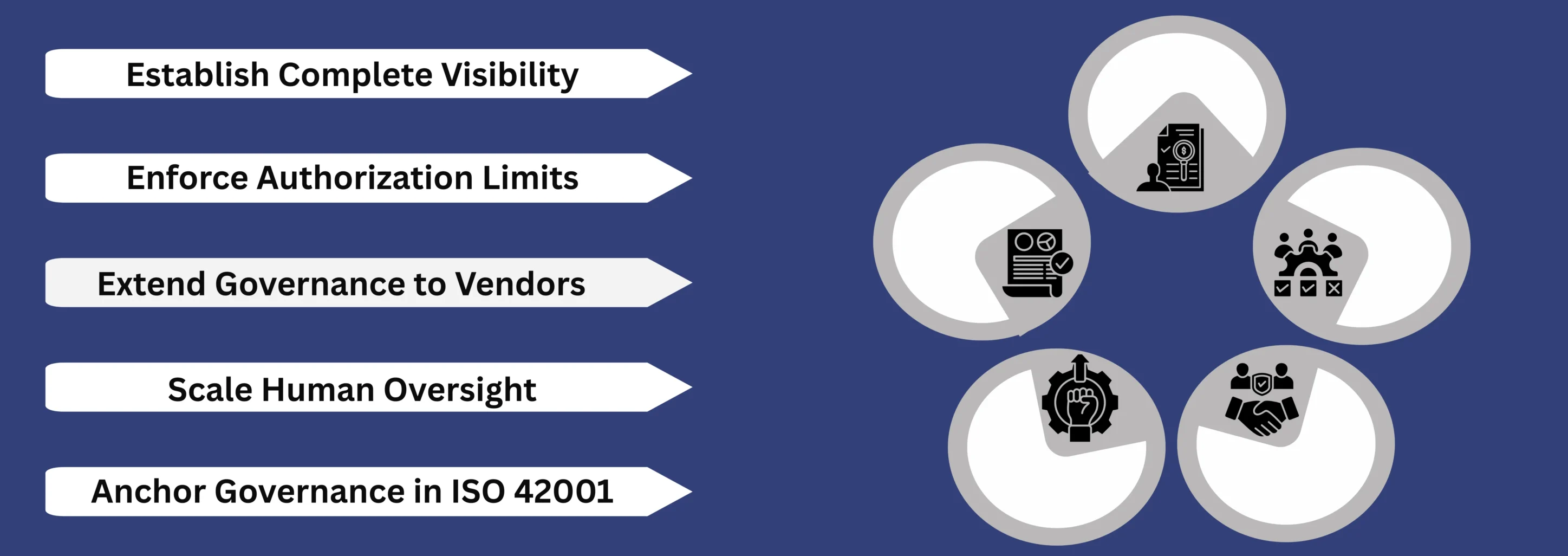
As autonomous systems become more common, organizations need governance models that can keep pace with their capabilities. The following best practices for agentic AI governance help organizations build control, accountability, and visibility into AI-driven operations.
-
Establish Complete Visibility
Effective Agentic AI governance starts with visibility. Organizations should maintain an up-to-date inventory of every AI agent in use, including its purpose, access permissions, data scope, and risk level. This inventory should also include third-party applications that contain embedded agent functionality. Without a complete inventory, governance decisions are built on incomplete information.
-
Enforce Authorization Limits
Every AI agent should have clearly documented authority limits before it enters production. Organizations should define which systems an agent can access, what data it can use, and which actions require additional approval. Establishing these boundaries early helps prevent uncontrolled autonomy and reduces operational risk.
-
Extend Governance to Vendors
Many SaaS platforms now include autonomous AI features. As a result, AI agents governance should apply to both internal systems and third-party services. Vendor assessments should evaluate how AI capabilities access data, make decisions, and interact with business processes.
-
Scale Human Oversight
Not every agent action requires human review. Instead, organizations should reserve approval requirements for high-impact, irreversible, or sensitive decisions. This approach allows automation to deliver value while maintaining appropriate governance controls.
-
Anchor Governance in ISO 42001
Organizations seeking a structured approach to Agentic AI governance should consider ISO/IEC 42001. The standard provides a formal framework for accountability, risk management, oversight, and continual improvement. It also offers a credible path for demonstrating governance maturity to regulators, customers, and stakeholders as expectations around Agentic AI security continue to evolve.
How ISO 42001 Supports Agentic AI Governance
As organizations deploy more autonomous systems, many are discovering that policies alone are not enough. Effective Agentic AI governance requires a structured management system that defines accountability, oversight, risk management, and continuous monitoring. This is where ISO/IEC 42001:2023 plays an important role.
ISO 42001 is the first international standard for Artificial Intelligence Management Systems (AIMS). It provides a formal framework for governing AI throughout its lifecycle, helping organizations move beyond ad hoc controls and fragmented AI policies.
For organizations deploying AI agents, the standard requires a documented inventory of AI systems, including each agent's purpose, capabilities, data access permissions, and risk classification. It also requires impact assessments before deployment and human oversight mechanisms that match the system's level of autonomy and risk.
More importantly, ISO 42001 helps address one of the biggest challenges in Agentic AI governance: accountability. The standard requires organizations to assign governance responsibilities, document risk ownership, and maintain ongoing evidence that AI systems operate within approved boundaries. These controls help transform governance from a policy exercise into a measurable and auditable process.
ISO 42001 also aligns closely with emerging regulatory expectations. Requirements within the standard map to many of the governance concepts found in the EU AI Act, including risk management, technical documentation, human oversight, and performance monitoring. As regulatory scrutiny increases, organizations that build an AIMS today are often better positioned for future compliance obligations.
When combined with ISO 27001, ISO 42001 creates a stronger foundation for both Agentic AI governance and Agentic AI security. Together, these frameworks help organizations manage security risks, governance failures, accountability gaps, and autonomous decision-making risks through a unified management system rather than isolated control programs.
Conclusion
Agentic AI governance is no longer a future consideration. It is becoming a core operational requirement for organizations deploying autonomous systems across business-critical environments. As AI agents gain the ability to make decisions, access systems, and execute actions independently, governance frameworks must evolve beyond traditional AI oversight models.
The challenge is not simply managing AI outputs. It is governing AI actions. Organizations need clear authorization boundaries, risk-based human oversight, continuous monitoring, and accountability mechanisms that can operate at the speed of autonomous systems. Without these controls, the gap between AI capability and governance maturity will continue to widen.
ISO/IEC 42001:2023 provides one of the most comprehensive frameworks currently available for building this governance foundation. By establishing an Artificial Intelligence Management System (AIMS), organizations can create a structured approach to risk management, oversight, accountability, and continual improvement that aligns with emerging regulatory expectations and industry best practices for agentic AI governance.
At CertPro, we conduct independent ISO 42001 assessments for organizations developing, deploying, and operating AI systems. As a licensed CPA firm enrolled in the AICPA Peer Review Program, we evaluate AI Management Systems against ISO/IEC 42001:2023 requirements using an evidence-based audit methodology. Our assessments focus on whether governance controls operate effectively in practice, generate defensible evidence, and provide the accountability that regulators, enterprise customers, and stakeholders increasingly expect from organizations using autonomous AI.