
An ISO 27001 certificate is valid for three years. The risks it addresses change daily. That gap sits at the center of a shift now underway in how organizations manage their Information Security Management Systems.
For years, many organizations treated ISO 27001 as an annual event. Evidence was assembled in the weeks before the surveillance audit. Controls were reviewed under deadline pressure. Gaps discovered late were patched quickly and documented hastily. ISO 27001 continuous compliance replaces that cycle with a different operating model: controls that are monitored throughout the year, evidence that accumulates as a byproduct of normal operations, and an ISMS that is always in an auditable state.
The shift is not optional posturing. The standard itself is built around continual improvement. Clause 9 requires ongoing monitoring, measurement, and evaluation of ISMS performance. Clause 10 requires corrective action and improvement as a permanent discipline. An organization that engages with its ISMS only before audits is working against the design of the standard it is certified to.
This guide explains what ISO 27001 continuous compliance means in practice, why the market is moving toward it, how automation supports it, and what organizations should do to move from audit-driven compliance to an always-ready posture.

Concern
Organizations that treat ISO 27001 as an annual project face predictable problems: evidence gaps discovered under audit pressure, control failures that persist undetected for months, and surveillance audit findings that could have been prevented. Certificates based on the 2013 edition expired after October 2025, and auditors now scrutinize whether controls operate continuously, not just whether they existed on audit day. ISO 27001 continuous compliance addresses the growing distance between point-in-time certification and real operational security.
Overview
ISO 27001 continuous compliance means maintaining the ISMS in an audit-ready state throughout the certification cycle. It combines continuous compliance monitoring of control performance, automated evidence collection from operational systems, scheduled internal audits, and management reviews that respond to real signals rather than calendar dates. The approach aligns directly with Clause 9 performance evaluation and Clause 10 continual improvement requirements.
Solution
Organizations should map each Annex A control to a monitoring method, automate evidence collection where systems allow it, define alert thresholds for control drift, and run internal audits on a rolling schedule rather than an annual scramble. Maintaining compliance this way reduces surveillance audit findings, shortens audit timelines, lowers the internal cost of certification, and gives leadership genuine visibility into security posture between audits.
What Is Continuous Compliance Monitoring
What is continuous compliance monitoring? It is the ongoing, largely automated evaluation of whether security controls are operating as intended, measured against the requirements of a framework such as ISO 27001. Instead of checking controls quarterly or annually, monitoring runs constantly. Configuration drift, missed access reviews, expired training records, and unpatched systems surface as they occur, not months later during audit preparation.
In an ISO 27001 continuous compliance model, monitoring covers three layers. Technical controls are checked through automated integrations with cloud platforms, identity systems, and endpoint tools. Process controls, such as access reviews and incident response drills, are tracked against defined schedules with automated reminders and escalations. Governance activities, including management reviews and internal audits, follow a documented cadence with evidence captured at each step.
The distinction from traditional compliance management is operational, not cosmetic. A traditional program answers the question: were we compliant on the day the auditor checked? ISO 27001 continuous compliance answers a harder question: are we compliant right now, and can we prove it without preparation? For enterprise buyers and regulators, the second answer carries considerably more weight.
Point-in-Time Audits and Their Blind Spot
A surveillance audit examines a sample of evidence from a defined period. It cannot observe what happens between audits. A firewall rule changed without approval in March may be invisible to an audit conducted in November. Controls that fail silently between audits are precisely the failures that extend detection times.
Why ISO 27001 Continuous Compliance Matters Now
Three forces are pushing organizations toward ISO 27001 continuous compliance, and each has intensified over the past two years.
Auditor Expectations Have Changed
The transition to ISO 27001:2022 concluded in October 2025, and certificates based on the 2013 edition are no longer valid. With the transition complete, certification body attention has shifted from structural conformity to operational effectiveness. Auditors increasingly test whether controls operated across the full period, request system-generated evidence rather than manually compiled records, and treat reconstructed documentation with professional skepticism.
Buyer Scrutiny Demands More Than Certification
Enterprise procurement teams now treat an ISO 27001 certificate as a starting point rather than a conclusion. Security questionnaires ask about vulnerability management cadence, third-party oversight, incident metrics, and how evidence is maintained between audits. A vendor that can demonstrate continuous control operation answers these questions from live records. A vendor that cannot must rely on assurances that sophisticated buyers discount.
The Cost-Effective Method
Audit-driven compliance concentrates cost into intense preparation periods, pulls engineering and security teams away from their work, and still produces findings. ISO 27001 continuous compliance distributes the effort across the year in small, manageable increments. Teams that operate this way typically spend a few hours per week maintaining their ISMS and move through surveillance audits without disruption. The upfront investment in monitoring infrastructure is recovered through reduced audit preparation, fewer findings, and lower remediation costs.
How to Automate ISO 27001 Continuous Compliance
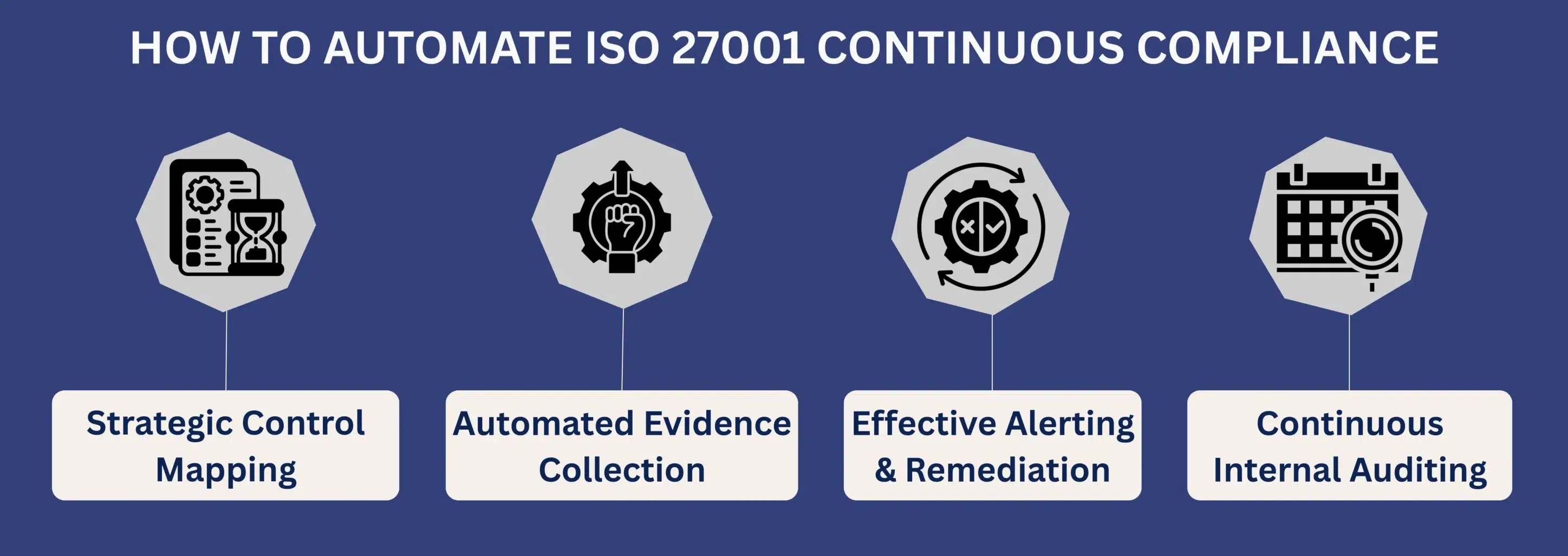
Understanding how to automate ISO 27001 continuous compliance starts with a simple principle: evidence should be generated by systems doing their normal work, not assembled by people preparing for an audit. The following steps reflect how mature organizations build that capability.
-
Strategic Control Mapping
Begin with the Statement of Applicability. For each applicable Annex A control, define how its operation will be verified and at what frequency. Technical controls such as encryption, logging, and access restrictions can usually be verified through automated checks. Process controls such as background screening or supplier reviews require scheduled workflows with documented completion. This mapping exercise also reveals controls that currently have no monitoring at all, which are the ones most likely to fail silently.
-
Automated Evidence Collection
Connect monitoring tooling directly to the systems where controls operate: cloud infrastructure, identity providers, endpoint management, ticketing, and HR platforms. Automated evidence collection through API integrations is timestamped, system-generated, and immutable, which is exactly the profile auditors trust most. This is the core mechanism of ISO 27001 continuous compliance: the evidence base builds itself continuously, and audit preparation becomes a review exercise rather than a collection project.
-
Effective Alerting and Remediation
Monitoring without response is observation, not governance. Configure alerts for control drift, and route them into the tools teams already use for daily work. An access review that misses its deadline should generate a task, an owner, and an escalation path. A misconfigured storage bucket should trigger an immediate notification with a defined remediation timeline. Each resolved alert becomes documented evidence of Clause 10 corrective action operating in practice.
-
Continuous Internal Auditing
Automation does not replace internal audits; it changes their character. Instead of one exhaustive annual exercise, distribute internal audit coverage across the year, focusing each cycle on a subset of controls or a specific risk area. Rolling audits surface issues while they are small, keep audit skills active within the team, and produce a continuous record of Clause 9 performance evaluation that surveillance auditors consistently regard as a marker of ISMS maturity.
Who Needs ISO 27001 Certification and Continuous Compliance
Who needs ISO 27001 certification? Formally, the standard is voluntary. Practically, certification has become a condition of doing business for organizations that handle sensitive data or sell into enterprise and regulated markets. Contractual obligations, vendor risk requirements, and data protection regulations frequently make it a de facto requirement.
The organizations with the strongest need include:
- SaaS and Technology Companies: Enterprise procurement teams routinely filter vendors by certification status before evaluation begins. Certification shortens security questionnaires and accelerates sales cycles.
- Healthcare Organizations: ISO 27001 complements HIPAA obligations and provides internationally recognized assurance for organizations operating across borders.
- Financial Services and Fintech: Banks, payment processors, and fintech companies face concentrated cyber risk and regulatory scrutiny that certification helps address systematically.
- Managed Service Providers and Telecom: Organizations that operate infrastructure or transport data for others carry their customers' risk and are expected to demonstrate governance over it.
- Companies Entering Global Markets: SOC 2 dominates North American buyer expectations, while ISO 27001 is the recognized standard internationally. Organizations selling globally frequently need both.
For each of these groups, the question is shifting from whether to certify to how the certification is maintained. A certificate backed by ISO 27001 continuous compliance gives buyers confidence that controls operate every day, not only during audit windows. That difference increasingly determines which vendors clear enterprise due diligence without friction.
Maintaining Compliance Across the Certification Cycle
Maintaining compliance under ISO 27001 follows a defined external rhythm: surveillance audits in years one and two, and a full recertification audit in year three. Organizations that fail to address nonconformities between these audits risk suspension or withdrawal of their certificate. ISO 27001 continuous compliance turns this external rhythm into an internal operating discipline, so each audit confirms a state that already exists rather than testing one assembled for the occasion.
The practices that sustain this discipline are consistent across mature programs:
- Keep the risk assessment current. Review it after significant changes to systems, suppliers, or operations, not only at the annual checkpoint. An outdated risk register undermines every control decision built on it.
- Update the Statement of Applicability when the business changes. New products, new infrastructure, and new data flows change which controls apply and how. The SOA version must always reflect the current environment.
- Track corrective actions to closure. Auditors examine whether findings from previous audits and internal reviews were resolved. Open items with no progress are among the most common causes of escalated findings.
- Maintain training and awareness continuously. Security awareness is a control with a decay rate. Scheduled refreshers, onboarding coverage, and role-specific training keep the people layer of the ISMS operational.
- Document management reviews with substance. Reviews should respond to monitoring data, incident trends, and audit results. A review that produces the same minutes every quarter signals a governance process running on paper only.
Maintaining compliance this way changes the experience of the three-year cycle. Surveillance audits become shorter and calmer. Recertification becomes a confirmation rather than a rebuild. And the ISMS delivers what it was designed to deliver: sustained protection, not periodic proof. That is the practical meaning of ISO 27001 continuous compliance.
Conclusion
ISO 27001 continuous compliance reflects how an ISMS is intended to operate. Clause 9 requires ongoing performance evaluation, while Clause 10 requires continual improvement. Surveillance and recertification audits also assume that controls operate consistently between audit periods. Organizations that adopt continuous monitoring, automated evidence collection, and rolling internal audits are better positioned to demonstrate ongoing conformity with ISO/IEC 27001:2022 requirements.
The business value extends beyond certification. Continuous compliance helps reduce audit preparation effort, supports more efficient surveillance audits, strengthens responses to customer due diligence, and provides greater visibility into the effectiveness of security controls.
At CertPro, we conduct independent ISO 27001 certification audits in accordance with ISO/IEC 27001:2022 and ISO 19011 guidelines. During Stage 2, surveillance, and recertification audits, our auditors evaluate objective evidence to determine whether controls have operated effectively throughout the audit period. Certification is issued by an IAF-accredited certification body upon successful completion of the audit.