
The certificate arrives, the team celebrates, and a quiet question follows: what happens now, and what should the ISO 27001 surveillance audit checklist for next year contain? ISO 27001 certification is valid for three years, but the certification body does not disappear for that period. It returns every year, and what it examines is different from what it examined the first time.
That difference is why a dedicated ISO 27001 surveillance audit checklist matters. Surveillance audits are narrower than the initial certification audit, but the bar for operating effectively does not drop. Auditors arrive with specific expectations: an internal audit completed, a management review held, prior findings closed, and evidence that accumulated across the year rather than in the weeks before the visit.
This guide explains what changes after initial certification and provides a practical ISO 27001 surveillance audit checklist organized around what certification bodies actually verify, so the annual visit confirms normal operations instead of interrupting them.

Concern
Organizations often prepare for surveillance audits the way they prepared for certification, or worse, barely prepare at all. Both approaches fail. Surveillance is targeted rather than comprehensive: auditors concentrate on mandatory governance clauses, previously raised findings, changed areas of the business, and a rotating sample of Annex A controls. Teams without an ISO 27001 surveillance audit checklist routinely miss the four items auditors always verify, and unresolved minors from the previous audit escalate to majors.
Overview
Surveillance audits occur annually in years one and two of the three-year certificate cycle, with recertification in year three. Every surveillance visit verifies four core items: a completed internal audit, a documented management review with leadership sign-off, closed corrective actions from the previous audit, and an updated risk assessment. Around this core, auditors sample different Annex A control areas each year to build full coverage across the cycle and examine any significant changes to scope, systems, or suppliers.
Solution
Work from an ISO 27001 surveillance audit checklist structured in three parts: mandatory governance evidence, operational control records, and change documentation. Complete the internal audit and management review well before the visit, maintain dated evidence throughout the year through ISO 27001 continuous monitoring, and track every prior finding to verified closure. Organizations that run this cycle treat surveillance as a short confirmation, not an annual crisis.
What Is a Surveillance Audit?
What is surveillance audit activity in the ISO world? The question comes up in every first-certification cycle, and the answer is precise. A surveillance audit is a mandatory annual assessment conducted by the certification body during the three-year validity of an ISO 27001 certificate. It verifies that the Information Security Management System continues to operate effectively after certification, that required governance activities are running, and that the organization has addressed findings from previous audits.
The three-year cycle follows a fixed rhythm. Initial certification involves a Stage 1 documentation review and a Stage 2 implementation assessment. Surveillance audits follow roughly twelve and twenty-four months after certification. Before the certificate expires, a recertification audit, similar in rigor to Stage 2, resets the cycle for another three years. Surveillance visits are shorter and narrower, with duration governed by the certification body's procedures and the International Accreditation Forum's mandatory audit time requirements.
What Is the Primary Focus of ISO 27001 Surveillance Audits?
The primary purpose of ISO 27001 surveillance audit visits is to confirm that the certified management system has not degraded since the last assessment. Auditors are not re-certifying the organization. They are testing whether controls still operate, risks are still managed, leadership remains engaged, and the continual improvement cycle required by Clause 10 is genuinely running. A well-built ISO 27001 surveillance audit checklist mirrors exactly these priorities.
What Changes After Initial Certification?
The difference between a certification audit and a surveillance audit comes down to scope and focus. Stage 2 examined everything: all mandatory clauses, every in-scope Annex A control, the complete documentation set, and implementation evidence for each declared control. Surveillance samples. The auditor selects a subset of controls each year, rotating areas so the full control set is covered across the three-year cycle.
Three areas receive guaranteed attention at every surveillance visit. First, the mandatory governance clauses that anchor every ISO 27001 surveillance audit checklist: internal audit, management review, corrective action, and risk assessment currency. Second, anything that changed since the last audit: new systems, new locations, acquisitions, major suppliers, or scope adjustments. Third, the status of every finding raised previously. An unresolved minor from last year is routinely upgraded to a major this year.
The preparation posture changes accordingly. Certification preparation was a build project. Surveillance preparation is an operating discipline, and the ISO 27001 surveillance audit checklist below reflects that shift: less proving that the system exists, more proving that it ran all year.
The ISO 27001 Surveillance Audit Checklist
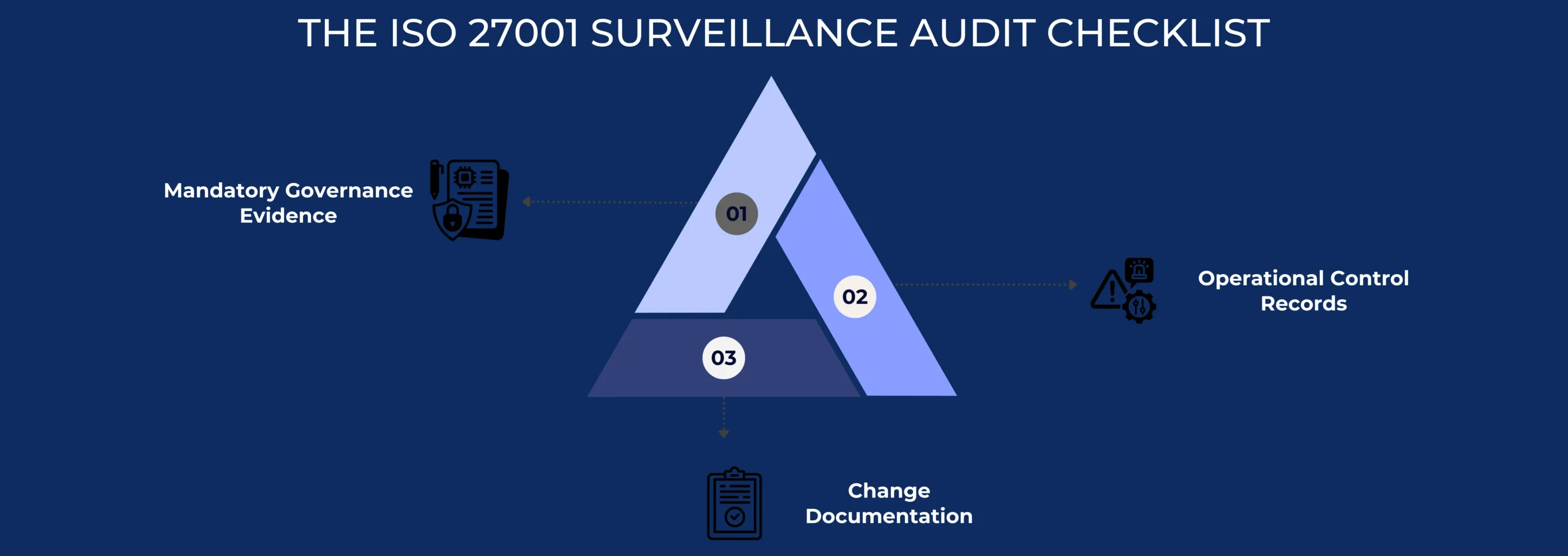
This ISO 27001 surveillance audit checklist is organized into the three groups auditors work through: mandatory governance evidence, operational control records, and change documentation. Every item should produce a dated record, because evidence spread across the year is what distinguishes a running system from one assembled for the visit.
Mandatory Governance Evidence:
- Internal audit completed since the last external visit, covering its planned share of the ISMS scope, with documented findings and independence from the areas audited
- Management review held with senior leadership, minuted with decisions, resource commitments, and sign-off, and covering all inputs required by Clause 9.3
- Corrective actions from the previous audit closed with root cause analysis and verification evidence, not just marked complete
- Risk assessment reviewed and updated, with treatment decisions reflected in the current Statement of Applicability version
Operational Control Records:
- Access reviews completed on schedule, with leaver and mover accounts deprovisioned on time
- Security awareness training records current for all staff, including joiners since the last audit
- Incident register maintained, with response records and lessons learned for sampled events
- Vulnerability management evidence showing scans, prioritization, and remediation within defined timelines
- Supplier reviews completed for critical vendors, with certificates and contracts current
- Backup and restoration tests performed and documented at the stated frequency
Change Documentation:
- Scope statement reviewed against current operations, locations, and services
- New systems, cloud services, and major suppliers risk-assessed before deployment
- Organizational changes such as restructures or acquisitions reflected in the ISMS documentation
- Policy set reviewed and version-controlled, with approvals recorded
The governance group deserves the most attention, because it is where surveillance findings concentrate. Auditors also verify that the mandatory documents for ISO 27001 remain current and approved. An ISO 27001 surveillance audit checklist that tracks document review dates alongside operational evidence closes the most common gap: paperwork that quietly aged out of accuracy while operations moved on.
Sequencing matters as much as completeness. The ISO 27001 internal audit should conclude far enough before the external visit that findings can be closed or show credible progress, and its results must appear in the management review inputs. Auditors read this sequence as evidence that governance runs on its own schedule rather than the certification body's.
ISO 27001 Continuous Monitoring: Staying Ready Between Audits
ISO 27001 continuous monitoring is the practice of tracking control performance and collecting evidence throughout the year rather than reconstructing it before each audit. Clause 9.1 requires organizations to determine what to monitor, how, and when, and surveillance auditors increasingly test whether monitoring genuinely operates by checking the dates on the evidence they sample.
Monitoring transforms how the ISO 27001 surveillance audit checklist gets completed. Access review exports, training completions, scan reports, and incident records accumulate automatically in the systems where the work happens, and the ISO 27001 surveillance audit checklist simply confirms their presence. The checklist then becomes a quarterly verification exercise, confirming records exist and gaps are closed, instead of an annual collection project.
A quarterly rhythm works well in practice: one quarter of internal audit coverage, a risk register review, a policy review batch, and a rotation of technical control checks. This is the operating model behind continuous compliance auditing, and organizations that adopt it consistently report shorter surveillance visits with fewer findings, because every sampled record carries a date from the middle of the year rather than the month before the audit.
Using ISO 27001 Surveillance Audit Checklist to Prevent Common Findings
Surveillance findings follow a predictable pattern, and each maps directly to an item on the ISO 27001 surveillance audit checklist above. The most frequent are a missing or late internal audit, management reviews without required inputs or leadership sign-off, prior corrective actions closed without root cause analysis, risk assessments untouched since certification, and access records that fall apart under leaver sampling.
Quarterly Reviews: A quarterly pass catches a lapsed access review in weeks rather than months, while the fix is still simple and the exposure window is short. It also produces the dated evidence trail that auditors treat as the strongest indicator of a living management system.
Clear Ownership: Governance items belong to the ISMS manager, operational records to the teams that generate them, and change documentation to whoever leads the change. Unowned items are the ones that surface as findings.
Audit Agenda: Certification bodies share their audit plan in advance. Mapping the plan against the completed ISO 27001 surveillance audit checklist shows exactly what will be sampled and confirms the evidence is ready, which shortens the visit and steadies the team walking into it.
It also helps to keep surveillance in context. Every ISO 27001 security audit in the cycle, from Stage 1 through recertification, tests the same underlying question with different depth: does the management system genuinely operate? For a complete walkthrough of the surveillance process itself, including costs and typical auditor questions, see our comprehensive ISO 27001 surveillance audit guide.
Conclusion
What changes after initial certification is the nature of the work. The implementation phase ends, and the ongoing operation of the Information Security Management System begins. Surveillance audits recognize organizations that consistently operate their ISMS and identify those that treat certification as a one-time milestone. An ISO 27001 surveillance audit checklist, reviewed regularly and assigned to accountable owners, provides a practical way to maintain audit readiness throughout the certification cycle.
The checklist also creates continuity. Evidence collected throughout the year supports internal audits, informs management reviews, and demonstrates continual improvement as required by ISO/IEC 27001. By the time recertification arrives in the third year, organizations that have consistently followed their ISO 27001 surveillance audit checklist typically have the documents, records, and evidence needed for a full-scope audit already in place.
At CertPro, we conduct independent ISO 27001 certification, surveillance, and recertification audits worldwide as a licensed CPA firm. Our auditors evaluate objective evidence, review documents, records, and operational evidence across the audit period, classify nonconformities against ISO/IEC 27001 requirements, and verify corrective actions before findings are closed. Every audit engagement follows a structured, evidence-based methodology aligned with ISO/IEC 27001:2022 and ISO 19011, with certification decisions made by an IAF-accredited certification body.