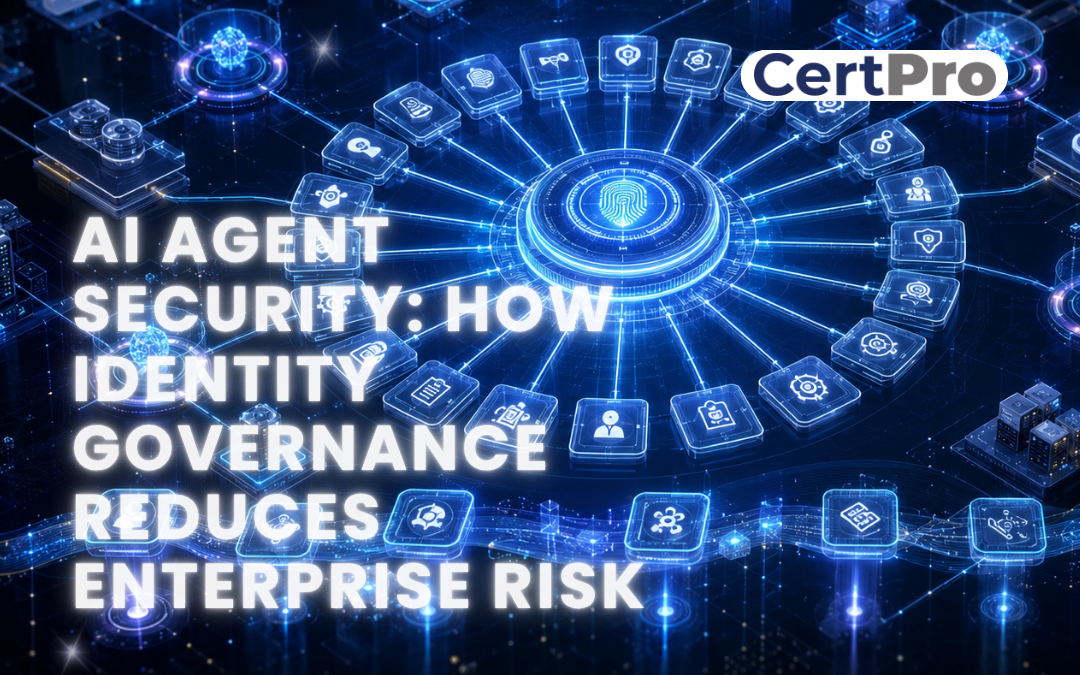
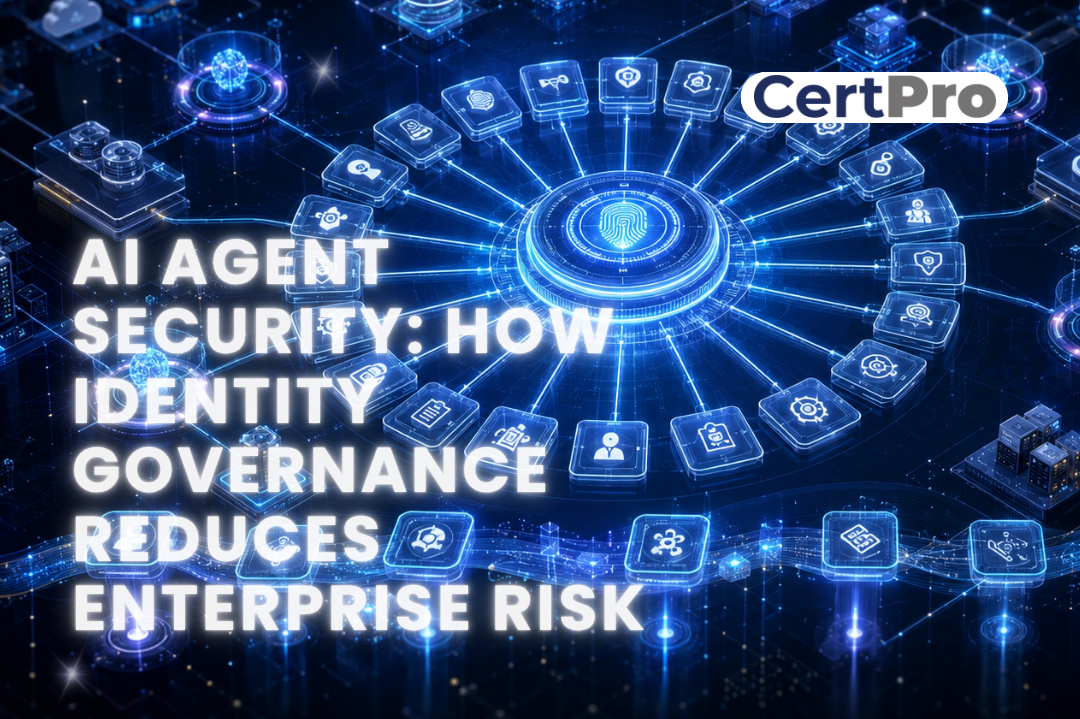

AI agent security has become one of the most important challenges in enterprise security, yet many organizations continue to treat AI agents as applications instead of identities. Every new AI agent introduced into the enterprise receives credentials, accesses business systems, retrieves data, and performs actions across digital environments. As organizations deploy more autonomous agents, the number of machine identities continues to grow alongside them.
Every AI agent operates through an identity. Whether it queries a database, invokes an API, accesses cloud resources, or initiates a workflow, it authenticates and acts using credentials. Without clear ownership, controlled permissions, lifecycle management, and continuous oversight, these identities can accumulate excessive access, remain active beyond their intended purpose, and create security blind spots that traditional identity governance processes were never designed to address.
AI agent security is therefore no longer limited to securing models or protecting prompts. It has become an identity governance challenge. Organizations that manage AI agents with the same discipline applied to human users, service accounts, and privileged identities are better positioned to maintain visibility, accountability, and control as autonomous systems become part of everyday business operations.
This guide explores why AI agent security begins with identity governance, where governance gaps commonly emerge, and the identity ownership, lifecycle, and access governance practices that help enterprises manage AI agents at scale.

Concern
AI agent security often breaks down at the identity layer before model security becomes relevant. Every AI agent operates through an identity to access systems, retrieve data, invoke APIs, and execute business workflows. Without ownership, controlled permissions, lifecycle management, and continuous oversight, AI agents can accumulate unnecessary access, create governance gaps, and perform unintended actions across the enterprise.
Overview
AI agent security begins with identity governance. Every AI agent should be treated as a governed enterprise identity with a designated owner, a defined lifecycle, least-privilege access, continuous monitoring, and complete audit logs. Applying these governance principles creates accountability and keeps autonomous systems operating within approved boundaries.
Solution
Extend existing identity governance practices to AI agents. Maintain a complete inventory of AI identities, assign accountable owners, provision access based on business need, review permissions regularly, retire identities that are no longer required, and require human approval for high-impact actions. Integrating these controls into an AI management system helps organizations build AI agent security that is measurable, repeatable, and supported by audit-ready evidence.
Why AI Agent Security Is Now an Identity Problem
AI agent security is the discipline of protecting enterprise systems from the risks created when autonomous AI agents hold credentials, access data, and take actions across live environments. Its center of gravity is identity. To elaborate, it deals with what each agent is allowed to do, who authorized it, how that authority is enforced at runtime, and how it is revoked when the agent's task or trustworthiness changes.
The reason identity dominates is structural. An agent is not an application waiting for input; it is an actor that acquires goals, selects tools, and executes. Compromise the identity layer, and every downstream defense inherits the failure. For instance, a poisoned agent with legitimate credentials could pass authentication, satisfy authorization, and generate activity that looks like normal operations. OWASP's Agentic Security Initiative classifies this pattern as identity and privilege abuse, one of the defining risks of agentic systems.
The challenge becomes even greater when AI agents inherit excessive permissions. An agent can only operate within the boundaries of the credentials assigned to it. If those credentials provide broader access than the task requires, the agent gains the same unnecessary privileges across systems, applications, and data. A simple workflow can quickly become a high-impact security risk when identities are granted unrestricted or persistent access. AI agent security must therefore begin with governing identities and permissions before focusing on the agent itself.
Non-Human Entities: The Governance Gap Agents Are Widening
Non-human identities are the credentials that software uses to access enterprise systems. They include service accounts, API keys, OAuth tokens, machine certificates, and the identities assigned to AI agents. Like human users, these identities authenticate, receive permissions, and perform actions across business environments.
However, many organizations still govern them differently. Human identities usually have defined owners, approval workflows, and lifecycle processes. In contrast, non-human identities often remain active without clear ownership, regular access reviews, or timely retirement. As the number of AI agents grows, these governance gaps become more difficult to manage.
AI agents introduce a new level of complexity because they operate with greater autonomy. Traditional machine identities perform predefined tasks. AI agents can interact with multiple systems, use different tools, retrieve information, and execute workflows based on their objectives. Their actions depend on the permissions attached to their identities.
Therefore, AI agent security cannot rely on traditional identity management alone. Organizations need identity governance that gives every AI agent a defined owner, appropriate access, continuous oversight, and a controlled lifecycle. These controls help maintain visibility, accountability, and security as AI agents become part of everyday business operations.
AI Identity Governance: The Core Controls
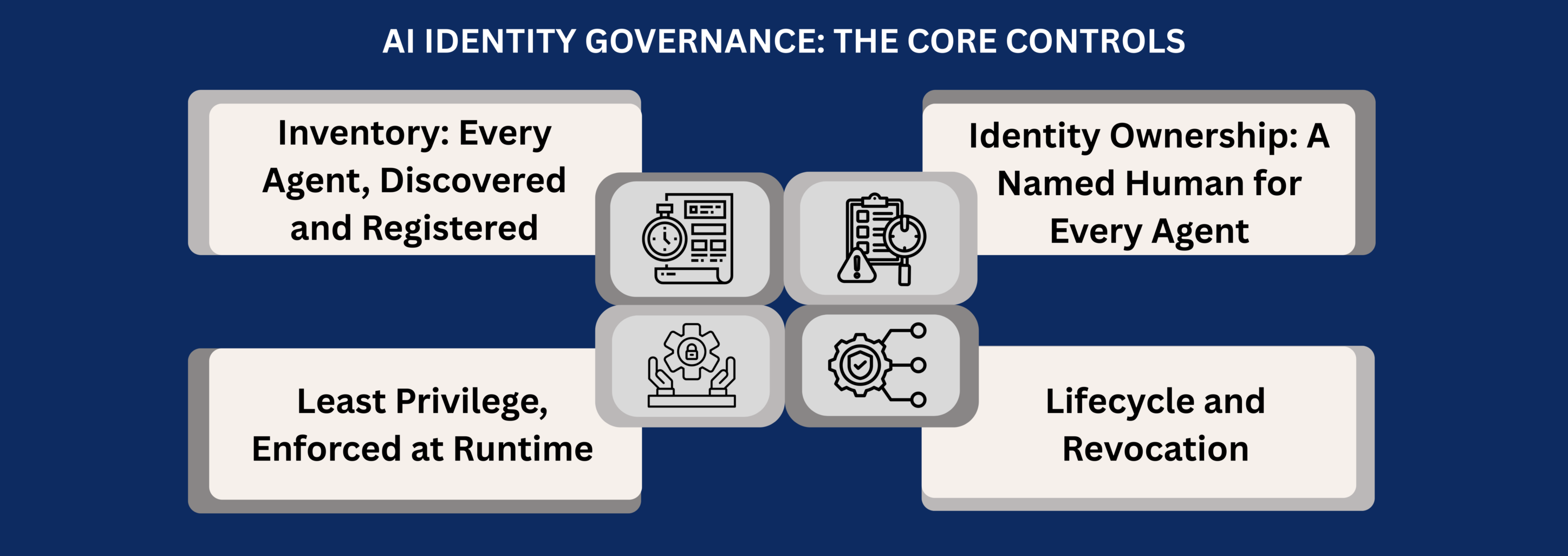
AI identity governance applies the discipline built for human identities to agents: every identity is inventoried, owned, scoped, reviewed, and eventually retired. The controls below form the working core.
Inventory: Every Agent, Discovered and Registered
AI agent security governance begins with knowing what exists. Every agent, including those activated inside SaaS platforms without formal review, belongs in a registry recording its purpose, model dependency, credential set, data access scope, and tool integrations.
Identity Ownership: A Named Human for Every Agent
Identity ownership is the control that makes every other control enforceable. Each agent needs a named, accountable human owner responsible for its access scope, its behavior, and the decision to retire it. Ownership converts AI agent security from a diffuse aspiration into a set of answerable questions: who approved this agent's permissions, who reviews them, and who gets paged when it misbehaves. Orphaned agents, like orphaned service accounts before them, are the accounts attackers find first.
Least Privilege, Enforced at Runtime
Agent credentials should be scoped to the task and the time window, not granted as standing broad access. Role-based access control extends naturally: define agent roles, bind permissions to roles, and review them on the same cadence as privileged human access. The same identity-first logic that drives zero trust security applies directly, since an agent is precisely the kind of actor that should never be trusted by network location or prior behavior alone.
Lifecycle and Revocation
Every AI agent should follow a defined identity lifecycle, from provisioning to retirement. Organizations should document every stage to maintain accountability and control. However, security gaps often appear during identity changes. An AI agent may retain unnecessary access, inherit outdated permissions, or remain active after its purpose ends. Therefore, AI agent security depends on timely credential revocation and complete audit logs. Revoking credentials immediately stops unauthorized access, while tamper-evident logs provide a reliable record of every action for investigations, compliance, and audit evidence.
Access Governance for AI Agents in Practice
Access governance answers a simple but important question: who or what has access to which resources, and should they? For AI agents, the answer requires more than assigning permissions. Organizations should continuously review access, define approval boundaries, and align governance with evolving identity standards.
- Continuous Reviews
Review AI agent access with the same discipline applied to privileged human accounts. Compare each agent's permissions with its approved business purpose. Remove unnecessary access as responsibilities change. Regular reviews help prevent permission creep and reduce unnecessary risk over time.
- Human Oversight
Some actions should always require human approval. Financial transactions, production changes, external communications, and access to sensitive data should follow clearly defined approval thresholds. These guardrails keep AI agents within approved operating boundaries and improve accountability for high-impact decisions.
- Standards Alignment
Build AI agent governance on established identity and access management principles. Use standardized authentication, authorization, and lifecycle processes across every AI agent. However, governance should extend beyond documented policies. Organizations should continuously monitor identities, validate permissions, and adapt controls as AI environments evolve.
AI Agent Governance Under ISO 42001
AI agent governance builds on identity controls by adding policies, accountability, and ongoing oversight. As organizations deploy more AI agents, these governance practices become essential for maintaining control at scale. ISO/IEC 42001 provides a structured framework for this approach. It requires organizations to maintain an AI inventory, assess risks before deployment, establish human oversight, and continuously monitor AI systems. These requirements are reflected throughout the ISO 42001 controls and clauses.
- Governance Alignment
The connection between identity governance and an AI management system is straightforward. An AI inventory supports the agent registry. Accountability requirements establish identity ownership. Human oversight defines approval thresholds, while monitoring requirements support audit logging. Together, these controls create a single governance process that also produces the evidence required during an ISO 42001 audit.
- Business Confidence
Enterprise customers increasingly expect organizations to demonstrate responsible AI governance. ISO 42001 certification is becoming that proof during security reviews and procurement assessments. At the same time, the same governance structure strengthens AI risk management in enterprise security by providing clear visibility, accountability, and audit-ready evidence for every AI agent.
Conclusion
The identity population has already inverted, and AI agents are accelerating the shift. Organizations reducing enterprise risk share a common approach: they treat every agent as an identity, every identity as accountable, and every permission as temporary. Built on that foundation, AI agent security scales because the same governance processes, inventory, ownership, access reviews, revocation, and logging remain effective whether an organization manages 50 agents or 50,000.
As AI adoption expands, governing agent identities becomes part of governing AI itself. Organizations that maintain clear ownership, documented controls, and verifiable audit evidence are better positioned to manage AI risks, demonstrate accountability, and support independent assessment. Identity governance is no longer just an IT discipline. It has become a foundational component of responsible AI governance.
At CertPro, we conduct ISO 42001 assessments worldwide as a licensed CPA firm. Our audits evaluate whether an organization's AI Management System (AIMS) conforms to the requirements of ISO/IEC 42001:2023 through objective evidence, including governance structures, accountability, documented controls, AI system inventories, risk and impact assessments, and operational records. Organizations that embed AI agent governance within their broader AIMS are better prepared to demonstrate conformity during the certification process.