
A SOC 2 report can contain exceptions and still provide useful assurance. The key is understanding what each finding says about the vendor's controls.
SOC 2 exceptions are deviations identified during control testing. They show that a tested control did not operate as described for one or more instances. However, the number of exceptions alone does not tell a buyer whether a vendor presents unacceptable risk.
The better approach is to read SOC 2 exceptions in context. Look at the control, testing population, frequency, affected Trust Services Criterion, business impact, and management response. This gives procurement and security teams a more reliable basis for vendor decisions.

Concern
SOC 2 exceptions can make vendor reports harder to evaluate. Buyers need to understand what each finding means for their specific risk.
Overview
SOC 2 exceptions show where tested controls deviated from their expected operation. Their significance depends on the control, testing results, frequency, affected criterion, and business impact.
Solution
Evaluate each exception in context instead of counting findings. Review the scope, auditor's opinion, testing results, management response, and relevance to your vendor risk.
What Are SOC 2 Exceptions?
SOC 2 exceptions are specific deviations identified when an independent practitioner tests controls against the applicable Trust Services Criteria. In simple terms, the auditor expected a control to operate in a certain way and found an instance where the evidence did not support that conclusion.
These audit exceptions appear in the report's description of tests and results. The report can identify the criterion, control, population, sample, testing procedure, and deviations found. The exact presentation varies by report.
For example, suppose a vendor reviews privileged user access every quarter. The auditor tests the required reviews and finds one review completed late. That finding becomes one of the SOC 2 audit exceptions considered in the report.
The finding does not automatically mean the vendor failed its examination. SOC 2 reports provide an auditor's opinion based on the engagement and evidence examined, so SOC 2 exceptions need context. Buyers should therefore read the exception alongside the opinion and the system description.
This also answers the common question: "What are audit exceptions?" They are evidence of a control deviation found through testing. Their significance depends on context.
Where Do SOC 2 Exceptions Appear in a Report?
A buyer should start with the auditor's opinion, then move to the system description and the relevant testing results. This sequence shows what the report covers before you interpret individual findings.
SOC 2 audit exceptions generally appear with the results of the auditor's tests of controls. The report may show the control or criterion tested, the nature of the test, the population or sample information, and the exceptions identified.
The report period also matters. A Type 1 report evaluates the suitability of control design at a specified date. A Type 2 report evaluates both control design and operating effectiveness over a specified period. Therefore, SOC 2 Type 2 exceptions can provide evidence about how a control performed during the examination period.
Buyers should also check whether the exception relates to a control that matters to their relationship with the vendor. An exception involving access to customer data deserves closer attention than a minor process lapse with limited relevance to the service being purchased.
The report's management response can add useful context. It may describe the cause of the exception and actions management took or plans to take. Treat that response as management's explanation while keeping the auditor's testing results separate.
How Should Buyers Evaluate SOC 2 Exceptions?
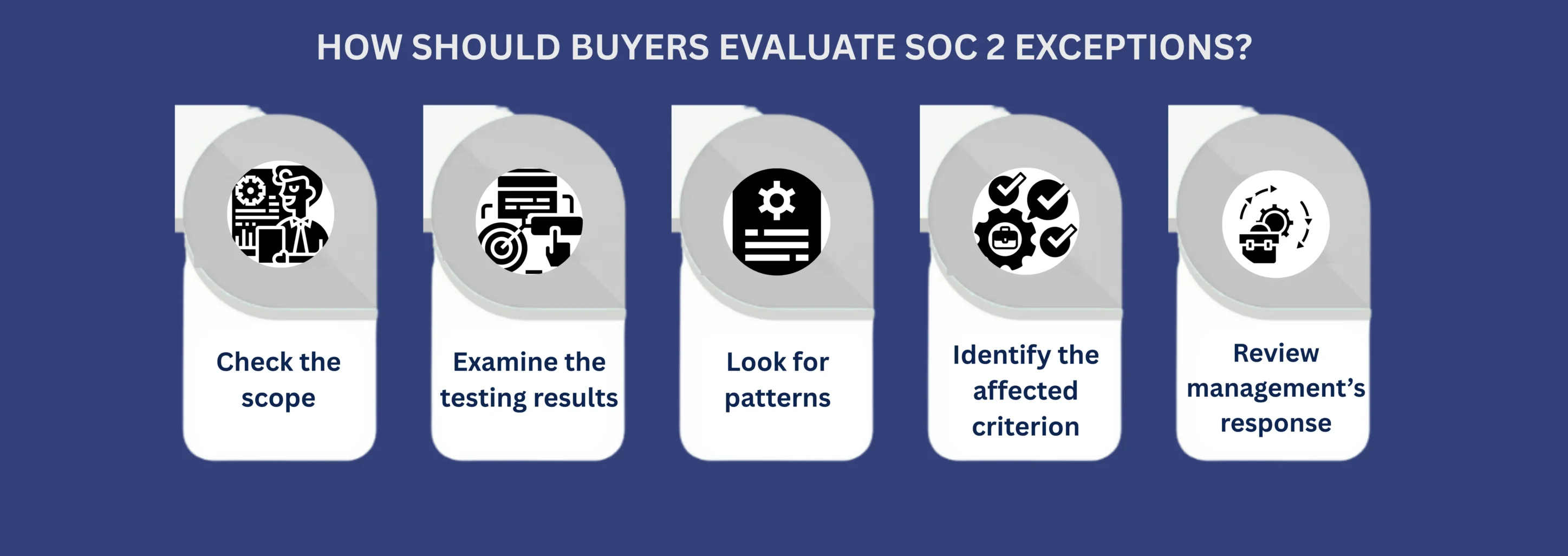
To assess the significance of a SOC 2 exception, buyers should review several factors together rather than focus on the finding alone.
- Check the scope
Confirm that the report covers the legal entity, services, systems, locations, and subservice organizations relevant to your relationship. A finding outside your exposure may have limited relevance, while a small finding inside a critical system may deserve closer review.
- Examine the testing results
Review the population, sample, and testing results associated with the finding. One exception among a large population can present a different picture from repeated failures in a small population. Avoid fixed percentage thresholds because the significance of a rate depends on the control and testing context.
- Look for patterns
Determine whether the finding appears isolated or recurring. A single late access review may represent an isolated lapse. Similar failures across several periods may point to a recurring process issue. Consider the frequency, timing, and nature of the failures together.
- Identify the affected criterion
Determine which Trust Services Criterion and control the exception affects, then connect the finding to your risk exposure. For example, an exception involving logical access may deserve closer attention when the vendor can access sensitive customer information.
- Review management's response
Look for a clear explanation of the issue, actions taken, and relevant dates. If the vendor provides evidence of subsequent action, consider whether that evidence comes from an appropriate assurance procedure or simply reflects management's own follow-up.
Do SOC 2 Exceptions Mean a Vendor Failed?
A SOC 2 audit exception does not automatically mean the vendor failed its examination. An auditor evaluates the findings in the context of the engagement and determines the effect on the report conclusion.
This is why buyers should avoid two common shortcuts. Treating every exception as a reason to reject a vendor can overlook minor, isolated lapses. Treating an unqualified opinion as proof that every control worked perfectly can miss important risk signals.
Consider a SaaS provider with one missed quarterly access review during a Type 2 period. Management identifies the cause, corrects the process, and provides evidence supporting the change. That SOC 2 exception may deserve monitoring, but it tells a different story from repeated failures involving privileged access.
The distinction becomes clearer when comparing SOC 2 Type 2 exceptions with the report's overall conclusion. Type 2 testing provides evidence about control operation during the stated period. The exception details help buyers understand where that operation fell short.
There is also no universal number of acceptable SOC 2 exceptions. Buyers should assess each finding against scope, population, pattern, criterion, impact, and management response. A consistent review method produces better decisions than a simple exception count.
A Practical Buyer Checklist
When reviewing a vendor report, use this sequence:
- Confirm the report period and scope
- Read the auditor's opinion before reviewing individual findings
- Identify each affected control and Trust Services Criterion
- Review the population, sample, and testing results where reported
- Check whether the finding appears isolated or recurring
- Consider how the control relates to your data and service dependency
- Read management's response and any stated remediation dates
- Ask for appropriate evidence when the issue affects a material risk
- Document your conclusion and the reason for your decision
For example, suppose a vendor reports one access review exception from a population of 200 reviews. The control relates to a system that stores customer data. The exception occurred once, management identified the cause, and later evidence shows the review process changed.
That case deserves attention, but the buyer has more context than a simple statement that the vendor had one exception. The same framework works when reviewing multiple audit exceptions.
The goal is interpretation, not counting. A buyer should be able to explain what happened, why it matters, how management responded, and whether the remaining risk fits the organization's vendor requirements.
Conclusion
SOC 2 exceptions give buyers useful evidence about how controls performed during an examination. They deserve attention, but they require context.
The strongest review starts with scope and the auditor's opinion. From there, examine each exception through population, pattern, affected criterion, business impact, and management response. This approach turns SOC 2 audit exceptions into useful vendor-risk information.
CertPro is a licensed CPA firm that conducts independent SOC 2 examinations for technology organizations. Its role is to examine controls and issue an independent attestation report based on the applicable engagement requirements. Management remains responsible for designing and operating its controls.