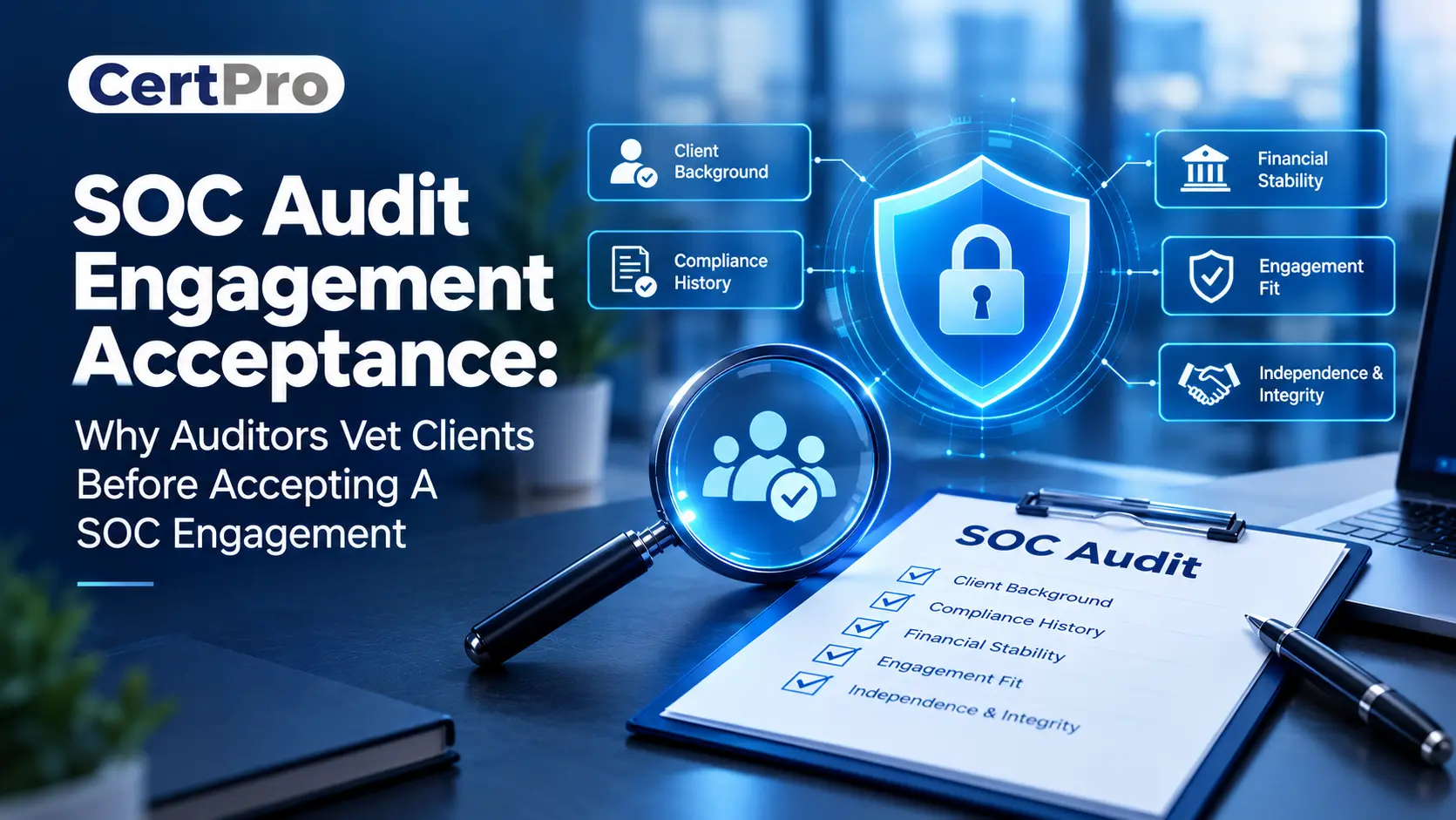

A licensed CPA firm decides whether to accept a SOC engagement before any control walkthrough or testing begins. Under AT-C sections 105 and 205, the firm evaluates whether the engagement can be performed in accordance with professional standards, whether independence can be maintained, and whether the subject matter is suitable for attestation. If those conditions cannot be met, the firm must decline.
Every SOC engagement begins before the first control walkthrough, before the evidence portal opens, and before a single test is performed. It begins with a decision that the auditor makes: whether to accept the engagement.
That decision is not an administrative formality. Under AICPA attestation standards codified in AT-C sections 105 and 205, a licensed CPA firm performing a SOC 2 engagement must evaluate whether the engagement can be conducted in accordance with professional standards, whether independence can be maintained, and whether the subject matter is suitable for attestation. If those conditions cannot be met, the firm must decline.
Most published content on SOC engagements skips this pre-acceptance phase entirely, jumping straight to scoping and testing. That gap leaves service organizations unprepared for the questions their auditor will ask, and uninformed about the reasons an engagement might be rejected or restructured before it starts.
This article explains what licensed CPA firms evaluate during SOC engagement acceptance, why each factor matters, and how the acceptance process ultimately protects the integrity of the report that relying parties will depend on.

Concern
Service organizations seeking a SOC 2 report often assume any licensed CPA firm will accept their engagement automatically. In practice, independent auditors perform a structured pre-acceptance evaluation, and a failed vetting can delay or prevent a report entirely.
Overview
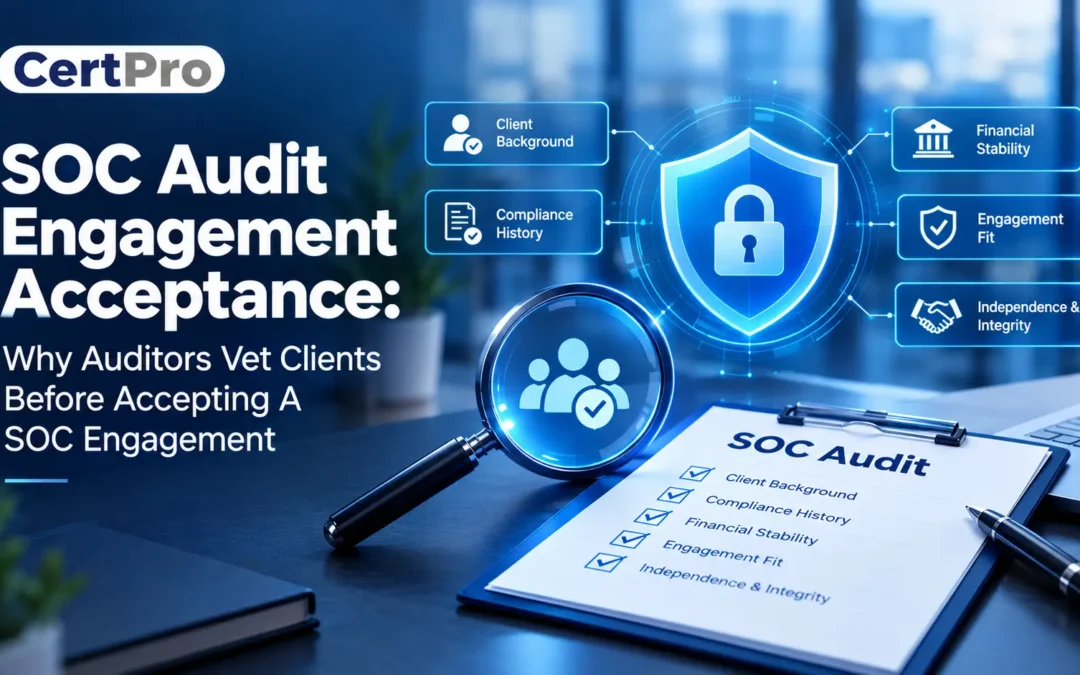
Under AICPA attestation standards (AT-C 105 and AT-C 205), a CPA firm must assess management integrity, scope feasibility, independence, subservice organization complexity, and prior audit findings before committing to a SOC engagement.
Solution
Understanding what auditors evaluate during acceptance helps service organizations present a well-defined system boundary, demonstrate management integrity, and enter the examination phase without preventable delays.
What Professional Standards Require Before a SOC Engagement Begins
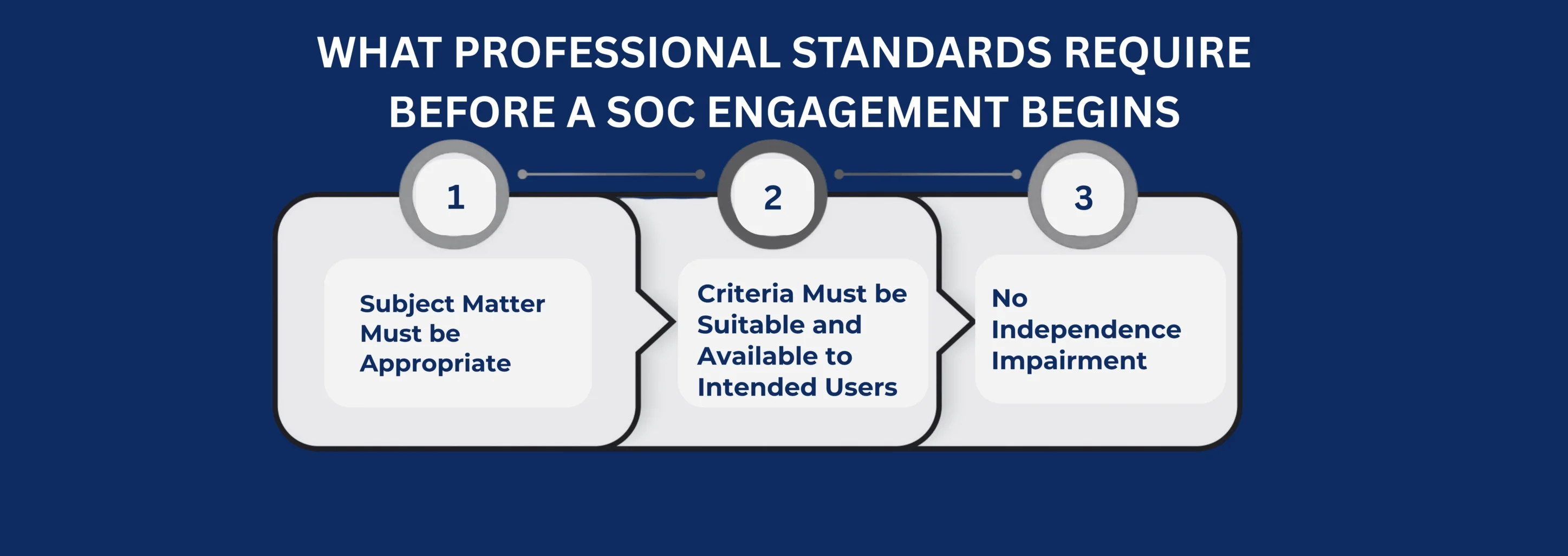
The AICPA's attestation framework, particularly AT-C section 105 (Concepts Common to All Attestation Engagements) and AT-C section 205 (Examination Engagements), places a clear obligation on the practitioner: before accepting any attestation engagement, the CPA firm must determine that the preconditions for the engagement exist (Source: AICPA, AT-C 105).
For a SOC engagement, those preconditions include certain non-negotiable elements.
- First, the subject matter must be appropriate. Meaning, the service organization's system and controls must be identifiable, measurable against the Trust Services Criteria, and capable of being examined through available evidence.
- Second, the criteria must be suitable and available to intended users; in a SOC 2 engagement, the AICPA's 2017 Trust Services Criteria fulfill this requirement when properly scoped.
- Third, the practitioner must have no independence impairment that would prevent issuing an opinion.
AT-C section 320, which governs SOC 1 reporting on controls at service organizations specifically, adds a further condition: the service auditor must obtain an understanding of the service organization's system sufficient to assess whether the scope, as described by management, can actually support an examination. A system description that is vague, internally inconsistent, or materially incomplete is itself a red flag at acceptance.
These standards exist because the SOC report's value flows directly from the independence and rigor of the firm that issues it. When an independent CPA firm accepts a SOC engagement, it is representing to all relying parties that the examination was conducted under professional standards. Accepting an engagement the firm cannot properly perform would undermine that representation entirely.
Risk Factors Auditors Evaluate During SOC Engagement Acceptance
In practice, engagement acceptance for a SOC engagement involves evaluating several categories of risk. Understanding these helps service organizations anticipate what an auditor may examine before signing an engagement letter. Some of the factors include:
-
Management integrity and cooperation
The auditor assesses whether management is likely to provide complete, accurate information and respond to inquiries in good faith. Indicators of concern include reluctance to define system boundaries, prior disputes with auditors, or significant unresolved regulatory findings.
-
Scope feasibility
The proposed system boundary must be specific enough to be auditable. Overly broad scope, such as including dozens of loosely related services under a single description, increases the risk that the examination cannot be completed with sufficient depth. Conversely, a scope so narrow that it excludes controls material to the Trust Services Criteria produces a report of limited value to user entities.
-
Independence and conflicts of interest
A CPA firm cannot perform a SOC 2 engagement for an organization where the firm has also designed, implemented, or operated the controls under examination. This independence requirement is a foundational principle; any prior or concurrent consulting relationship must be evaluated carefully (Source: AICPA, ET section 1.297).
-
Subservice organization complexity
When the service organization relies on third-party infrastructure providers, the auditor must determine at acceptance whether the carve-out or inclusive method is appropriate and feasible, and whether the subservice organizations present risks that could prevent an unqualified opinion.
-
Prior period findings and repeat exceptions
A history of qualified opinions, significant exceptions, or management's failure to remediate known control deficiencies signals elevated audit risk. The auditor may accept the engagement with modified procedures or, in some cases, decline until remediation is independently verified.
When Auditors Decline a SOC Engagement — and Why That Protects You
Declination is rare but consequential. A licensed CPA firm will decline a SOC engagement when one or more acceptance conditions cannot be satisfied and cannot be remediated through modified scope or procedures. Common triggers include an independence impairment that cannot be resolved, a system description so incomplete that no meaningful examination is possible, or evidence that management's assertions would be materially misleading.
From the service organization's perspective, a declination can feel like an obstacle. In professional-standards terms, it is the opposite: it is the assurance framework working as intended. A SOC 2 report issued under conditions that should have triggered declination carries no real credibility. Customers, prospective clients, and their own auditors rely on the assumption that the issuing firm independently verified it could perform the examination properly.
A declined engagement also signals to the service organization where its control environment or documentation needs attention before any audit, independent of which firm eventually conducts it.
How often are SOC 2 reports required varies by customer contract terms and industry expectations. Each renewal cycle is a new engagement and a new acceptance decision. It may not be considered a routine extension of the prior year's work.
Engagement Acceptance vs. Engagement Planning: A Critical Distinction
Engagement acceptance and engagement planning are sequential, not simultaneous. Acceptance must occur before planning can begin in earnest, because planning decisions about the nature, timing, and extent of testing are only meaningful once the auditor has confirmed the engagement should proceed.
Engagement planning covers the activities most commonly described in SOC guidance: defining system boundaries, selecting Trust Services Criteria, assessing risk and materiality, determining the subservice organization scoping method, and scheduling walkthroughs. All of that work presupposes an accepted engagement.
The practical implication for service organizations is timing. Organizations that approach an independent CPA firm expecting to move directly from introductory conversation to fieldwork often underestimate the time the acceptance phase requires. For a first-time SOC 2 engagement, acceptance may involve reviewing prior certifications, understanding the technology stack, confirming the system description concept, and resolving any independence questions. The process may take several weeks.
Distinguishing these phases also clarifies roles. During acceptance, the auditor is evaluating whether the engagement is appropriate to take on. During planning, the auditor is structuring how the examination will be conducted. Service organizations that conflate the two sometimes provide extensive control documentation during the acceptance phase when what the auditor actually needs at that stage is a clear system description and a frank discussion about scope.
A well-structured SOC engagement depends on this sequential discipline being observed by both parties from the outset.
Conclusion
The SOC engagement acceptance process is the professional foundation on which every credible SOC report rests. Independent CPA firms evaluate management integrity, scope feasibility, independence, subservice organization complexity, and prior findings before committing to an examination, as a requirement under AICPA attestation standards.
For a SOC 2 engagement specifically, the acceptance decision repeats annually, because each period's report requires a fresh independent examination. The frequency with which SOC 2 audits are done means this is not a one-time exercise but a recurring professional evaluation.
As an independent audit and attestation provider, CertPro performs SOC 2 engagements under AICPA attestation standards, providing the independent assurance that user entities and their auditors rely on.
Ready to Discuss Your SOC Engagement?
CertPro is an independent, licensed CPA firm. We perform SOC 2 engagements under AICPA attestation standards and evaluate scope, independence, and engagement requirements before accepting an engagement. Schedule a meeting with our auditors to discuss your system boundary and engagement requirements