
HITRUST and SOC 2 overlap in control subject matter, but auditors test that subject matter against different standards. HITRUST assesses conformity with prescribed HITRUST CSF requirement statements, applies maturity scoring, and adds a HITRUST Alliance quality assurance review before certification. A SOC 2 examination results in a CPA firm's opinion on management's controls against the AICPA Trust Services Criteria. A clean SOC 2 report does not predict a clean HITRUST score.
When an organization holds a clean SOC 2 Type 2 report and then pursues HITRUST certification, something unexpected often happens: controls that passed the SOC 2 examination generate scored deficiencies in the HITRUST assessment. The controls did not change. The auditor testing methodology did.
The HITRUST vs SOC 2 conversation in the market focuses almost entirely on scope, cost, and which framework customers prefer. That framing misses the more important question for any organization preparing for either audit: why do auditors approach overlapping controls so differently, and what does that mean for the evidence you need to produce?
The central distinction in HITRUST vs SOC 2 lies in the assessment criteria, testing procedures, evidence requirements, and reporting outcomes. HITRUST assessments evaluate conformity with applicable HITRUST CSF requirement statements and apply a defined maturity scoring approach. A SOC 2 examination evaluates management's controls against the applicable AICPA Trust Services Criteria.
Understanding the HITRUST vs SOC 2 differences helps management select the right engagement, interpret existing assurance, and identify where one assessment can inform another without replacing it.

Concern
Organizations that hold both a SOC 2 report and a HITRUST certification often discover that controls passing one audit still generate findings in the other, because the two audits test them in fundamentally different ways.
Overview
HITRUST vs SOC 2 differences run deeper than scope: HITRUST prescribes exact requirement statements, scores evidence across five maturity levels, and adds a centralized HITRUST Alliance quality assurance review before certification is issued. A CPA firm conducting a SOC 2 examination evaluates management's controls against the applicable AICPA Trust Services Criteria.
Solution
Management should match each engagement to the required assurance, evidence, system scope, and reporting period. A HITRUST certification can inform SOC 2 planning, but the CPA firm must obtain sufficient appropriate evidence to support its own examination opinion.
How HITRUST vs SOC 2 Defines What the Auditor Tests
HITRUST CSF: Requirement Statements Set by HITRUST
The HITRUST Common Security Framework (CSF) establishes requirement statements that guide HITRUST assessments. HITRUST defines the assessment methodology, applicable requirements, and scoring approach. The assessment type determines the breadth and depth of evaluation.
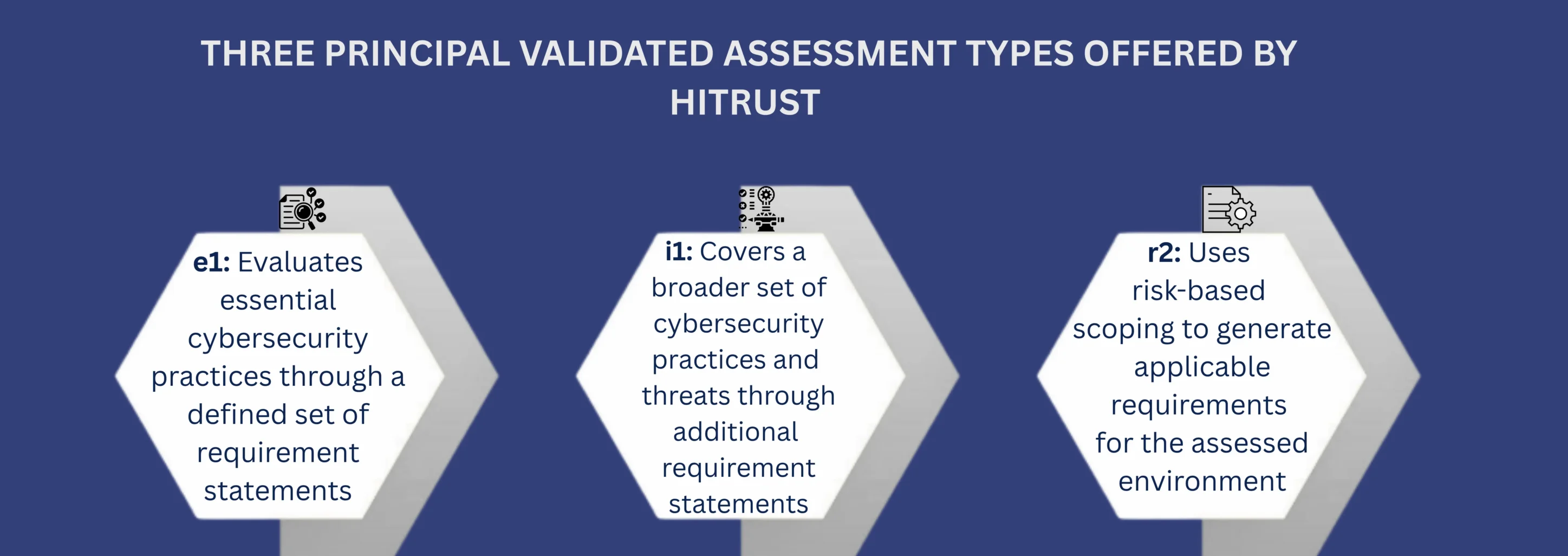
HITRUST offers three principal validated assessment types:
- e1: Evaluates essential cybersecurity practices through a defined set of requirement statements.
- i1: Covers a broader set of cybersecurity practices and threats through additional requirement statements.
- r2: Uses risk-based scoping to generate applicable requirements for the assessed environment.
HITRUST defines the e1 and i1 requirement sets. For r2, the scoping process considers relevant risk factors and generates a tailored set of requirements. The assessment therefore reflects the selected assessment type and the scope of the environment.
The HITRUST controls under assessment do not represent a universal checklist that applies identically to every organization. Management must understand which requirement statements apply to its defined environment and how the selected assessment evaluates them.
SOC 2: Criteria Set by the AICPA, Controls Set by Management
While comparing HITRUST vs SOC 2, SOC 2 starts from a different structure. The AICPA Trust Services Criteria establish the criteria for evaluating controls. Management defines the service organization's system, identifies relevant commitments and requirements, and designs controls to address the applicable criteria.
Security forms part of every SOC 2 examination through the common criteria. Management may also select Availability, Processing Integrity, Confidentiality, and Privacy when those categories fit the system and engagement objectives.
The service auditor evaluates management's system description against the AICPA description criteria, commonly known as DC 200. The auditor also evaluates the controls against the applicable Trust Services Criteria and considers management's assertion.
SOC 2 vs. HITRUST: Audit Structure at a Glance
-
Framework owner
SOC 2: AICPA
HITRUST: HITRUST Alliance
-
Control definition
SOC 2: Organization-defined to meet criteria
HITRUST: HITRUST-prescribed requirement statements
-
Scoring model
SOC 2: No score — pass/qualified/adverse opinion
HITRUST: PRISMA-based maturity scores; minimum thresholds required
-
QA layer
SOC 2: CPA firm issues report independently
HITRUST: HITRUST Alliance reviews assessor work before certification
-
Validity
SOC 2: Covers a past review period; renewed annually
HITRUST: e1/i1: 1 year; r2: 2 years with interim assessment
Same Control Topic, Different Test Question
The most practically important HITRUST vs SOC 2 difference is the evidence sufficiency gap. It is the reason a control that satisfies a CPA firm's SOC 2 testing can still produce scored deficiencies in a HITRUST assessment.
Consider logical access. A SOC 2 auditor may evaluate whether management authorizes access, restricts privileged permissions, and removes access when appropriate under criteria such as CC6.1. HITRUST may address related activities through multiple requirement statements, each with its own assessment expectations. One management control can therefore support several requirements, while one requirement may need evidence from multiple control activities.
This distinction explains why a HITRUST SOC 2 mapping cannot establish equivalent compliance by itself. An organization with mature operations but informal policy documentation can achieve SOC 2 without issue and still score below the r2 domain threshold of 62. The HITRUST controls are not harder in concept, they are harder in documentation specificity.
What Evidence Each Engagement Requires
A SOC 2 auditor selects procedures based on the examination objectives, risks, and applicable criteria. The auditor may use inquiry, inspect records, observe control activities, or reperform a procedure.
HITRUST applies an assessment-specific scoring method. For r2, the maturity model considers five levels: policy, procedure, implemented, measured, and managed. The assessor evaluates evidence against the applicable scoring expectations for each level.
The e1 and i1 assessments focus on the implemented maturity level. Their scope and scoring approach differ from r2, so management should avoid treating the three assessment types as equivalent. A HITRUST validated assessment also involves an authorized external assessor and a quality assurance review before HITRUST determines certification.
These processes produce a different result from a SOC 2 opinion. HITRUST scoring communicates assessment results against its requirements and certification thresholds. SOC 2 reports the service auditor's opinion and, for Type 2, describes the tests of controls and their results.
Six Evidence Differences at a Glance
-
Who sets requirements
HITRUST validated assessment: HITRUST defines the applicable CSF requirement statements.
SOC 2 examination: The AICPA establishes the Trust Services Criteria.
-
Who tests
HITRUST validated assessment: An authorized HITRUST external assessor conducts assessment procedures.
SOC 2 examination: An independent CPA firm conducts the examination.
-
Evidence standard
HITRUST validated assessment: Evidence supports assessment and scoring against applicable HITRUST requirements.
SOC 2 examination: Evidence must support the auditor's conclusions under applicable attestation standards.
-
Period coverage
HITRUST validated assessment: Depends on the selected assessment and HITRUST assessment rules.
SOC 2 examination: Type 1 addresses a specified date; Type 2 addresses a specified period.
-
How deviations surface
HITRUST validated assessment: Requirement scores, identified gaps, and corrective action plans where applicable.
SOC 2 examination: Control test exceptions and their effect on the auditor's opinion.
-
Report output
HITRUST validated assessment: HITRUST assessment results and certification, subject to applicable requirements.
SOC 2 examination: A SOC 2 report with the system description, management assertion, and service auditor's report.
Where a HITRUST Certification Does and Does Not Shorten a SOC 2 Examination
What HITRUST SOC 2 Mapping Tells the Auditor
The HITRUST SOC 2 mapping data — roughly 80% of HITRUST e1 controls map to at least one Trust Services Criterion — is frequently cited as a reason organizations can leverage SOC 2 work toward HITRUST certification. That is directionally accurate but requires important qualifications.
Evidence reuse is feasible in areas where SOC 2 and HITRUST controls share subject matter and where the SOC 2 evidence is granular enough to satisfy HITRUST's prescriptive requirement statements. Access management, MFA enforcement, change management logging, vendor management documentation, and incident response records are commonly reusable. These areas tend to have specific, documentable outputs that map cleanly across both frameworks.
What the Auditor Still Obtains Directly
A HITRUST vs SOC 2 comparison must account for the difference between assessment results and examination evidence.
Evidence gaps appear in areas where HITRUST prescribes specificity that SOC 2 does not require, such as:
- Configuration hardening standards with defined benchmarks
- Formal risk management program documentation with quantified metrics
- Physical media handling procedures with disposal records, and
- Privacy-specific operational controls.
For r2 specifically, every requirement must show evidence at the policy and procedure maturity levels — documents that SOC 2 testing does not require organizations to maintain in HITRUST's prescribed format.
Efficiency Where Evidence Aligns
The HITRUST SOC 2 relationship can still create efficiencies when evidence aligns. Shared populations, such as access listings, approved change tickets, incident records, and backup logs, may support both engagements. Matching system boundaries, control owners, and examination periods can also reduce duplicate evidence requests.
Nevertheless, the service auditor must determine whether the evidence supports the specific SOC 2 control and criterion. The auditor may need additional samples, independent inspection, or testing over dates that the HITRUST assessment does not cover.
The SOC 2 + HITRUST combined report, a collaboration between HITRUST and the AICPA, addresses part of this gap by mapping HITRUST CSF controls to Trust Services Criteria within a single engagement. This produces an attestation report rather than a certification. Organizations should understand that the combined report and standalone HITRUST certification are different outputs with different market recognition.
Conclusion
HITRUST and SOC 2 are not interchangeable. They pose different test questions.
The HITRUST vs SOC 2 question is settled by understanding that two audits built on different testing philosophies will evaluate the same control environment through fundamentally different lenses: one producing a scored certification with centralized quality assurance, the other producing an independent auditor's opinion against organization-defined controls.
CertPro CPA LLC is a licensed, independent CPA firm. In a SOC 2 examination, CertPro tests management's controls against the applicable Trust Services Criteria, obtains sufficient appropriate evidence to support its own opinion, and issues the service auditor's report. To scope an engagement, review our SOC 2 audit services or schedule a meeting with our team.
Preparing for a SOC 2 Examination?
CertPro is a licensed, independent CPA firm. Schedule a meeting with our auditors to confirm the system scope, evidence requirements, and examination period for your SOC 2 engagement.