
NEW ZEALAND
ISO 42001 CERTIFICATION IN NEW ZEALAND
Artificial Intelligence is becoming a core part of New Zealand’s business operations. For example, New Zealand businesses are quickly adopting AI across various sectors, including smart farming tools, predictive healthcare, AI chatbots in e-commerce, and government services. But such an opportunity always comes with a big responsibility. The goal is to make sure these AI systems and tools are safe, ethical, and trustworthy. This is where ISO 42001 certification in New Zealand becomes crucial. ISO 42001:2023 is the world’s first standard focused on managing AI systems responsibly. To add on, it’s designed for any organization that uses or builds AI tools. This standard applies to various organizations, such as startups in Wellington and logistics firms in Auckland, that are planning to integrate AI into their workflows.
Right now, many businesses are using AI without clear rules or risk controls. This can lead to biased decisions, privacy violations, or even regulatory issues under the Privacy Act 2020. You don’t have to wait for something to go wrong. Instead, ISO 42001 certification in New Zealand helps you take charge. It gives you a clear system to manage AI risks, avoid legal trouble, and build public trust. Moreover, obtaining ISO 42001 certification in New Zealand shows clients and partners that you take AI seriously. It shows them your business uses AI safely and fairly.
So, if you’re wondering how to keep your AI systems in check, avoid ethical missteps, and future-proof your business in New Zealand, ISO 42001 compliance is your answer. And the best part is you don’t have to figure it out alone. CertPro is here to guide you in the journey of achieving a strong AI governance model with ISO 42001 certification in New Zealand.
AUDIT AND CERTIFICATION SERVICES BY CERTPRO FOR ISO 42001 IN NEW ZEALAND
WHY CHOOSE CERTPRO FOR ISO 42001 AUDIT AND CERTIFICATION SERVICES
Getting ISO 42001 certification in New Zealand can feel confusing. This is true if you’re new to AI or worried about the cost, time, or complexity. Many Kiwi businesses delay AI compliance because they think it’s only for big tech firms or government contractors. But this delay could cost you trust, clients, and future growth.
CertPro understands this pain point in achieving ISO 42001 certification in New Zealand. Therefore, simplify the process and lower the cost of AI governance without resorting to any shortcuts. That’s our topmost priority; our audits and certification services exactly follow the standards. Whether you’re a small AI startup in Wellington or a growing firm in Christchurch using automation, we help you build safe, fair, and accountable AI systems. Our audit team works closely with your people. In simple words, we listen, explain things in plain language, and guide you through all the crucial steps. With our expert guidance, you can build the foundation for trustworthy AI that your clients, users, and regulators can count on.
WHAT IS ISO 42001?
ISO/IEC 42001:2023 is the first global standard for managing artificial intelligence (AI) responsibly. It’s designed for real businesses, like yours in New Zealand. You might be building AI tools or using them in daily operations.
Yes, AI is moving fast, and so are the risks associated with handling it. This is to say that one small flaw in an AI-driven system can hurt customers, damage your brand, or even attract legal trouble. Hence, achieving ISO 42001 certification in New Zealand gives you a clear, step-by-step framework to keep your AI trustworthy, traceable, understandable, and aligned with your values. It helps you put structure around AI use, something that’s becoming urgent with growing global and regional regulations. The best part? If you already follow standards like ISO 27001 or ISO 9001, ISO 42001 certification in New Zealand perfectly fits in your compliance posture. Moreover, this AI governance standard has no chaos or confusion. There is only clarity, control, and credibility in building, integrating, and maintaining AI systems.
WHY DO WE NEED ISO 42001 CERTIFICATION?
Though integration of AI is exciting in the business world, it’s not always fair as a working model. For instance, using AI tools could help Kiwi businesses move faster, cut costs, and explore bold ideas. But you can’t deny the fact that it could cause potential risks if left unregulated. Hence, the need for obtaining ISO 42001 certification in New Zealand arises. AI is no longer the future. It is already here, showing its impact on key industries like tech, finance, and healthcare. But here’s the problem: when an algorithm makes a bad call, the damage is real. For example, your AI-powered chatbot could give incorrect advice to a customer filing a complaint. For instance, your pricing algorithm might raise prices during a natural disaster because of increased demand. That’s not smart automation; instead, it’s a fast track to losing loyalty and trust.
Your team may trust the AI you’ve built or bought. But how will you make your customers trust it? How will you establish trust with your board and the regulator after five years? That’s why ISO 42001 certification in New Zealand matters. It’s not just another certificate. It’s a way to prove that your AI is ethical, fair, and accountable. For engineers, it’s clarity; for leaders, it’s protection; and for customers, it’s trust. And ultimately, for your brand, it’s a bold move toward leadership in safe, responsible, and ethical AI governance. Therefore, don’t wait for a scandal or a new law to compel you to implement ISO 42001 AIMS. Start your ISO 42001 compliance journey with CertPro to avoid unwanted risks and scrutiny regarding your AI systems.
ENQUIRE NOW
Related Links
SOC 2 in New Zealand
ISO 27701 in New Zealand
GDPR in New Zealand
ISO 27018 in New Zealand
HIPAA in New Zealand
CCPA in New Zealand
PIPEDA in New Zealand
ISO 17025 in New Zealand
ISO 13485 in New Zealand
CE Mark in New Zealand
GDP in New Zealand
GLP in New Zealand
ISO 9001 in New Zealand
ISO 14001 in New Zealand
ISO 45001 in New Zealand
ISO 22000 in New Zealand
HACCP in New Zealand
ISO 22301 in New Zealand
ISO 21001 in New Zealand
ISO 41001 in New Zealand
ISO 20000-1 in New Zealand

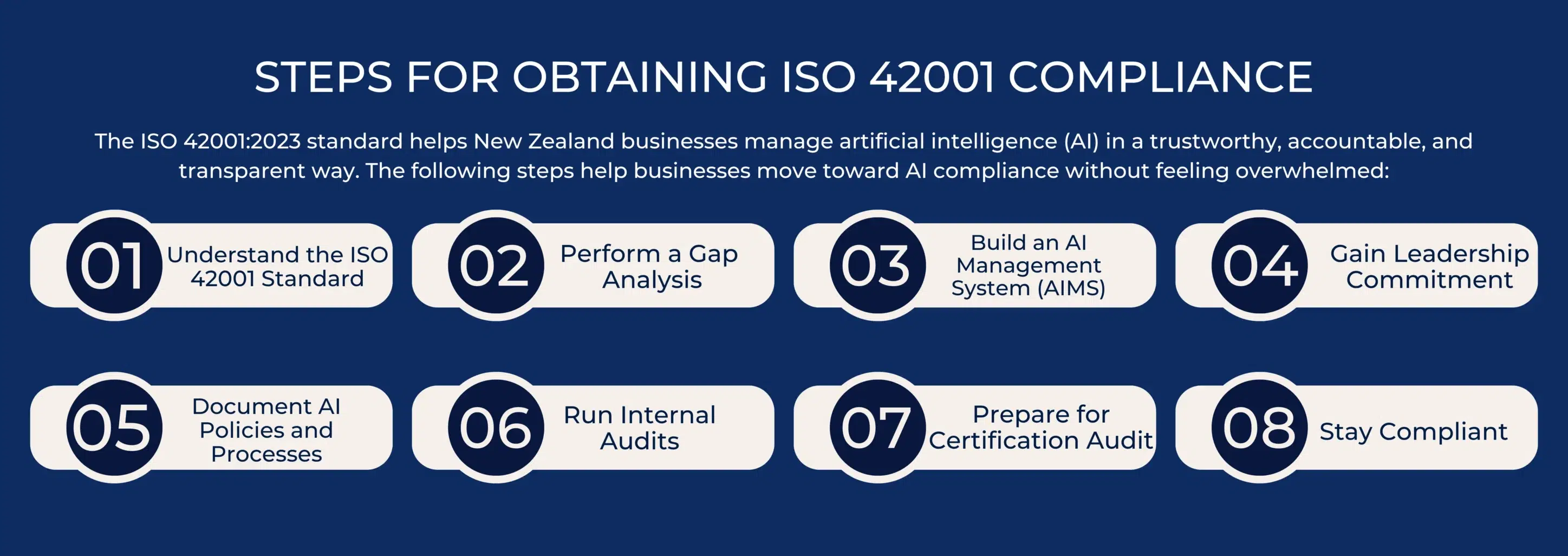
STEPS FOR OBTAINING ISO 42001 COMPLIANCE
The ISO 42001:2023 standard helps New Zealand businesses manage artificial intelligence (AI) in a trustworthy, accountable, and transparent way. The following steps help businesses move toward AI compliance without feeling overwhelmed:
Understand the ISO 42001 Standard: Start by learning how ISO 42001 standards apply to your sector and the way you use AI. Whether you’re automating customer service or building predictive tools in finance or healthcare, understanding the AI governance rules is important.
Perform a Gap Analysis: Compare your current AI practices with ISO 42001 requirements. Therefore, identify what is working well and what may be lacking. A simple checklist can reveal blind spots in privacy, bias controls, or data handling.
Build an AI Management System (AIMS): This doesn’t need to be complicated. Think of it as a shared rulebook for how your team builds, uses, and checks AI. Simply articulate and write down your purpose, responsibilities, and values, and ensure that everyone agrees.
Gain Leadership Commitment: Top management needs to show commitment and support, not just sign off. Their intent and actions set the tone and unlock resources for ISO 42001 certification in New Zealand.
Document AI Policies and Processes: Keep your policy documents and records clear and simple. From the person handling AI-related complaints to the process used in reducing the bias, everything must be documented.
Run Internal Audits: Prior to facing external scrutiny, make sure your work undergoes a thorough internal review. Conducting small tests through internal audits prevents big issues later.
Prepare for Certification Audit: Once you have rectified your issues found during internal audits, partner with a trusted third-party auditor like CertPro to verify your setup.
Stay Compliant: AI requires constant attention and maintenance. Therefore, review your system often. Update it according to the evolving changes and regulations.
REQUIREMENTS FOR ISO 42001 AUDIT AND CERTIFICATION PROCESS
To get ISO 42001 certification in New Zealand, you need more than just a few policy changes. Notably, this AI governance standard lays out specific, practical steps to help your organization use artificial intelligence safely, fairly, and legally. Here are some of the specific requirements to be taken care of during ISO 42001 compliance journey.
Purpose and Scope: First, get clear on why you’re using AI and where it fits in your business. Are you using it in hiring decisions, processing customer data, or predicting health trends? Accordingly, you need to outline your goals and any legal obligations in New Zealand. Simply put, identify the areas where your business falls under the AI framework.
Leadership Commitment: Senior leadership can’t just agree to AI compliance and move on. Moreover, they need to show real support by setting policies, assigning roles, and investing in people and tools. If the top doesn’t care, the bottom won’t either.
Risk Management: AI isn’t risk-free. It can make unfair decisions, raise privacy flags, or simply misfire. Therefore, you’ll need a structured plan to catch those risks early and respond fast.
Impact Assessment: Review how your AI system is impacting your team, your customers, or your legal position? Consequently, use scorecards, experts’ input, and regular reviews to judge impact. Also, don’t forget to keep records and update them as you progress.
Training: Don’t just hand over new tools. Additionally, train your people so they know how AI works, what to watch for, and why ethics matter.
Documentation and Communication: Keep a record of everything, including your actions, motivations, and methods for maintaining AI systems. That’s what builds trust.
Continuous Improvement: AI moves fast, so you should too. Therefore, conducting regular audits and upgrades helps you to stay compliant and confident.
ISO 42001 AUDIT AND CERTIFICATION COST IN NEW ZEALAND
The cost of ISO 42001 certification in New Zealand isn’t fixed. It depends on a few practical factors, like your company’s size, how complex your AI systems are, and how far along you are in managing AI risks. For example, a Wellington-based AI startup with one product will likely pay much less than a government agency or enterprise using AI across multiple departments. Plus, the audit partner you choose also matters here. Some offer full packages that include audits, while others bill separately for consulting and training.
Yes, it may feel like a big upfront expense. But here’s the thing: this isn’t just about passing an audit. It’s about building AI that earns trust and avoids disasters. Think biased credit scoring, flawed hiring tools, or customer data leaks. This is where the true cost resides. ISO 42001 certification in New Zealand helps you show that your AI is safe, ethical, and ready for scrutiny. And in a tight market like New Zealand’s, that edge could win you clients, partnerships, or even government projects.
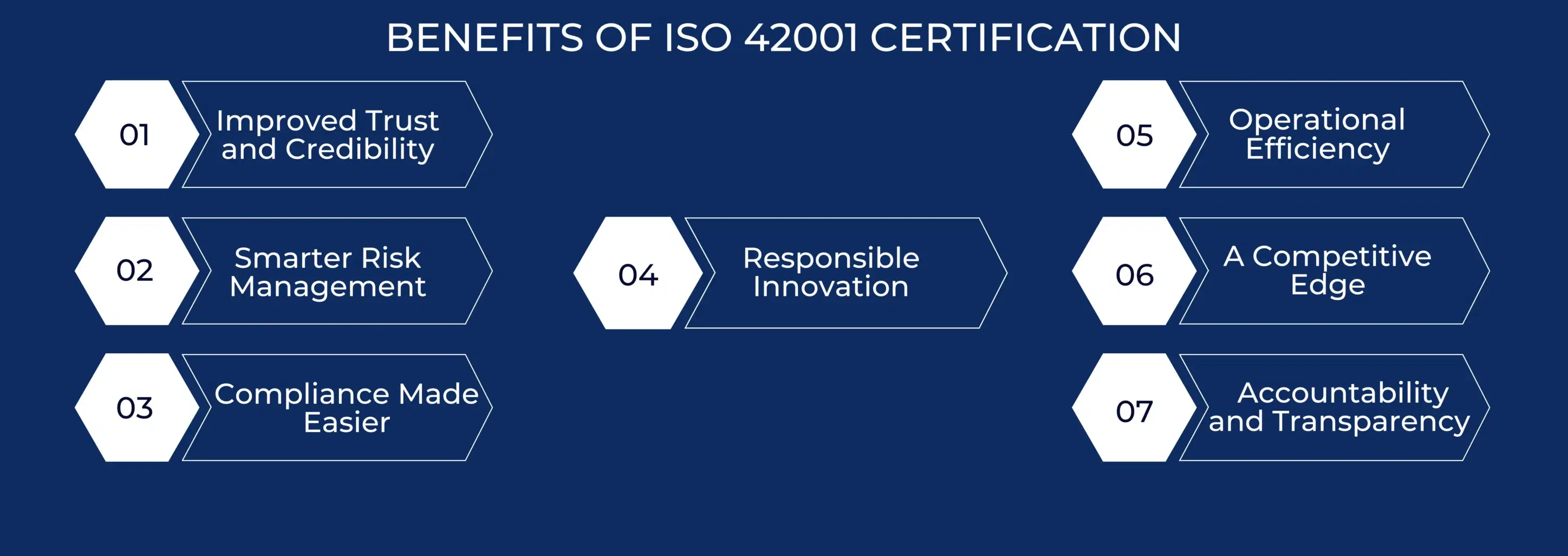
BENEFITS OF ISO 42001 CERTIFICATION IN NEW ZEALAND
Getting ISO 42001 certification in New Zealand goes beyond mere compliance. For Kiwi businesses, it’s a futuristic move that builds trust, safety, and long-term success. Here’s how it truly helps:
Improved Trust and Credibility: The truth is, people are still skeptical of AI. If your tools make decisions that impact lives, people want to know they’re fair and transparent. In this context, the ISO 42001 certification in New Zealand proves you’re using AI with care. It builds public trust, reassures clients, and shows regulators and investors you’re committed to ethical AI governance.
Smarter Risk Management: AI can be unpredictable. For example, a flawed recommendation engine or a biased algorithm can create real harm. ISO 42001 compliance helps you catch these problems early by identifying bias, protecting privacy, and fixing system errors before they spiral.
Compliance Made Easier: AI-focused regulations are changing fast, especially in places like the EU and Australia. If you’re exporting or scaling, you’ll need to align with those frameworks. ISO AI standards provides a solid foundation to meet those rules without starting from scratch.
Responsible Innovation: It’s tempting for businesses to move fast with AI. But speed without structure and regulation is risky. Hence, this certification helps you innovate safely by encouraging testing, feedback loops, and constant upgrades.
Operational Efficiency: With clear processes, your team won’t waste time fixing broken AI or handling complaints. Tasks become more efficient, and downtime decreases.
A Competitive Edge: Many firms are still figuring AI out. With that having been said, when your business gets ISO 42001 certified, it signals to partners, clients, and investors that you’re safe to work with.
Clear Accountability and Transparency: Everyone knows their role, and every AI decision is documented. That’s not just good practice; rather, it’s effective AI management.
CONCLUSION
AI isn’t just a future plan or an upcoming trend anymore. It’s already changing how your business runs today. But with that speed and efficiency, you could face biased systems, data leaks, regulatory fines, or worse, loss of trust. If you’re using or building AI without clear rules, you’re leaving your business exposed. This is why ISO 42001 certification in New Zealand matters now more than ever. It’s not just a formality. Instead, it’s your chance to prove that your AI is fair, understandable, and safe for your customers, your team, and your future. And this is exactly where CertPro becomes your strategic partner. We don’t just audit. We work closely with you at every step. From the first conversation to the final audit and assessment, we help you build practical and affordable systems that fit how your business works.
Whether you’re a fast-moving startup or a growing company integrating AI into operations, CertPro helps you stay ahead of regulations, avoid public backlash, and build long-term trust. You don’t need to be a compliance expert. That’s our job. We’ll break everything down in plain language, guide you through the process, and shape the journey around your goals and budget. Now is the time to build AI that people trust. Connect with CertPro today to start your AI compliance journey. Partnering with us won’t just guide you on the path of ISO 42001 certification in New Zealand. Additionally, partnering with us provides you with a reliable badge that helps build both revenue and trust.
FAQ
What are the benefits of ISO 42001 certification?
ISO 42001 certification builds trust in AI systems, ensures ethical and responsible AI use, improves governance, reduces regulatory risks, and boosts global credibility. It’s key for organizations deploying or managing artificial intelligence technologies at scale.
How many controls are there in ISO 42001?
ISO 42001 Annex A contains 38 controls that address key areas such as AI risk management, data quality, transparency, human oversight, and accountability. These controls form the foundation of an auditable Artificial Intelligence Management System (AIMS).
Which companies require ISO 42001 certification?
Any organization developing, deploying, or managing an AI system should pursue ISO 42001 certification to meet ethical AI standards and ensure compliance with evolving AI regulations. This is particularly true in heavily regulated industries like tech, healthcare, finance, and defense.
What are the risks of non-compliance with ISO 42001 AI standards?
Not following ISO 42001 can result in harm to your reputation, biased AI systems, legal fines, loss of customer trust, and not meeting rules, especially as global AI laws and ethical standards become stricter.
How to establish an ISO 42001 AIMS?
To build an ISO 42001-compliant AIMS, define your AI scope, assess risks, implement required controls, train staff, and document policies. Use gap assessments and audits to align with the standard’s governance and accountability framework.

GRC IN CYBERSECURITY: WHAT IT MEANS AND WHY IT MATTERS IN 2026
In 2026, the pressure on companies to manage cyber risk responsibly has never been greater. Regulators demand structured controls, boards want clear risk reporting, and threat actors are becoming more sophisticated. Against this backdrop, GRC in cybersecurity has...
HOW COMPLIANCE AUDIT SOFTWARE IMPROVES AUDIT READINESS
Today, most companies deal with a growing number of compliance regulations. From data privacy standards to security frameworks like SOC 2 and ISO 27001, the list of compliance obligations keeps expanding. At the same time, regulators and external auditors now expect...

Compliance Best Practices in 2026: How to stay ahead of regulatory changes
Why is the implementation of compliance best practices critical for 2026? Compliance in 2026 demands operational proof, not the documentation intent. Regulations change faster, audit scrutiny is higher, and reporting timelines are tighter across privacy,...