
SWEDEN
HIPAA CERTIFICATION IN SWEDEN
HIPAA Certification in Sweden plays a crucial role in upholding the privacy and security of healthcare data in this Scandinavian nation. The Health Insurance Portability and Accountability Act (HIPAA) sets the standard for protecting sensitive patient information, and compliance is mandatory for healthcare providers, insurers, and business associates nationwide, including within Sweden’s dynamic healthcare sector.
Being a hub for healthcare services, Sweden accommodates various hospitals, clinics, and healthcare entities handling patient data regularly. To ensure the safeguarding of this sensitive information, these organizations must adhere rigorously to HIPAA standards. Certification in HIPAA ensures that healthcare professionals and entities understand the intricacies of the legislation, covering patient rights, data security, and breach reporting.
HIPAA compliance in Sweden involves comprehensive training and education on the laws and regulations. This certification is beneficial not only for healthcare practitioners but also for IT professionals, compliance officers, and anyone dealing with protected health information (PHI). Moreover, it signifies a commitment to protecting patient data and maintaining the highest ethical standards in healthcare.
Ultimately, HIPAA certification in Sweden is a vital aspect of the nation’s healthcare landscape, fostering patient trust, ensuring data security, and ensuring legal compliance in an environment known for its vibrant healthcare industry.
SWEDEN CLIENTS




CERTIFICATION AND AUDITING SERVICES BY CERTPRO FOR HIPAA IN SWEDEN
CertPro excels in offering premier HIPAA consulting services in Sweden, dedicated to assisting healthcare organizations in meeting rigorous privacy and security regulations. Our proficient team provides thorough training and assessments, enabling companies to navigate HIPAA laws effortlessly. Through meticulous audits, we identify compliance gaps and propose tailored solutions. With CertPro’s HIPAA Compliance services in Sweden, you can consistently safeguard patient data, mitigate risks, and ensure compliance, reinforcing your reputation and guaranteeing the utmost level of data security in the healthcare industry.
WHY CHOOSE CERTPRO FOR HIPAA CERTIFICATION AND AUDITING?
Choose CertPro for HIPAA certification and auditing, leveraging our unmatched expertise and commitment to healthcare data protection. Our experienced team understands the intricacies of HIPAA requirements, ensuring your organization stays compliant. We offer personalized training and auditing services tailored to your specific needs, identifying issues and providing effective solutions. CertPro’s proven track record in the healthcare industry speaks volumes, ensuring the highest standards of data security and compliance. Let CertPro assist you in safeguarding patient data, mitigating risks, and enhancing your organization’s reputation in the competitive healthcare sector.
WHAT IS HIPAA?
Enacted in 1996, the Health Insurance Portability and Accountability Act (HIPAA) is pivotal U.S. legislation aimed at ensuring the security, integrity, and accessibility of Protected Health Information (PHI) while facilitating the efficient flow of healthcare data. HIPAA tackles important healthcare industry concerns through its Privacy Rule, setting strict criteria for securing PHI, giving individuals control over their health information, and requiring written consent. The Security Rule focuses on electronic PHI (ePHI), setting standards for digital health record security. Enforcement by the Office for Civil Rights (OCR) of the U.S. Department of Health and Human Services includes potential severe sanctions for noncompliance. The Breach Notification Rule mandates reporting breaches of unsecured PHI to affected parties, the OCR, and sometimes the media.
HIPAA extends to covered entities like healthcare providers, health plans, and clearinghouses, emphasizing secure healthcare information sharing, patient privacy protection, and accountability for data security. Continuously evolving, HIPAA remains a cornerstone of U.S. healthcare regulation, adapting to emerging technologies and practices.
WHY DO WE NEED HIPAA CERTIFICATION?
HIPAA certification holds paramount importance as it ensures that healthcare professionals and organizations are well-equipped to handle sensitive patient information securely and within legal parameters. Given its status as federal legislation, strict adherence to HIPAA regulations is mandatory, with violations carrying severe penalties and potential legal consequences. The attainment of HIPAA accreditation serves as a visible commitment by organizations to prioritize the security of patient data, instilling trust and confidence in individuals seeking healthcare services. This certification plays a pivotal role in proactively preventing costly data breaches, mitigating not only financial losses but also potential legal liabilities.
The necessity for HIPAA certification extends beyond mere legal compliance; it is an indispensable investment in data protection and professional development for individuals and entities within the healthcare sector. By obtaining HIPAA certification, healthcare professionals and organizations contribute to creating a secure and trustworthy healthcare environment, reinforcing their commitment to ethical and secure patient information management.
HOW TO GET HIPAA CERTIFICATION IN SWEDEN?
To obtain HIPAA certification in Sweden, organizations can follow a systematic process, often involving the engagement of HIPAA compliance services in Sweden.
Initiate the process by assessing your organization’s existing HIPAA compliance status. Scrutinize your procedures, policies, and security protocols to identify any gaps or vulnerabilities. Ensure comprehensive HIPAA training for your employees, particularly those handling protected health information (PHI), enabling them to comprehend the regulations and their responsibilities. Obtaining HIPAA certification significantly streamlines the process, as the security measures and practices required by HIPAA are naturally in line with HIPAA compliance.
Engaging external specialists for HIPAA certification not only expedites the process but also ensures a thorough and globally recognized framework for information security. This aspect is crucial for establishing and upholding HIPAA compliance within Sweden’s healthcare sector. The involvement of expert services contributes to a robust and internationally compliant approach to information security in alignment with HIPAA regulations.
ENQUIRE NOW
Related Links
SOC 2 in Sweden
ISO 27701 in Sweden
GDPR in Sweden
ISO 27018 in Sweden
HIPAA in Sweden
CCPA in Sweden
PIPEDA in Sweden
ISO 17025 in Sweden
ISO 13485 in Sweden
CE Mark in Sweden
GDP in Sweden
GLP in Sweden
ISO 9001 in Sweden
ISO 14001 in Sweden
ISO 45001 in Sweden
ISO 22000 in Sweden
HACCP in Sweden
ISO 22301 in Sweden
ISO 21001 in Sweden
ISO 41001 in Sweden
ISO 20000-1 in Sweden

STEPS FOR OBTAINING HIPAA CERTIFICATION
In order to ensure that healthcare organizations and people fulfill the stringent criteria of the Health Insurance Portability and Accountability Act, obtaining HIPAA certification involves a number of steps. Although there isn’t a formal process for HIPAA certification, businesses can show their commitment to patient data safety and compliance by completing the following actions:
Step 1: Recognize the HIPAA requirements: Verify that you and your employees are knowledgeable about HIPAA laws. Examine the Security Rule, Privacy Rule, and other pertinent regulations to comprehend the obligations and prerequisites for maintaining protected health information (PHI).
Step 2: Conduct a HIPAA risk assessment: To find and fix any ePHI security flaws or concerns, do routine risk assessments. Develop a risk management plan to deal with the hazards that have been identified.
Step 3: Construct HIPAA policies and practices: Establish, maintain, and record policies and procedures in compliance with HIPAA regulations. These ought to cover things like security, breach response, and patient privacy. Establish a framework for sustaining and amending policies in reaction to shifting requirements for compliance.
Step 4: Implementing physical and technical safeguards: It is imperative to implement suitable physical and technological security measures. These security measures cover a broad spectrum of procedures, such as encryption, secure data storage, and access controls.
Step 5: Regular monitoring: Maintain a close watch on your company’s compliance initiatives, and review and modify policies and procedures frequently to account for modifications to the law.
Step 6: Maintain HIPAA Documentation: All HIPAA-related activities, including risk assessments, training, policy, and audit findings, should be meticulously documented. A thorough and accurate record shows your commitment to compliance and facilitates audits and inquiries.
Step 7: Appointing an HIPAA Compliance officer: Assign a designated HIPAA Compliance Officer to oversee adherence to regulations and the safeguarding of personal information.
Note: It is significant to remember that different organizations may have different intricacies with this problem. For a more thorough explanation of the details, please get in touch with us at CertPro.com, and we will give you the pertinent data.
REQUIREMENTS FOR HIPAA CERTIFICATION
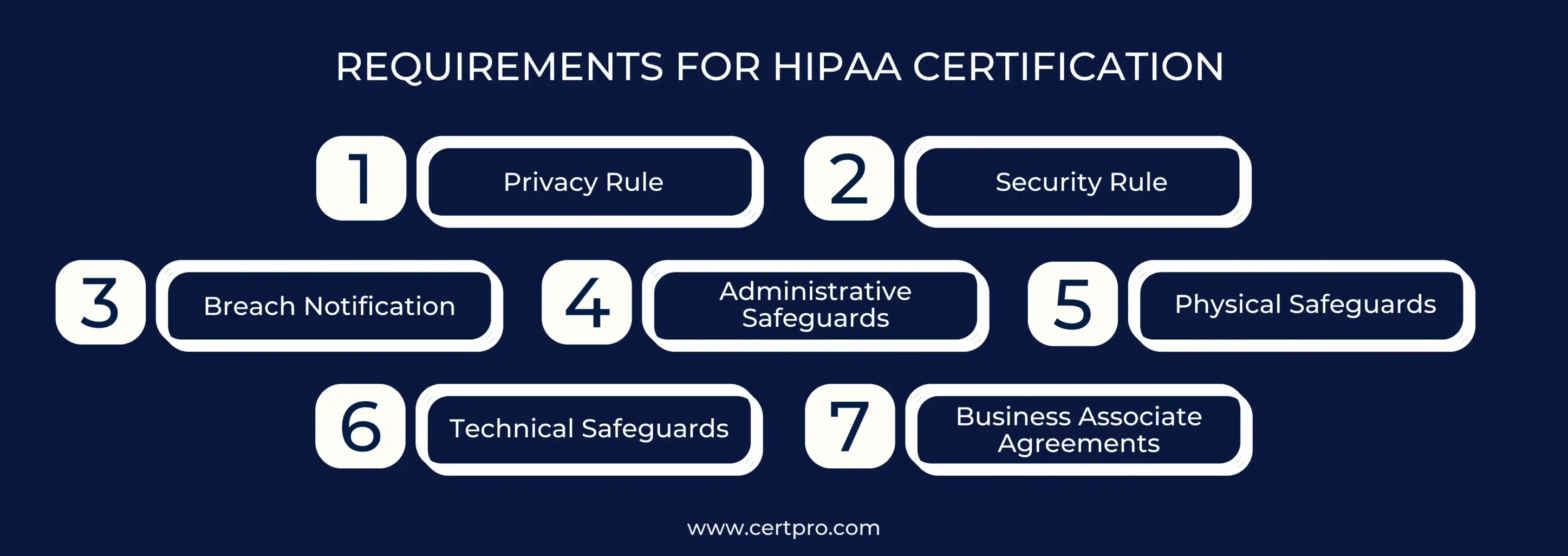
Healthcare businesses must adhere to HIPAA regulations, even though there isn’t a formal accreditation process for the Health Insurance Portability and Accountability Act. To achieve HIPAA compliance, businesses need to meet specific requirements rather than obtain certification. The primary prerequisites for HIPAA compliance are as follows:
Privacy Rule: Establish and maintain policies and procedures to guarantee the confidentiality of protected health information (PHI). People should be informed in a clear and concise manner about their rights to privacy and the handling and disclosure of their PHI.
Security Rule: To protect electronic protected health information, develop and implement thorough security policies and procedures (ePHI). Use technological measures like audit logs, encryption, and access controls to secure ePHI.
Breach Notification: Establish a process for notifying others of breaches involving the unauthorized acquisition, use, disclosure, or access to unsecured patient health information. Notify the impacted parties, the US Department of Health and Human Services (HHS), and, in certain cases, the media in the event of a PHI breach.
Administrative Safeguards: Administrative methods include establishing PHI security and privacy policies and procedures, appointing a privacy and security officer, educating staff on HIPAA requirements, and risk management.
Physical Safeguards: Take into account physical security measures, including building access controls and the safekeeping of tangible documents that hold PHI. Keep unauthorized individuals out of any places used for processing or storing PHI.
Technical Safeguards: Put in place technological measures for data security, such as access limits, encryption, and frequent security audits. Ensure that the infrastructure and IT solutions you use are HIPAA compliant and equipped to protect electronic protected health information (ePHI).
Business Associate Agreements: When handling PHI on your behalf, business partners should sign formal agreements. The duties and responsibilities for protecting PHI should be outlined in these agreements.
Note: It is imperative to acknowledge that the nuances of this matter may differ between companies. Please get in touch with us at CertPro.com so that we can provide you with the information you need to grasp the details in greater detail.
HIPAA CERTIFICATION COST IN SWEDEN
The expense of obtaining HIPAA certification in Sweden is contingent on the size of the healthcare organization. Larger entities with extensive personnel and infrastructure might incur higher costs due to the scale of compliance efforts. Many organizations opt to enlist the services of HIPAA certification providers or auditors in Sweden to assist them in achieving HIPAA compliance. The associated costs vary based on the complexity of the organization and the extent of assistance required. Expenses related to employee HIPAA training contribute to the overall cost, encompassing materials, workshops, and certification examinations. Technological investments aimed at enhancing data security, such as encryption software and secure communication tools, can further contribute to the overall expenditure. Legal counsel may be necessary to navigate intricate HIPAA regulations, leading to additional legal expenses. Costs may also arise from conducting risk assessments and implementing risk management systems to fortify defenses against potential data breaches.
BENEFITS OF HIPAA CERTIFICATION
HIPAA (Health Insurance Portability and Accountability Act) certification offers several advantages to healthcare organizations and individuals, even if it is not an official credential. Achieving and preserving HIPAA compliance offers several benefits.
Data security: If a person or organization has the skills required to implement robust data security protocols, they can apply to be certified. This lessens the chance of unauthorized access to patient data and data breaches.
Legal Compliance: HIPAA certification attests to a person’s or organization’s adherence to federal law. This lessens the likelihood that serious fines and legal repercussions may result from HIPAA violations.
Better Data Management: Patients and clients feel more confident when HIPAA compliance is observed. People are more likely to share their health information with healthcare professionals when they are certain that it is being handled carefully and securely, which improves the quality of care.
Avoiding Breach Notification Costs: A breach of PHI-related data can have significant financial and reputational consequences.
Better Healthcare results: Certification helps people and organizations understand their responsibilities regarding the safety of patient data. Liability may be reduced in the event of a breach or incident with this understanding.

HIPAA COMPLIANCE SERVICES IN SWEDEN: AN EXPERT’S GUIDE
CertPro provides tailored HIPAA consulting services in Sweden, recognizing the crucial importance of safeguarding patient data and maintaining HIPAA certification in the contemporary healthcare landscape. Their experienced team understands the intricacies of HIPAA requirements, emphasizing the significance of upholding patient trust. CertPro guides healthcare providers and organizations in Sweden through the development and refinement of HIPAA-compliant policies and procedures, ensuring patient privacy and data security. Through thorough risk assessments, they identify vulnerabilities and create personalized risk management plans. CertPro helps set up strong technical safeguards to protect electronic protected health information (ePHI) and create clear breach response plans that follow HIPAA rules. By keeping meticulous records of all compliance activities, CertPro helps organizations demonstrate their commitment to HIPAA, empowering them to navigate the complexities with confidence and succeed in Sweden’s healthcare sector.
FAQ
What role does HIPAA Certification play in Sweden's healthcare industry?
How does HIPAA Certification benefit healthcare professionals and entities in Sweden?
How often should healthcare organizations in Sweden conduct HIPAA risk assessments?
What is the significance of HIPAA Compliance services in Sweden offered by CertPro?
Why choose CertPro for HIPAA Certification and Auditing in Sweden?

HIPAA UPDATES 2026: KEY REGULATORY CHANGES, NEW RULES, AND COMPLIANCE IMPACT EXPLAINED
Healthcare data breaches continue to rise, and the pattern is clear. Attackers target patient records because they carry long-term value. At the same time, many organizations still rely on outdated controls, scattered data systems, and weak vendor oversight. That gap...

Why is HIPAA Important to Patients
LAST UPDATE -- 10-01-2025 The Health Insurance Portability and Accountability Act, also known as HIPAA, is crucial for patients because it safeguards their privacy and health information. In order to provide national standards for the security of specific health...
WHAT IS THE HIPAA OMNIBUS RULE
In the U.S. healthcare sector, sensitive medical records are often subjected to cyberattacks like data breaches and ransomware. For example, recently a misconfigured MongoDB database has led to the exposure of 2.7 million patient profiles. This incident is due to a...