
ISO 27001 Certification in Auckland
The ISO/IEC 27001:2022 standard is structured around two primary components: the main clause requirements (Clauses 4 through 10) that define ISMS governance obligations, and Annex A, which contains 93 information security controls organised across four control themes. Together, these components define what an organisation must establish, implement, and demonstrate during an ISO 27001 certification audit. Understanding both the clause structure and Annex A controls is essential for any Auckland organisation preparing for or undergoing third-party certification assessment.
OUR CLIENTS










What Is ISO 27001 Certification and Why Does It Matter for Auckland Organisations?
ISO 27001 Certification in Auckland is issued by CertPro CPA LLC, a Licensed CPA Firm operating as an independent third-party certification body. CertPro evaluates organisations against the requirements of ISO/IEC 27001:2022, the internationally recognised standard for Information Security Management Systems (ISMS). Certification confirms that an organisation’s information security controls, risk treatment processes, and management practices conform to the standard’s requirements through independent third-party audit. For Auckland organisations operating in technology, financial services, healthcare, or government sectors, ISO 27001 Certification provides demonstrable assurance to customers, regulators, and procurement teams that information assets are systematically protected.
Defining ISO/IEC 27001:2022 and Its ISMS Framework
ISO/IEC 27001:2022 is the current version of the international standard that specifies requirements for establishing, implementing, maintaining, and continually improving an Information Security Management System. The standard replaced ISO/IEC 27001:2013 and introduced a restructured Annex A with 93 controls organised across four themes: Organisational, People, Physical, and Technological. Organisations certified to the 2013 version were required to transition to the 2022 standard by 31 October 2025, as mandated by accredited certification bodies globally. ISO 27001 Certification confirms through independent audit that an organisation’s ISMS addresses information security risks in a systematic, documented, and continuously improved manner — covering confidentiality, integrity, and availability of information assets.
ISO 27001 compliance in Auckland is increasingly demanded by enterprise customers, government agencies, and international trading partners as a precondition for contracts involving access to sensitive data. The standard applies to organisations of all sizes and industries. Auckland’s technology ecosystem — encompassing SaaS providers, fintech firms, cloud service providers, health technology companies, data centre operators, telecommunications providers, and AI businesses — produces and processes large volumes of sensitive information that require structured security governance. ISO 27001 Certification in Auckland provides a universally recognised mechanism for demonstrating that governance, whether for Wynyard Quarter technology businesses, North Shore professional services firms, Newmarket healthcare organisations, or enterprises across the wider Auckland metropolitan area.
The Role of Independent Third-Party Certification Audit
ISO 27001 Certification is distinguished from self-declaration or internal assessment by the requirement for an independent third-party audit conducted by a qualified certification body. CertPro CPA LLC, as a Licensed CPA Firm, performs ISO 27001 certification audit engagements that evaluate the design, implementation, and operating effectiveness of an organisation’s ISMS against the standard’s clause requirements and Annex A controls. The audit produces objective evidence of conformity rather than a subjective assessment. The resulting certificate carries credibility with procurement teams, regulators, and business partners across New Zealand and internationally. Third-party certification audit removes the subjectivity inherent in self-assessment and provides stakeholders with independent verification of an organisation’s information security posture.
ISO 27001 Certification in Auckland carries particular significance given New Zealand’s regulatory environment. The New Zealand Privacy Act 2020 and its Information Privacy Principles establish obligations around personal information management. The Health Information Privacy Code 2020 applies additional requirements to health sector organisations. While ISO 27001 Certification does not automatically establish compliance with these or any other laws, the structured risk assessment and control framework it requires frequently supports and evidences an organisation’s approach to meeting privacy and data protection obligations. Auckland organisations engaging in cross-border data flows with Australia, the United States, or other jurisdictions similarly benefit from certification as an internationally recognised indicator of information security governance maturity.
Who Pursues ISO 27001 Certification in Auckland?
ISO 27001 Certification for Auckland businesses spans a broad range of industries and organisation sizes. SaaS providers and software development companies pursue certification to satisfy enterprise customer security questionnaires and procurement requirements. Fintech firms and financial institutions in Auckland’s growing financial technology sector obtain ISO 27001 Certification to demonstrate information security governance to the Reserve Bank of New Zealand and to international customers. Healthcare technology organisations and clinical service providers pursue certification in connection with health data protection obligations under the Health Information Privacy Code 2020. Government technology providers, agritech businesses, logistics and supply-chain companies, e-commerce operators, and cybersecurity firms across Auckland and the wider New Zealand market pursue ISO 27001 Certification to differentiate their security posture and access new market opportunities.

ENQUIRE NOW
Related Resources
Related Services in Auckland
ISO 27001 ISMS Framework and Annex A Controls
The ISO/IEC 27001:2022 standard is structured around two primary components: the main clause requirements (Clauses 4 through 10) that define ISMS governance obligations, and Annex A, which contains 93 information security controls organised across four control themes. Together, these components define what an organisation must establish, implement, and demonstrate during an ISO 27001 certification audit. Understanding both the clause structure and Annex A controls is essential for any Auckland organisation preparing for or undergoing third-party certification assessment.
ISMS Clause Requirements: Clauses 4 Through 10
The main body of ISO/IEC 27001:2022 contains seven mandatory clause groups that define ISMS requirements. Clause 4 requires organisations to understand their context — including internal and external factors affecting information security — and to identify interested parties and their requirements. Clause 5 addresses leadership, requiring top management to demonstrate commitment to the ISMS and to establish an information security policy. Clause 6 covers planning, including risk assessment and risk treatment. Clause 7 addresses support, covering resources, competence, awareness, communication, and documented information. Clause 8 covers operational planning and control, including implementation of risk treatment plans. Clause 9 requires performance evaluation through monitoring, internal audit, and management review. Clause 10 addresses continual improvement, requiring nonconformities to be resolved through corrective action and the ISMS to be continuously improved.
Annex A Control Themes and the ISMS Control Assessment
Annex A of ISO/IEC 27001:2022 contains 93 controls organised into four themes. Organisational controls (37 controls) address policies, roles, asset management, supplier relationships, incident management, and business continuity. People controls (8 controls) address screening, employment terms, awareness, and disciplinary processes. Physical controls (14 controls) address physical security perimeters, entry controls, equipment protection, and clear desk policies. Technological controls (34 controls) address access control, cryptography, network security, endpoint protection, vulnerability management, secure development, and monitoring. During an ISMS Control Assessment, the auditor evaluates whether each applicable Annex A control has been included in the Statement of Applicability, whether excluded controls are justified, and whether included controls are implemented and operating effectively.
The Statement of Applicability (SoA) is a mandatory document required by ISO/IEC 27001:2022 that identifies all 93 Annex A controls, indicates whether each is applicable or excluded, provides justification for exclusions, and describes the implementation status of applicable controls. The SoA is a primary audit artefact reviewed during an ISO 27001 certification audit because it demonstrates that the organisation has systematically considered all controls in relation to its risk treatment plan. Auckland organisations are assessed against their own SoA, meaning the ISMS Control Assessment evaluates conformity with the organisation’s documented control selections rather than imposing a universal control set. This risk-based approach is one key distinction that sets ISO 27001 apart from prescriptive compliance frameworks.
| Annex A Theme | Number of Controls | Example Controls |
|---|---|---|
| Organisational | 37 | Information security policies, asset management, supplier security, incident management |
| People | 8 | Screening, employment terms, security awareness, disciplinary process |
| Physical | 14 | Physical security perimeters, equipment siting, clear desk and screen policies |
| Technological | 34 | Access control, cryptography, network security, vulnerability management |
Risk Assessment and Risk Treatment in the ISMS
ISO/IEC 27001:2022 is fundamentally a risk-based standard. Clause 6.1 requires organisations to define and apply an information security risk assessment process that identifies risks associated with the loss of confidentiality, integrity, and availability of information assets. Risk owners must be identified, and risks must be analysed and evaluated against defined risk acceptance criteria. Clause 6.1.3 requires the organisation to define and apply a risk treatment process that selects appropriate treatment options — typically selecting Annex A controls to address identified risks — and produces a risk treatment plan. The risk assessment and risk treatment documentation is central to the ISO 27001 audit, as it demonstrates that the organisation’s control selections are evidence-based and directly linked to identified information security risks rather than arbitrary choices.
ISO 27001 Certification Requirements
Achieving ISO 27001 Certification in Auckland requires organisations to satisfy mandatory documentation, operational, and governance requirements defined by ISO/IEC 27001:2022. These requirements must be met before and during the ISO 27001 certification audit. CertPro CPA LLC evaluates conformity with each requirement during the Stage 1 and Stage 2 audit phases. The following summarises the key categories of certification requirements Auckland organisations must address.
ISO/IEC 27001:2022 specifies a set of mandatory documented information that must exist and be maintained as evidence of ISMS operation. Required documents include the ISMS scope (Clause 4.3), the information security policy (Clause 5.2), the risk assessment process and results (Clause 6.1.2), the risk treatment plan (Clause 6.1.3), the Statement of Applicability (Clause 6.1.3d), information security objectives (Clause 6.2), evidence of competence (Clause 7.2), operational planning and control evidence (Clause 8.1), monitoring and measurement results (Clause 9.1), internal audit programme and results (Clause 9.2), management review records (Clause 9.3), and corrective action records (Clause 10.1). Each of these documents is reviewed during the ISO 27001 certification audit as primary evidence of ISMS conformity.
Beyond documentation, ISO 27001 compliance requires evidence that the ISMS is operationally active. Information security controls documented in the SoA must be implemented and demonstrably operating. Internal audits must have been completed against the ISMS scope, and findings must be addressed. Management review must have occurred, with top management demonstrating active oversight of ISMS performance — including review of risk assessment results, audit findings, nonconformities, and information security objectives. For Auckland organisations, this operational evidence is assessed during the Stage 2 audit through document review, interviews, observation, and control testing. The auditor must be satisfied that the ISMS is not merely documented but is actively implemented and maintained across the organisation’s defined scope.
- ✓Defined ISMS scope with documented boundaries and exclusions
- ✓Information security policy approved by top management
- ✓Completed information security risk assessment with documented results
- ✓Risk treatment plan with control selections linked to identified risks
- ✓Statement of Applicability covering all 93 Annex A controls
- ✓Implemented and operating Annex A controls as per the SoA
- ✓Completed internal ISMS audit with documented findings and corrective actions
- ✓Management review records demonstrating top management ISMS oversight
The ISMS scope defines the boundaries within which an organisation’s information security management system operates and within which ISO 27001 Certification applies. For Auckland organisations, the scope statement must clearly identify the organisational units, physical locations, information assets, processes, and systems included within the ISMS. A SaaS provider in Wynyard Quarter may scope its ISMS to cover cloud platform development, operations, and customer support functions. A financial institution operating across Auckland CBD and North Shore may scope its ISMS to cover specific products or business divisions handling sensitive customer data. The scope must be documented, realistic, and aligned with the organisation’s risk assessment. CertPro evaluates scope appropriateness during the Stage 1 audit to confirm it is not artificially narrow in a way that excludes material information security risks.
- ✓Mandatory Documentation Requirements
- ✓Operational and Governance Requirements
- ✓ISMS Scope Definition for Auckland Organisations
ISO 27001 Certification Process in Auckland
The ISO 27001 certification audit process for Auckland organisations follows a structured, multi-stage methodology conducted by CertPro CPA LLC as the certification body. The process is designed to evaluate ISMS conformity objectively and systematically, culminating in an independent certification decision. The following stages define the ISO 27001 certification audit process that Auckland organisations undergo with CertPro.
The Stage 1 audit — also referred to as the documentation review or readiness review — evaluates whether the organisation’s ISMS documentation meets the requirements of ISO/IEC 27001:2022. During Stage 1, the CertPro auditor reviews the ISMS scope, information security policy, risk assessment methodology and results, risk treatment plan, Statement of Applicability, and evidence of internal audit and management review completion. The Stage 1 audit identifies significant gaps or areas of concern that must be addressed before proceeding to Stage 2. It also confirms that the organisation is sufficiently prepared for the full ISO 27001 certification audit and allows the auditor to plan Stage 2 sampling and testing activities. Stage 1 is typically conducted remotely for Auckland organisations, though on-site review may be arranged depending on scope complexity.
The Stage 2 audit is the main ISO 27001 certification audit during which CertPro evaluates the implementation and operating effectiveness of the organisation’s ISMS and its Annex A controls. The auditor collects objective evidence through document review, personnel interviews, observation of processes, and testing of control operation. The ISMS Control Assessment during Stage 2 evaluates whether controls documented in the Statement of Applicability are implemented as described and operating effectively over the defined period. Nonconformities identified during Stage 2 are classified as major or minor. Major nonconformities — representing failures to meet a clause requirement or the absence of a required control — must be resolved before certification can be issued. Minor nonconformities must have an accepted corrective action plan before certification is granted.
The ISO 27001 certification audit process for Auckland organisations concludes with a certification decision made independently by CertPro CPA LLC following Stage 2 completion and resolution of any nonconformities. Upon a positive certification decision, CertPro issues an ISO 27001 certificate covering the defined ISMS scope. The certificate is valid for three years, subject to annual surveillance audits conducted in years one and two to verify that the ISMS continues to conform to the standard’s requirements and that continual improvement is occurring. A recertification audit is conducted before the certificate’s three-year expiry to renew certification for a further three-year cycle.
ISO 27001 Certification requires ongoing surveillance to maintain validity. Surveillance audits are conducted annually — typically at 12 months and 24 months after initial certification — and focus on verifying that the ISMS continues to operate effectively. Auditors confirm that internal audits and management reviews have been completed, that nonconformities have been addressed, and that continual improvement activities are underway. Surveillance audits do not reassess the full ISMS; instead, they focus on key ISMS processes and a rotating sample of Annex A controls. Failure to undergo surveillance audits within required timeframes results in certificate suspension or withdrawal. A full recertification audit is required before the three-year certificate expires. Auckland organisations should factor surveillance and recertification schedules into their ISMS planning to maintain uninterrupted ISO 27001 Certification status.
| Audit Stage | Timing | Focus Areas |
|---|---|---|
| Stage 1 Audit | Prior to Stage 2 | ISMS documentation, scope, risk assessment, SoA, internal audit and management review evidence |
| Stage 2 Audit | After Stage 1 clearance | ISMS implementation, Annex A control effectiveness, operational evidence, interviews |
| Surveillance Audit 1 | 12 months post-certification | Ongoing ISMS operation, selected controls, nonconformity resolution, continual improvement |
| Surveillance Audit 2 | 24 months post-certification | Ongoing ISMS operation, rotating control sample, internal audit and management review verification |
| Recertification Audit | Before 3-year expiry | Full ISMS reassessment against ISO/IEC 27001:2022 requirements |
- ✓Stage 1 Audit: ISMS Documentation Review
- ✓Stage 2 Audit: ISMS Implementation and Control Effectiveness Assessment
- ✓Surveillance Audits and Recertification
ISO 27001 Certification Cost in Auckland
The factors that determine the scope and complexity of an ISO 27001 certification audit directly influence the effort required to complete the assessment. Auckland organisations considering ISO 27001 Certification should understand the key variables that affect audit scope and, consequently, the investment associated with third-party certification assessment by CertPro CPA LLC.
Factors Affecting ISO 27001 Audit Scope and Complexity
The scope and complexity of an ISO 27001 audit is determined by several organisational factors. The number of employees and contractors within the ISMS scope affects the volume of interviews and personnel-related control testing required. The number and complexity of in-scope systems, applications, and information assets affects the depth of technological control testing. The number of physical locations within scope — whether a single Auckland CBD office or multiple sites across the wider Auckland metropolitan area — affects the extent of physical control assessment. The number and complexity of third-party supplier relationships within scope affects supplier security control evaluation. Organisations with complex cloud environments, multi-jurisdiction data flows, or heavily regulated information assets generally require more extensive audit procedures than organisations with simpler, single-location, on-premises environments.
Audit Effort and Certification Investment Variables
ISO 27001 Certification investment for Auckland organisations reflects the audit days required to complete Stage 1, Stage 2, surveillance, and recertification assessments. Audit day requirements are determined by ISMS scope complexity, number of in-scope personnel, number of locations, and the maturity and completeness of existing ISMS documentation and controls. Organisations with well-documented, operationally mature ISMS environments typically require fewer corrective action cycles during the certification process, reducing overall time to certificate issuance. Auckland organisations should engage directly with CertPro CPA LLC to discuss their specific ISMS scope and obtain a structured assessment of the ISO 27001 audit effort applicable to their certification requirements. CertPro does not publish fixed audit pricing schedules, as scope-specific variables are assessed individually for each engagement.
Benefits of ISO 27001 Certification for Auckland Businesses
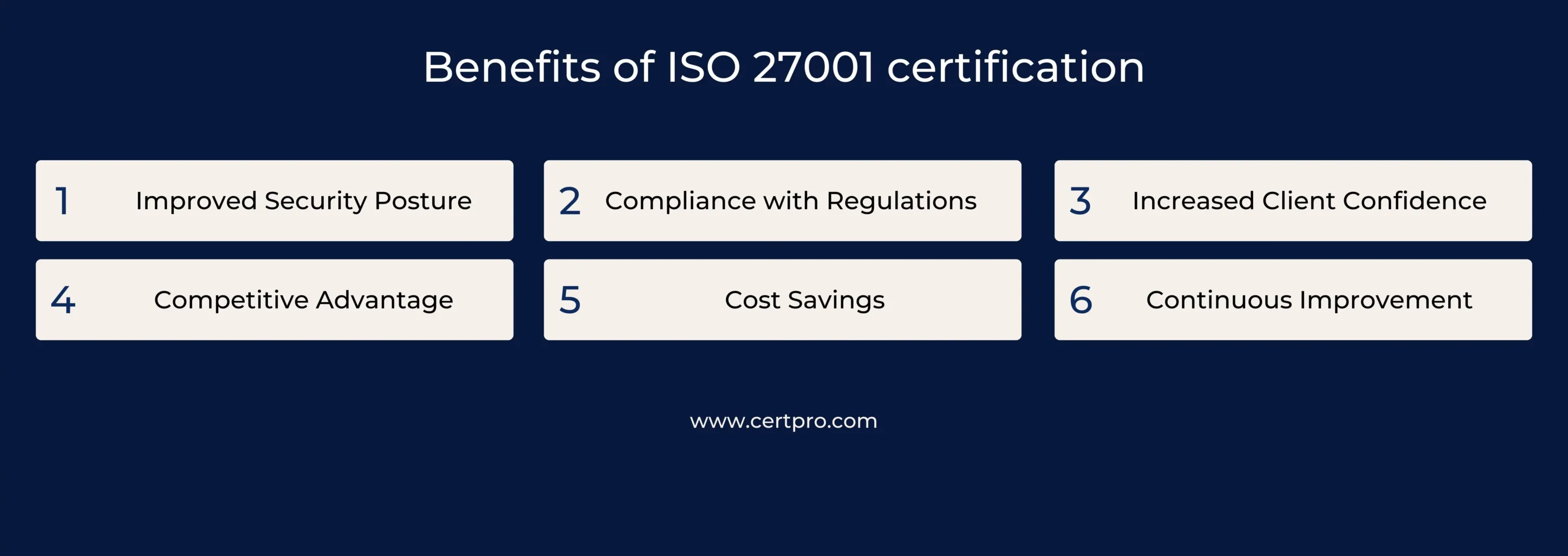
ISO 27001 Certification in Auckland delivers measurable business, commercial, and regulatory benefits to organisations across the technology, financial services, healthcare, government, and professional services sectors. The following benefits are consistently reported by Auckland-based organisations that have achieved ISO 27001 Certification through independent third-party audit.
ISO 27001 Certification for Auckland businesses directly expands market access by satisfying security requirements in enterprise and government procurement processes. New Zealand government agencies increasingly require vendors to demonstrate ISO 27001 Certification as part of supplier assurance frameworks. Large enterprises across financial services, telecommunications, and healthcare routinely mandate ISO 27001 Certification from technology suppliers and managed service providers. For Auckland SaaS providers and technology companies competing for contracts with Australian, United States, or United Kingdom customers, ISO 27001 Certification provides an internationally recognised credential that reduces the burden of responding to individual security questionnaires and due diligence requests. Certification materially reduces sales cycle friction and strengthens an organisation’s competitive position in security-sensitive procurement processes.
Implementing and maintaining an ISO 27001-conformant ISMS produces demonstrable improvements in information security governance. The mandatory risk assessment and treatment process requires organisations to identify, evaluate, and systematically address information security risks — reducing the likelihood of security incidents that could compromise customer data, disrupt operations, or attract regulatory scrutiny. For Auckland fintech firms and financial institutions, this risk reduction supports alignment with Reserve Bank of New Zealand operational resilience expectations. For healthcare technology organisations, structured ISMS governance supports the information security aspects of Health Information Privacy Code 2020 obligations. Across all sectors, the internal audit and management review requirements of ISO 27001 compliance create feedback loops that identify control weaknesses before they result in security failures, improving the organisation’s overall security posture over time.
- ✓Expanded access to enterprise and government procurement opportunities in New Zealand and internationally
- ✓Reduced security questionnaire burden through an internationally recognised ISO 27001 Certification credential
- ✓Demonstrated ISO 27001 compliance to customers, regulators, and business partners
- ✓Systematic identification and treatment of information security risks across the organisation
- ✓Improved internal information security governance through structured ISMS processes
- ✓Independent audit evidence of control effectiveness for board and executive reporting
- ✓Support for alignment with New Zealand Privacy Act 2020 and sector-specific data protection requirements
- ✓Strengthened supplier and third-party security management processes
ISO 27001 Certification provides Auckland organisations with an independently verified credential that communicates information security governance maturity to customers, investors, and business partners. Unlike self-declared security postures or internal assessments, ISO 27001 Certification by a Licensed CPA Firm as third-party auditor carries independent credibility that internal representations cannot replicate. For Auckland cloud service providers, data centre operators, and organisations processing sensitive personal or financial information, ISO 27001 Certification signals to stakeholders that information security is subject to ongoing independent scrutiny. This independently verified assurance supports customer retention, strengthens supplier relationships, and provides boards and senior management with objective evidence of ISMS effectiveness for governance reporting purposes.
- ✓Market Access, Procurement, and Competitive Differentiation
- ✓Information Security Risk Reduction and Governance Improvement
- ✓Customer Trust and Stakeholder Confidence
ISO 27001 Compliance and Auckland’s Regulatory Environment
ISO 27001 compliance in Auckland operates within a regulatory environment shaped by New Zealand privacy law, sector-specific information security requirements, and international data protection obligations. Auckland organisations must understand how ISO 27001 Certification relates to — but does not substitute for — compliance with applicable laws and regulations. The following covers key regulatory considerations relevant to Auckland organisations pursuing ISO 27001 Certification.
New Zealand Privacy Act 2020 and Information Privacy Principles
The New Zealand Privacy Act 2020 and its thirteen Information Privacy Principles (IPPs) govern the collection, use, storage, and disclosure of personal information by organisations operating in New Zealand. The Privacy Act applies to all Auckland organisations handling personal information, regardless of industry sector or size. ISO 27001 Certification does not automatically establish compliance with the Privacy Act or the IPPs, as legal compliance requires additional legal analysis and specific operational practices. However, implementing an ISO 27001-conformant ISMS — particularly risk assessment, access control, incident management, and supplier security controls — frequently provides documented evidence of the technical and organisational measures an organisation has implemented to protect personal information. This evidence is relevant to demonstrating a privacy-aware information security posture. Auckland organisations should seek independent legal advice on Privacy Act obligations separately from their ISO 27001 Certification programme.
Sector-Specific Regulatory Considerations for Auckland Organisations
Auckland’s financial services sector operates under Reserve Bank of New Zealand (RBNZ) oversight, with operational resilience and information security requirements applied to registered banks, insurers, and other regulated entities. The Financial Markets Authority (FMA) similarly applies conduct and operational requirements with information security implications to market participants. Auckland’s health sector organisations are subject to the Health Information Privacy Code 2020, which imposes specific obligations on the collection, use, and protection of health information. ISO 27001 compliance in Auckland across these sectors provides a structured framework for addressing information security risks relevant to regulatory obligations, and ISO 27001 Certification may be viewed positively in regulatory reviews of an organisation’s information security governance. Certification does not independently satisfy sector-specific regulatory requirements, and organisations should assess their regulatory obligations separately.
Cross-Border Data Flows and International Regulatory Alignment
Auckland organisations engaging in cross-border data flows — particularly those transferring personal data to Australia, the European Union, the United Kingdom, or the United States — may face additional data protection obligations under applicable foreign law. Australia’s Privacy Act 1988 and Australian Privacy Principles apply to transborder data flows involving Australian personal information. The EU General Data Protection Regulation (GDPR) applies to processing of EU residents’ personal data regardless of where the processor is located. ISO 27001 Certification does not satisfy GDPR, Australian Privacy Act, or other international legal compliance requirements. However, the structured information security governance and documented controls required for certification are considered positively in many international regulatory and contractual frameworks. Auckland-based exporters of technology and data services frequently cite ISO 27001 Certification as a key component of their international security assurance strategy.
ISO 27001 Certification for Auckland’s Key Industry Sectors
ISO 27001 Certification in Auckland serves a diverse range of industry sectors, each with distinct information security risk profiles and certification drivers. The following covers the primary Auckland industry sectors for which ISO 27001 certification audit is most frequently pursued and the specific certification considerations relevant to each sector.
Technology, SaaS, and Cloud Service Providers
Auckland’s technology sector — including SaaS providers, cloud-native software companies, managed service providers, and AI businesses concentrated in Wynyard Quarter, Auckland CBD, and North Shore — represents the most active segment pursuing ISO 27001 Certification. Technology companies targeting enterprise and government customers in New Zealand, Australia, and international markets routinely face security questionnaire requirements that ISO 27001 Certification satisfies more efficiently than case-by-case responses. The ISO 27001 certification audit for Auckland technology organisations focuses heavily on technological Annex A controls — including access control (A.8.2–A.8.5), network security (A.8.20–A.8.22), secure development (A.8.25–A.8.31), and vulnerability management (A.8.8) — as well as cloud-specific considerations relevant to organisations operating in shared-responsibility cloud environments. ISO 27001 Certification for Auckland technology companies also supports SOC 2 Type II reporting alignment for customers in US markets.
Financial Services, Fintech, and Insurance
ISO 27001 Certification demand within Auckland’s financial services sector is driven by procurement requirements from major banks, Reserve Bank of New Zealand operational resilience expectations, and the need to demonstrate information security governance to institutional customers and counterparties. Fintech firms providing payment processing, lending platforms, wealth management software, and financial data services pursue ISO 27001 compliance as a foundation for demonstrating security governance maturity. The ISO 27001 certification audit for financial services organisations emphasises controls relevant to high-sensitivity financial data: cryptography (A.8.24), access control, incident management (A.5.24–A.5.26), business continuity (A.5.29–A.5.30), and supplier security assessment (A.5.19–A.5.22). Auckland technology companies operating in the fintech space frequently pursue ISO 27001 Certification as a precondition for partnerships with major banking institutions and payment networks operating in New Zealand.
Healthcare, Government Technology, and Critical Infrastructure
Auckland healthcare technology organisations, clinical software providers, and health data processors pursue ISO 27001 Certification in the context of Health Information Privacy Code 2020 obligations and the sensitivity of health information under New Zealand law. The ISO 27001 certification audit in this sector focuses on information asset classification, access control, data retention and disposal, and incident response — controls directly relevant to the protection of sensitive health information. Government technology providers operating in Auckland pursue ISMS certification as part of vendor assurance requirements in New Zealand government procurement, where information security certification is increasingly a mandatory supplier qualification. Telecommunications providers, data centre operators, and organisations operating critical infrastructure similarly pursue ISO 27001 Certification to demonstrate resilient, independently audited information security governance to regulators, customers, and government stakeholders.
ISO 27001 Certification vs ISO 27001 Compliance — Key Distinctions
Auckland organisations frequently encounter the terms ISO 27001 Certification and ISO 27001 compliance used interchangeably, but they represent meaningfully different states. Understanding the distinction is important for procurement decisions, regulatory engagements, and internal governance reporting. The following clarifies the key differences between ISO 27001 Certification and ISO 27001 compliance for Auckland organisations.
ISO 27001 Compliance: Self-Assessed Conformity
ISO 27001 compliance refers to an organisation’s internally assessed conformity with the requirements of ISO/IEC 27001:2022. An organisation that has implemented an ISMS, completed risk assessments, selected Annex A controls, and developed the required documentation may describe itself as ISO 27001 compliant based on its own evaluation of conformity with the standard. ISO 27001 compliance in this sense does not involve independent third-party audit or formal certification and does not produce a certificate. While internal compliance assessments can be valuable as part of an ISMS improvement programme, they do not carry the same credibility as ISO 27001 Certification in procurement processes, regulatory reviews, or customer due diligence evaluations. Auckland organisations self-declaring ISO 27001 compliance without certification should clearly communicate the basis of that declaration to all stakeholders.
ISO 27001 Certification: Independent Third-Party Verified Conformity
ISO 27001 Certification is the formal outcome of a successful ISO 27001 certification audit conducted by an independent third-party certification body such as CertPro CPA LLC. Certification requires the organisation to demonstrate conformity with all applicable ISO/IEC 27001:2022 clause requirements and Annex A controls through objective evidence evaluated by a qualified auditor. Upon a positive certification decision, the organisation receives a certificate that is publicly verifiable, time-limited (three years with annual surveillance), and scope-specific. ISO 27001 Certification carries credibility that self-declared compliance cannot replicate, because it is based on independent evaluation rather than internal assessment. For Auckland organisations responding to enterprise RFPs, government procurement requirements, or regulatory enquiries, the distinction between certified and compliant frequently determines whether the organisation satisfies the security qualification criterion.
| Attribute | ISO 27001 Compliance (Self-Assessed) | ISO 27001 Certification (Third-Party Audited) |
|---|---|---|
| Assessment basis | Internal review and self-declaration | Independent ISO 27001 audit by Licensed CPA Firm |
| Certificate issued | No | Yes — scope-specific, 3-year validity |
| Third-party verification | None | Required — conducted by certification body |
| Procurement credibility | Limited — self-declared | High — independently verified |
| Ongoing requirements | Internal to organisation | Annual surveillance audits required |
Why CertPro for ISO 27001 Audit in Auckland
CertPro CPA LLC is a Licensed CPA Firm providing independent ISO 27001 audit services to Auckland organisations across technology, financial services, healthcare, government, and professional services sectors. CertPro conducts ISO 27001 certification audit engagements under a structured methodology aligned with ISO/IEC 27001:2022 and international certification body requirements. The following outlines the key attributes of CertPro’s ISO 27001 audit practice relevant to Auckland organisations.
Licensed CPA Firm and Independent Certification Body
CertPro CPA LLC operates as a Licensed CPA Firm and independent certification body, providing ISO 27001 certification audit services under a structured methodology that prioritises objectivity, evidence-based assessment, and institutional credibility. As an independent certification body, CertPro maintains the independence from advisory, consulting, and implementation activities required for credible third-party ISO 27001 Certification. CertPro does not provide ISMS implementation, policy development, control design, or readiness consulting services — ensuring that the ISO 27001 audit remains fully independent and its outcomes credible to customers, procurement teams, and regulators. Auckland organisations engaging CertPro for ISO 27001 Certification receive an assessment conducted by qualified auditors with demonstrated expertise in ISO/IEC 27001:2022 requirements and ISMS audit methodology.
Structured Audit Methodology and Auckland-Relevant Expertise
CertPro’s ISO 27001 audit methodology for Auckland follows a structured sequence: scope definition and audit programme determination, Stage 1 ISMS documentation review, Stage 2 ISMS implementation and ISMS Control Assessment, nonconformity review and corrective action evaluation, independent certification decision, and issuance of the ISO 27001 certificate. Each stage involves clearly defined audit objectives, evidence collection procedures, and documented findings. CertPro auditors bring relevant industry knowledge applicable to Auckland’s technology, fintech, healthcare, and government sectors, enabling effective and efficient assessment of sector-specific ISMS implementations. The ISO 27001 certification audit process is conducted with full transparency, providing organisations with clear audit findings, nonconformity classifications, and documented certification decisions that can be communicated to stakeholders in procurement and regulatory contexts.
Certification Scope Flexibility and Ongoing Surveillance
CertPro provides ISO 27001 certification audit services across a range of ISMS scope configurations relevant to Auckland organisations. Single-site certifications covering Auckland CBD or Wynyard Quarter operations, multi-site certifications spanning Auckland CBD, North Shore, Newmarket, or wider Auckland metropolitan locations, and certifications covering cloud-delivered services and distributed workforce environments are all within CertPro’s ISO 27001 audit programme. Following initial ISO 27001 Certification, CertPro conducts annual surveillance audits to verify ongoing ISMS conformity and continual improvement, and recertification audits at the three-year certificate renewal point. This ongoing audit relationship ensures that ISO 27001 Certification remains current and credible throughout the certificate lifecycle, providing Auckland organisations with continuous independent verification of their ISMS operation.
FAQ
▶
What is ISO 27001 certification?
▶
What is ISO 27001 certification and what does it certify?
▶
How long does the ISO 27001 certification audit process take for Auckland organisations?
▶
What is the difference between a Stage 1 and Stage 2 ISO 27001 audit?
▶
What is an ISMS Control Assessment in the context of ISO 27001?
▶
Does ISO 27001 certification establish compliance with the New Zealand Privacy Act 2020?
▶
How long is an ISO 27001 certificate valid, and what are the ongoing audit requirements?
▶
Which Auckland industries most commonly pursue ISO 27001 certification?
Get In Touch
have a question? let us get back to you.