
ISO 27001 Certification in Wellington
CertPro is a Licensed CPA Firm conducting ISO 27001 certification audits for Wellington-based organisations across government, financial services, technology, and health sectors. Audit evaluations are structured against ISO/IEC 27001:2022 requirements, Annex A controls, and applicable Trust Services Criteria, covering scope definition through certification decision and surveillance recertification cycles.
OUR CLIENTS










Introduction to ISO 27001 Certification in Wellington
ISO 27001 certification in Wellington represents a formal, third-party verified commitment to maintaining a structured Information Security Management System (ISMS) aligned with ISO/IEC 27001:2022. Wellington organisations operating in government, financial services, technology, and healthcare sectors increasingly rely on ISO 27001 certification to demonstrate systematic control over information security risks, data governance obligations, and operational resilience requirements. The certification is granted following a structured audit process conducted by an accredited certification body evaluating the organisation’s ISMS against the full clause requirements of the standard and applicable Annex A controls.
Wellington is New Zealand’s capital city and a concentration point for central government agencies, public sector technology units, financial institutions, and a growing technology sector encompassing SaaS providers, cloud-native firms, and managed service organisations. These sectors handle significant volumes of personally identifiable information (PII), classified government data, and commercially sensitive records, making robust information security governance a regulatory and contractual necessity. ISO 27001 certification provides an internationally recognised framework that aligns with New Zealand’s Privacy Act 2020 obligations, the New Zealand Information Security Manual (NZISM), and sector-specific data handling expectations imposed by central government procurement standards.
ISO/IEC 27001:2022 — The Current Standard
ISO/IEC 27001:2022 is the current version of the internationally recognised Information Security Management System standard, published in October 2022 and replacing the previous ISO/IEC 27001:2013 version. The 2022 revision introduced significant structural and control-level changes, reducing the total number of Annex A controls from 114 to 93 and reorganising them into four thematic domains: Organisational Controls (37), People Controls (8), Physical Controls (14), and Technological Controls (34). These domains replace the previous 14 control categories of the 2013 standard and reflect a more modern, risk-aligned approach to information security governance.
The transition deadline for organisations previously certified to ISO 27001:2013 was set at October 31, 2025, by major accreditation bodies. Wellington organisations that have not yet transitioned their ISMS to the 2022 standard must prioritise this update to maintain valid certification status. New applicants seeking ISO 27001 certification in Wellington must demonstrate compliance with ISO/IEC 27001:2022 from the outset. Key additions in the 2022 version include new controls covering threat intelligence, information security for cloud services, ICT readiness for business continuity, physical security monitoring, and data masking — all areas of direct relevance to Wellington’s technology and government sectors.
Wellington’s Regulatory and Sectoral Context
Wellington organisations seeking ISO 27001 certification operate within a distinct regulatory environment shaped by New Zealand’s Privacy Act 2020, the New Zealand Information Security Manual (NZISM), and the Government Chief Digital Officer (GCDO) framework. The Privacy Act 2020 imposes mandatory breach notification requirements and enforceable information privacy principles on all organisations handling personal information about New Zealand individuals. ISO 27001 certification supports compliance with these obligations by establishing documented risk assessment processes, incident response procedures, and access control mechanisms that map directly to privacy impact management expectations.
Central government agencies in Wellington are additionally subject to NZISM requirements, which specify mandatory security controls for government information and systems. ISO 27001 certification provides a compatible framework that government agencies can leverage to demonstrate NZISM alignment, particularly in areas of risk management, asset classification, access management, and incident management. Wellington-based technology vendors supplying services to government agencies frequently encounter ISO 27001 certification requirements embedded in All-of-Government (AoG) procurement contracts and agency-specific security assurance frameworks, making certification a commercial prerequisite in addition to a governance best practice.
ISO 27001 as a Global and Local Trust Signal
ISO 27001 certification functions as an internationally recognised trust signal that Wellington organisations use to demonstrate information security maturity to clients, partners, regulators, and auditors. The certification is accepted across more than 160 countries and is referenced in procurement frameworks, financial services regulations, and international data transfer agreements. For Wellington-based organisations with international operations or offshore client relationships — particularly in Australia, the United Kingdom, the European Union, and the United States — ISO 27001 certification provides a common assurance language that reduces the burden of bespoke security questionnaires and individual client audit requests.
Within Wellington’s local market, ISO 27001 certification increasingly appears as a qualification criterion in public and private sector tenders. Wellington’s concentration of government agencies, Crown entities, state-owned enterprises, and large financial institutions means that technology and professional services firms operating in the city encounter ISO 27001 requirements more frequently than in other New Zealand regions. Certification demonstrates that an organisation has implemented a systematic, auditable approach to information security risk management — an outcome that procurement evaluators and security assurance teams can verify through the certificate and audit reports rather than through subjective self-assessment.

Benefits of ISO 27001 Certification for Wellington Organisations
ISO 27001 certification delivers measurable organisational benefits that extend beyond regulatory compliance. For Wellington organisations operating in sectors with high information security expectations — government, financial services, health technology, and SaaS — certification provides a structured mechanism for reducing cyber risk exposure, establishing governance accountability, and demonstrating security maturity to external stakeholders. The benefits of ISO 27001 certification are realised across operational, commercial, and risk management dimensions, each reinforcing the others as the ISMS matures through surveillance and recertification cycles.
ISO 27001 certification requires organisations to implement a structured risk assessment methodology that identifies information security threats, evaluates the likelihood and impact of risk scenarios, and selects appropriate Annex A controls for risk treatment. This process creates a documented risk register and risk treatment plan that the organisation maintains and updates as part of ongoing ISMS operation. For Wellington organisations facing threats including ransomware, phishing campaigns, insider risks, and cloud misconfiguration, the ISO 27001 risk assessment framework provides a systematic basis for prioritising security investments and demonstrating due diligence in risk governance.
Cyber resilience is enhanced through ISO 27001’s requirements for documented incident response plans, business continuity integration, and regular testing of security controls through internal audits and management reviews. Wellington organisations that achieve and maintain ISO 27001 certification develop institutional knowledge and repeatable processes for detecting, responding to, and recovering from information security incidents — capabilities that are independently verified through periodic surveillance audits. This structured approach to resilience is particularly valuable for Wellington government agencies and financial institutions that operate critical infrastructure or process sensitive data under strict availability and integrity requirements.
ISO 27001 certification supports Wellington organisations in meeting obligations under New Zealand’s Privacy Act 2020 by establishing documented controls for personal information protection, access management, breach detection, and incident notification. The standard’s requirement for a Statement of Applicability (SoA) provides a structured mapping between the organisation’s selected Annex A controls and applicable legal, regulatory, and contractual requirements — including the Privacy Act 2020 information privacy principles. This mapping documents the rationale for included and excluded controls, creating an auditable compliance record that satisfies both internal governance requirements and external regulatory enquiries.
Wellington organisations in the financial services sector benefit from ISO 27001 certification’s alignment with Reserve Bank of New Zealand (RBNZ) operational risk expectations and the Financial Markets Authority’s (FMA) technology risk governance guidance. While ISO 27001 is not mandated by RBNZ or FMA, certification provides evidence of a systematic approach to information security risk management that satisfies the intent of regulatory expectations for technology risk governance. Organisations that have implemented ISO 27001 controls are better positioned to respond to regulatory examinations, demonstrate compliance with sector-specific security requirements, and manage the information security aspects of operational risk reporting obligations.
ISO 27001 certification provides Wellington technology companies, SaaS providers, and managed service organisations with a verifiable competitive differentiator in procurement processes where security assurance is evaluated. Government agencies and large enterprise clients increasingly require evidence of ISO 27001 certification or equivalent information security maturity as a condition of contract award, particularly for services involving access to sensitive government data, financial information, or health records. Wellington firms that hold ISO 27001 certification can reference the certificate number and issuing body in tender responses, reducing the evaluation burden on procurement teams and increasing the credibility of security-related representations.
The certification also reduces the volume and complexity of customer security questionnaires that Wellington technology vendors typically receive from enterprise and government clients. ISO 27001 certification provides a standardised assurance artefact — the certificate and associated audit report — that clients can rely on in lieu of conducting their own security assessments, reducing the administrative overhead associated with managing bespoke security reviews. This efficiency benefit is particularly significant for Wellington SaaS and cloud service providers that serve multiple government agencies or financial institutions simultaneously, each with distinct security assurance requirements that ISO 27001 certification can collectively address.
- ✓Structured risk assessment and documented risk treatment plans aligned to ISO/IEC 27001:2022 Annex A controls
- ✓Independent third-party verification of information security controls through accredited certification audit
- ✓Alignment with New Zealand Privacy Act 2020 information privacy principles and breach notification obligations
- ✓Support for NZISM compliance requirements applicable to Wellington government agencies and Crown entities
- ✓Reduced customer security questionnaire burden through internationally recognised certification artefact
- ✓Competitive differentiation in Wellington government and enterprise procurement processes
- ✓Systematic incident detection, response, and recovery processes verified through surveillance audits
- ✓Demonstrated information security maturity to regulators, investors, and international business partners
- ✓Structured internal audit and management review cadence supporting continuous ISMS improvement
- ✓Foundation for integration with complementary frameworks including SOC 2 and ISO 27701 privacy extensions
Beyond external validation, ISO 27001 certification delivers internal governance benefits by establishing clear ownership of information security controls, documented policies and procedures, and a formal management review process. Wellington organisations that implement an ISO 27001-aligned ISMS develop structured accountability for information security across business units, technology teams, and executive leadership. The standard’s requirement for defined roles, responsibilities, and authorities creates an organisational framework for information security governance that persists across personnel changes and organisational restructuring — a significant benefit for Wellington public sector organisations that experience regular machinery-of-government changes and leadership transitions.
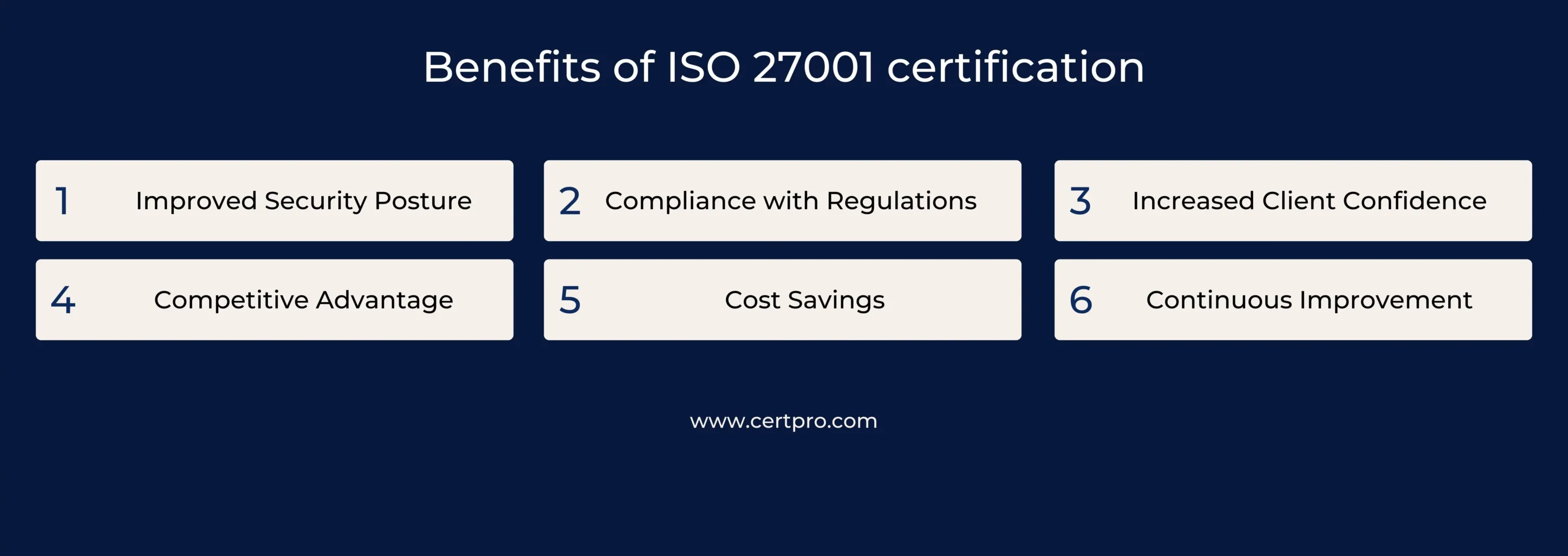
- ✓Risk Reduction and Cyber Resilience
- ✓Regulatory Compliance Alignment
- ✓Commercial and Competitive Advantages
- ✓Operational and Internal Governance Benefits
ISO 27001 Certification Process for Wellington Organisations
The ISO 27001 certification process follows a structured sequence of audit stages governed by ISO/IEC 17021-1, the international standard for certification body requirements. For Wellington organisations, the certification process is conducted by an accredited certification body — such as CertPro as a Licensed CPA Firm — and encompasses scope definition, Stage 1 documentation review, Stage 2 on-site audit, nonconformity resolution, certification decision, and an ongoing surveillance and recertification cycle. Each stage of the process involves specific evaluation activities, documentation requirements, and decision points that determine the outcome of the certification assessment.
Scope definition is the foundational activity of the ISO 27001 certification process. The ISMS scope document specifies the organisational boundaries, locations, assets, systems, and processes included within the certification boundary. Wellington organisations must define their scope with sufficient precision to capture all information assets and processing activities that carry material information security risk. The scope definition is documented in the ISMS scope statement and must be consistent with the organisation’s context analysis conducted under Clause 4 of ISO/IEC 27001:2022, which requires identification of internal and external issues relevant to the organisation’s information security objectives and the expectations of interested parties including regulators, customers, and supply chain partners.
The Stage 1 audit is a documentation review conducted by the certification auditor to evaluate the ISMS documentation against the requirements of ISO/IEC 27001:2022. During Stage 1, the auditor reviews the ISMS scope statement, information security policy, risk assessment methodology, risk treatment plan, Statement of Applicability (SoA), and key supporting procedures. The Stage 1 audit identifies any significant gaps in documentation that would prevent a successful Stage 2 audit and produces an audit report that informs the Stage 2 audit program. Stage 1 is typically conducted on-site or remotely and is completed before scheduling the Stage 2 audit, usually with an interval of at least four to six weeks to allow the organisation to address identified documentation deficiencies.
The Stage 2 audit is the primary certification assessment, conducted on-site at the Wellington organisation’s premises or through remote audit techniques for distributed or cloud-native environments. During Stage 2, the certification auditor evaluates the implementation and operational effectiveness of the ISMS against all applicable Clause requirements (Clauses 4–10) and selected Annex A controls documented in the Statement of Applicability. Control evaluation involves examination of documented procedures, observation of operational practices, interviews with personnel responsible for implementing and maintaining controls, and review of records demonstrating control operation over the audit period.
The Stage 2 audit program is structured to provide sufficient coverage of all ISMS scope elements, functional areas, and high-risk processes identified in the risk assessment. For Wellington organisations with complex technical environments — including cloud infrastructure, hybrid on-premises and SaaS deployments, and third-party managed services — the audit program addresses technology controls including access management, encryption, vulnerability management, logging and monitoring, and change management. The auditor documents findings as conformances, observations, or nonconformities, categorised as major (systemic failure to meet a clause requirement) or minor (isolated control weakness not indicating systemic failure).
Nonconformities identified during the Stage 2 audit require documented corrective actions before certification can be granted. Major nonconformities require the organisation to implement corrections and corrective actions and provide objective evidence of resolution to the certification body, typically within 90 days. Minor nonconformities are addressed within the agreed corrective action timeframe and are verified at the subsequent surveillance audit. The nonconformity resolution process requires the organisation to determine the root cause of each nonconformity, implement corrective actions to address the root cause, and verify the effectiveness of the corrective action through objective evidence such as updated procedures, implementation records, or testing results.
Following successful completion of the Stage 2 audit and resolution of any major nonconformities, the certification body’s impartial review function evaluates the audit evidence and makes a certification decision. The certification decision is made independently of the audit team to ensure impartiality. Upon a positive certification decision, the organisation is issued an ISO 27001 certificate specifying the certification scope, standard version (ISO/IEC 27001:2022), certification body accreditation details, issue date, and expiry date. ISO 27001 certificates are valid for three years and are maintained through annual surveillance audits and a full recertification audit at the end of the three-year cycle.
The certificate and associated audit report provide Wellington organisations with documented evidence of ISO 27001 certification that can be referenced in procurement submissions, regulatory correspondence, and client assurance requests. The certificate references the accreditation body (such as UKAS, JAS-ANZ, or equivalent) that has assessed the certification body’s competence, providing assurance to relying parties that the certification has been conducted in accordance with international certification body requirements. Wellington organisations should retain the certificate, audit report, and supporting ISMS documentation in a manner that facilitates retrieval for audits and regulatory reviews.
ISO 27001 certification is maintained through annual surveillance audits conducted in the first and second years following initial certification. Surveillance audits are narrower in scope than the initial Stage 2 audit and focus on verifying that the ISMS continues to operate effectively, that identified nonconformities have been addressed, and that the organisation has maintained its internal audit and management review processes. Surveillance audits also evaluate changes to the organisation’s context, scope, or risk profile that may affect the ISMS — a particularly relevant consideration for Wellington technology firms that experience rapid growth, product changes, or shifts in their cloud infrastructure footprint between certification cycles.
Recertification audits are conducted at the end of the three-year certificate validity period and involve a comprehensive reassessment of the ISMS comparable to the initial Stage 2 audit. Recertification provides an opportunity for the organisation to demonstrate ISMS maturity improvements achieved over the certification cycle and to update the ISMS scope, risk assessment, and Statement of Applicability to reflect changes in the organisation’s operations, technology environment, and threat landscape. For Wellington organisations transitioning from ISO 27001:2013 to ISO 27001:2022, the recertification audit is the designated mechanism for completing the standard transition and updating the certificate to reference the current standard version.

- ✓Stage 1: Scope Definition and Documentation Review
- ✓Stage 2: On-Site Audit and Control Evaluation
- ✓Nonconformity Review and Corrective Action
- ✓Certification Decision and Certificate Issuance
- ✓Surveillance Audits and Recertification
ISO 27001 Certification Cost in Wellington
The cost of ISO 27001 certification in Wellington is determined by multiple variables including organisational size, ISMS scope complexity, number of locations, audit duration, and the certification body selected. Certification costs are not fixed and are quoted by certification bodies based on a detailed assessment of the organisation’s scope and audit requirements. Wellington organisations should obtain formal quotations from accredited certification bodies to determine the specific cost applicable to their circumstances. The following cost components are typically involved in an initial ISO 27001 certification engagement.
Certification Audit Fees
Certification audit fees are charged by the accredited certification body for Stage 1 documentation review and Stage 2 on-site audit activities, and are calculated based on auditor-day rates and the number of audit days required. The number of audit days is determined by the IAF MD 5 guidance on audit time calculation, which considers the number of employees within scope, the complexity of the ISMS scope, the number of sites, and the maturity of existing security controls. For Wellington organisations, Stage 1 audits typically require one to two auditor-days, while Stage 2 audits for small to medium organisations may require two to four auditor-days. Annual surveillance audits are shorter, typically one to two auditor-days, and recertification audits are comparable in scope to the initial Stage 2 audit.
Internal ISMS Development and Operational Costs
In addition to external certification audit fees, Wellington organisations incur internal costs associated with ISMS development and ongoing operation. Internal costs include staff time allocated to ISMS documentation development, risk assessment activities, policy and procedure writing, control implementation, internal audit, and management review. Technology investment costs may include security information and event management (SIEM) solutions, identity and access management (IAM) platforms, endpoint protection, vulnerability scanning tools, and document management systems required to meet ISO 27001 technical control requirements. Wellington organisations should evaluate their existing technology security stack against ISO 27001 Technological Controls requirements early in the certification process to identify investment requirements and avoid timeline delays.
| Cost Component | Typical Range (NZD) | Notes |
|---|---|---|
| Stage 1 Documentation Audit | $2,000 – $5,000 | Varies by scope complexity and auditor-day rate |
| Stage 2 Certification Audit | $6,000 – $20,000 | Based on IAF MD 5 audit day calculation |
| Annual Surveillance Audit | $3,000 – $10,000 | Conducted in Year 1 and Year 2 post-certification |
| Recertification Audit (Year 3) | $6,000 – $18,000 | Full ISMS reassessment comparable to initial Stage 2 |
| Internal ISMS Development Costs | Variable | Staff time, technology tools, training, and documentation |
Wellington organisations should treat ISO 27001 certification costs as an ongoing operational investment rather than a one-time project expense. The three-year certification cycle, comprising initial certification, two annual surveillance audits, and recertification, represents a sustained financial commitment to information security governance. Organisations that maintain a well-operated ISMS between audits — through consistent internal audit, management review, and corrective action processes — typically experience lower surveillance audit fees and shorter audit durations than organisations that allow ISMS documentation and controls to become outdated between certification cycles. The operational cost of maintaining ISO 27001 certification is directly influenced by the quality and consistency of ISMS governance activities conducted throughout the year.
ISO 27001 Annex A Controls Relevant to Wellington Sectors
Wellington organisations across government, financial services, technology, and health sectors encounter distinct Annex A control requirements shaped by their specific operational contexts, technology environments, and regulatory obligations. Understanding which Annex A controls are most material to each sector enables Wellington organisations to prioritise control implementation efforts and structure their ISMS scope to reflect the highest-risk areas of their operations. The following analysis identifies Annex A controls of particular relevance to Wellington’s primary certification sectors.
Government and Public Sector Controls Focus
Wellington government agencies and Crown entities face specific information security requirements shaped by the handling of classified and sensitive government information, obligations under the Official Information Act 1982, and the requirements of the New Zealand Information Security Manual (NZISM). Key Annex A controls for government organisations include Control 5.2 (Information Security Roles and Responsibilities), requiring formal designation of security roles including information security officers and asset custodians; Control 5.12 (Classification of Information), mandating systematic classification of information assets according to sensitivity levels; and Control 5.13 (Labelling of Information), requiring application of information labels consistent with classification schemes.
Personnel security controls are particularly significant for Wellington government organisations, where security clearance requirements, background screening obligations, and access management for classified systems create complex ISMS requirements. Annex A Controls 6.1 (Screening), 6.2 (Terms and Conditions of Employment), and 6.5 (Responsibilities After Termination or Change of Employment) must be implemented in a manner consistent with New Zealand Government Security System (NZGSS) personnel security requirements. Physical security controls including Control 7.1 (Physical Security Perimeters), Control 7.3 (Securing Offices, Rooms, and Facilities), and Control 7.6 (Working in Secure Areas) must align with NZISM physical security zone requirements applicable to government premises in Wellington’s CBD and surrounding areas.
Financial Services Controls Focus
Wellington financial services organisations — including banks, insurance companies, investment managers, and fintech firms regulated by RBNZ and FMA — face information security control requirements shaped by financial data sensitivity, transaction integrity obligations, and regulatory technology risk expectations. Critical Annex A controls for financial services organisations include Control 8.5 (Secure Authentication), requiring strong authentication mechanisms for access to financial systems and customer data; Control 8.11 (Data Masking), requiring masking of sensitive financial data in non-production environments; and Control 8.12 (Data Leakage Prevention), establishing controls to prevent unauthorised disclosure of financial information.
Supply chain and third-party risk management controls are particularly relevant for Wellington financial services organisations that rely extensively on technology service providers, payment processors, data analytics platforms, and cloud service providers. Control 5.19 (Information Security in Supplier Relationships), Control 5.20 (Addressing Information Security Within Supplier Agreements), and Control 5.21 (Managing Information Security in the ICT Supply Chain) require Wellington financial institutions to establish formal processes for assessing supplier security, incorporating security requirements in contracts, and monitoring supplier compliance throughout the relationship lifecycle. These controls align with RBNZ’s outsourcing and third-party risk management expectations and FMA’s operational resilience guidance.
Technology and SaaS Sector Controls Focus
Wellington technology companies, SaaS providers, and managed service organisations require ISO 27001 ISMS implementations that address the specific security challenges of cloud-native environments, multi-tenant architectures, and software development lifecycles. Control 8.25 (Secure Development Lifecycle), requiring integration of security requirements into software development processes; Control 8.26 (Application Security Requirements), mandating security requirements specification for internally developed and acquired applications; and Control 8.28 (Secure Coding), establishing coding standards and practices to prevent common application vulnerabilities — are directly applicable to Wellington technology firms that develop or operate software products and services.
Cloud security controls introduced in ISO/IEC 27001:2022 are particularly relevant to Wellington’s technology sector. Control 5.23 (Information Security for Use of Cloud Services) requires organisations to establish processes for identifying, selecting, managing, and exiting cloud services in a manner that protects information security. For Wellington SaaS providers that operate primarily in public cloud environments — such as AWS ap-southeast-2, Azure Australia East, or local cloud infrastructure — this control requires documented cloud security policies, shared responsibility model documentation, and cloud service provider security assessment processes. Control 8.23 (Web Filtering) and Control 8.29 (Security Testing in Development and Acceptance) address web-based service security and application testing requirements relevant to Wellington’s software development community.
ISO 27001 and New Zealand Privacy Act 2020 Alignment
New Zealand’s Privacy Act 2020 imposes thirteen information privacy principles (IPPs) on organisations that collect, hold, use, or disclose personal information about New Zealand individuals. The Privacy Act 2020 applies to all Wellington organisations regardless of size or sector, and includes mandatory notifiable privacy breach obligations requiring organisations to notify the Privacy Commissioner and affected individuals when a privacy breach is likely to cause serious harm. ISO 27001 certification provides a structured framework for implementing the technical and organisational controls necessary to meet Privacy Act 2020 obligations, particularly in areas of data protection, access control, incident management, and third-party information sharing.
Mapping ISO 27001 Controls to Privacy Act Obligations
ISO 27001 Annex A controls map directly to multiple Privacy Act 2020 information privacy principles. IPP 5, requiring organisations to protect personal information from unauthorised access, use, modification, or disclosure, is addressed by ISO 27001 access control controls (8.2–8.6), cryptography controls (8.24), and network security controls (8.20–8.22). IPP 6, addressing accuracy of personal information, aligns with ISO 27001 integrity controls and configuration management requirements. IPP 11 and IPP 12, governing disclosure and assignment of personal information, are addressed by ISO 27001 controls covering supplier security (5.19–5.21), data handling procedures, and data classification (5.12–5.13).
The Privacy Act 2020 notifiable privacy breach requirements align with ISO 27001’s incident management controls, particularly Control 5.24 (Information Security Incident Management Planning and Preparation), Control 5.25 (Assessment and Decision on Information Security Events), and Control 5.26 (Response to Information Security Incidents). Wellington organisations with ISO 27001-certified ISMS have documented incident response plans that include breach detection, assessment, notification, and remediation processes — capabilities that directly support compliance with the 72-hour notification window expectation under the Privacy Act 2020 breach notification guidance. The Statement of Applicability provides a documented record of the organisation’s approach to privacy-relevant controls that can be referenced in responses to Privacy Commissioner enquiries.
Cross-Border Data Transfer Considerations for Wellington Organisations
Wellington organisations that transfer personal information to overseas recipients must comply with IPP 12 of the Privacy Act 2020, which restricts cross-border data transfers to countries or recipients that provide comparable privacy protections to New Zealand’s regime. ISO 27001 certification provides a framework for documenting and managing cross-border data flows, including identification of data transfer destinations, assessment of recipient country privacy protections, and implementation of contractual and technical safeguards for data in transit. Wellington technology companies and SaaS providers that use international cloud services or offshore development teams must address cross-border data transfer risks in their ISO 27001 risk assessment and Statement of Applicability to demonstrate compliance with IPP 12 obligations.
CertPro ISO 27001 Certification Audits in Wellington
Audit Methodology and Evaluation Framework
CertPro’s ISO 27001 audit methodology applies a risk-based audit program that allocates audit resources proportionally to the complexity, risk profile, and scope of the Wellington organisation’s ISMS. The audit program is developed from the Stage 1 documentation review findings and tailored to address the specific control domains, technology environments, and operational processes within the certification scope. Auditor assignments are made based on sector competence — CertPro assigns auditors with demonstrated knowledge and experience in the specific industry context of the Wellington organisation being assessed, including government information security frameworks, financial services regulation, and cloud technology environments.
Evidence collection during CertPro’s Stage 2 audits encompasses document and record review, personnel interviews, technical control observation, and system demonstration activities. Auditors evaluate both the design adequacy of documented controls and the operational effectiveness of controls as implemented in the Wellington organisation’s live environment. This dual-lens evaluation — assessing whether controls are designed to achieve their intended security objectives and whether they are operating as designed — provides a comprehensive basis for the certification decision and delivers meaningful assurance to Wellington organisations and their stakeholders about the actual state of information security control operation.
Wellington Sector Expertise and Local Knowledge
CertPro’s audit teams bring sector-specific knowledge of Wellington’s government, financial services, and technology environments that informs the audit program design and evidence evaluation process. This includes familiarity with the New Zealand Information Security Manual (NZISM), the Government Chief Digital Officer (GCDO) security assurance requirements, the Reserve Bank of New Zealand’s operational risk and outsourcing frameworks, and the Financial Markets Authority’s technology governance guidance. Audit programs for Wellington government agencies are structured to acknowledge NZISM control alignment as contextual evidence relevant to ISO 27001 compliance, reducing duplication in control documentation while maintaining the integrity of the certification evaluation.
Surveillance and Recertification Audit Continuity
CertPro maintains audit continuity for Wellington organisations through the full three-year certification cycle by assigning consistent audit team members across surveillance and recertification audits where possible. Audit continuity enables CertPro’s auditors to build institutional knowledge of the Wellington organisation’s ISMS, track the resolution of previously identified nonconformities and observations, and evaluate the organisation’s ISMS improvement trajectory over the certification cycle. Annual surveillance audit programs are structured to address areas not covered in the previous audit cycle, ensuring comprehensive ISMS coverage across the three-year period and avoiding gaps in evidence coverage that could affect the recertification assessment.
ISO 27001 Certification for Wellington Government Agencies
Wellington is the seat of New Zealand’s central government, hosting the majority of core government departments, Crown entities, state-owned enterprises, and public service agencies. Government agencies in Wellington handle significant volumes of classified information, citizen data, and policy-sensitive material that require robust information security governance frameworks. ISO 27001 certification provides Wellington government agencies with a structured, internationally recognised ISMS framework that complements and aligns with existing public sector security obligations under NZISM, the Protective Security Requirements (PSR), and the Government Chief Digital Officer (GCDO) security assurance expectations.
NZISM and ISO 27001 Alignment for Public Sector
The New Zealand Information Security Manual (NZISM) is the New Zealand Government’s primary information security standard, managed by the Government Communications Security Bureau (GCSB). NZISM specifies mandatory security controls for government agencies based on information classification levels, system criticality, and operational context. ISO 27001 and NZISM share significant control overlap, particularly in areas of access management, incident management, change management, and physical security, enabling Wellington government agencies to leverage ISO 27001 ISMS documentation and controls as evidence of NZISM compliance in many control domains.
Wellington government agencies pursuing ISO 27001 certification should structure their ISMS scope and Statement of Applicability to explicitly reference NZISM control mappings where applicable, creating an integrated compliance record that serves both ISO 27001 certification and NZISM compliance demonstration purposes. This integrated approach reduces the documentation burden associated with maintaining parallel compliance frameworks and provides a single source of truth for information security control status that can be referenced in GCDO security assurance submissions, internal audit reports, and ministerial briefings on agency information security posture. The integration of ISO 27001 and NZISM requirements is documented in the organisation’s compliance obligations register, maintained as part of the ISO 27001 legal, regulatory, and contractual requirements documentation.
Protective Security Requirements and ISMS Scope
New Zealand’s Protective Security Requirements (PSR) framework establishes baseline security obligations for government agencies in the areas of personnel security, physical security, and information security. The PSR information security domain specifies requirements for information asset classification, protective marking, secure handling, and access control that align closely with ISO 27001 Annex A controls in the Organisational and Physical control domains. Wellington government agencies implementing ISO 27001 can structure their ISMS to explicitly address PSR information security requirements through the risk assessment and Statement of Applicability, ensuring that PSR compliance is evidenced through the same ISMS documentation that supports ISO 27001 certification.
FAQ
▶
What is ISO 27001 certification and why is it relevant to Wellington organisations?
▶
How long does ISO 27001 certification take for a Wellington organisation?
▶
What is the difference between Stage 1 and Stage 2 ISO 27001 audits?
▶
Does ISO 27001 certification help Wellington organisations comply with the Privacy Act 2020?
▶
What is the ISO 27001 certification cost range for Wellington organisations?
▶
Is ISO 27001 certification mandatory for Wellington government agencies?
▶
What are the key differences between ISO 27001:2013 and ISO 27001:2022?
▶
How does ISO 27001 certification relate to SOC 2 for Wellington technology companies?
HOW COMPLIANCE AUDIT SOFTWARE IMPROVES AUDIT READINESS
Today, most companies deal with a growing number of compliance regulations. From data privacy standards to security frameworks like SOC 2 and ISO 2700…

THE ROLE OF GRC IN ISO 27001, SOC 2, AND OTHER FRAMEWORKS
The term GRC stands for Governance Risk and Compliance. It’s a system of integrated and centralized approaches used by organizations. This system comb…
HOW TO PREPARE FOR A MULTI-STANDARD AUDIT (SOC 2, ISO 27001, HIPAA) WITHOUT OVERLAPPING EFFORTS
The current regulatory landscape is no less than a proving ground for global businesses. Organizations are struggling to comply with the complex regul…
Get In Touch
have a question? let us get back to you.