
MALAYSIA
ISO 42001 CERTIFICATION IN MALAYSIA
In today’s fast-changing tech world, organizations are turning to global standards to prove they are ethical and trustworthy. ISO 42001 certification in Malaysia focuses on responsible artificial intelligence (AI) governance. Getting certified shows that your company values transparency, accountability, and continuous improvement. Moreover,by following these standards, Malaysian businesses go beyond basic compliance, they show a real commitment to consistency and building customer trust. To meet the rising demand for standardized AI governance, organizations must first understand the ISO 42001 assessment process in detail. This certification isn’t just about ticking boxes. It helps businesses navigate Malaysia’s complex AI regulations effectively.
Consequently, by aligning with ISO 42001 certification in Malaysia, your organization can manage AI risks better and follow global best practices. This involves conducting a strong AI risk assessment to find, evaluate, and reduce risks tied to AI systems. It also means protecting data, lowering bias, and using AI ethically in daily operations. Strong internal governance leads to smarter, more confident decisions. You’ll also benefit from regular ISO 42001 assessments that confirm ongoing improvement and compliance.In today’s digital market, trust is a powerful asset. Getting ISO 42001 certified gives Malaysian companies a real advantage. It boosts innovation and builds trust with customers, regulators, and investors. With ISO 42001 certification in Malaysia, you’re not just avoiding risks, you’re creating a safer, more responsible future for AI.
AUDIT AND CERTIFICATION SERVICES BY CERTPRO FOR ISO 42001 IN MALAYSIA
WHY CHOOSE CERTPRO FOR ISO 42001 CERTIFICATION?
Do you intend to obtain ISO 42001 certification in Malaysia? There are many benefits to using CertPro. We combine extensive regulatory knowledge with industry experience. Your team will find the entire certification process easier, quicker, and more seamless as a result. Every service we offer is customized to your business’s objectives and organizational structure, guaranteeing that our solutions are useful and pertinent. From establishing governance frameworks to establishing ethical standards and risk controls, our professionals assist you in fulfilling all of the essential ISO 42001 requirements. We also assist you with the preparation of documentation, access control procedures, and thorough gap analyses. CertPro continues to assist your company even after you become certified. We provide advice for continued compliance as well as assistance with renewals and surveillance audits. Post-certification services like recurring AI risk assessments and documentation updates are also offered by our team. You get more than just a consultant when you pick CertPro. You acquire a long-term ally committed to ethical AI governance.
WHAT IS ISO 42001 CERTIFICATION?
The world needed a framework that helped organizations to design, operate and govern AI responsibly. To meet this need, a new certification is introduced, ISO 42001. It is the first global management system standard created solely for artificial intelligence. The goal for it? It is to make AI safe, fair and effective across every industry, from government to e-commerce to healthcare and transportation. Understanding the ISO 42001 requirements from the start helps organizations align their AI strategy with regulatory expectations. When a company gets the ISO 42001 certification in Malaysia, it’s making a promise to be proactive about AI risk, champion transparency, and respect every user’s rights. As Malaysia speeds up its digital transformation, robust AI oversight is a must if we want to unlock all the benefits of technology while protecting society. Through detailed AI risk assessments, companies can identify how AI could impact customers, operations, and society.
WHY DO WE NEED ISO 42001 CERTIFICATION?
Companies that use or put in place AI-based systems should get a certification that is widely accepted. ISO 42001 certification in Malaysia shows that a business can keep an eye on how AI is used and lower the risks that come with it. Regular assessments of ISO 42001 help determine how well these systems handle AI-related risks and uphold ethical standards. An outside auditor checks the system to make sure it meets all the necessary safety requirements. Businesses build stronger relationships and gain the trust of their stakeholders by using AI in a safe and ethical way. This structured method makes sure that businesses meet and keep the ISO 42001 requirements over time. The certification also makes customers happier and improves the reputation of the brand. ISO 42001 certification in Malaysia encourages the responsible use of AI and encourages businesses to work together and grow.
ENQUIRE NOW
Related Links
SOC 2 in Malaysia
ISO 27701 in Malaysia
GDPR in Malaysia
ISO 27018 in Malaysia
HIPAA in Malaysia
CCPA in Malaysia
PIPEDA in Malaysia
ISO 17025 in Malaysia
ISO 13485 in Malaysia
CE Mark in Malaysia
GDP in Malaysia
GLP in Malaysia
ISO 9001 in Malaysia
ISO 14001 in Malaysia
ISO 45001 in Malaysia
ISO 22000 in Malaysia
HACCP in Malaysia
ISO 22301 in Malaysia
ISO 21001 in Malaysia
ISO 41001 in Malaysia
ISO 20000-1 in Malaysia

HOW TO GET ISO 42001 CERTIFICATION IN MALAYSIA
Aligning your AI management systems with the aims and objectives of the business is the first step towards obtaining ISO 42001 certification in Malaysia. All stakeholders’ expectations should be taken into account during the process. An early AI risk assessment is essential at this point. It assists in locating potential misuse or misunderstandings of AI. This step promotes secure, open, and moral AI practices. In Malaysia, ISO 42001 certification guarantees the dependability, security, and quality of AI systems. By using AI surveillance technologies, it also boosts market confidence. The ISO 42001 assessment procedure, which evaluates the effectiveness of systems’ control and operation, is directly aligned with these steps.
Consequently, the certification ensures that AI is used responsibly and in compliance. It increases overall efficiency and lowers operating costs. Additionally, it guarantees equity in AI-powered decision-making. Every stakeholder can better understand their role in maintaining compliance when ISO 42001 requirements are communicated clearly. The certification procedure creates a solid basis for evaluating the efficacy of your AI systems. Lastly, it provides structural direction for managing and regulating AI. The methodical, structured process of ISO 42001 certification in Malaysia acknowledges the difficulties associated with implementing AI and assists your company in responsibly overcoming them.
STEPS FOR ISO 42001 CERTIFICATION
The certification process demands a structural framework to guarantee that the AI-based system is effectively integrated into the organization’s functional procedure. Therefore, ISO 42001 certification in Malaysia needs to follow the following steps:
Understand the ISO 42001 AI Standards: You should begin by learning how ISO 42001 fits your organization’s AI use and strategic goals. It covers leadership roles, governance, and improvement processes. Clear scope definition ensures your AI systems align with Malaysia’s legal and ethical requirements.
Conduct Gap Analysis: It identifies and records the organization’s current AI management procedures. As a result, the auditors compare the current procedures with the particular demands of ISO 42001 certification in Malaysia. The auditing process also identifies the changes organizations must make to implement compliance effectively.
Establish an AI management System: Create a comprehensive AI Management System (AIMS) that aligns with your organization’s objectives, legal requirements, and ethical values. Define and document the scope and purpose of ISO 42001 certification. Ensure that all team members understand relevant policies, role assignments, and expected responsibilities to uphold transparency, data privacy, and fairness.
Leadership Commitment: Responsible AI implementation requires full executive support. Top-level leadership must take ownership by providing sufficient resources, clear direction, and sustained involvement to drive ISO 42001 certification forward.
Document Policies and Procedures: Based on the gap analysis, a comprehensive plan is developed and put into practice using ISO 42001. Furthermore, proper documentation establishes the resources needed for implementation and ranks the areas that want improvement. Maintaining a suitable documentation procedure for the audit is therefore essential.
Internal Audits: ISO 42001 certification in Malaysia includes an internal auditing procedure that examines the company’s AI management systems and identifies any defects. As a result, it identifies areas that require improvement and gets ready for an outside audit.
Certification Audit: External auditors evaluate the organization’s AI management system and examine the controls as the last stage of ISO 42001 certification in Malaysia. Non-conformities and certification problems require additional audits and corrections when organizations follow the proper protocol.
Certification and Ongoing Compliance: Regulatory compliance implementation necessitates ongoing observation and development. Thus, annual audits guarantee compliance adherence and aid in the compliance renewal process.

REQUIREMENTS FOR ISO 42001 CERTIFICATION
The ISO 42001 certification in Malaysia requirements depend on the organization’s specific needs. However, some general requirements are outlined below:
Purpose and Scope: For Malaysian companies, setting the right scope is a foundational step in the ISO 42001 journey. It requires identifying the business units and AI applications to cover, based on national laws, business goals, and ethical responsibilities.
Leadership Commitment: For Malaysian organizations, top-level leaders must take the lead in AI governance. They should exhibit their dedication through active participation, approval of AI policies, budget allocation, and support for ethical, transparent system implementation.
Risks Management: Identification of risks is essential to compliance implementation. It assists in identifying possible risks as well as opportunities pertaining to ISO 42001 certification in Malaysia.
Impact Assessment: These offer a thorough understanding of the possible risks associated with AI systems in businesses. Impact assessment also ensures that AI is used responsibly and helps to reduce risk. It also highlights the ethical and responsible application of AI for the good of society.
Training: In Malaysia, effective training is vital to ensure that teams are prepared to meet ISO 42001 expectations. Organizations should conduct regular awareness and skill-building sessions to promote compliance and responsible AI deployment.
Documentation and Communication: In Malaysia, an AI policy is key to building ethical AI governance. Clear documentation should support it by outlining system responsibilities, risk responses, and compliance measures. These records also serve as proof of responsible AI management.
Continuous Improvements: Malaysian organizations must develop a strategy to regularly review and improve their AI systems. This includes evaluating how AI is designed, deployed, and monitored. Ongoing updates and internal audits ensure continued alignment with ISO 42001 standards and national regulations.
ISO 42001 CERTIFICATION COST IN MALAYSIA
Obtaining an AI management certification can help organizations better manage their use of AI technologies. The first international standard created to assist businesses in using AI responsibly and ethically is ISO 42001. In Malaysia, ISO 42001 certification improves business relationships and fosters stakeholder trust. Because of this, businesses that use or create AI technologies ought to give this certification careful thought. It ensures the safe and ethical use of AI across all systems and operations. Many businesses now use AI to make automated decisions. ISO 42001 certification in Malaysia brings transparency, impartiality, and equity to those decisions. Additionally, it assists businesses in adhering to local and international standards for the responsible use of AI. The size and complexity of the company and its AI systems are the main determinants of the cost of ISO 42001 certification in Malaysia.
Additional sector-specific regulations may raise overall costs in some industries. Furthermore, long-term resilience and financial planning are necessary when constructing infrastructure for compliance. Significant financial resources may also be required for the audit process, which includes gap analysis and the identification of operational risk factors. After certification, compliance requires continuing expenditures for system monitoring, internal audits, and external audits. It’s critical to realize that ISO 42001 certification requires ongoing investment. Maintaining compliance requires constant updates and enhancements. As a result, businesses frequently require outside assistance or professional advice in order to properly implement controls. However, non-compliance frequently comes at a far higher cost. Regulation violations can result in fines, monetary losses, and reputational harm. These dangers have the potential to severely impede company expansion. Every organization should thus abide by the applicable regulatory requirements. In addition to avoiding fines, doing this promotes market credibility and speeds up growth.
BENEFITS OF ISO 42001 CERTIFICATION
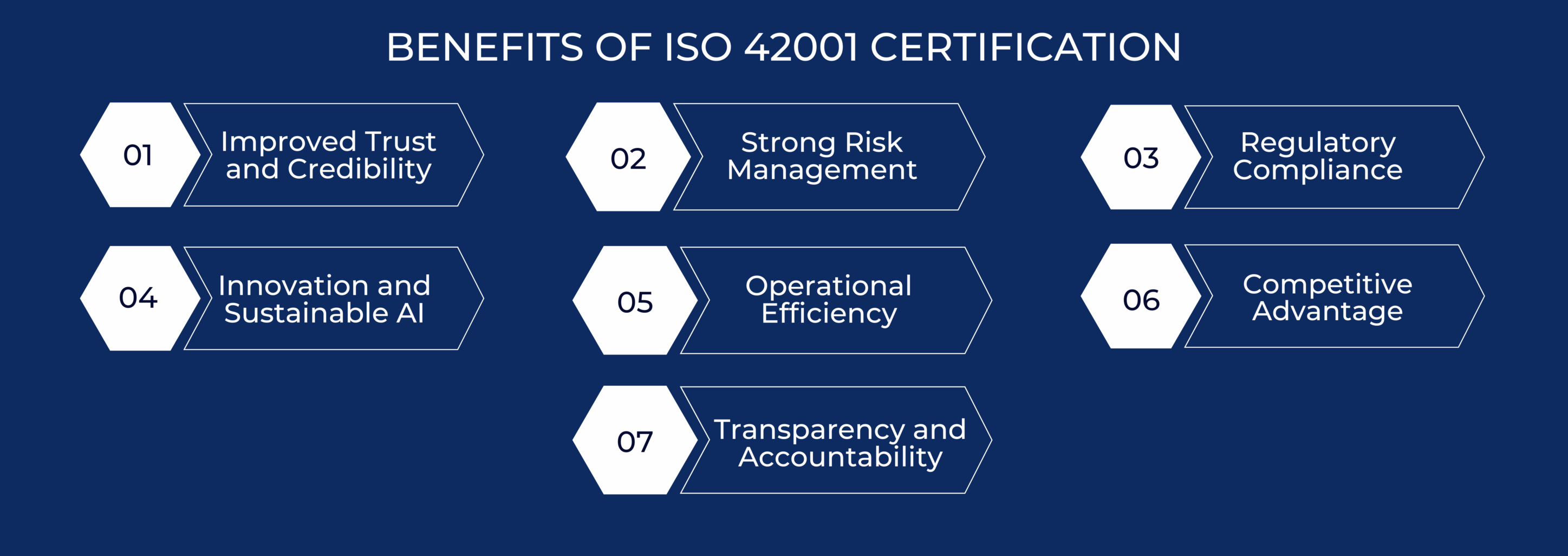
ISO 42001 certification in Malaysia offers multiple benefits that strengthen your organization’s operations, compliance, and AI system management.
Improved Trust and Credibility: ISO 42001 certification in Malaysia shows a company’s commitment to responsible AI use. This helps build customer trust and strengthens long-term relationships.
Strong Risk Management: The certification simplifies how organizations design, develop, and deploy AI systems. Following a standardized framework ensures safety and reduces inefficiencies.
Regulatory Compliance: ISO 42001 certification in Malaysia confirms that your company meets global standards. It highlights your dedication to using AI in a reliable and responsible way.
Innovation and Sustainable AI Solutions: The certification supports legal and ethical use of AI, helping companies build more dependable and sustainable systems. It lays the foundation for better AI accountability.
Operational Efficiency: With structured and well-managed AI systems, your teams can automate tasks effectively. This reduces errors, cuts downtime, and saves valuable time and resources.
Competitive Advantages: In a fast-changing market, ISO 42001 certification provides a clear competitive edge. It draws in new customers and opens up business opportunities.
Transparency and Accountability: ISO 42001 certification in Malaysia reinforces your company’s commitment to ethical AI practices. It also helps stakeholders understand the impact and responsibilities tied to AI use.
SECURE YOUR ISO 42001 CERTIFICATION IN MALAYSIA WITH CERTPRO
ISO 42001 certification in Malaysia indicates that your organization prioritizes AI governance and maintenance. Thus, it supports the growing business environment in Malaysia. If you plan for ISO 42001 certification, consider CertPro as your certification guide. Our experts walk you through AI risk assessments and all necessary documentation to meet compliance standards. We assure you of the quality of our services at a reasonable price and our experts will assist you in the process. Our support and guidance will help your organization use AI responsibly. Furthermore, our experts will tailor your certification process to the organization’s needs and ensure easy processing. This tailored approach also helps manage your ISO 42001 certification cost effectively.
Thus, collaboration with CertPro improves your AI monitoring process and reduces risks. We guarantee positive market reputations and customer relationships through our services. Ready to lead in AI governance? Partner with CertPro for reliable, cost-effective ISO 42001 certification in Malaysia. Contact CertPro.com to get started.
FAQ
How can a company get ISO certification in Malaysia?
To get ISO certification in Malaysia, a company selects the relevant standard like ISO 9001, ISO 14001, or ISO 42001. The process includes a gap analysis, implementing controls, and an audit by an accredited body. CertPro can help simplify compliance and certification.
Is there an official ISO 42001 certification for AI in Malaysia?
Yes, ISO 42001 is the official global standard for AI management systems and is available in Malaysia. It provides a structured framework for ethical and safe AI use. Organizations can apply through accredited bodies, with consultants like CertPro helping streamline compliance and audits.
What is the cost of getting ISO 14001 certification in Malaysia?
ISO 14001 certification costs in Malaysia vary by size, industry, and scope. Expenses include gap analysis, training, and audits. Small firms pay less; large ones more. For accurate pricing, consult experts like CertPro for a tailored quote.
Who accredits ISO certification bodies in Malaysia?
In Malaysia, the Department of Standards Malaysia (DSM) accredits ISO certification providers. DSM ensures bodies follow global standards. Companies should choose DSM-accredited certifiers to ensure credibility and international recognition for their ISO certification.
Is ISO 42001 certification mandatory for companies using AI in Malaysia?
ISO 42001 certification isn’t mandatory in Malaysia or worldwide, but it’s strongly recommended for AI-focused companies. It supports ethical governance, builds trust, ensures compliance, and boosts competitiveness. As AI rules evolve, ISO 42001 may become a future compliance benchmark.

GRC IN CYBERSECURITY: WHAT IT MEANS AND WHY IT MATTERS IN 2026
In 2026, the pressure on companies to manage cyber risk responsibly has never been greater. Regulators demand structured controls, boards want clear risk reporting, and threat actors are becoming more sophisticated. Against this backdrop, GRC in cybersecurity has...

HOW COMPLIANCE AUDIT SOFTWARE IMPROVES AUDIT READINESS
Today, most companies deal with a growing number of compliance regulations. From data privacy standards to security frameworks like SOC 2 and ISO 27001, the list of compliance obligations keeps expanding. At the same time, regulators and external auditors now expect...

Compliance Best Practices in 2026: How to stay ahead of regulatory changes
Why is the implementation of compliance best practices critical for 2026? Compliance in 2026 demands operational proof, not the documentation intent. Regulations change faster, audit scrutiny is higher, and reporting timelines are tighter across privacy,...