
SOC 2 Certification in Dublin
The SOC 2 audit process for Dublin organizations follows a defined sequence of evaluation stages conducted by the Licensed CPA Firm. Each stage produces structured findings that inform the auditor’s opinion on the organization’s control environment. The process is governed by AICPA AT-C Section 205 attestation standards and requires independence, professional skepticism, and sufficient appropriate evidence at every stage. The following describes the standard SOC 2 examination workflow as applied to organizations undergoing SOC 2 Certification in Dublin.
OUR CLIENTS










SOC 2 Certification for Dublin-Based Financial and Technology Organizations
SOC 2 Certification in Dublin is issued exclusively by a Licensed CPA Firm following an independent examination conducted under AICPA AT-C Section 205 attestation standards. The examination evaluates whether an organization’s internal controls are suitably designed — and, for Type 2 engagements, have operated effectively over a defined observation period. The resulting SOC 2 report provides structured, third-party verified evidence that controls governing security, availability, processing integrity, confidentiality, and privacy meet the applicable Trust Services Criteria (TSC) established by the American Institute of Certified Public Accountants.
Dublin operates as one of Europe’s primary technology and financial services hubs. The city hosts the European headquarters of major multinational technology enterprises, a dense concentration of SaaS providers, cloud platforms, AI businesses, fintech companies, financial institutions, healthcare and life sciences organizations, pharmaceutical companies, cybersecurity firms, and large-scale data center operators. These organizations routinely process sensitive data on behalf of enterprise customers in Ireland, across the European Union, in the United States, and in international markets. For these entities, SOC 2 attestation has become a standard requirement in vendor assurance, procurement, and enterprise sales processes — functioning as independently verified evidence of control effectiveness that customers and partners rely upon when evaluating third-party risk.
The demand for SOC 2 Certification in Dublin has grown significantly as multinational enterprises headquartered in the United States have made SOC 2 Type 2 reports a baseline requirement for cloud vendors, software providers, and data processors across their supply chain. Irish-founded technology companies and fintech organizations seeking to enter North American markets face similar expectations. At the same time, European customers and regulated financial institutions operating under frameworks such as the EU General Data Protection Regulation (GDPR), Ireland’s Data Protection Act 2018, and the NIS2 Directive increasingly reference SOC 2 reports as supporting evidence when assessing vendor control environments.
It is important to note that SOC 2 attestation does not automatically establish compliance with GDPR, the Data Protection Act 2018, NIS2, or other Irish or EU regulatory requirements — those determinations are made by the relevant regulatory authorities. SOC 2 attestation addresses the design and operational effectiveness of internal controls against the Trust Services Criteria, which is a distinct but complementary evaluation.
SOC 2 Certification in Dublin is relevant across a wide range of sectors and organizational profiles. Dublin-based SaaS companies providing enterprise software to regulated industries, cloud service providers managing infrastructure for financial or healthcare customers, managed security service providers, payment technology firms, clinical data organizations, AI platform operators processing personal information, and data center operators providing colocation or hosting services to multinational clients are among the primary candidates.
The SOC 2 examination scope is defined by the service organization itself — in consultation with the Licensed CPA Firm performing the audit — based on the systems, services, and data types that are material to customer commitments and service level agreements. This flexibility allows the examination to be precisely calibrated to the organization’s actual service delivery environment rather than applied as a one-size-fits-all framework.
CertPro operates as an independent Licensed CPA Firm delivering SOC 2 audit and attestation services to organizations across Dublin and Ireland. The firm conducts SOC 2 examinations strictly under AICPA attestation standards, evaluating control design and operational effectiveness against the Trust Services Criteria. CertPro does not provide consulting, advisory, control design, implementation, remediation, or managed compliance services — the firm functions exclusively as an independent third-party auditor, maintaining the objectivity and independence required for a credible SOC 2 attestation engagement. This separation is fundamental to the integrity of the SOC 2 report and its value to customers, partners, and regulators who rely on it as an independent assessment of the service organization’s control environment.

What Is SOC 2 Certification
SOC 2 Certification is an independent attestation engagement performed by a Licensed CPA Firm under AICPA AT-C Section 205. The examination determines whether a service organization’s controls are suitably designed and operating effectively in accordance with the Trust Services Criteria. SOC 2 is not a product certification or a regulatory license — it is an attestation report issued by a qualified auditor expressing an opinion on the state of a service organization’s control environment during a specified period or at a specific point in time.
The Trust Services Criteria define the control requirements across five categories: Security, Availability, Processing Integrity, Confidentiality, and Privacy. Security is the only mandatory criterion; the remaining four are included based on the nature of the services provided and the commitments made to customers.
The AICPA Trust Services Criteria Framework
The AICPA Trust Services Criteria framework organizes control requirements into five distinct categories. The Security criterion — also referred to as the Common Criteria — addresses logical and physical access controls, risk management, change management, system monitoring, and incident response. Availability addresses whether systems are available for operation and use as committed. Processing Integrity evaluates whether system processing is complete, valid, accurate, timely, and authorized. Confidentiality addresses how confidential information is collected, used, retained, and disclosed. Privacy evaluates the collection, use, retention, and disposal of personal information in accordance with the organization’s privacy notice and applicable privacy principles.
Dublin-based organizations typically include Security as the baseline criterion and add Availability, Confidentiality, or Privacy based on their service commitments and the sensitivity of data they process.
Each Trust Services Criterion is further organized into points of focus — specific attributes that illustrate how the criterion can be met through various control activities. The auditor evaluates whether the organization’s controls address these points of focus in the context of the specific services and systems within scope. For Dublin-based cloud service providers and SaaS companies, the Security criterion typically involves evaluating logical access provisioning and deprovisioning procedures, multi-factor authentication controls, encryption standards, vulnerability management programs, security incident detection and response procedures, and vendor management controls.
The inclusion of the Privacy criterion is particularly relevant for Dublin organizations processing personal data on behalf of customers subject to GDPR, though the SOC 2 examination evaluates privacy controls against the AICPA’s Privacy criteria rather than directly against GDPR requirements.
SOC 2 Certification vs. SOC 2 Compliance
A critical distinction exists between SOC 2 certification and SOC 2 compliance. SOC 2 compliance refers to an organization following its own internal control procedures or aligning with the Trust Services Criteria without independent third-party verification. SOC 2 Certification — more precisely referred to as SOC 2 attestation — occurs only when a Licensed CPA Firm has independently examined the organization’s controls and issued a formal opinion.
The SOC 2 examination is the mechanism through which compliance becomes attestation: the auditor tests controls, reviews evidence, evaluates design suitability, and concludes whether the organization’s controls meet the applicable Trust Services Criteria. Customers, enterprise procurement teams, and regulators rely on SOC 2 attestation precisely because it reflects independent verification rather than self-assessment. Organizations in Dublin that describe themselves as SOC 2 compliant without a completed audit have not completed a SOC 2 examination.
SOC 2 Type 1 and Type 2 Reports — Structure and Distinctions
SOC 2 reports are issued in two distinct forms — Type 1 and Type 2 — each serving a different purpose and reflecting a different scope of examination. Understanding the structural differences between these report types is essential for Dublin organizations determining which engagement is appropriate for their current stage, customer requirements, and audit program objectives. The choice between a SOC 2 Type 1 and Type 2 engagement is driven by the nature of the evidence available, the organization’s control environment maturity, and the assurance requirements of the organization’s customers and partners.
SOC 2 Type 1 Certification Dublin — Point-in-Time Examination
A SOC 2 Type 1 certification Dublin engagement evaluates the design suitability of an organization’s controls at a specific point in time. The auditor determines whether the controls described in management’s system description are suitably designed to meet the applicable Trust Services Criteria as of the report date. The Type 1 examination does not assess whether controls have operated effectively over a period — it addresses design only.
This makes Type 1 appropriate for organizations that have recently implemented a control framework and need to demonstrate to customers or partners that their controls are appropriately structured before completing a full observation period. The Type 1 report provides a formal, auditor-issued attestation that can be shared with customers while the organization builds the operational history required for a Type 2 engagement.
For Dublin-based technology and fintech organizations entering enterprise sales processes or responding to vendor assurance questionnaires, a SOC 2 Type 1 report can satisfy initial customer requirements and demonstrate control design maturity while the Type 2 observation period is underway. The Type 1 examination typically requires less elapsed time than Type 2 because there is no observation period requirement — the audit evaluates the state of controls as of a single date rather than across a defined period.
However, many enterprise customers and procurement functions in North American markets — which are significant for Dublin’s technology sector — ultimately require a Type 2 report to confirm that controls are not only designed correctly but have also operated consistently over time.
SOC 2 Type 2 Certification Dublin — Operational Effectiveness Examination
A SOC 2 Type 2 certification Dublin engagement evaluates both the design suitability of controls and their operational effectiveness over a defined observation period. The observation period for a Type 2 examination is typically six to twelve months, with twelve months being the most commonly requested period by enterprise customers. During this period, the auditor collects evidence demonstrating that each control within scope operated as described — including configuration logs, access reviews, change management records, security monitoring outputs, incident response documentation, and personnel training records.
The auditor tests a sample of control instances across the observation period to form a conclusion on operational effectiveness. The resulting SOC 2 Type 2 report reflects the highest level of assurance available under the SOC 2 framework.
| Attribute | SOC 2 Type 1 | SOC 2 Type 2 |
|---|---|---|
| Examination Scope | Control design evaluated at a specific date | Control design and operational effectiveness evaluated over a defined period |
| Observation Period | None — point-in-time assessment only | Typically 6 to 12 months |
| Evidence Collected | Documentation of control design and structure | Design documentation plus operational testing across the full period |
| Assurance Level | Design suitability only | Design suitability and operating effectiveness |
| Primary Use Case | Initial attestation; early-stage control environments | Ongoing vendor assurance; enterprise and regulated-sector requirements |
SOC 2 Audit Process for Dublin Organizations
The SOC 2 audit process for Dublin organizations follows a defined sequence of evaluation stages conducted by the Licensed CPA Firm. Each stage produces structured findings that inform the auditor’s opinion on the organization’s control environment. The process is governed by AICPA AT-C Section 205 attestation standards and requires independence, professional skepticism, and sufficient appropriate evidence at every stage. The following describes the standard SOC 2 examination workflow as applied to organizations undergoing SOC 2 Certification in Dublin.
Scope definition is the foundational stage of the SOC 2 audit process. The service organization defines the systems, services, infrastructure components, and data types that fall within the examination boundary. The auditor reviews the proposed scope against the organization’s service commitments, customer contracts, and system description to confirm that the scope is complete and accurately represents the services being attested.
The Trust Services Criteria categories to be included are determined based on the nature of the services in scope — for example, a Dublin-based cloud infrastructure provider would typically include Security and Availability, while a payments processing platform may also include Processing Integrity. The Licensed CPA Firm then determines the audit program: the specific procedures, evidence requirements, and testing approach that will be applied to evaluate each control within the defined scope.
For Dublin organizations operating across hybrid cloud environments — which is common among the city’s technology and financial services firms — scope definition must address the boundaries between systems managed by the organization and those managed by subservice organizations such as cloud infrastructure providers (AWS, Microsoft Azure, Google Cloud). The auditor determines whether the examination will use the inclusive method (including subservice organization controls within scope) or the carve-out method (excluding subservice organization controls and requiring the organization to obtain their own SOC reports as evidence).
Most Dublin-based service organizations use the carve-out method and reference their cloud provider’s SOC 2 reports as complementary user entity controls, which the auditor reviews as part of the evidence evaluation process.
The Stage 1 audit focuses on reviewing documentation that supports the organization’s control environment and assessing whether controls are suitably designed to meet the applicable Trust Services Criteria. The auditor reviews the system description prepared by management, which must accurately describe the services, infrastructure, software, people, procedures, and data involved in delivering the in-scope services.
The auditor also reviews policies, procedures, control matrices, risk assessments, vendor agreements, organizational charts, and supporting documentation to determine whether the control framework is coherent and whether each Trust Services Criterion is addressed by at least one control. Deficiencies in control design identified at Stage 1 are communicated to management and must be addressed before the examination proceeds to operational testing.
Control testing is the core operational phase of the SOC 2 examination. For Type 2 engagements, the auditor collects and evaluates evidence of control operation across the full observation period. Evidence types include observational evidence (screenshots, system configurations, real-time observations), documentary evidence (access review records, change management tickets, incident logs, training completion records), and analytical evidence (security monitoring dashboards, log reports, trend analyses).
The auditor applies sampling methodology to select instances of control operation for testing, evaluating whether each sampled instance demonstrates that the control operated as described in the system description. The volume and nature of evidence required depends on the frequency of the control — automated daily controls require different sampling than quarterly management reviews.
Following the completion of control testing, the auditor conducts a nonconformity review — evaluating any identified control deviations, exceptions, or gaps against the overall conclusion. Not every deviation results in a qualified opinion; the auditor assesses the nature, frequency, and systemic impact of exceptions before forming a final conclusion.
The SOC 2 report is then prepared, incorporating management’s system description, the auditor’s description of tests performed and results obtained, and the auditor’s opinion. The report is issued to management and is intended for distribution to specified users — typically current customers, prospective customers under NDA, and relevant regulators — under the restricted use provisions applicable to SOC 2 reports. The SOC 2 audit Dublin process concludes with report issuance; ongoing control monitoring and annual re-examination are management responsibilities.
- ✓Scope Definition and Audit Program Determination
- ✓Stage 1 Audit — Documentation and Control Design Review
- ✓Control Testing, Evidence Collection, and Report Issuance
Why Organizations in Dublin Pursue SOC 2 Certification
Organizations across Dublin pursue SOC 2 Certification for Dublin-specific commercial, regulatory, and operational reasons. The primary driver is enterprise customer demand: large technology companies, financial institutions, healthcare organizations, and regulated enterprises operating in North American and European markets require independent evidence of control effectiveness before onboarding technology vendors, data processors, or cloud service providers. A SOC 2 Type 2 report satisfies this requirement in a standardized, auditor-verified format that procurement and security teams can evaluate without conducting their own audits of each vendor’s environment.
Commercial and Market Access Drivers
For Dublin-based SaaS companies and cloud providers targeting North American enterprise customers, SOC 2 Type 2 certification has become a baseline procurement requirement rather than a differentiating factor. Organizations without a current SOC 2 report are frequently eliminated from procurement processes or required to complete extensive customer-specific security questionnaires that consume significant internal resources.
SOC 2 certification for Dublin fintech companies serving regulated US financial institutions carries additional expectations, with SOC 2 Type 2 reports often required under vendor management programs governed by OCC and FFIEC guidance. Dublin’s role as the European headquarters location for major US technology firms also means that many locally-based entities are subject to their parent organizations’ vendor assurance requirements, which typically mandate SOC 2 attestation for material service providers.
Within the Irish and European market, SOC 2 compliance in Dublin is increasingly referenced in vendor assurance and third-party risk management programs operated by regulated financial institutions, insurance companies, healthcare organizations, and public sector entities. While the NIS2 Directive and DORA (Digital Operational Resilience Act) establish their own requirements for ICT risk management and third-party oversight, SOC 2 reports are used as supporting documentation in vendor assessment processes because they provide detailed, auditor-tested evidence of specific control activities.
Irish financial institutions regulated by the Central Bank of Ireland and entities subject to EBA outsourcing guidelines reference SOC 2 reports as part of their ongoing due diligence on critical and important function service providers.
Operational and Risk Management Outcomes
Beyond external market requirements, the SOC 2 examination process produces internal outcomes that strengthen an organization’s control environment. The discipline of defining controls, documenting evidence, and sustaining consistent operation across an observation period creates accountability structures that reduce the likelihood of security incidents, access control failures, and availability disruptions.
Organizations that complete annual SOC 2 Type 2 cycles typically develop more mature control monitoring programs, cleaner access management processes, and more structured incident response procedures than organizations without independent examination obligations. The evidence collection requirements of the SOC 2 audit — including centralized logging, access review records, and change management documentation — align with the operational monitoring practices required for effective security management.
SOC 2 Certification Scope and Independent Decision Framework
Determining the appropriate scope for a SOC 2 examination is a critical decision that affects the relevance, credibility, and commercial utility of the resulting report. The scope encompasses the systems, services, people, processes, and data flows that are material to the delivery of the in-scope services and to customer commitments. A scope that is too narrow may not satisfy customer requirements; a scope that is too broad may include systems or processes that are not relevant to the attested services, increasing examination complexity without adding meaningful assurance value.
Defining System Boundaries and Included Components
The system description prepared by management for a SOC 2 examination must accurately identify the five components of the system: infrastructure (hardware and operating systems), software (applications and databases), people (personnel and their roles), procedures (manual and automated processes), and data (types of data processed and stored). For Dublin-based technology organizations operating in multi-cloud or hybrid environments, the system description must clearly delineate which infrastructure components are within scope, which are operated by subservice organizations under carve-out, and how data flows between components.
The auditor evaluates the completeness and accuracy of the system description as part of the examination — a system description that omits material components or misrepresents data flows can result in a qualified opinion.
For Dublin organizations that have undergone organizational changes — acquisitions, product expansions, geographic expansion, or migration to new cloud platforms — scope decisions must reflect the current state of the service delivery environment as of the examination period. Controls that were in place at the beginning of the observation period but were subsequently replaced or discontinued must be addressed in the system description and audit evidence.
The auditor’s testing must cover the full observation period, including any transitional periods during which control environments changed. This is a common consideration for Dublin-based technology companies operating in fast-growing sectors where infrastructure and product architecture evolve frequently during any twelve-month observation window.
Management Responsibilities and the Independence of the Licensed CPA Firm
The SOC 2 examination is structured on a clear division between management responsibilities and auditor responsibilities. Management of the service organization is responsible for designing and implementing controls, maintaining the systems within scope, preparing the system description, and making the assertion that controls meet the applicable Trust Services Criteria. Management is also responsible for maintaining the evidence that supports the assertion — including access logs, configuration records, incident reports, and review documentation — throughout the observation period.
The Licensed CPA Firm is responsible for independently evaluating management’s assertion, testing the evidence, and issuing the audit opinion. The Licensed CPA Firm does not design controls, prepare the system description, or select which Trust Services Criteria to include — these are exclusively management decisions.
SOC 2 and Regulatory Alignment in Europe
Dublin organizations operating within the European regulatory environment must understand the relationship between SOC 2 attestation and applicable Irish and EU regulatory frameworks. SOC 2 is a voluntary attestation framework developed by the AICPA and does not constitute a regulatory requirement under Irish or EU law. However, SOC 2 reports are widely referenced in regulatory and contractual contexts across Europe because they provide structured, auditor-verified evidence of control effectiveness that supports vendor due diligence, data processing agreement obligations, and third-party risk management programs.
GDPR, Data Protection Act 2018, and SOC 2 Attestation
The EU General Data Protection Regulation (GDPR) and Ireland’s Data Protection Act 2018 impose specific obligations on data controllers and data processors regarding the implementation of appropriate technical and organizational measures to protect personal data. Article 28 of GDPR requires data controllers to use only processors that provide sufficient guarantees regarding technical and organizational measures. A SOC 2 Type 2 report — particularly one that includes the Privacy Trust Services Criterion — provides documented, auditor-tested evidence of technical and organizational control measures that Dublin-based data processors can reference in negotiations with data controllers seeking to satisfy their Article 28 due diligence obligations.
It is essential to clarify that a SOC 2 attestation does not constitute a determination of GDPR compliance — GDPR compliance determinations are made by data protection authorities such as the Irish Data Protection Commission (DPC), not by a Licensed CPA Firm conducting a SOC 2 examination.
The NIS2 Directive, transposed into Irish law through the European Union (Measures for a High Common Level of Cybersecurity) Regulations, establishes cybersecurity risk management and incident reporting requirements for entities in essential and important sectors. Dublin-based organizations in sectors covered by NIS2 — including digital infrastructure, cloud computing services, ICT service management, and financial market infrastructure — must implement appropriate and proportionate technical and operational measures.
While NIS2 does not mandate SOC 2 attestation, the control evidence documented in a SOC 2 Type 2 report — covering network security, access control, cryptography, supply chain security, and incident handling — aligns with the technical measures expected under NIS2 Article 21. SOC 2 examination reports from Dublin engagements are therefore increasingly referenced by NIS2-covered entities as supporting documentation in their compliance records, subject to the understanding that the SOC 2 examination evaluates controls against the AICPA’s TSC rather than against NIS2 requirements directly.
DORA and Financial Sector ICT Risk Management
The Digital Operational Resilience Act (DORA) applies to financial entities and their critical ICT third-party service providers operating in the EU. For Dublin-based fintech companies, payment processors, and ICT service providers serving financial institutions, DORA introduces mandatory contractual requirements, ICT risk assessments, and oversight obligations for critical third-party providers. SOC 2 attestation in Dublin is referenced by some financial sector entities as part of their third-party ICT risk assessment programs because it provides independently verified evidence of controls relevant to ICT resilience — including availability, change management, incident response, and business continuity.
However, DORA compliance determinations are made by the relevant competent authority under DORA’s oversight framework; a SOC 2 report supports but does not substitute for DORA-required assessments and documentation.
SOC 2 Certification Requirements for Dublin Organizations
SOC 2 examination requirements center on demonstrating that controls exist, are suitably designed, and — for Type 2 examinations — have operated effectively throughout the observation period. Dublin organizations preparing for a SOC 2 audit must ensure that their control environment is documented, that evidence of control operation is systematically captured and retained, and that management can make a credible assertion regarding control effectiveness. The following summarizes the principal requirement categories evaluated during a SOC 2 examination.
The SOC 2 examination requires the service organization to maintain documented policies and procedures that describe how controls operate. Documentation requirements include information security policies, access management procedures, change management workflows, risk assessment processes, vendor management procedures, business continuity and disaster recovery plans, and incident response procedures. These documents must reflect the actual operation of controls during the examination period — outdated or aspirational documentation that does not match current practice creates discrepancies that the auditor identifies and reports.
For Dublin-based organizations, documentation should also address controls relevant to data center operations, cloud environment configurations, personnel security, and customer data handling procedures specific to the services within scope.
- ✓Information security policy and supporting procedures covering the in-scope environment
- ✓Access management records demonstrating provisioning, review, and deprovisioning of user access
- ✓Change management documentation including approvals, testing records, and deployment logs
- ✓Risk assessment documentation identifying, evaluating, and addressing risks to the in-scope systems
- ✓Vendor and subservice organization management records including SOC reports from cloud providers
- ✓Incident response records documenting identification, escalation, investigation, and resolution
- ✓Business continuity and disaster recovery plans with evidence of testing during the observation period
- ✓Security monitoring outputs including logs, alerts, and vulnerability scan results
Technical controls evaluated during a SOC 2 audit include logical access controls, network segmentation and firewall configuration, encryption of data in transit and at rest, multi-factor authentication, vulnerability management and patch management processes, centralized logging and monitoring systems, and configuration management. Centralized logging is a critical technical requirement: the SOC 2 examination relies on log evidence to verify that controls such as access reviews, system monitoring, and incident detection operated as described.
Dublin organizations operating in cloud environments must ensure that logging is enabled at the appropriate level across all in-scope infrastructure and that log retention meets the requirements of the observation period. The auditor reviews log configurations and samples log outputs as part of operational effectiveness testing.
Operational controls include periodic access reviews (typically quarterly), security awareness training completion, management review of security metrics and dashboards, change advisory board approvals, and vendor risk review cycles. The frequency and consistency of these operational controls must be maintained throughout the observation period — controls that are performed for part of the period but lapse at other times may result in exceptions noted in the Type 2 report.
For Dublin-based organizations with distributed teams, remote workforce arrangements, or operations across multiple jurisdictions, operational control consistency requires deliberate coordination to ensure that control performance is documented and evidence is captured regardless of where personnel are located or what systems they are accessing.
- ✓Documentation and Control Framework Requirements
- ✓Technical and Operational Control Requirements
Benefits of SOC 2 Certification for Dublin-Based Organizations
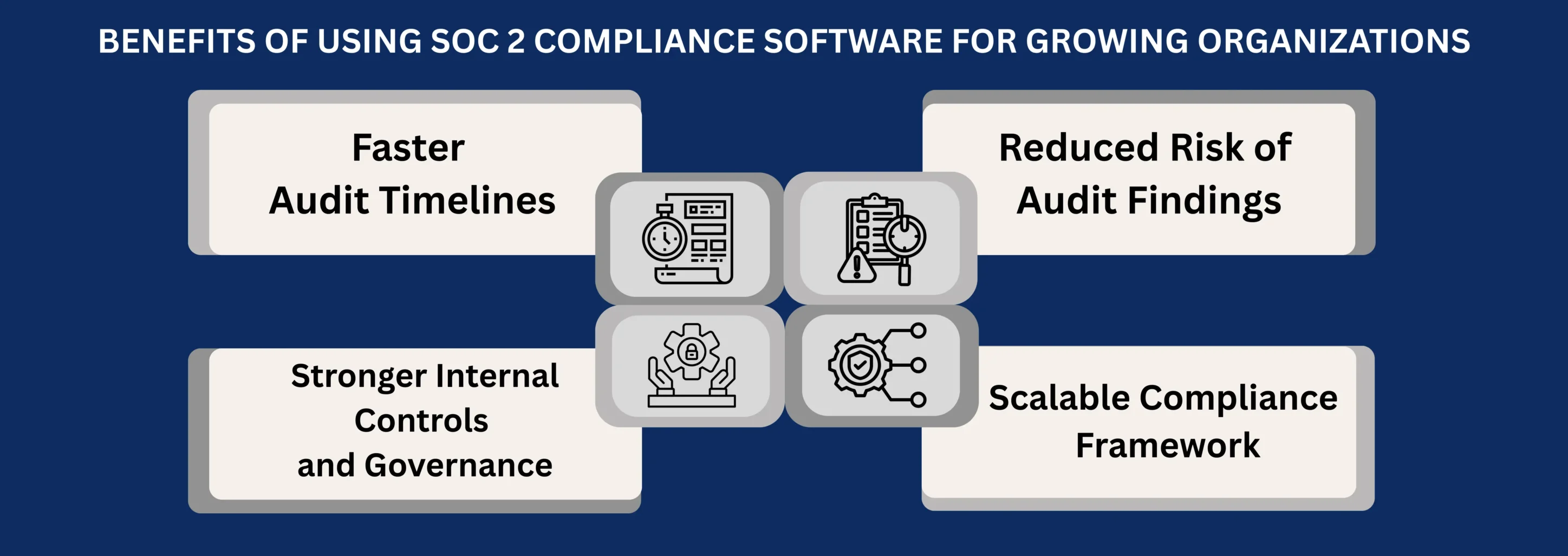
The benefits of SOC 2 Certification in Dublin extend across commercial, operational, and risk management dimensions. A completed SOC 2 examination produces a formal attestation report that serves as independently verified evidence of control effectiveness — a tangible asset in enterprise sales, vendor onboarding, regulatory due diligence, and customer retention contexts. The following summarizes the principal benefits that Dublin organizations derive from completing a SOC 2 audit.
- ✓Accelerated enterprise sales cycles by satisfying vendor assurance requirements with a standardized, auditor-issued report rather than custom security questionnaires
- ✓Market access to North American enterprise customers and regulated financial institutions that require SOC 2 Type 2 attestation as a procurement condition
- ✓Enhanced credibility in GDPR Article 28 data processing negotiations by providing auditor-tested evidence of technical and organizational measures
- ✓Strengthened third-party risk management positioning with European customers, regulated entities, and NIS2-covered organizations
- ✓Documented control environment that supports internal audit, board-level risk reporting, and investor due diligence processes
- ✓Annual SOC 2 examination discipline that drives consistent control monitoring, evidence capture, and risk management across the organization
- ✓Formal report that can be shared with multiple customers simultaneously, reducing the time burden of individual customer security assessment requests
- ✓Demonstrated maturity in information security governance that differentiates Dublin technology companies in competitive procurement evaluations
A SOC 2 Type 2 report covers a specific observation period and is dated as of the end of that period. The report does not carry an indefinite validity — customers and enterprise procurement functions typically expect a report dated within the preceding twelve months. Organizations that allow their SOC 2 report to lapse by more than twelve months risk losing the commercial and assurance benefits of the certification because customers cannot rely on a report that does not reflect a current evaluation of the control environment.
Dublin organizations maintaining ongoing SOC 2 compliance must complete annual Type 2 examination cycles to sustain a current report. Annual re-examination also ensures that changes to the control environment — new systems, organizational changes, cloud migrations, product expansions — are captured and evaluated in the most recent report period.
- ✓Report Validity and Annual Examination Cycles
Why CertPro for SOC 2 Attestation in Dublin
CertPro operates as a Licensed CPA Firm delivering SOC 2 attestation exclusively under AICPA AT-C Section 205 standards. The firm’s examination methodology is structured around the Trust Services Criteria and applies rigorous audit procedures to evaluate control design and operational effectiveness. CertPro’s SOC 2 attestation Dublin engagements are conducted by qualified audit professionals with direct experience in technology, financial services, cloud environments, and data-intensive operations — the sectors that represent the majority of SOC 2 audit demand across Dublin and Ireland.
Independent Audit Methodology and Structured Examination Approach
CertPro’s SOC 2 examination methodology follows the structured audit process described by AICPA attestation standards: scope definition and audit program determination, Stage 1 documentation review and control design assessment, observation period evidence collection and control testing, nonconformity evaluation, and formal report issuance. The firm maintains strict independence from the service organizations it examines — CertPro does not provide control design, policy development, remediation, or management consulting services to examination clients.
This independence is a prerequisite for a credible SOC 2 attestation under professional standards and is the foundation of the report’s value to the customers and partners who rely on it.
CertPro’s structured SOC 2 examination approach is specifically adapted to the operational realities of Dublin’s technology and financial services organizations. The firm’s auditors are experienced in evaluating cloud-native control environments — including AWS, Azure, and Google Cloud configurations — multi-tenant SaaS architectures, payment processing control frameworks, clinical data environments, and AI platform operations. The examination procedures account for carve-out subservice organization arrangements, which are standard in Dublin’s cloud-dependent technology sector, and include review of subservice organization SOC reports as part of the complementary user entity control assessment. The resulting SOC 2 attestation report is structured for direct use in enterprise procurement, vendor assurance, and regulatory due diligence contexts.
Sector Coverage Across Dublin’s Technology and Financial Services Ecosystem
CertPro conducts SOC 2 examinations across the full range of technology and data-intensive sectors represented in Dublin’s business ecosystem. This includes SaaS providers and cloud platform operators serving enterprise customers, fintech companies and payment technology organizations, financial services technology providers, healthcare and life sciences data organizations, pharmaceutical companies managing clinical and regulatory data, cybersecurity service providers, managed detection and response firms, AI and machine learning platform operators processing personal or sensitive data, and data center operators providing colocation, managed hosting, or infrastructure-as-a-service to regulated-sector customers. Each sector presents distinct control environment characteristics that inform the audit program and evidence collection approach applied during the SOC 2 examination.
FAQ
▶
What is SOC 2 Certification in Dublin?
▶
What is SOC 2 Certification and how does it apply to Dublin organizations?
▶
What is the difference between SOC 2 Type 1 and Type 2 for Dublin companies?
▶
How long does a SOC 2 audit take for a Dublin organization?
▶
Which Trust Services Criteria should Dublin organizations include in their SOC 2 examination?
▶
Does SOC 2 attestation demonstrate GDPR compliance for Dublin organizations?
▶
What evidence is required for a SOC 2 Type 2 examination in Dublin?
▶
How does SOC 2 Certification differ from ISO 27001 for Dublin organizations?
SOC 1 VS SOC 2: WHICH REPORT YOUR CUSTOMERS ACTUALLY ASK FOR
If you sell SaaS or provide outsourced services, you have likely been asked for a SOC report. However, the follow-up question is rarely easy to answer…

AICPA Issues New Guidance for Peer Reviewers Evaluating SOC 2 Engagements
AICPA SOC 2 guidance has been issued to help peer reviewers identify quality risks associated with SOC 2 engagements as the use of compliance automati…
SOC 2 Certified: What Does It Mean for Your Business
For companies that handle sensitive data or run cloud-based services, the question “Can you provide your SOC 2 report?” carries enormous weight. Yet, …
Get In Touch
have a question? let us get back to you.