Issues and nonconformities are unavoidable in any organization. Whether they are the result of a quality issue, a process flaw, or a customer complaint, these incidents can have a significant impact on operational effectiveness and customer satisfaction. Organizations frequently use a methodical methodology known as “Corrective Action Reports” (CARs) to address and resolve these problems efficiently.
A Corrective Action Report is a critical tool that assists businesses in identifying the core causes of difficulties, implementing corrective measures, and preventing their recurrence. CARs enable continuous improvement and promote organizational performance by recording the problem, understanding its underlying causes, and articulating the activities done to fix the situation. In this blog will go over the specifics of a CAR and give a step-by-step tutorial on how to efficiently construct one. Organizations may improve their problem-solving capacities and establish a culture of quality and improvement by knowing and employing this essential tool.

Tl; DR:
Concern: Organizations across industries face unavoidable issues such as process flaws, quality failures, and customer complaints. Left unresolved, these nonconformities impact efficiency, compliance, and customer trust. Without a structured method, problems may recur, increasing costs and reducing overall performance.
Overview: A Corrective Action Report (CAR) is a formal document that helps businesses address nonconformities systematically. It is part of quality management system documentation and often links with quality control reports and process improvement methods. CARs ensure issues are identified, root causes are analyzed, and corrective measures are implemented and monitored for effectiveness. By promoting accountability, transparency, and continuous improvement, CARs become a critical tool for maintaining quality standards and supporting long-term organizational resilience.
Solution: The CAR process involves clear problem identification, structured root cause analysis, actionable corrective steps, assigned responsibilities, and verification of outcomes. Using methods like the 5 Whys, fishbone diagrams, and PDCA, organizations can prevent recurrence. Modern digital QMS tools and CAPA frameworks further strengthen monitoring, ensuring sustainable process improvement and enhanced customer satisfaction.
WHAT IS A CORRECTIVE ACTION REPORT?
A corrective action report (CAR) is a document that details the activities taken to address and remedy a recognized problem or nonconformity within an organization. It is a methodical technique to determine the core cause of an issue and devise a strategy to prevent its recurrence in the future. A CAR’s objective is to provide a systematic framework for finding, assessing, and correcting problems in order to improve processes, systems, and overall performance. It usually starts with a description of the problem, including data like when and where it happened, the impact it had, and any urgent steps taken to reduce its repercussions.
The CAR then uses approaches such as the 5 Whys, fishbone diagrams, or cause-and-effect analysis to determine the root cause of the problem. Coming up with a corrective action plan can be helpful. This aids in determining the underlying causes of the problem, whether they are connected to human error, equipment failure, procedure inadequacies, or other issues. Today, CARs are not just reactive but also support quality management system documentation requirements. Many organizations integrate CARs with their quality control reports and audit trails, ensuring traceability and readiness for compliance checks.
A WELL EXECUTING PLAN FOR CAR
A Corrective Action Report (CAR) plan is a document that explains the methods and procedures for addressing and resolving reported issues, problems, or non-conformities inside a company.
The goal of this report is to provide a disciplined and methodical approach to problem solving and process improvement. It assists companies in identifying the fundamental causes of problems, implementing effective remedial steps, and preventing similar difficulties in the future.
Firstly, identify the problem and explain the nonconformance or issue in full, including specifics such as what went wrong, when and where it occurred, and any relevant supporting information or proof.
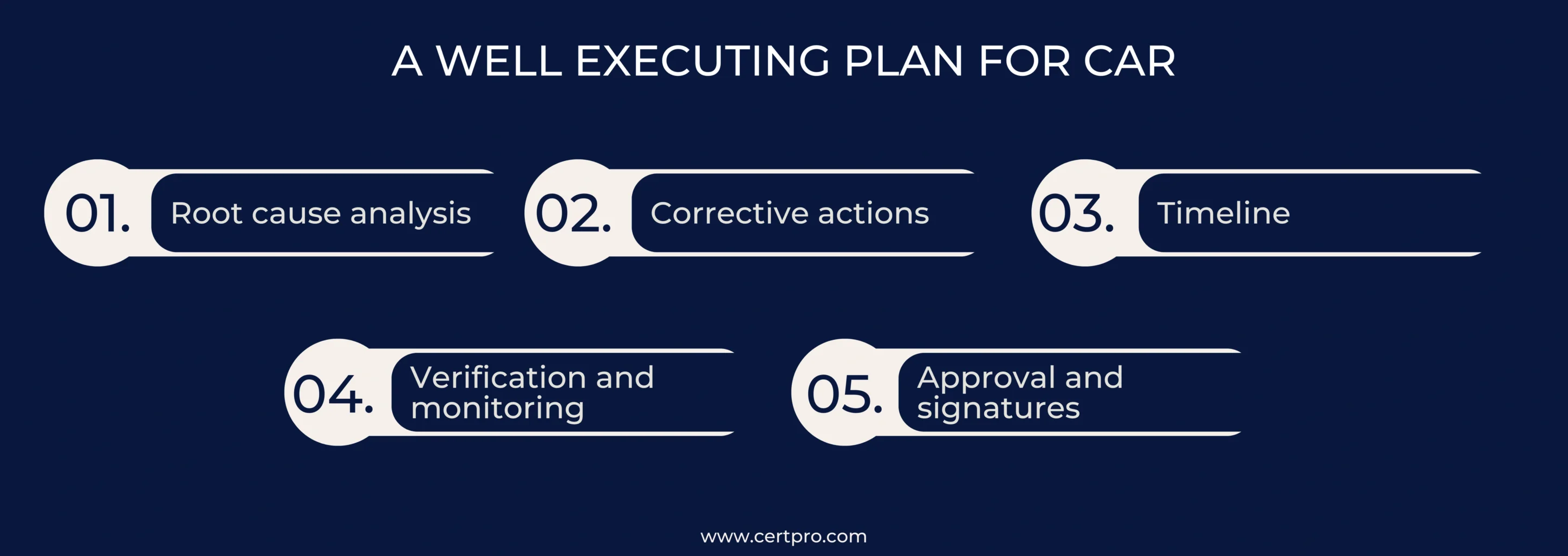
A typical Corrective Action Report contains the following details:
1. Root cause analysis: Determine the fundamental cause(s) of the problem using root cause analysis. This entails looking into and examining the causes that led to the noncompliance. The root cause analysis assists in determining why the problem happened and in preventing similar problems in the future.
2. Corrective actions: Describe the precise steps taken to resolve the problem. This may involve adjustments to processes, procedures, training, or any other actions required to prevent the issue from recurring. Corrective activities should be well-defined, attainable, and aimed at resolving the fundamental problem.
3. Timeline: Establish a timetable for taking remedial measures. This helps to guarantee that the essential procedures are performed in a timely manner and that the problem is fixed.
4. Verification and monitoring: Describe the procedures used to assess the efficacy of remedial efforts. Monitoring, inspections, audits, or other assessment tools may be used to confirm that the problem has been fixed and that the actions taken have been effective. Organizations increasingly use digital QMS tools and dashboards to monitor closure rates and recurrence trends.
5. Approval and signatures: Obtain approvals and signatures from key stakeholders such as supervisors, quality managers, or other responsible parties. Signatures show that the Corrective Action Report and its conclusions have been acknowledged and accepted.
PREPARING A CORRECTIVE ACTION REPORT
Recording and describing the steps taken to address a problem or nonconformity and prevent its recurrence results in a corrective action report. Here’s a general approach to writing a report:
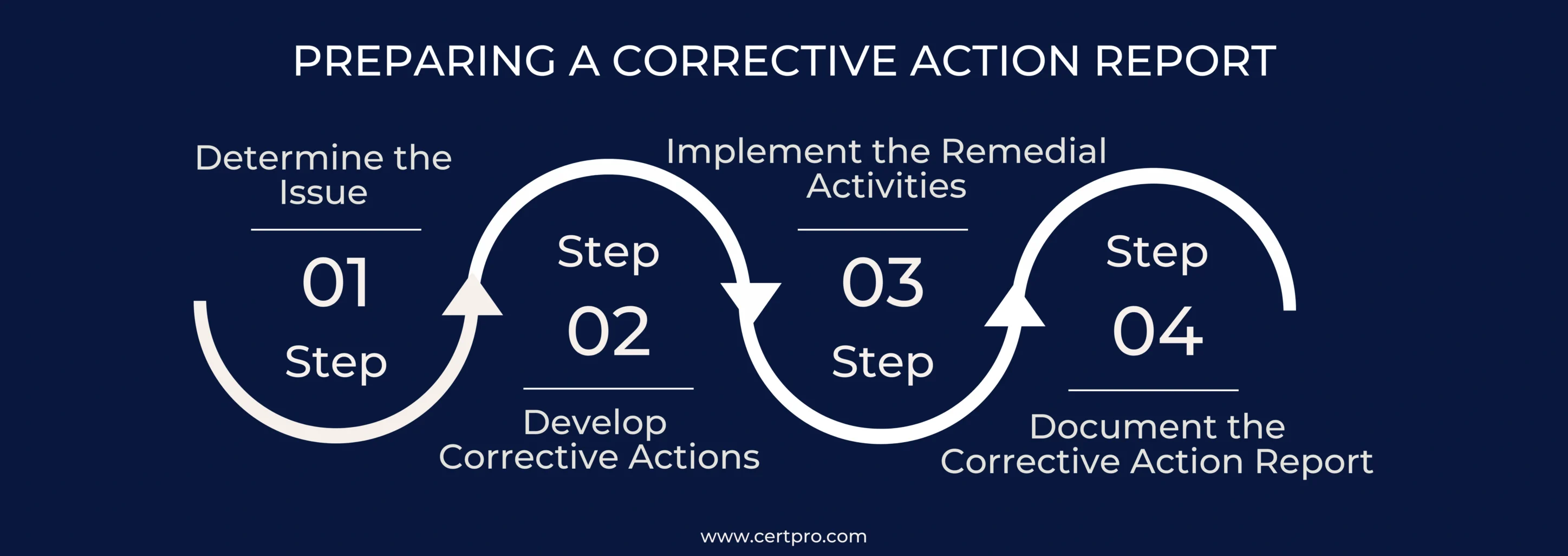
1. Determine the issue: Define the issue or nonconformity that has to be solved. Describe the problem in full, including its impact and any supporting facts or statistics. Investigate the problem’s underlying causes to find the root cause(s). To discover relevant elements, employ approaches such as the 5 Whys, fishbone diagrams, or cause-and-effect analysis.
2. Develop corrective actions: Propose specific corrective measures based on the root cause analysis that will solve the problem and avoid its recurrence. Each remedial action must be specific, quantifiable, and time-bound. Consider the following elements:
What steps must be taken to fix the problem?
Who will be in charge of carrying out the actions?
What resources or assistance will be needed?
What is the expected completion date?
3. Implement the remedial activities: Make certain that the suggested corrective measures are carried out. Monitor implementation progress and handle any issues or roadblocks that occur. Organizations are now adopting AI-enabled quality systems to track actions, send reminders, and flag delays proactively.
4. Document the corrective action report as follows: Formalize all pertinent material and results into a report. Include the parts listed below:
- Problem description: Provide a short explanation of the problem, remedial measures taken, and their consequences in the executive summary. Describe the problem or nonconformity in detail, including the impact and supporting evidence.
- Analysis of the underlying causes: Explain the fundamental reasons discovered throughout the analysis.
- Corrective actions: Describe the exact steps taken to resolve the issue, including responsibilities, resources, and dates.
- Implementation specifics: Describe how the remedial activities were carried out and any difficulties encountered.
- Effectiveness assessment: Examine the effectiveness of the remedial activities and their impact on the issue’s resolution.
After the report has been authorized, continue to monitor the situation to ensure the problem does not reoccur. Monitor progress and ensure that corrective interventions continue to be effective.
Keep in mind that the structure and content of the corrective action report may differ based on your organization’s needs and industry norms. Adapt the preceding stages and sections to meet the needs of your company.
After the report has been authorized, continue to monitor the situation to ensure the problem does not reoccur. Monitor progress and ensure that corrective interventions continue to be effective. Keep in mind that the structure and content of the corrective action report may differ based on your organization’s needs and industry norms. Adapt the preceding stages and sections to meet the needs of your company.
KEY POINTS TO REMEMBER
Finally, a Corrective Action Report (CAR) is a formal document used inside an organization to identify and rectify non-conformances or concerns. It takes a systematic approach to problem resolution by documenting the issue, doing a root cause analysis, executing remedial activities, and assessing their efficacy. The CAR is a detailed record of the problem, its resolution, and the efforts made to prevent it from happening again. It encourages organizational responsibility, openness, and continual development. Organizations may successfully resolve problems, identify and remove fundamental causes, and improve overall quality and efficiency by following the procedures specified in a corrective action report.
Moreover, CARs have become central to quality management system documentation, helping organizations demonstrate compliance during audits and integrate lessons learned into broader process improvement methods. They also strengthen accountability by connecting corrective actions to quality control reports and performance dashboards. Organizations may develop a culture of learning, problem-solving, and proactive improvement by using Corrective Action Reports. It guarantees that concerns are addressed in a methodical manner, preventing their recurrence and encouraging a more robust and resilient operation. Finally, the CAR assists firms in improving their quality, customer satisfaction, and organizational excellence.
FAQ
How do you write an effective corrective action report?
A corrective action report is written by defining the issue, analyzing root causes, planning corrective steps, assigning responsibilities, and documenting outcomes. It ensures problems are resolved systematically and prevents recurrence through verification and continuous monitoring.
What are the main steps in the corrective action process?
The corrective action process typically includes identifying the issue, analyzing root causes, developing corrective measures, implementing solutions, and verifying effectiveness. These structured steps ensure issues are permanently resolved while strengthening quality management and compliance across the organization.
What does a CAPA report mean in quality management?
A CAPA report, or Corrective and Preventive Action report, is a structured document used to address quality issues, eliminate root causes, and prevent recurrence. It supports compliance with standards like ISO and ensures continuous process improvement.
Can you give examples of corrective actions in the workplace?
Examples of corrective actions include retraining staff, updating procedures, revising workflows, repairing faulty equipment, or implementing new quality checks. Each action directly addresses the root cause of a nonconformity and prevents similar issues in the future.
What is an 8D CAPA report and why is it important?
An 8D CAPA report follows an eight-discipline problem-solving method. It helps teams identify root causes, implement corrective actions, and prevent recurrence. Widely used in manufacturing and quality management, it provides a structured, team-based approach to long-term improvements.